
Wristwatches · Wristwatch
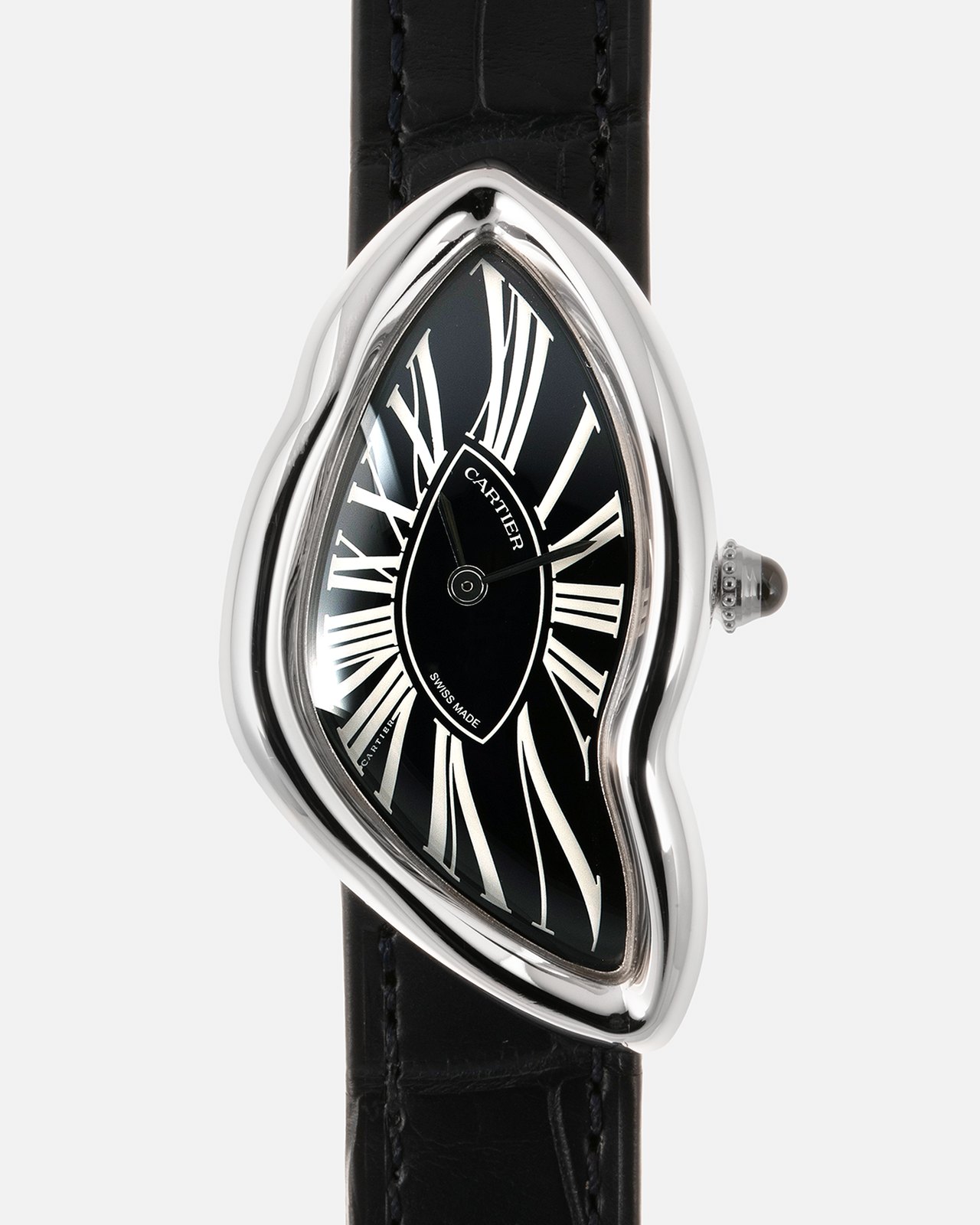
Cartier Crash NSO White Gold Blue, 2023
- Maker / attribution
- Cartier (maker)
- Date
- 2023
- Historical period
- Contemporary Horology (2010 – Present)
- Country of origin
- France
- Object type
- Wristwatch
- Materials / technique
- white gold
- Dimensions
- Case 42 mm
- Stock no.
- Product 6971076771927
- Credit line
- Dealer listing, S.Song Watches (product 6971076771927)
- Catalogue title (original)
- Cartier Crash NSO White Gold Blue (English)
View the source record (dealer listing) ↗ (opens another website in a new tab)Suggest a correction
Record summary
Catalogued by S.Song Watches (dealer), Seattle (stock number Product 6971076771927), this is a wristwatch by Cartier, made in France, dated 2023. The Atlas places it in the Contemporary Horology period (2010 – Present) of its Wristwatches collection. Materials and techniques recorded by the source: white gold. Recorded dimensions: Case 42 mm. The record is illustrated with 6 photographs.
Assembled from the source record's structured fields. Dates and attributions are given as the source states them; where a field is missing the Atlas leaves it blank rather than estimating.
Catalogue description
Dealer description — S.Song Watches
The name Cartier needs no introduction. As one of the most influential and celebrated jewellery and watch brands of the last 100 years, it has always stood as a mark of luxury and desirability. Without taking away from its historical significance, I would say that when it comes to watches, Cartier has always been predominantly known as a ‘design’ brand rather than a pure watchmaking one, with stunningly iconic models such as the Tank, the Crash, and the Santos Dumont all seen as important due to how it looks. In fact, to this day, it is the beautiful and unconventional designs that attract collectors and give it a unique position in the watch brand hierarchy that no other possesses. Out of all of Cartier’s designs that went on to attain their respective ‘icon’ status, there is one design that undoubtedly stands above the rest—the Crash. Famed for its unique and completely insane shape, today it has become a cult classic. Before delving into the origin of the Crash, it is important to note the context in which it came about. During the ’60s, while Cartier as a brand name remained unified, it had been split into three distinctive Maisons in New York, Paris, and London, between Alfred Cartier’s three sons Pierre, Jean-Jacque, and Louis respectively. Despite being under an overarching brand name and maintaining the ‘Cartier look’, this separation resulted in some truly unique and differing designs and production methods. Of the three, the most legendary house of the period was undoubtedly the London boutique, with their New Bond Street shop producing some of the most creative and daring products of the 20th century. The Crash you see here today is one of the many creations. There are a few theories as to how the Crash came about. Legend has it that the inception of the Cartier Crash was initially linked to a client who, after a fiery car accident, brought in a damaged Cartier Baignoire Allongée that had partially deformed and melted. The story suggested that the Maison drew inspiration from the distorted case to create a new and unique design but this has largely been unproven. On top of this, some theories even suggested that the inspiration for the Crash was taken from Salvador Dali’s pocket watches in his famous Surrealist 1931 painting, The Persistence of Memory. It is easy to see the connection but this too, has largely been unproven. According to Francesca Cartier-Brickell, granddaughter of Jean-Jacques Cartier, the reality is that the genesis of the Crash watch can be attributed to the partnership of Jean-Jacques and Rupert Emmerson, who were looking to push the boundaries amidst the creative revolution of the ‘Swingin’ Sixties’. As we can see, the result hovered on the line of pure insanity and revolutionary genius. Fast forward to today, and history speaks for itself- the Crash is an icon and the most in-demand watch by the Maison. This particular example was conceived as a part of Cartier’s NSO program (New Special Order) and it is an exclusive offering only made available to Cartier's most exclusive clients, allowing them to craft semi-custom Cartier timepieces using design options available in Cartier's catalogue. It comes in a configuration that features an asymmetrical 18-carat rhodium-plated white gold case measuring 42mm x 24mm. What sets it apart is its bold and polarizing appearance as it is truly unlike anything I have ever seen or handled before. Despite its striking and unconventional appearance, the case construction is surprisingly elegant and simple, featuring a subtle curvature that ensures a comfortable fit on the wrist, with proprietary lugs discreetly tucked beneath for a seamless overall design. The dial exhibits a somewhat chameleonic character, with deep blue hues visible at certain angles and under specific lighting conditions, transitioning mostly to a deep black-looking dial by default. It gracefully follows the gentle downward contour of the case, adorned with Cartier's signature Roman numerals that conform to the case's unique shape. Furthermore, it showcases a set of exquisite steel sword hands, creating a striking contrast against the dial. In keeping with Cartier's iconic style, the case is adorned with a blue sapphire cabochon set within the beaded crown. With the Crash’s unique form, a tiny mechanical movement was used to fit the unusual watch. Using Cartier’s in-house, manual-winding Cal. 1917 MC, it is an ultra-thin movement that is tonneau-shaped and derives its namesake from the birth year of the Tank (1917). It has a 38-hour power reserve. Today, Cartier sparingly makes Crash’s, with the only current production model being the Bond Street Edition, capped at one piece per month. Even within the NSO program, for one to be approved for an NSO Crash, you would have to be one of the Maison’s top spenders. If you are looking to stand out, the pinnacle lies in the cult-classic Cartier Crash.
Historical context
Contemporary Horology (2010 – Present)
Silicon components, connected watches, optical-lattice research clocks and a thriving independent scene.
Smartwatches became the world's best-selling watches, while mechanical watchmaking focuses on craft, innovation (silicon components, new escapements) and independent makers.
Read the period in the timelineMore wristwatches from this periodEarlier: Mechanical Renaissance
Atlas type guide
Wristwatches
Bracelet watches were worn by women from the early nineteenth century — Breguet made one for Caroline Murat, Queen of Naples, in 1810–12 — but the wristwatch only became a man's instrument with military use and aviation in the early twentieth century. Between the World Wars it overtook the pocket watch; the 1920s and 1930s brought rectangular Art Deco cases, water-resistant cases and the first automatic winding systems.
After 1945 the wristwatch became a carrier of identity — dress watches, sports and dive watches, chronographs, calendars — produced by Swiss, American, Japanese, German, Soviet and Chinese industries. The quartz revolution after 1969 and the mechanical renaissance since the 1990s, including the rise of independent watchmakers, complete the story.
What to look for
- The reference number (between the lugs or inside the case back) and serial number, the starting point for dating.
- The calibre: its maker and number are often stamped under the dial or on the bridge.
- Originality of dial, hands and crown — refinished ('redial') dials are common.
- Case material marks: 18K/750, 14K/585, stainless steel, gold-filled, plated.
Dating clues
- Wire-lug cases: before c. 1925.
- Water-resistant screw-down cases: from 1926.
- Quartz movements: from 1969; sapphire crystals widespread after c. 1980.
General guidance written by the Atlas editors about this kind of object. It is not a statement about this particular piece; for that, rely on the source record above and on physical examination.
Related records

Clocks · 1863
Clock by Albert-Ernest Carrier-Belleuse, France, 1863
The Metropolitan Museum of Art, New York

Clocks · c. 1980s
Cartier "art Deco", c. 1980s
Antiquorum auction archive, Geneva

Clocks · c. 2000s
Cartier Desk Clock with Alarm, c. 2000s
Antiquorum auction archive, Geneva

Clocks · c. 2000s
Cartier Lacquer Arched Desk Clock with Alarm, ref. W0100037, c. 2000s
Antiquorum auction archive, Geneva
Wristwatches · c. 2010s
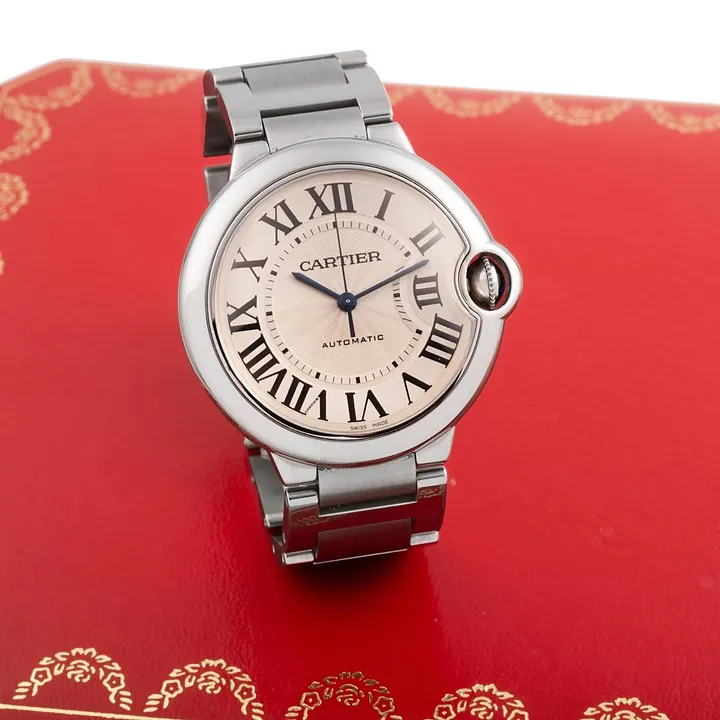
Cartier Ballon Bleu, ref. 3284, c. 2010s
Antiquorum auction archive, Geneva

Wristwatches · originally sold in December 2021 (per the lot record)
Cartier Tank Must, ref. CRWSTA0054, originally sold in December 2021
Antiquorum auction archive, Geneva
Wristwatches · originally sold in 2023 (per the lot record)
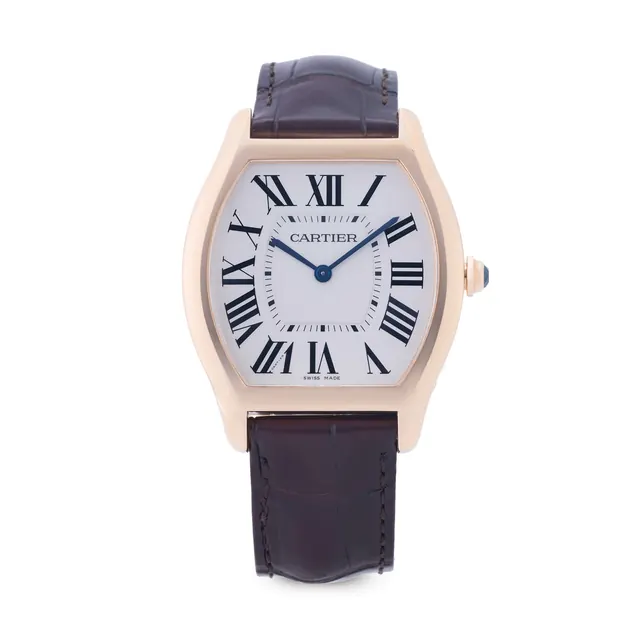
Cartier wristwatch, ref. WGTO0002, Tortue, originally sold in 2023
Antiquorum auction archive, Geneva
Wristwatches · c. 2020
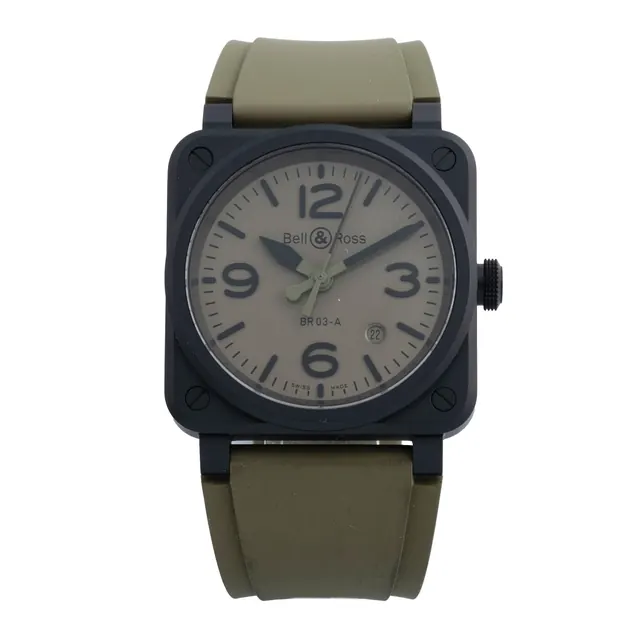
Bell & Ross wristwatch, ref. BR, Aviation Type, circa 2020
Antiquorum auction archive, Geneva