
Wristwatches · Wristwatch
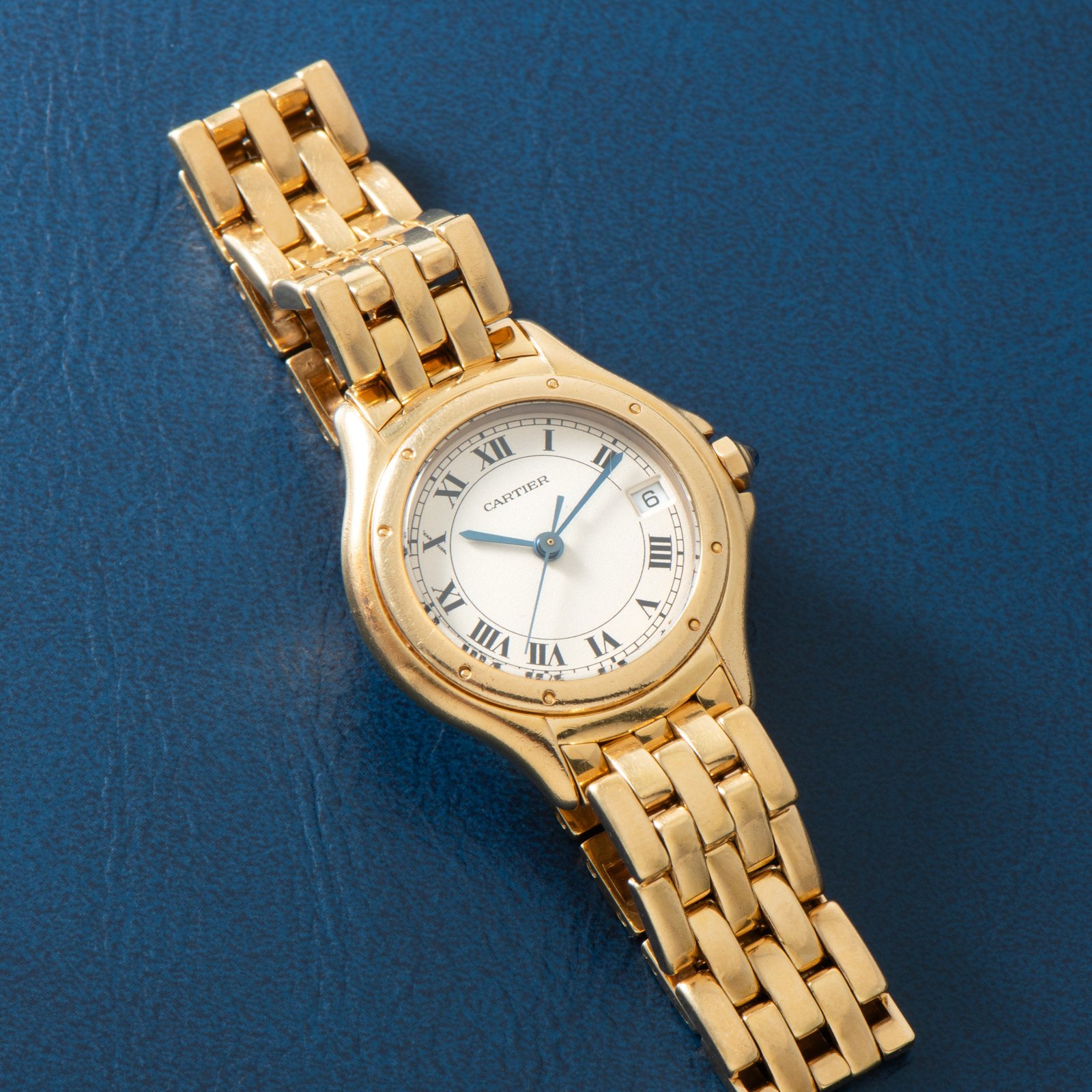
Cartier Cougar, 1990s
- Maker / attribution
- Cartier (maker)
- Date
- 1990s
- Historical period
- Mechanical Renaissance (1990 – 2010)
- Country of origin
- France
- Object type
- Wristwatch
- Dimensions
- Case 26 mm
- Stock no.
- 40950591
- Credit line
- Dealer listing, Analog/Shift (40950591)
- Catalogue title (original)
- Cartier Cougar (English)
View the source record (dealer listing) ↗ (opens another website in a new tab)Suggest a correction
Record summary
Catalogued by Analog/Shift (dealer), New York (stock number 40950591), this is a wristwatch by Cartier, made in France, dated 1990s. The Atlas places it in the Mechanical Renaissance period (1990 – 2010) of its Wristwatches collection. Recorded dimensions: Case 26 mm. The record is illustrated with 6 photographs.
Assembled from the source record's structured fields. Dates and attributions are given as the source states them; where a field is missing the Atlas leaves it blank rather than estimating.
Catalogue description
Dealer description — Analog/Shift
Not every great Cartier wears a rectangular case. While the Tank and Santos have long defined the maison's watchmaking legacy, the 1980s and 1990s saw Cartier embrace a softer, more contemporary aesthetic with models like the Cougar. Combining the elegance of a traditional Cartier dress watch with the practicality of an integrated bracelet, the Cougar perfectly captured the era's growing appetite for luxury sports watches, all while remaining unmistakably Cartier. This particular example, dating to the 1990s, is crafted entirely in 18K yellow gold and measures a refined 26mm across. Its gently rounded case flows seamlessly into a matching multi-link bracelet with a concealed clasp, creating a fluid silhouette that wears as comfortably as it looks elegant. A polished bezel punctuated by eight signature screws lends just enough visual texture without distracting from the watch's graceful proportions. The dial is quintessential Cartier. An ivory-white backdrop is framed by a classic chemin-de-fer minute track and bold black 'Roman' numerals, while blued steel 'sword' hands sweep elegantly across the surface. A date aperture at three o'clock adds everyday practicality, and the sapphire cabochon crown provides the finishing touch that has become one of the maison's enduring signatures. Powering the watch is a reliable quartz movement, making the Cougar as effortless to wear today as it was when it left Cartier's workshops more than three decades ago. Often overlooked in favor of its more famous siblings, the Cougar has quietly developed a devoted following among collectors who appreciate its blend of sporty sophistication and unmistakable Cartier style. Elegant enough for evening wear and versatile enough for everyday use, it remains one of the hidden gems of the maison's neo-vintage catalog.
Historical context
Mechanical Renaissance (1990 – 2010)
Mechanical watches return as cultural objects; independent watchmaking flourishes.
Mechanical watches returned as cultural and luxury objects. Complications, tourbillons and new materials proliferated; independent watchmakers such as George Daniels, F.P. Journe and Philippe Dufour revived artisanal watchmaking; collecting vintage watches became a major field.
Read the period in the timelineMore wristwatches from this periodEarlier: Quartz Revolution
Atlas type guide
Wristwatches
Bracelet watches were worn by women from the early nineteenth century — Breguet made one for Caroline Murat, Queen of Naples, in 1810–12 — but the wristwatch only became a man's instrument with military use and aviation in the early twentieth century. Between the World Wars it overtook the pocket watch; the 1920s and 1930s brought rectangular Art Deco cases, water-resistant cases and the first automatic winding systems.
After 1945 the wristwatch became a carrier of identity — dress watches, sports and dive watches, chronographs, calendars — produced by Swiss, American, Japanese, German, Soviet and Chinese industries. The quartz revolution after 1969 and the mechanical renaissance since the 1990s, including the rise of independent watchmakers, complete the story.
What to look for
- The reference number (between the lugs or inside the case back) and serial number, the starting point for dating.
- The calibre: its maker and number are often stamped under the dial or on the bridge.
- Originality of dial, hands and crown — refinished ('redial') dials are common.
- Case material marks: 18K/750, 14K/585, stainless steel, gold-filled, plated.
Dating clues
- Wire-lug cases: before c. 1925.
- Water-resistant screw-down cases: from 1926.
- Quartz movements: from 1969; sapphire crystals widespread after c. 1980.
General guidance written by the Atlas editors about this kind of object. It is not a statement about this particular piece; for that, rely on the source record above and on physical examination.
Related records

Clocks · 1863
Clock by Albert-Ernest Carrier-Belleuse, France, 1863
The Metropolitan Museum of Art, New York

Clocks · c. 1980s
Cartier "art Deco", c. 1980s
Antiquorum auction archive, Geneva

Clocks · c. 2000s
Cartier Desk Clock with Alarm, c. 2000s
Antiquorum auction archive, Geneva

Clocks · c. 2000s
Cartier Lacquer Arched Desk Clock with Alarm, ref. W0100037, c. 2000s
Antiquorum auction archive, Geneva
Wristwatches · c. 1990
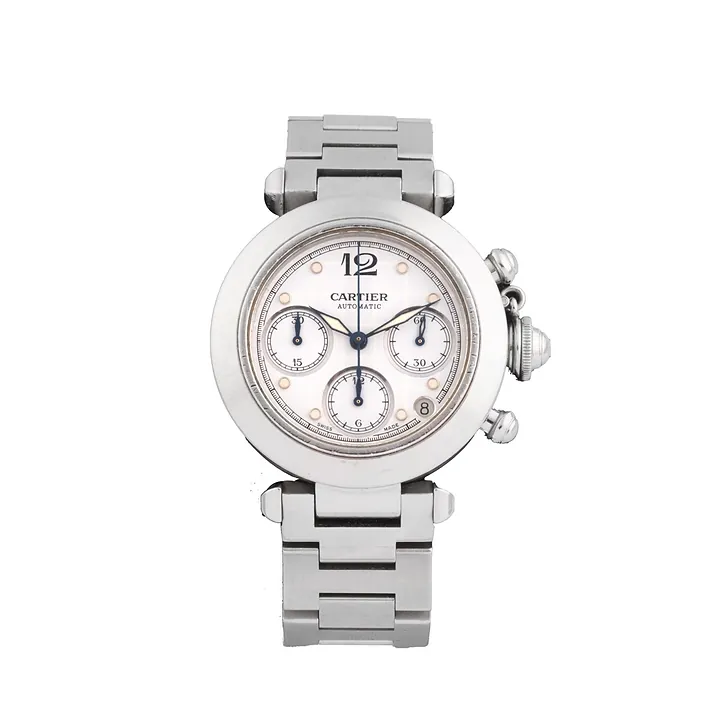
Cartier Pasha, ref. 2412, c. 1990
Antiquorum auction archive, Geneva
Wristwatches · c. 1990
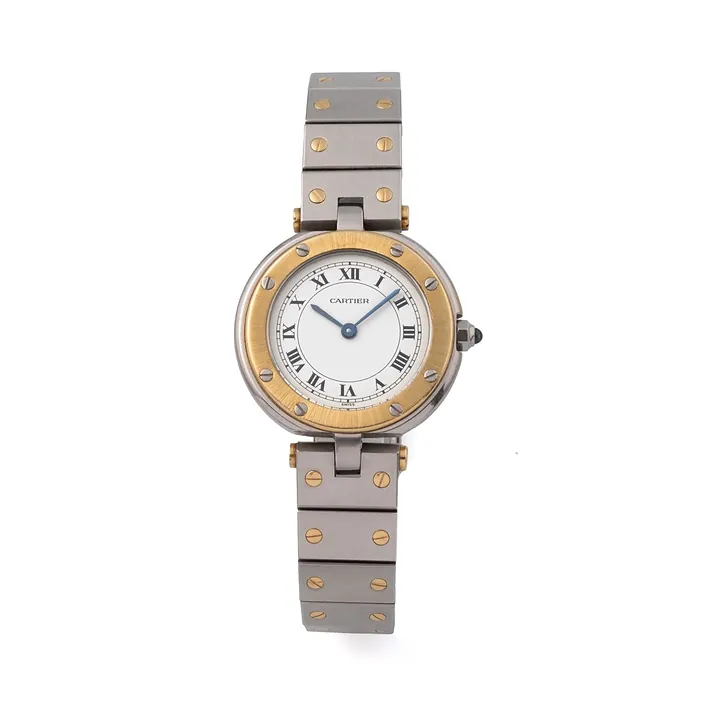
Cartier Santos Ronde Vendome, c. 1990
Antiquorum auction archive, Geneva
Wristwatches · c. 1990s
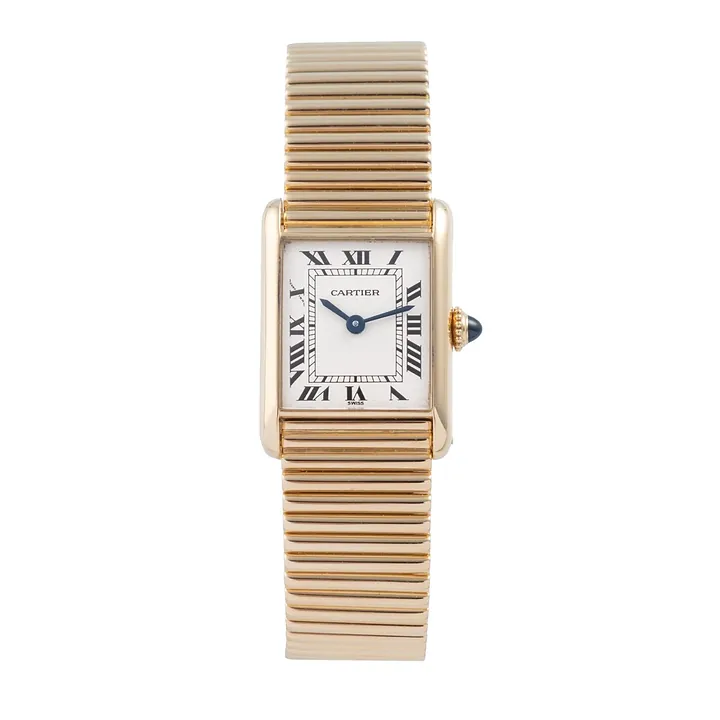
Cartier Tank Louis Cartier, ref. 6711, c. 1990s
Antiquorum auction archive, Geneva
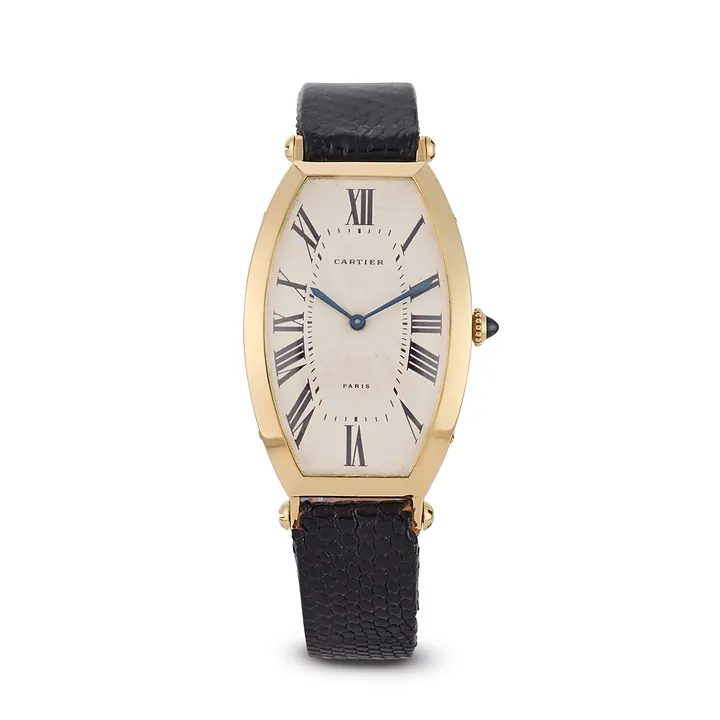
Wristwatches · c. 1991
Cartier Tonneau Paris 1991, c. 1991
Antiquorum auction archive, Geneva