
Clocks · Cartel clock
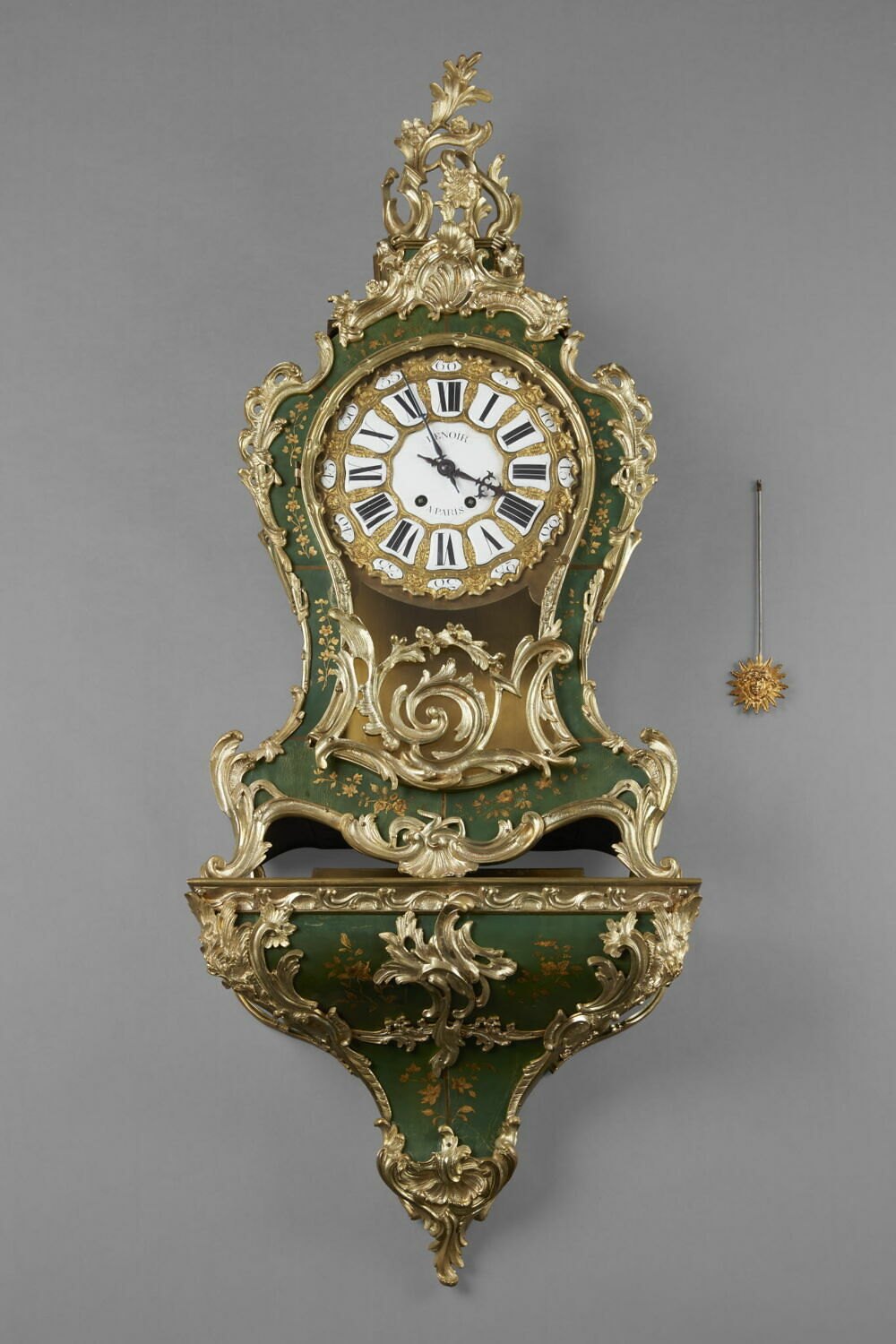
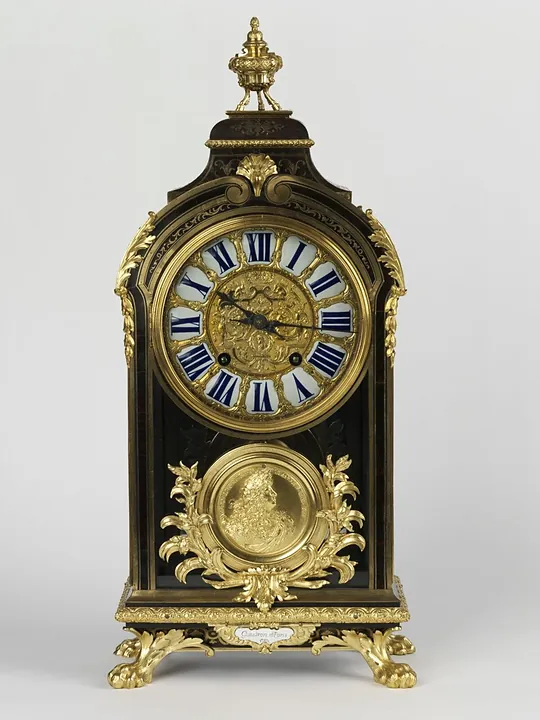
Cartel clock by Etienne Lenoir, France, 1700–1800
- Maker / attribution
- Etienne Lenoir (Horloger)
- Date
- 1700–1800
- Historical period
- Early Modern Horology (1600 – 1750)
- Country of origin
- France
- Place
- France
- Object type
- Cartel clock
- Materials / technique
- bronze, wood
- Dimensions
- height 86 cm; width 44 cm; depth 19 cm; height 38 cm; width 46 cm; depth 22 cm
- Holding institution
- Musée du Louvre, Paris
- Accession / object no.
- OAR 378
- Credit line
- Musée du Louvre
- Catalogue title (original)
- Cartel d'applique et son cul-de-lampe (French)
View the source record ↗ (opens another website in a new tab)Suggest a correction
Record summary
Held and catalogued by Musée du Louvre, Paris (object number OAR 378), this is a cartel clock by Etienne Lenoir, made in France, dated 1700–1800. The Atlas places it in the Early Modern Horology period (1600 – 1750) of its Clocks collection. Materials and techniques recorded by the source: bronze, wood. Recorded dimensions: height 86 cm; width 44 cm; depth 19 cm; height 38 cm; width 46 cm; depth 22 cm. The record is illustrated with 6 photographs.
Assembled from the source record's structured fields. Dates and attributions are given as the source states them; where a field is missing the Atlas leaves it blank rather than estimating.
Catalogue description
Catalogue description — Musée du Louvre (French)
cartel d'applique de corne verte à fleurs avec son cul-de-lampe, de même nature ; couronnement et encadrement de bronze doré ; cadran de cuivre doré à plaques d'émail avec la signature de "LENOIR A PARIS". Mouvement moderne. Epoque Louis XV (rest.). Le cartel lui même est en deux parties, il possède une clef pour le remonter, et le balancier a été déposé ; la console est séparée.
Shown in the original language of the source catalogue. An editor-reviewed English translation has not yet been published; we do not publish machine translations as authoritative text.
Dating and period as catalogued (French)
Epoque / période : Louis XV (1715-1774) (Occident->époque moderne = Ancien Régime->dynastie des Bourbons) · · Date de création/fabrication : 1700 - 1800
Shown in the original language of the source catalogue. An editor-reviewed English translation has not yet been published; we do not publish machine translations as authoritative text.
Materials and techniques as catalogued (French)
Matériau : bronze · Technique : doré = dorure (techniques métal) · Technique : émail peint (techniques métal->émaillé = émaillage = émail = émaux) · Matériau : bois · Technique : peint = peinture (techniques bambou/ bois/ corne/ ivoire/ écaille) · Technique : techniques bambou/ bois/ corne/ ivoire/ écaille (ébénisterie)
Shown in the original language of the source catalogue. An editor-reviewed English translation has not yet been published; we do not publish machine translations as authoritative text.
Inscriptions & marks
Etiquette : ; "M.N.L. / Nlle Sie / OAR 378" (au dos de la grande partie du cartel et au dos de la partie supéreure) ; Signature : ; "LENOIR A PARIS" (sur le cadran)
Provenance
d'après la liste de l'OBIP des oeuvres récupérées en Allemagne, le cartel est identifié de la façon suivante : « [n° ordre] 8 ; n° allemand : - ; Provenance : 37° Munich ; Epoque : Louis XVI (sic) ; Sujet : Cartel ; Matière : cuivre laqué vert ». Cette liste précise que le cartel provenait du trente-septième convoi de Munich, mais sur cette liste aucun cartel n'est indiqué. Sur la liste des expéditions du troisième convoi de Baden-Baden, datée du 7 janvier 1948, est inventorié un cartel sous le n° 623 : « Caisses : N° 8 - 60kg ; Désignation des pièces : 623 cartel style Régence ; Valeur 1938 : 8 000 ; Provenance : TUBINGEN ». Il est précisé sur une liste de décembre 1947 préparatoire au troisième convoi en provenance de Baden-Baden que ce cartel est en écaille verte avec socle, détails qui correspondent à l'OAR 378 : « Caisse N° 8 ; Cartel Style Régence écaille verte avec socle, N° 623 ». Le calepin de déballage des objets à Paris mentionne, le 6 janvier 1948, le cartel dans la caisse n° 8 : « Caisse N° 8 ; N° 623 ; Cartel Régence, écaille verte ». A ce jour, le cartel est peu documenté. Il proviendrait de Tubingen sans qu'il ait été possible de déterminer les conditions de son transfert de la France vers l'Allemagne, ni dans quelles circonstances il a été retrouvé. Il aurait été récupéré par les services français après la guerre et envoyé au Central Collecting Point de Baden-Baden où il aurait été enregistré sous le numéro « 623 ». Le cartel aurait fait partie du troisième c
Historical context
Early Modern Horology (1600 – 1750)
Huygens' pendulum and balance spring transform accuracy; English makers develop the anchor and deadbeat escapements.
Huygens's pendulum (1656–57) improved clock accuracy from about a quarter of an hour to under a minute a day. The anchor escapement (c. 1670) and the long seconds pendulum created the longcase clock; London makers such as Fromanteel, Knibb, Tompion and Quare led European clockmaking, and French makers created the Boulle pendule.
Read the period in the timelineMore clocks from this periodEarlier: Renaissance Horology
Atlas type guide
Mantel and French pendule clocks
The mantel clock — the French pendule de cheminée — is as much decorative art as timekeeper. From the late seventeenth century Parisian clockmakers worked with cabinet-makers, bronze founders and gilders (ciseleurs-doreurs) to create cases in Boulle marquetry, gilt bronze and marble, while the movements were often supplied by specialist makers. Clocks of the Louis XIV, Louis XV and Louis XVI periods, and Empire clocks with allegorical figures, set fashions copied across Europe.
The nineteenth century industrialised the type. The 'Paris movement', a standardised round movement with silk-thread or Brocot suspension and count-wheel striking, was made in huge numbers by firms such as Japy and Vincenti, and fitted into cases of every style and material.
What to look for
- Round 'Paris' movements with makers' stamps (e.g. Japy Frères, Vincenti, S. Marti) and medal marks from exhibitions.
- Suspension type: silk thread (earlier) or Brocot adjustable suspension (after c. 1840).
- Visible Brocot escapement on the dial in later clocks.
- Fire-gilt (mercury) gilding on bronzes versus later electro-gilding.
- Signed dials naming a retailer rather than the movement maker.
Dating clues
- Silk-suspension Paris movements: c. 1800–1850.
- Brocot suspension and visible escapements: after c. 1840.
- Exhibition medal stamps on movements give dates after the medal year.
General guidance written by the Atlas editors about this kind of object. It is not a statement about this particular piece; for that, rely on the source record above and on physical examination.
Read next:Anchor (recoil) escapement
Related records
Clocks · 1765–1770
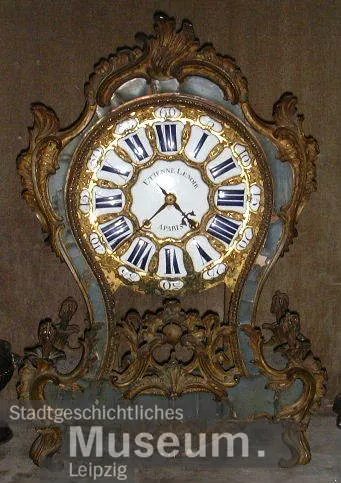
Table clock by Etienne Lenoir, France, 1765–1770
Museum of City History Leipzig
Pocket Watches · 1700–1747
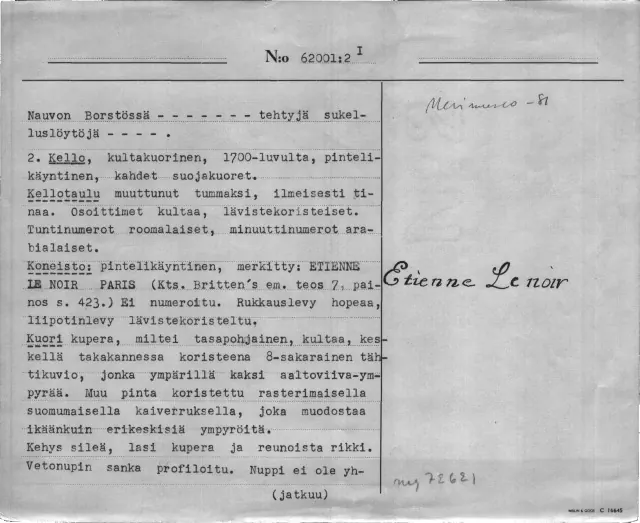
Pocket watch by Etienne Lenoir, France, 1700–1747
Suomen kansallismuseo
Pocket Watches · 1725–1750
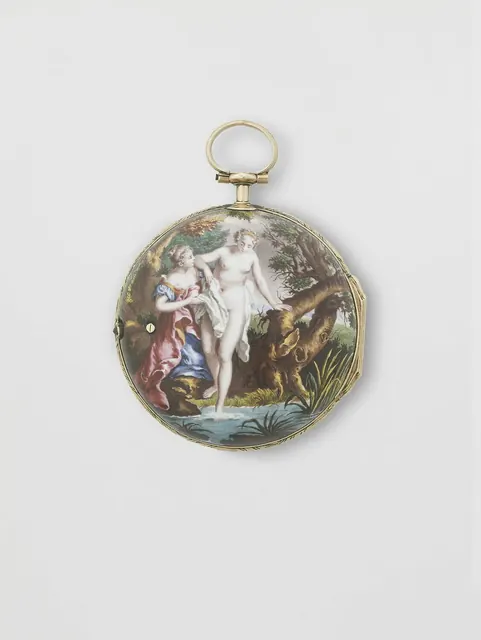
Watch by Etienne Lenoir, France, 1725–1750
Musée du Louvre, Paris
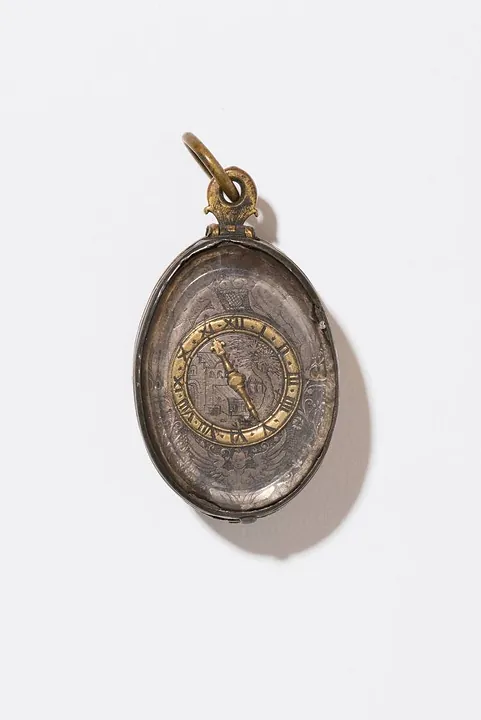
Clocks · 1590–1610
Clock, France, 1590–1610
MAK – Museum of Applied Arts
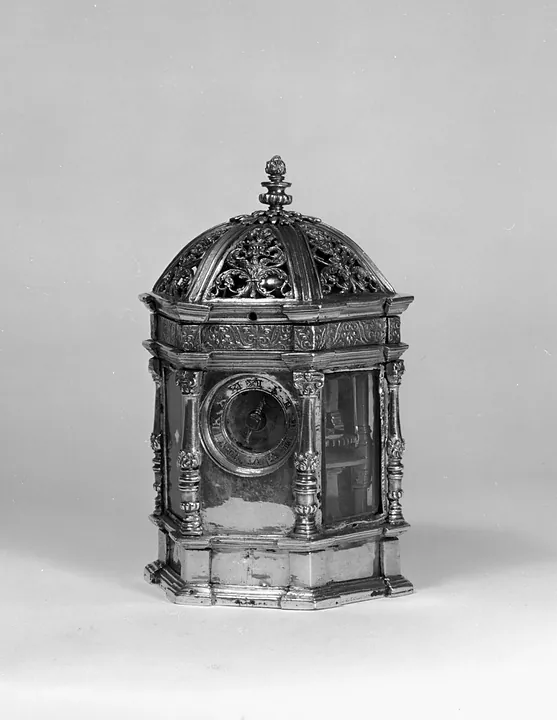
Clocks · c. 1600
Table Clock, sheet brass, engraved, pierced and gilt, Paris, ca.1600, signed 'B(?) Pichard, à Paris'
Victoria and Albert Museum, London
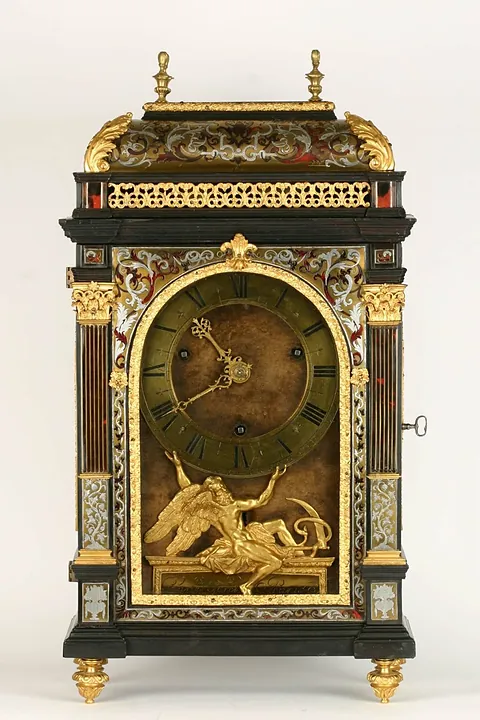
Clocks · 1600–1699
Table clock by Charles Goret, France, 1600–1699
German Clock Museum
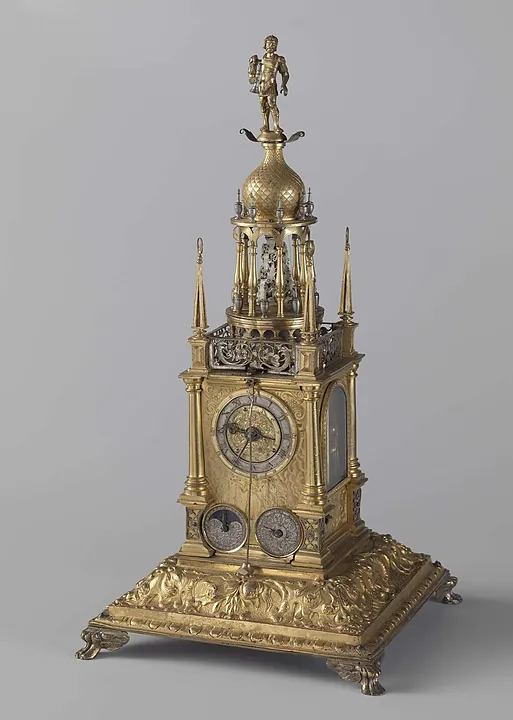
Clocks · 1640
Table clock, France, 1640
Rijksmuseum
Clocks · late 17th century
Clock with case of tortoiseshell inlaid with brass, Paris, late 17th century
Victoria and Albert Museum, London