
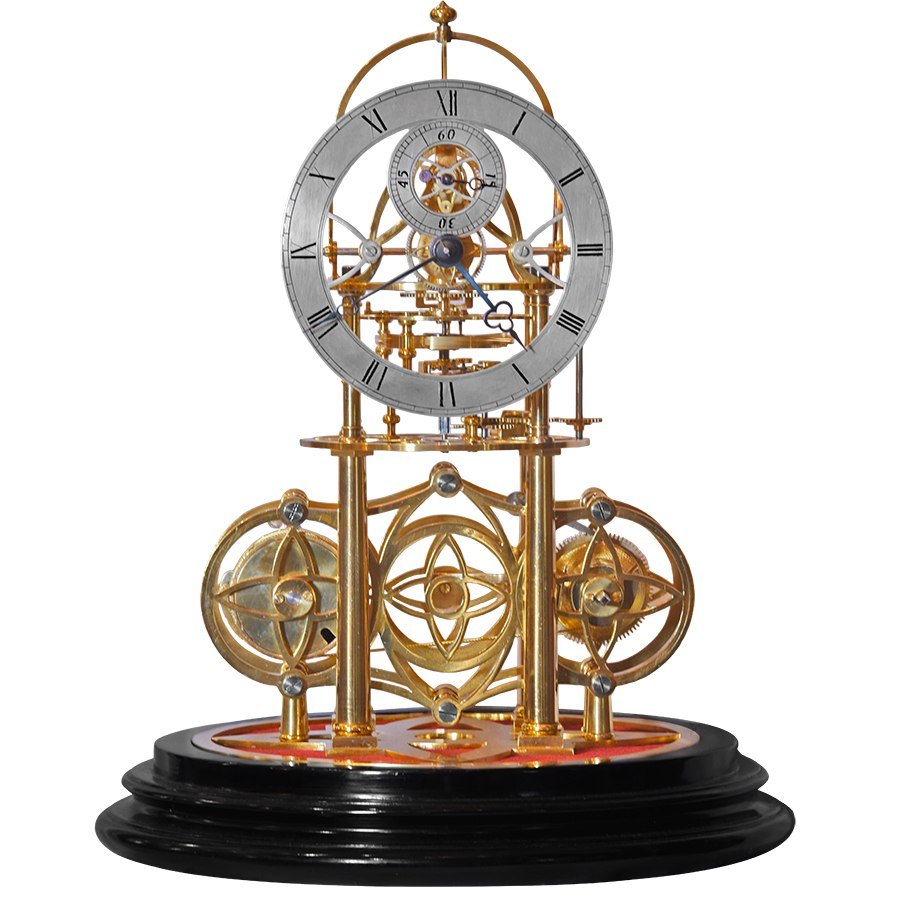
Clocks · Tourbillon skeleton clock
Carlo Croce Tourbillon Skeleton Clock
- Maker / attribution
- Carlo Croce (source attribution)
- Date
- c. 1999
- Historical period
- Mechanical Renaissance (1990 – 2010)
- Country of origin
- Italy
- Object type
- Tourbillon skeleton clock
- Dimensions
- Clock alone 12 in high; overall under dome 17 in high x 12 in diameter
- Holding institution
- Renaissance Antiques
- Accession / object no.
- SLEF 3 P
- Credit line
- Renaissance Antiques
- Catalogue title (original)
- Rare Italian Tourbillon Skeleton Clock By Carlo Croce - Renaissance Antiques (English)
View the source record ↗ (opens another website in a new tab)Suggest a correction
Record summary
Held and catalogued by Renaissance Antiques (object number SLEF 3 P), this is a tourbillon skeleton clock attributed to Carlo Croce, made in Italy, dated c. 1999. The Atlas places it in the Mechanical Renaissance period (1990 – 2010) of its Clocks collection. Recorded dimensions: Clock alone 12 in high; overall under dome 17 in high x 12 in diameter. The record is illustrated with 1 photograph.
Assembled from the source record's structured fields. Dates and attributions are given as the source states them; where a field is missing the Atlas leaves it blank rather than estimating.
Catalogue description
Original object description
Identified in trade documentation under reference SLEF 3 P and attributed to Italian maker Carlo Croce circa 1999, this openwork skeleton clock is mounted on a stepped, blackened wooden plinth. Two upright brass pillars frame pierced lower members and gear wheels, supporting a primary silvered ring with black Roman hours and an inner minute division traced by blued steel hands, the minute pointer ending in a pierced clover motif; a secondary dial calibrated in Arabic numerals from 15 to 60 sits immediately above. Dealer descriptions cite an eight-day running time governed by a tourbillon cage with a Mudge escapement, though these internal features along with maker inscriptions or serial numbers are absent from the primary front image. Standing 12 inches high on its own, the ensemble is documented as measuring 17 inches tall and 12 inches wide with its glass dome, although the dome itself is omitted from the listing's photograph.
Historical context
Mechanical Renaissance (1990 – 2010)
Mechanical watches return as cultural objects; independent watchmaking flourishes.
Mechanical clocks returned as luxury and craft objects, alongside radio-controlled and designer quartz clocks. Independent makers and restorers revived traditional techniques, and museums increasingly documented industrial and electric clocks as heritage.
Read the period in the timelineMore clocks from this periodEarlier: Quartz Revolution
Atlas type guide
Skeleton clocks
A skeleton clock displays its movement: the plates are pierced to a minimum so that wheels, escapement and fusee can be seen, usually under a glass dome. French makers produced fine skeleton clocks in the late eighteenth century; in Victorian England they became popular showpieces, with frames in the shapes of cathedrals and famous buildings.
What to look for
- Pierced brass plates in scroll or architectural shapes.
- A glass dome and wooden or marble base.
- Fusee movements and sometimes passing strike on a bell.
Dating clues
- French skeleton clocks: c. 1780–1830.
- English cathedral-style skeleton clocks: c. 1840–1890.
General guidance written by the Atlas editors about this kind of object. It is not a statement about this particular piece; for that, rely on the source record above and on physical examination.
Read next:FuseeAnchor (recoil) escapement
Related records

Clocks · c. 2008
Panerai table clock, ref. OP6599, Pam173 Alarm Clock Limited 0184/1000, circa 2008
Antiquorum auction archive, Geneva
Clocks · c. 1990
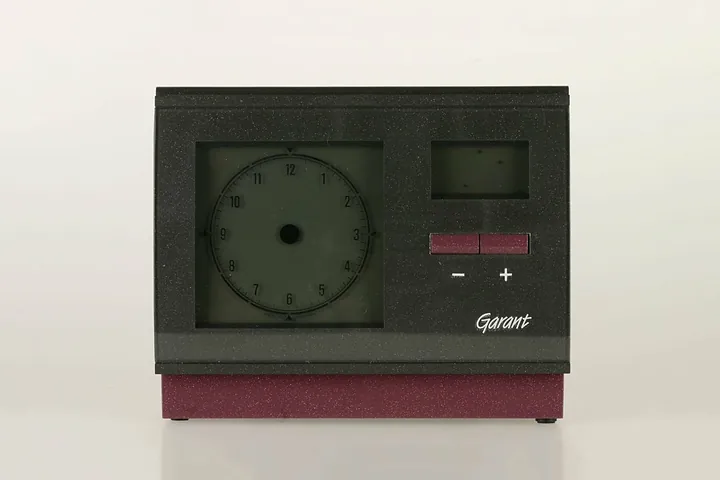
Alarm clock by Andreas GmbH und Co. Haller, Germany, c. 1990
German Clock Museum

Clocks · c. 1990s
Audemars Piguet Royal Oak, c. 1990s
Antiquorum auction archive, Geneva

Clocks · c. 1990s
Breitling clock, c. 1990s (Antiquorum Lot 389-18)
Antiquorum auction archive, Geneva
Clocks · c. 1990s
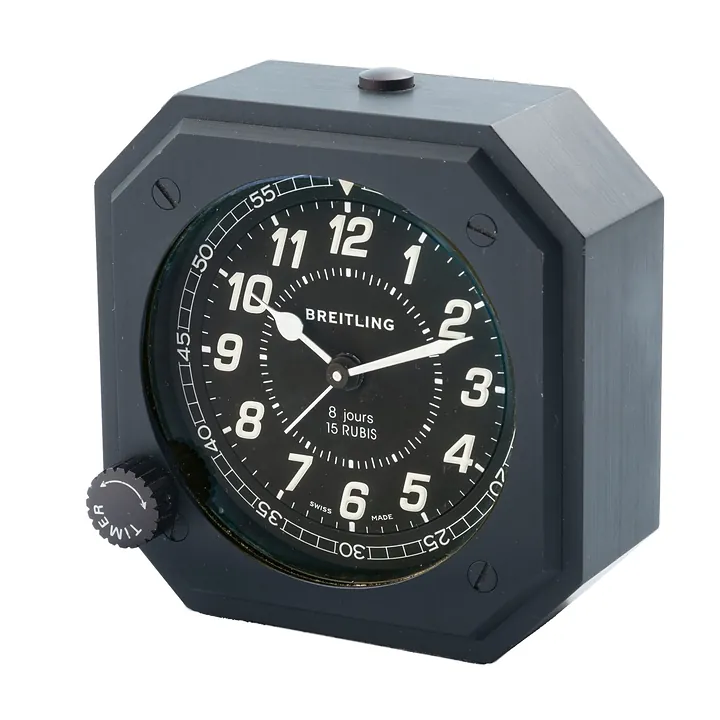
Breitling clock, c. 1990s (Antiquorum Lot 389-20)
Antiquorum auction archive, Geneva
Clocks · c. 1995
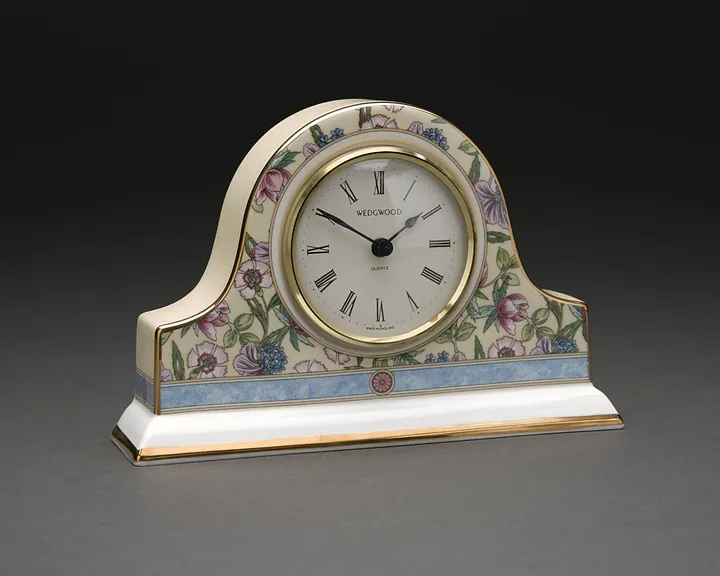
Clock, Bone China with transfer printing, Josiah Wedgwood and Sons, Barlaston, c. 1995 (V&A WE.18792-2014)
Victoria and Albert Museum, London
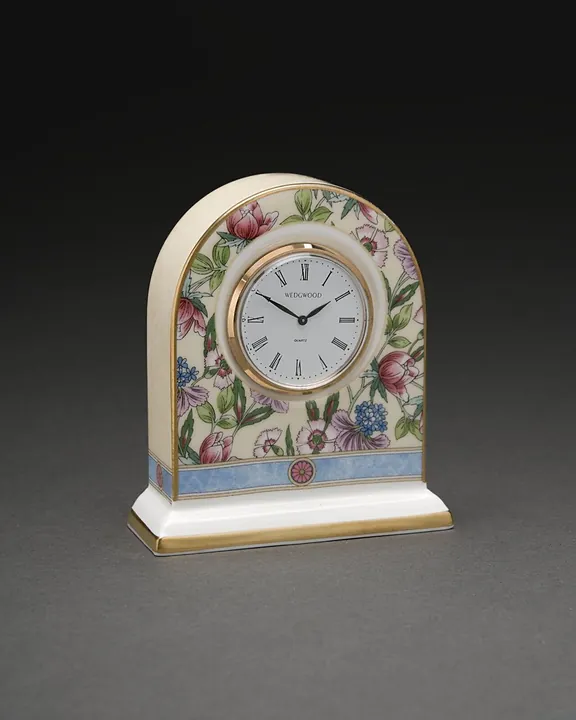
Clocks · c. 1995
Clock, Bone China with transfer printing, Josiah Wedgwood and Sons, Barlaston, c. 1995 (V&A WE.18793-2014)
Victoria and Albert Museum, London
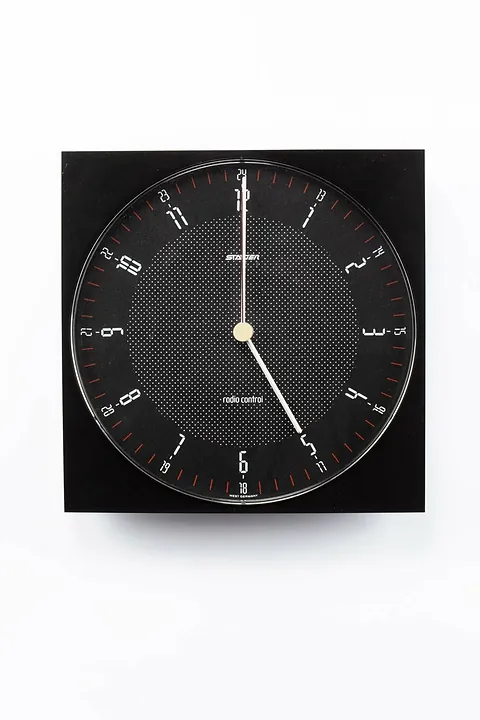
Clocks · c. 1990
Electric clock by Werner Staiger, Germany, c. 1990
German Clock Museum