
Wristwatches · Wristwatch
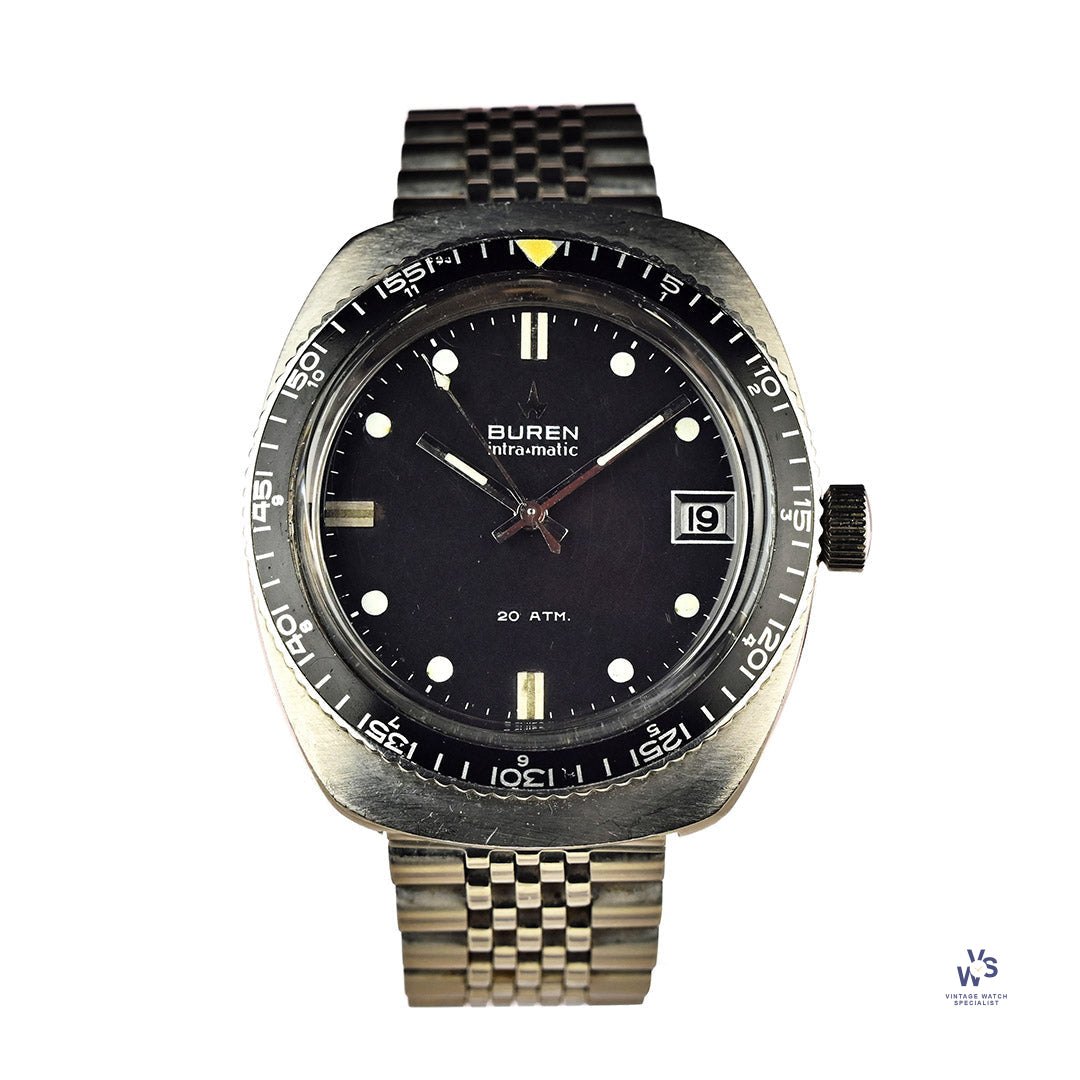
Buren Intra-Matic Dive Watch with Calendar, circa 1962
- Maker / attribution
- Buren (maker)
- Date
- c. 1962
- Historical period
- Modern Mechanical Horology (1945 – 1969)
- Country of origin
- Unrecorded in source
- Object type
- Wristwatch
- Dimensions
- Case 37 mm
- Stock no.
- VWS3278
- Credit line
- Dealer listing, Vintage Watch Specialist (VWS3278)
- Catalogue title (original)
- Buren Intra-Matic Dive Watch with Calendar - c.1962 (English)
View the source record (dealer listing) ↗ (opens another website in a new tab)Suggest a correction
Record summary
Catalogued by Vintage Watch Specialist (dealer), United Kingdom (stock number VWS3278), this is a wristwatch by Buren, dated c. 1962. The Atlas places it in the Modern Mechanical Horology period (1945 – 1969) of its Wristwatches collection. Recorded dimensions: Case 37 mm. The record is illustrated with 6 photographs.
Assembled from the source record's structured fields. Dates and attributions are given as the source states them; where a field is missing the Atlas leaves it blank rather than estimating.
Catalogue description
Dealer description — Vintage Watch Specialist
A Superb and Collectable Buren Intra-Matic Dive Watch Calendar in Fantastic Condition, Issued in Approximately 1962 and in Good Working Order with a 20 ATM Dial Marking Buren Watch Company, originally established in 1898 in Buren an der Aare, Switzerland, has a storied history marked by innovation and craftsmanship. Initially known as "Fritz Suter & Cie," the company rebranded to Buren Watch Co. in 1916. Renowned for its precision and reliability, Buren quickly gained a reputation among watch enthusiasts. In the mid-20th century, Buren introduced the "Micro-Rotor" movement—an innovative automatic winding mechanism that significantly reduced watch thickness. This breakthrough solidified their position in the industry and attracted attention from larger companies. In 1966, Hamilton Watch Company acquired Buren to leverage its cutting-edge technology. However, with the advent of quartz watches disrupting the market in the 1970s, traditional mechanical watchmakers faced challenges. Despite their pioneering spirit and technical advancements, Buren ceased operations in 1972. Today, vintage Buren watches remain highly sought after by collectors who appreciate their historical significance and intricate engineering. What's on Offer This Buren Intra Matic is in superb vintage condition and is a joy to those who appreciate historic dive watches. It exudes a timeless elegance and rugged charm, capturing the essence of classic dive watches from the mid-20th century. Crafted with meticulous attention to detail, this timepiece features a robust stainless steel case which at 37mm is considered mid-size, but it does enjoy a meaty presence on the wrist. One of its standout features is the distinctive rotating bezel, essential for tracking dive times with precision. The dial is rich black with luminous hour plots and stick hands with luminous inserts, there is also a subtle date aperture at 3 o'clock. The case is in superb condition and the watch is paired with a stylish steel bracelet which could be exchanged for a more colourful 'dive strap' should you want a more dynamic look! This is a great piece, it's running well and keeping good time, a great buy!
Historical context
Modern Mechanical Horology (1945 – 1969)
Tool watches for divers, pilots and astronauts; electric watches anticipate the electronic age.
The classic era of the mechanical wristwatch: dive watches, chronographs for motor racing and space flight, GMT watches for jet travel, slim dress watches, automatic calendars, and the rise of Japanese manufacturers alongside Swiss, American, German and Soviet industries.
Read the period in the timelineMore wristwatches from this periodEarlier: Golden Age of Mechanical Watchmaking
Atlas type guide
Dive and water-resistant watches
Keeping water and dust out of a wristwatch was a long-standing challenge. Rolex's screw-down Oyster case (1926) and Omega's Marine (1932) were landmarks; in the early 1950s Blancpain's Fifty Fathoms and Rolex's Submariner defined the professional dive watch with rotating bezels for timing dives, luminous dials and high water resistance. The ISO 6425 standard (1982) later codified what a 'diver's watch' must do.
Dive watches became icons of post-war design and exploration, and their evolution — helium escape valves, ceramic bezels, saturation-diving depth ratings — records the history of underwater work.
What to look for
- Unidirectional or bidirectional rotating bezel with minute markings.
- Screw-down crown and case back; depth rating printed on the dial.
- Luminous hands and markers (radium before c. 1960, tritium c. 1960–1998, then Super-LumiNova).
- Reference numbers on the case between the lugs or inside the back.
Dating clues
- Screw-down Oyster cases: from 1926.
- Professional dive watches: from 1953.
- Tritium 'T' marks on dials: c. 1960–1998.
General guidance written by the Atlas editors about this kind of object. It is not a statement about this particular piece; for that, rely on the source record above and on physical examination.
Related records
Pocket Watches · c. 1920
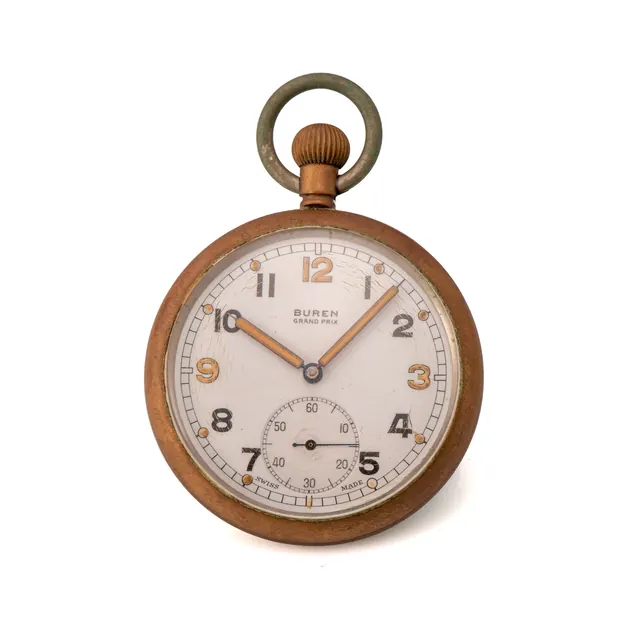
Buren pocket watch, Pocket Watch White Dial, circa 1920
Antiquorum auction archive, Geneva
Wristwatches · c. 1945
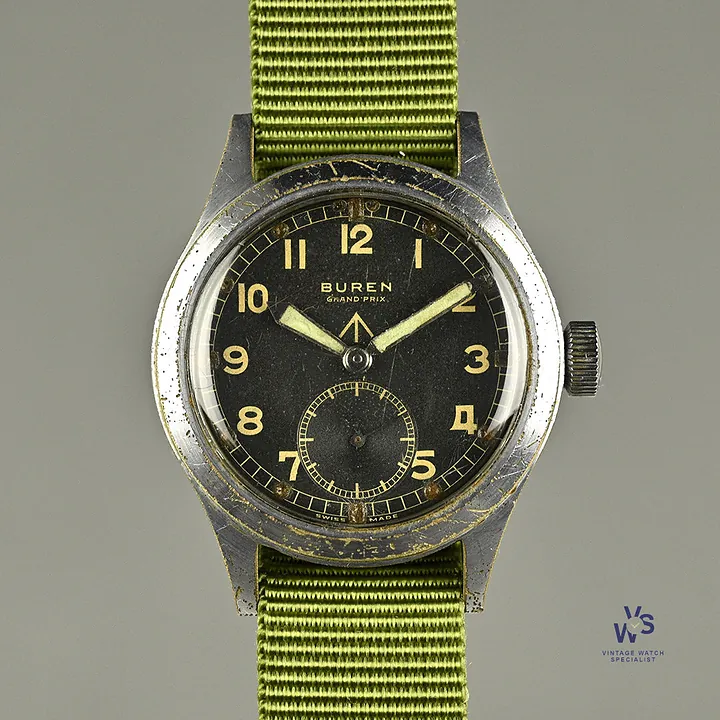
Buren WWW Dirty Dozen, WW2 British Military Issued Watch, circa 1945
Vintage Watch Specialist (dealer), United Kingdom
Wristwatches · c. 1945
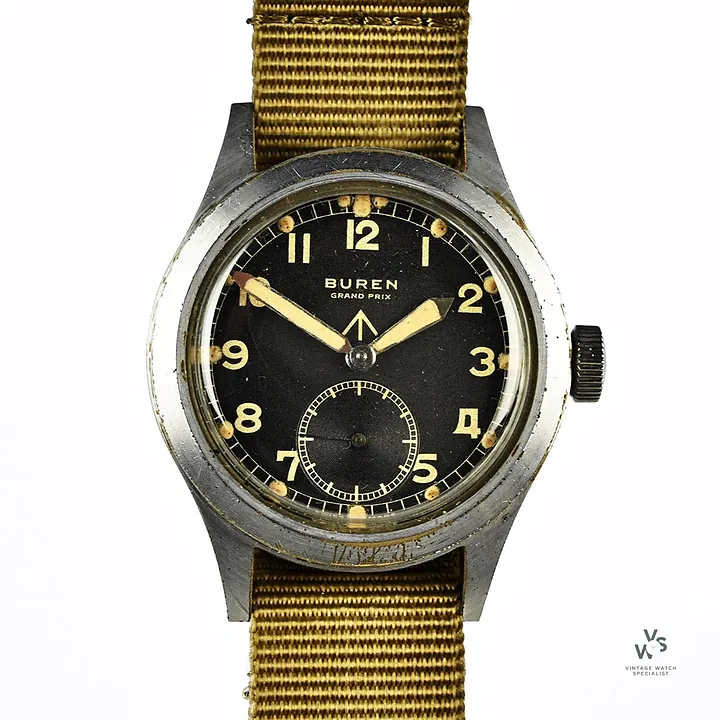
Buren WWW, Dirty Dozen WW2 Military Soldiers Watch, circa 1945
Vintage Watch Specialist (dealer), United Kingdom
Wristwatches · c. 1916
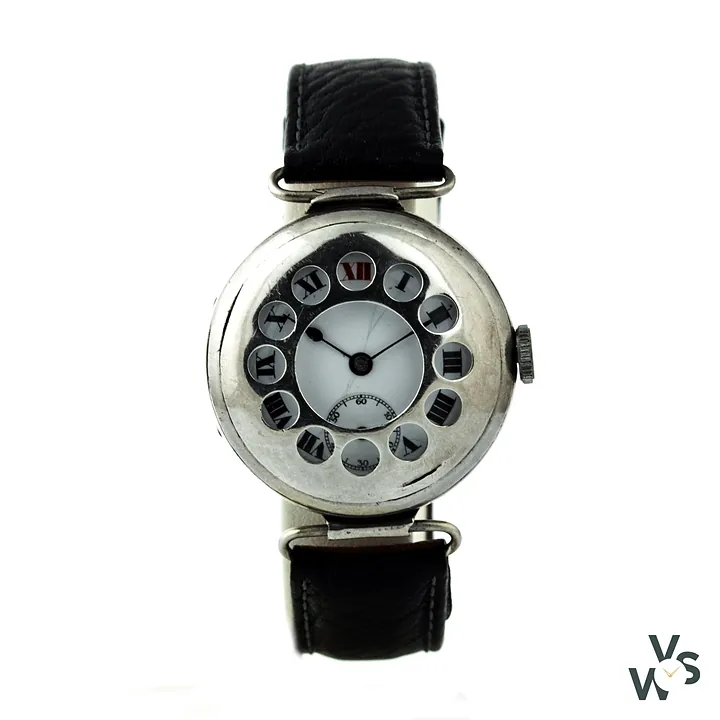
Buren Silver Trench Watch, Swivel Lugs and Shrapnel Guard, circa 1916
Vintage Watch Specialist (dealer), United Kingdom

Wristwatches · 1945
Wristwatch by Eterna, 1945
Museum Rotterdam

Wristwatches · c. 1945
Breitling Premier, ref. 790, c. 1945
Antiquorum auction archive, Geneva

Wristwatches · c. 1945
Universal Genève Uni-Compax, ref. 22492, c. 1945
Antiquorum auction archive, Geneva
Wristwatches · c. 1950s
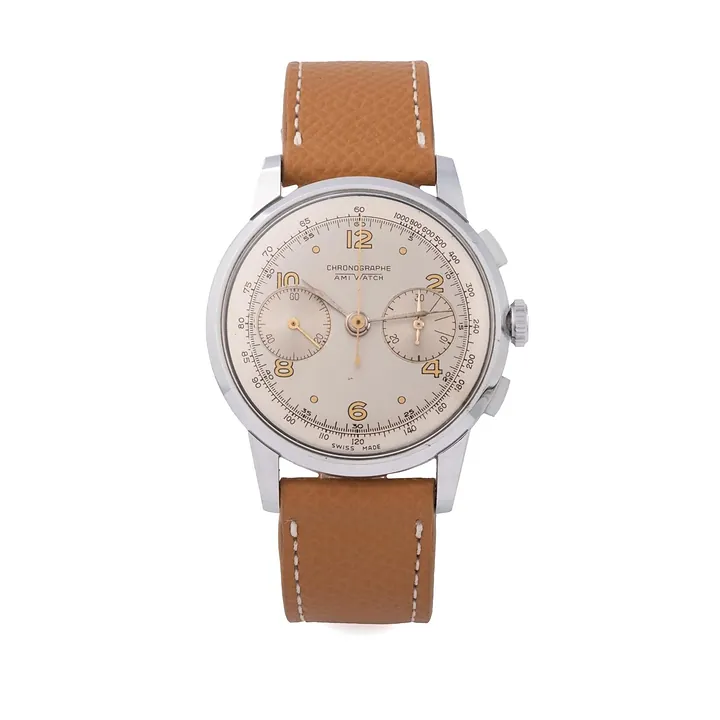
Ami Watch Chronographe, c. 1950s
Antiquorum auction archive, Geneva