
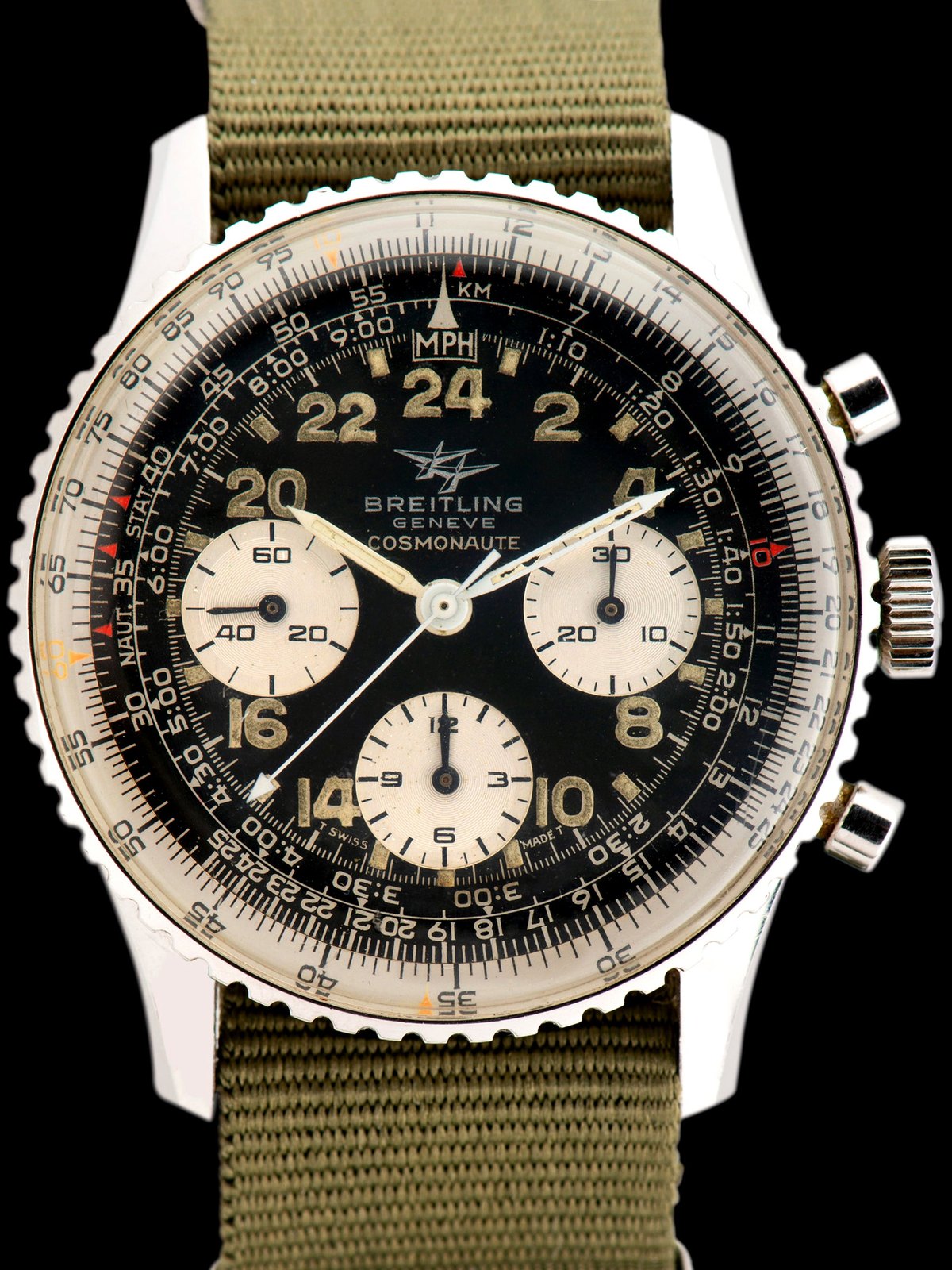
Wristwatches · Wristwatch
Breitling Cosmonaute (Ref. 809) "Twin Jets", 1969
- Maker / attribution
- Breitling (maker)
- Date
- 1969
- Historical period
- Quartz Revolution (1969 – 1990)
- Country of origin
- Switzerland
- Object type
- Wristwatch
- Stock no.
- BRTCN809TJ-2
- Credit line
- Dealer listing, Craft & Tailored (BRTCN809TJ-2)
- Catalogue title (original)
- 1969 Breitling Cosmonaute (Ref. 809) "Twin Jets" W/ Booklet & Letter From Air Canada Pilot Original Owner (English)
View the source record (dealer listing) ↗ (opens another website in a new tab)Suggest a correction
Record summary
Catalogued by Craft & Tailored (dealer), Los Angeles (stock number BRTCN809TJ-2), this is a wristwatch by Breitling, made in Switzerland, dated 1969. The Atlas places it in the Quartz Revolution period (1969 – 1990) of its Wristwatches collection. The record is illustrated with 6 photographs.
Assembled from the source record's structured fields. Dates and attributions are given as the source states them; where a field is missing the Atlas leaves it blank rather than estimating.
Catalogue description
Dealer description — Craft & Tailored
The Breitling Navitimer is truly something special when it comes to high-powered functionality in aviation watches. Operating much more similar to a navigational computer than just the everyday tool watch. The Navitimer hosts an extremely unique feature that we know as the slide rule bezel. This groundbreaking bezel can be used to calculate flight times, distance traveled, airspeed, ascent and descent rates, fuel consumption rates, and even has a metric conversion tool. The Breitling Navitimer was a lifesaver when pilots needed to make crucial calculations on the fly...pun very much intended. Scott Carpenter (right) wearing a Breitling Cosmonaut Ref 809 with Mercury 7 astronauts Walter “Wally” Schirra, Virgil “Gus” Grissom. Carpenter flew the Mercury-Atlas 7 flight, on May 24, 1962, becoming the second American to orbit the earth. The Breitling Cosmonaute as worn by Carpenter was the first Swiss wristwatch and or chronograph worn in space. John Glenn had worn a Heuer stopwatch during the Mercury Six flight on February 20, 1962. but it wasn't really a wristwatch as it only recorded the elapsed time and didn't actually tell the time. Photo: NASA Not only is the 24-hour Cosmonaute functionally a champion of watches, but it also boasts historical significance as well. Nicknamed the "Scott Carpenter" after the astronaut that took this beauty as his sidekick when he orbited the earth three times in May of 1962, inside the Aurora 7 space capsule. Scott needed a way to distinguish day from the night while in space, thus the Breitling Cosmonaute earned its nickname from its astronaut companion, who had fine taste indeed when it comes to timepieces Coming from the original owner, Mr. Gus Jonker is a retired Air Canada pilot who made his childhood dreams of becoming an airplane pilot come to fruition when he moved to Canada from the Netherlands as a teenager. Completing his dream, Mr. Jonker chose the perfect watch to accompany him throughout his extensive career as a Pilot, this Breitling Cosmonaute ref. 809. Stock # BRTCN809TJ-2 Brand Breitling Style Cosmonaute Model 809 Serial 130XXXX Size Men's Material Stainless Steel Dial Glossy Black Millimeters 41 Strap NATO Strap CASE & BRACELET The crisp case is believed to remain unpolished with every angle and brushed surface from the factory present, the case exhibits honest signs of light use. The case retains its original Breilting signed crown and pump pushers. The original acrylic crystal shows expected light signs of use. The case back remains unpolished and crisp like the mid-case, with factory markings fully intact. The watch comes supplied on a NATO strap. DIAL & HANDS The glossy black glit 24-hour dial shows honest, light aging, with silver text and charming vintage aesthetic. The silver sub-dials remain very well preserved with minimal aging present. The tritium Arabic numerals and plots have aged to a common grey patina and no degradation under U.V. light inspection. The original tritium hands match the dial perfectly, under U.V. light inspection the minute hand exhibits significant lume loss while the hour hand remains fully intact. ACCESSORIES The watch comes with its original Breitling instruction booklet, letter from the original owner, and photo copy photo of the watch next to a photo of Mr. Gus Jonker, the original owner. The watch is functioning correctly and keeping time, previous service history is unknown.
Historical context
Quartz Revolution (1969 – 1990)
Seiko's Astron begins mass quartz timekeeping; traditional industries contract sharply.
Quartz and digital watches transformed the market after 1969. Swiss employment collapsed, Japanese and Hong Kong production soared, and the Swatch (1983) helped the Swiss industry recover; mechanical watches survived as luxury goods.
Read the period in the timelineMore wristwatches from this periodEarlier: Modern Mechanical Horology
Atlas type guide
Military, pilot and travel watches
The wristwatch owes much of its adoption by men to warfare and aviation. Wristlets — small pocket watches soldered with lugs and worn on a strap — were used in colonial campaigns and became standard equipment in the First World War, with protective grilles over the crystal ('shrapnel guards'). Louis Cartier's Santos (1904), designed for the aviator Alberto Santos-Dumont, is often cited as an early purpose-made pilot's watch.
In the Second World War governments specified watches in detail: the German B-Uhr observation watches, the American A-11, and the British 'W.W.W.' (the 'Dirty Dozen' set of 1945). After the war, jet travel brought GMT and world-time watches, which show two or more time zones at once — Louis Cottier's world-time mechanism and the Rolex GMT-Master (1955) are examples.
What to look for
- Military markings on the case back: broad arrow, issue numbers, 'W.W.W.', 'A.T.P.'
- High-legibility black dials with luminous Arabic numerals; oversized crowns for gloved hands.
- 24-hour hands and rotating 24-hour bezels or city rings on GMT/world-time watches.
- Wire lugs on early wristlets converted from pocket watches.
Dating clues
- Wire-lug wristlets: c. 1900–1925.
- Military specifications of the Second World War: 1939–1945.
- GMT and world-time wristwatches: mainly after 1950.
General guidance written by the Atlas editors about this kind of object. It is not a statement about this particular piece; for that, rely on the source record above and on physical examination.
Related records
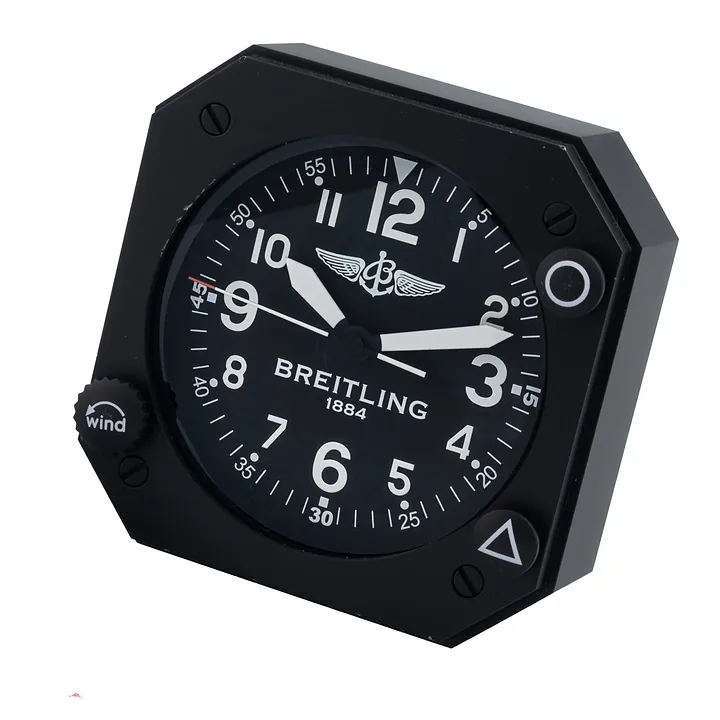
Clocks · c. 1990s
Breitling clock, c. 1990s (Antiquorum Lot 389-18)
Antiquorum auction archive, Geneva
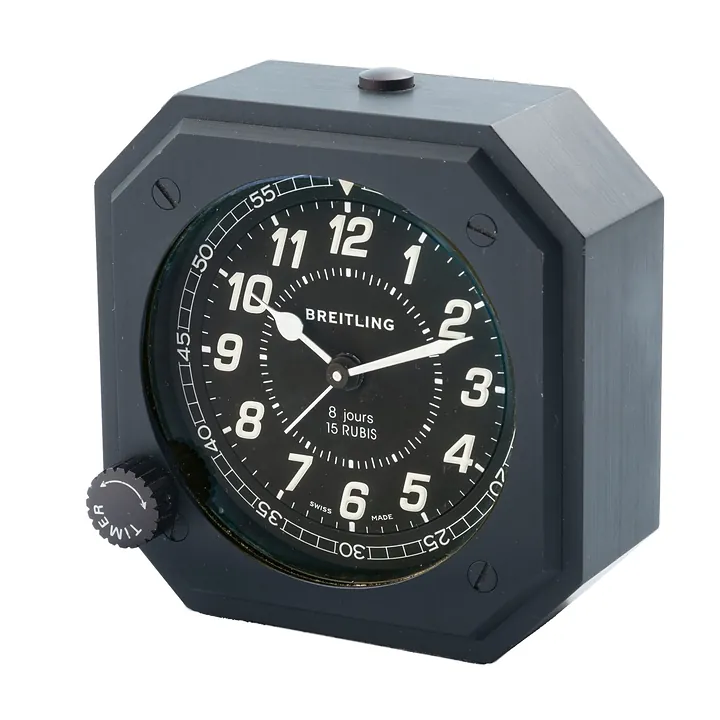
Clocks · c. 1990s
Breitling clock, c. 1990s (Antiquorum Lot 389-20)
Antiquorum auction archive, Geneva
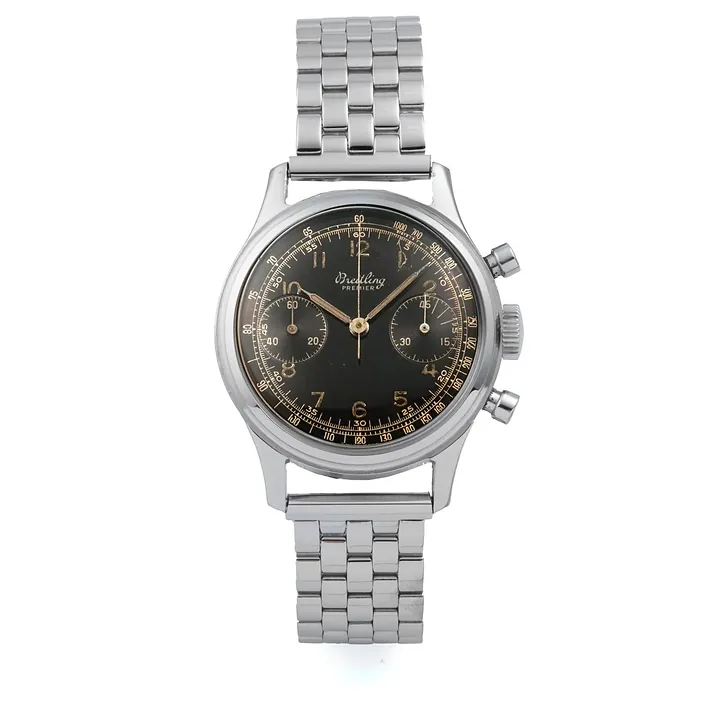
Wristwatches · c. 1940s
Breitling Premier, ref. 790, c. 1940s
Antiquorum auction archive, Geneva

Wristwatches · c. 1945
Breitling Premier, ref. 790, c. 1945
Antiquorum auction archive, Geneva

Wristwatches · 1970
Wristwatch by Heno, Switzerland, 1970
Museum Rotterdam

Wristwatches · 1960–1986
'Tri-Compax' calendar chronograph wristwatch in gold case, by Universal, Geneva, Switzerland, 1960–1986.
Science Museum Group, London

Wristwatches · 1969–1970
Beta 21 Quartz wristwatch movement, made in Switzerland, 1970.
Science Museum Group, London

Wristwatches · c. 1969
Omega Speedmaster Moonwatch, ref. 145022-69st, c. 1969
Antiquorum auction archive, Geneva