
Wristwatches · Wristwatch
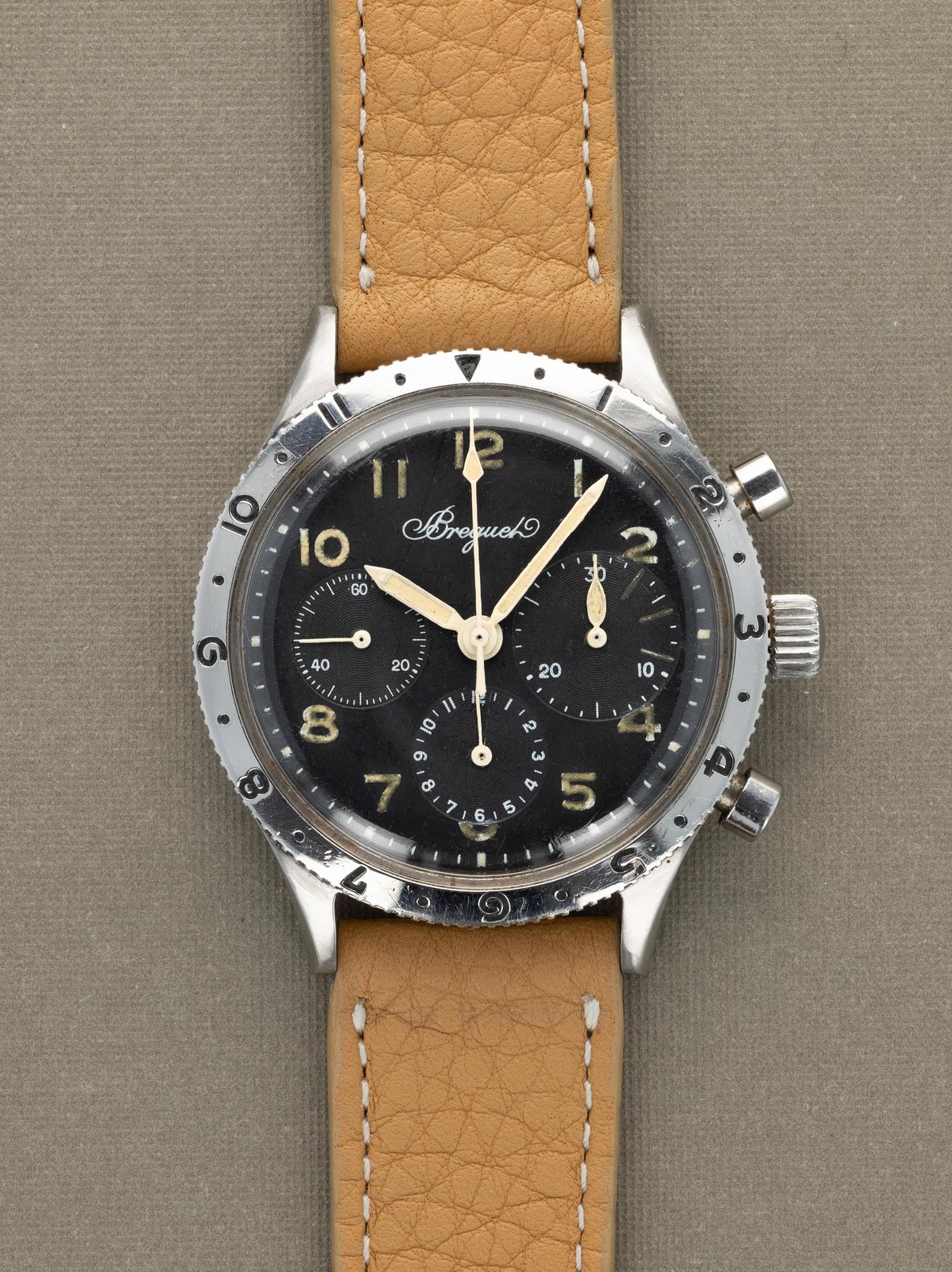
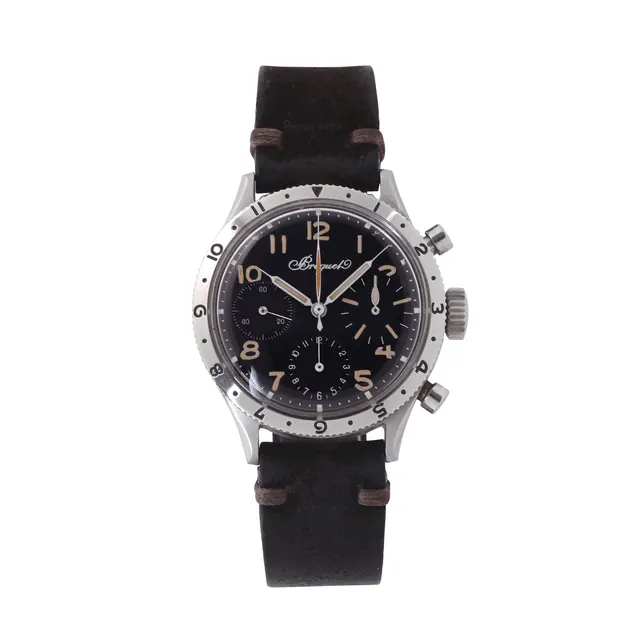
Breguet Type XX Chronograph, 'Civilian' Model
- Maker / attribution
- Breguet (maker)
- Date
- c. 1955
- Historical period
- Modern Mechanical Horology (1945 – 1969)
- Country of origin
- France
- Object type
- Wristwatch
- Dimensions
- Case 38 mm
- Stock no.
- OC3013
- Credit line
- Dealer listing, Oliver & Clarke (OC3013)
- Catalogue title (original)
- Breguet Type XX Chronograph - 'Civilian' Model (English)
View the source record (dealer listing) ↗ (opens another website in a new tab)Suggest a correction
Record summary
Catalogued by Oliver & Clarke (dealer), United Kingdom (stock number OC3013), this is a wristwatch by Breguet, made in France, dated c. 1955. The Atlas places it in the Modern Mechanical Horology period (1945 – 1969) of its Wristwatches collection. Recorded dimensions: Case 38 mm. The record is illustrated with 6 photographs.
Assembled from the source record's structured fields. Dates and attributions are given as the source states them; where a field is missing the Atlas leaves it blank rather than estimating.
Catalogue description
Dealer description — Oliver & Clarke
Parisian manufacturer Breguet, named after its founder, Abraham-Louis Breguet, was founded in 1775 and is one of the most stored and historically significant manufacturers in the world of horology. With a number of firsts, including *ahem* what many consider to be the first known wristwatch, Breguet is primarily known today for its stunning silver 'guilloche' dials, innovations in complications, and outstanding build quality. Prior to it's transfer of ownership and production location change to Switzerland in the late 1970s into the 1980s, it is estimated that only a few hundred pieces were every produced. So, the piece that we have here you might say, is something very, very special indeed and perhaps not what immediately comes to mind when you hear "Breguet." Dating to circa 1955, this chronograph was designed and produced as a civilian variant of the military-issued Type XX built to conform to the standards of the French Aéronautique Militaire. It utilizes a similarly-sized case coming in at 38mm in diameter, also with attractive lug chamfers, a screw-down caseback, and 'pump' pushers. The dial has a bit of added elegance in the form of "Breguet" script as well as an additional register at the 6 o'clock position, and a slightly different handset. The steel bezel still rotates, but this time can be used to track an additional time-zone with paint-filled its 12-hr engravings. The movement within is also a manually-wound Valjoux unit, this time a Cal. 720. The overall condition of this piece is excellent, showing normal wear throughout the case with an honest dial within. This Type XX has everything going for it... Manually-wound, objectively rare, historically significant, excellent overall condition, and from one of the most storied brands in existence.
Historical context
Modern Mechanical Horology (1945 – 1969)
Tool watches for divers, pilots and astronauts; electric watches anticipate the electronic age.
The classic era of the mechanical wristwatch: dive watches, chronographs for motor racing and space flight, GMT watches for jet travel, slim dress watches, automatic calendars, and the rise of Japanese manufacturers alongside Swiss, American, German and Soviet industries.
Read the period in the timelineMore wristwatches from this periodEarlier: Golden Age of Mechanical Watchmaking
Atlas type guide
Chronographs and split-seconds watches
A chronograph is a watch with an additional seconds hand that can be started, stopped and returned to zero independently of the timekeeping. Louis Moinet built an early example in 1816 and Nicolas Rieussec a recording 'chronographe' in 1821; Adolphe Nicole's heart-shaped reset cam (patented 1862) made the modern return-to-zero possible. Split-seconds (rattrapante) chronographs add a second hand that can be stopped for intermediate times; flyback chronographs restart instantly.
Chronographs were essential tools for doctors (pulsometer scales), artillery (telemeter), engineers and sport. In wristwatches, Valjoux, Venus, Lemania and later the automatic chronographs of 1969 (Zenith El Primero, the Chronomatic Calibre 11 group and Seiko 6139) are milestones.
What to look for
- Push-pieces on the case band or a single button in the crown (monopusher).
- Subsidiary registers for minutes and hours; tachymeter, telemeter or pulsometer scales.
- Column wheel versus cam control visible in the movement.
- Calibre markings of specialist makers (Valjoux, Lemania, Venus, Landeron).
Dating clues
- Pocket chronographs with heart cam reset: after 1862.
- Wrist chronographs: from c. 1910; two-button designs from the 1930s.
- Automatic chronographs: from 1969.
General guidance written by the Atlas editors about this kind of object. It is not a statement about this particular piece; for that, rely on the source record above and on physical examination.
Read next:Flyback chronographChronograph
Related records
Pocket Watches · 1700–1799
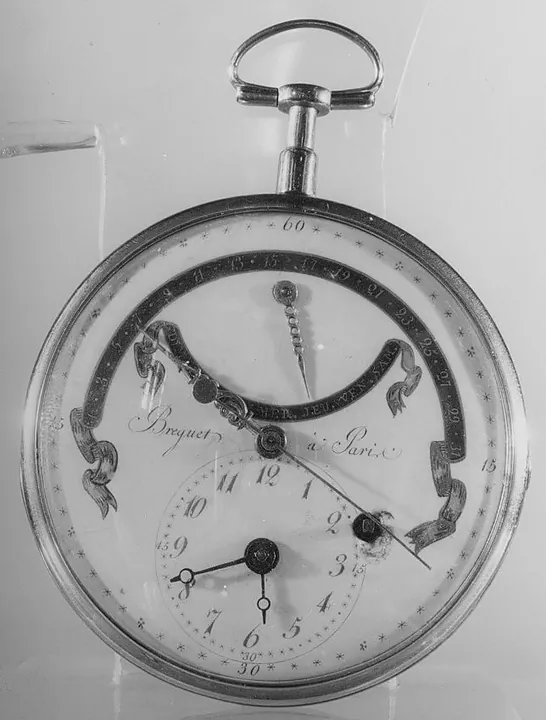
Pocket watch by Breguet, Belgium, 1700–1799
Royal Institute for Cultural Heritage
Pocket Watches · 1700–1799
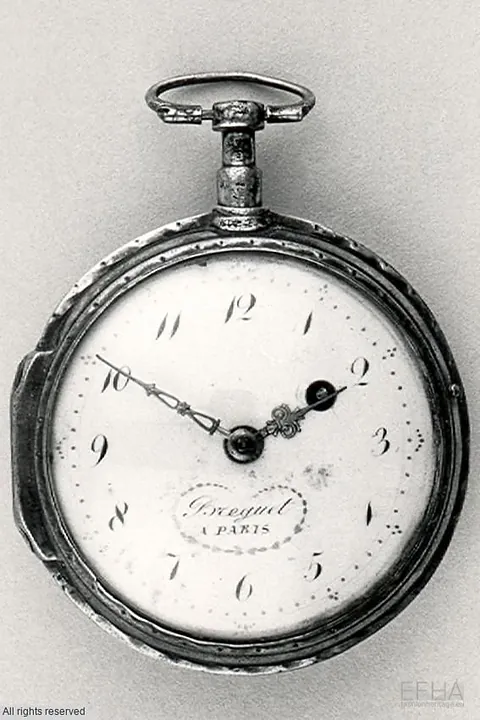
Pocket watch by Breguet, France, 1700–1799
Fashion Museum of Antwerp
Pocket Watches · c. 1790
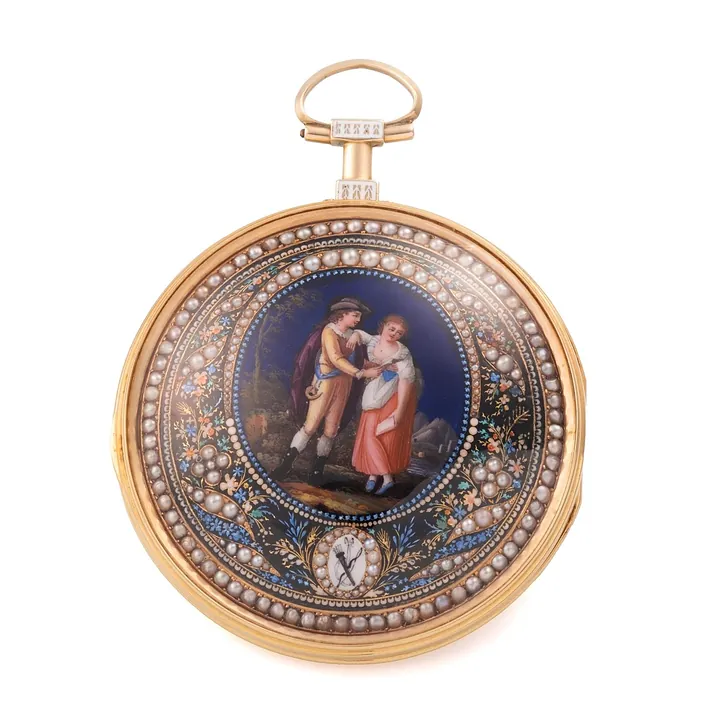
Breguet Love Letter, c. 1790
Antiquorum auction archive, Geneva
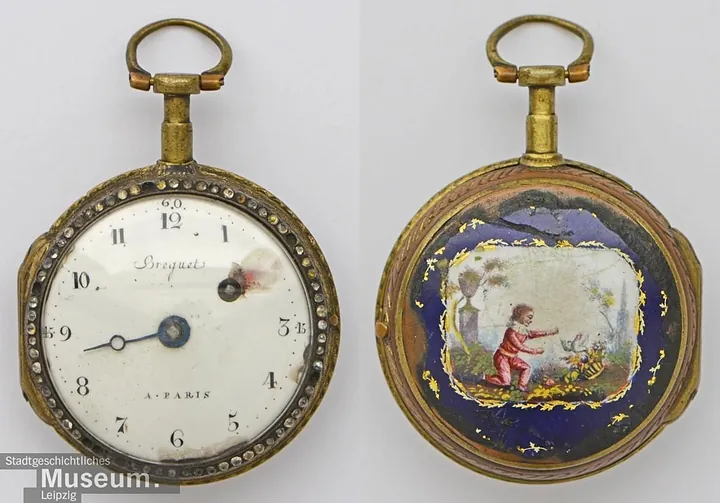
Pocket Watches · 1790
Pocket watch possibly by Breguet, France, 1790
Museum of City History Leipzig
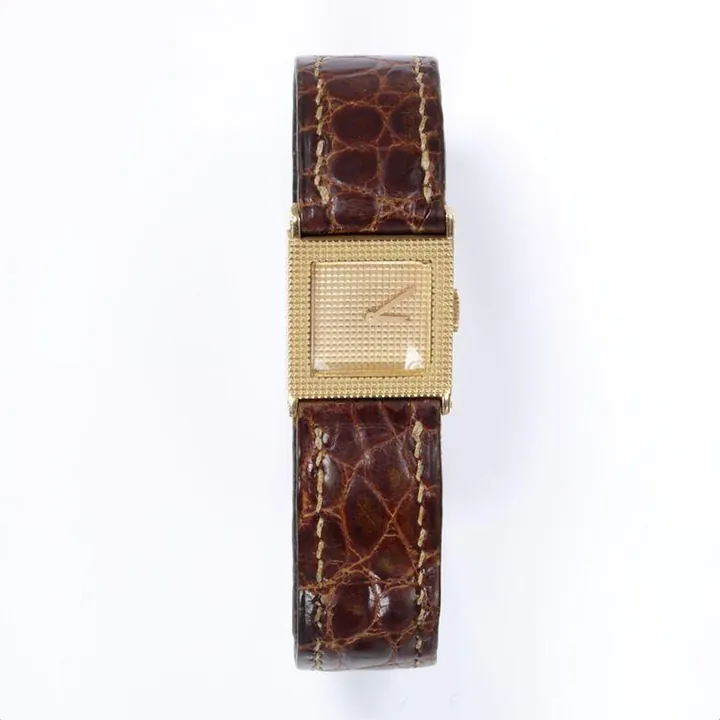
Wristwatches · c. 1963
Wristwatch with gold case and leather strap, Boucheron, Paris, about 1963.
Victoria and Albert Museum, London
Wristwatches · 1960–1965
Wristwatch, France, 1960–1965
Suomen kansallismuseo
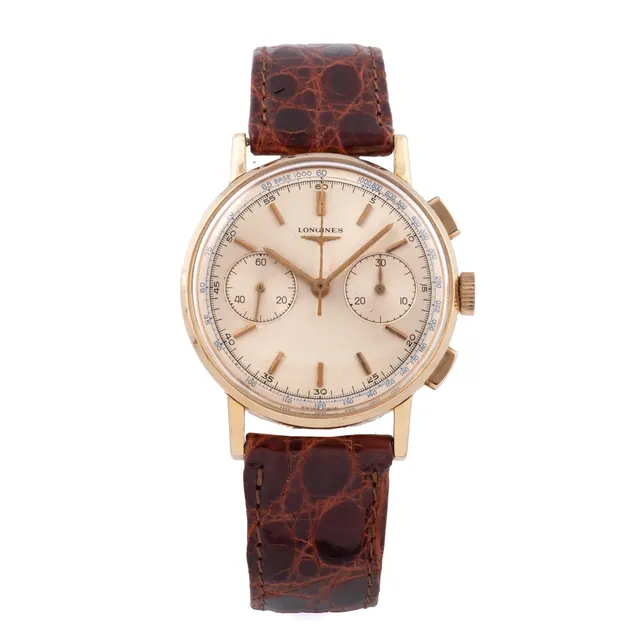
Wristwatches · c. 1960s
Longines wristwatch, 30 Ch French Case, circa 1960's
Antiquorum auction archive, Geneva
Wristwatches · 1958
Breguet wristwatch, 1958
Antiquorum auction archive, Geneva