
Wristwatches · Wristwatch
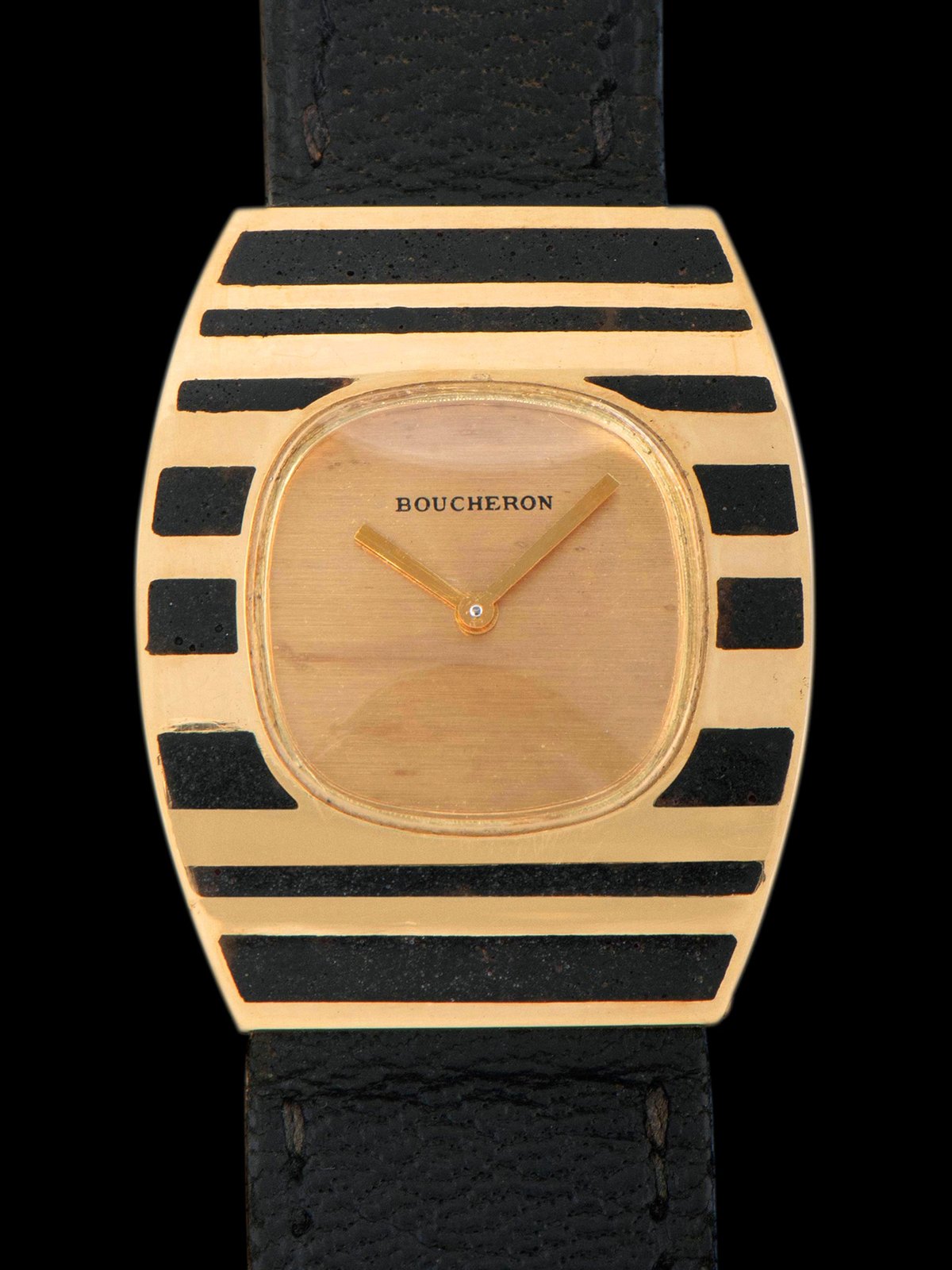
Boucheron "Bumblebee" Cocktail Watch 18K YG W/ Black Enamel, 1970s
- Maker / attribution
- Boucheron (maker)
- Date
- 1970s
- Historical period
- Quartz Revolution (1969 – 1990)
- Country of origin
- Unrecorded in source
- Object type
- Wristwatch
- Stock no.
- BOUCW18K
- Credit line
- Dealer listing, Craft & Tailored (BOUCW18K)
- Catalogue title (original)
- 1970s Boucheron "Bumblebee" Cocktail Watch 18K YG W/ Black Enamel (English)
View the source record (dealer listing) ↗ (opens another website in a new tab)Suggest a correction
Record summary
Catalogued by Craft & Tailored (dealer), Los Angeles (stock number BOUCW18K), this is a wristwatch by Boucheron, dated 1970s. The Atlas places it in the Quartz Revolution period (1969 – 1990) of its Wristwatches collection. The record is illustrated with 6 photographs.
Assembled from the source record's structured fields. Dates and attributions are given as the source states them; where a field is missing the Atlas leaves it blank rather than estimating.
Catalogue description
Dealer description — Craft & Tailored
Boucheron is a brand with extremely deep roots in fine jewelry since the first store opened in 1858 at the Galerie de Valois in Paris. The legacy of the Maison began with Frederic Boucheron, who initially opened the shop by humbly selling jewelry crafted by various artists, however, the nature of Boucheron changed when Frederic opened his first workshop in 1866 and immediately began winning awards for illustrious jewelry designs. Rapidly rising to the equivalency of Van Cleef & Arpels, Cartier, and Tiffany & Co., Boucheron quickly expanded with stores opening all over Europe, Asia, and even the United States. While it is extremely uncommon for fine jewelry houses to make a significant mark in the watch industry, apart from the few aforementioned market leaders, Boucheron entered the space with its first line of wristwatches in 1885. However, it wasn't until after the Second World War, under the helm of Louis Boucheron (Frederic's son), that the Maison would enter the watch market with force. Debuting in 1947, the Boucheron Reflect was a new concept in wristwatches, featuring true innovation melded with Art Deco and Mid-Century design. The Reflect introduced a proprietary and patented strap system that integrated directly into a sliding barrel within the curved rectangular case, this allowed for seemingly quick interchangeability between different straps and bracelet options. After the Reflect, Boucheron continued to innovate and created another patented strap system under the patent number BT7023160 in 1970, like the example on the featured timepiece, which is an adjustable leather strap system that greatly reduces the bulkiness of the more common deployant clasp system of the era. Boucheron was aware that its strength was in the design of jewelry and not the complexities of watchmaking, so by partnering with notable Swiss watch movement manufacturers they could focus all their efforts on the creation of unique watch case and bracelet concepts. Most early Boucheron wristwatches will feature an Omega heartbeat, however on rare occasions, other Swiss manufacturers would lend their movements, such as Ulysses Nardin, which is employed in the example presently available. Stock # BOUCW18K Brand Boucheron Style Cocktail Watch Model N/A Serial 67XX Size Women's / Unisex Material 18K Yellow Gold W/ Black Enamel Dial Gold Millimeters 23.5 x 29 Strap Black Bucheron Leather Strap W/ BT7023160 18K YG Clasp CASE & BRACELET The unique and superbly beautiful 18K yellow gold curved tonneau/coffin-style case features incredible black enamel striped inlaid throughout the top side of the case, whimsically resembling the striping of a bumble bee. The case remains in extremely well-preserved condition, with only gentle elements of age present, but no actual damage. The back of the case maintains deep hallmarks and factory markings that all remain in very crisp condition. The original black Bucheron leather strap features the patented BT7023160 18K yellow gold clasp system. The strap shows gentle signs of use but remains in excellent and usable condition overall. DIAL & HANDS The original "less is more" gold dial features a horizontal brushed detail and shows some subtle, yet attractive oxidation, which does not affect the overall original aesthetic of the watch. Otherwise, the dial exhibits no damage. The original gold hands are in excellent condition as well. ACCESSORIES
Historical context
Quartz Revolution (1969 – 1990)
Seiko's Astron begins mass quartz timekeeping; traditional industries contract sharply.
Quartz and digital watches transformed the market after 1969. Swiss employment collapsed, Japanese and Hong Kong production soared, and the Swatch (1983) helped the Swiss industry recover; mechanical watches survived as luxury goods.
Read the period in the timelineMore wristwatches from this periodEarlier: Modern Mechanical Horology
Atlas type guide
Wristwatches
Bracelet watches were worn by women from the early nineteenth century — Breguet made one for Caroline Murat, Queen of Naples, in 1810–12 — but the wristwatch only became a man's instrument with military use and aviation in the early twentieth century. Between the World Wars it overtook the pocket watch; the 1920s and 1930s brought rectangular Art Deco cases, water-resistant cases and the first automatic winding systems.
After 1945 the wristwatch became a carrier of identity — dress watches, sports and dive watches, chronographs, calendars — produced by Swiss, American, Japanese, German, Soviet and Chinese industries. The quartz revolution after 1969 and the mechanical renaissance since the 1990s, including the rise of independent watchmakers, complete the story.
What to look for
- The reference number (between the lugs or inside the case back) and serial number, the starting point for dating.
- The calibre: its maker and number are often stamped under the dial or on the bridge.
- Originality of dial, hands and crown — refinished ('redial') dials are common.
- Case material marks: 18K/750, 14K/585, stainless steel, gold-filled, plated.
Dating clues
- Wire-lug cases: before c. 1925.
- Water-resistant screw-down cases: from 1926.
- Quartz movements: from 1969; sapphire crystals widespread after c. 1980.
General guidance written by the Atlas editors about this kind of object. It is not a statement about this particular piece; for that, rely on the source record above and on physical examination.
Related records
Wristwatches · c. 1940s
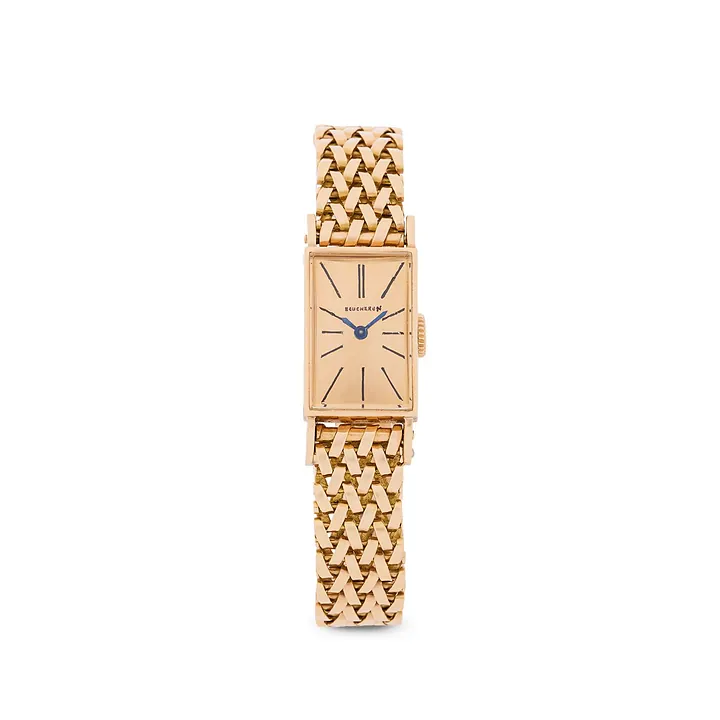
Boucheron wristwatch, ref. 3.914, c. 1940s
Antiquorum auction archive, Geneva
Wristwatches · c. 1963
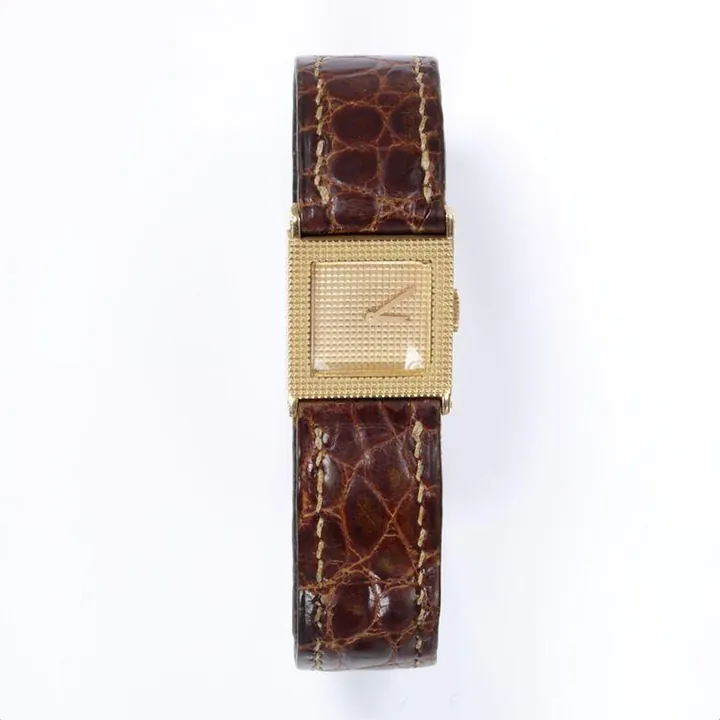
Wristwatch with gold case and leather strap, Boucheron, Paris, about 1963.
Victoria and Albert Museum, London
Pocket Watches · 1893–1911
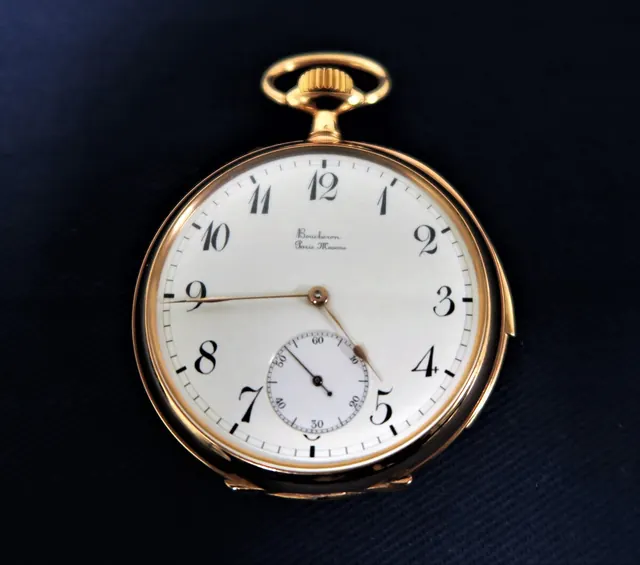
Pocket watch by Boucheron, France, 1893–1911
HKM / Kulttuurihistoriallinen
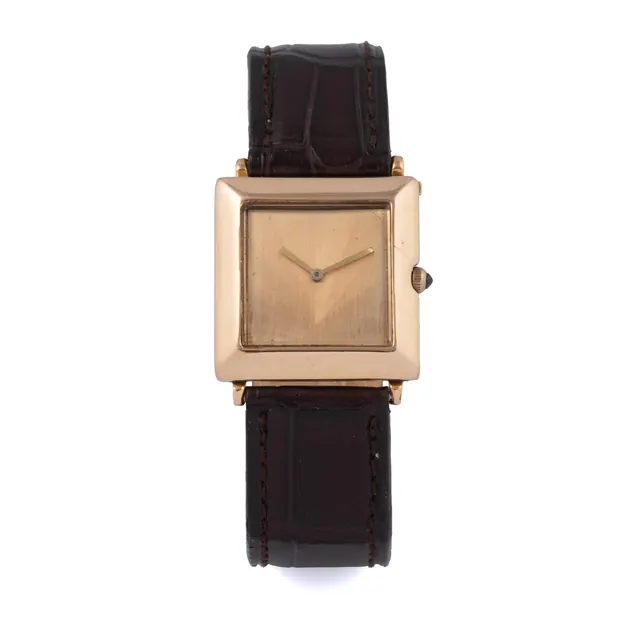
Wristwatches · c. 1970s
Boucheron wristwatch, France Carree, circa 1970's
Antiquorum auction archive, Geneva

Wristwatches · 1970
Wristwatch by Heno, Switzerland, 1970
Museum Rotterdam
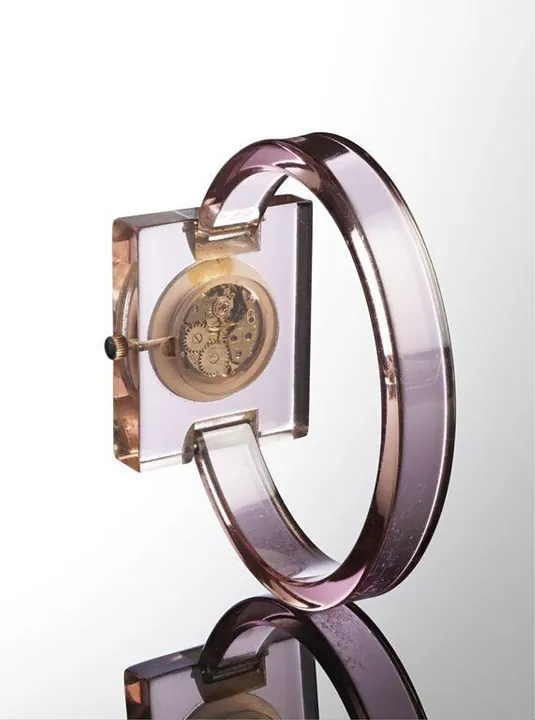
Wristwatches · 1970s
Wristwatch, plastic, by Gucci; Italy, 1970s.
Victoria and Albert Museum, London
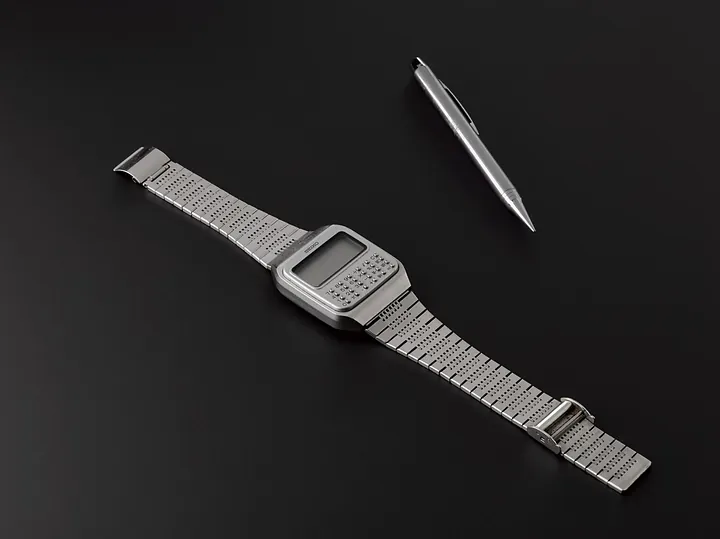
Wristwatches · 1978
Calculator wristwatch by Suwa Seikosha Co. Limited, Japan, 1978
Science Museum Group, London
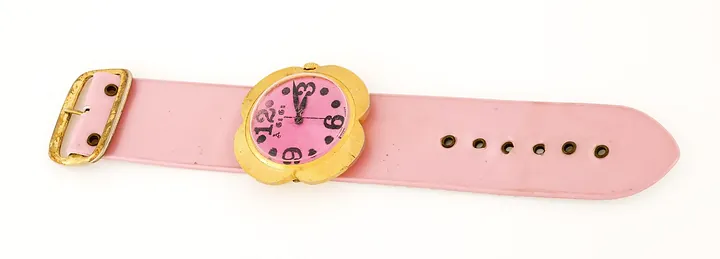
Wristwatches · 1980
Wristwatch, 1980 (no. 71413)
Museum Rotterdam