
Wristwatches · Wristwatch
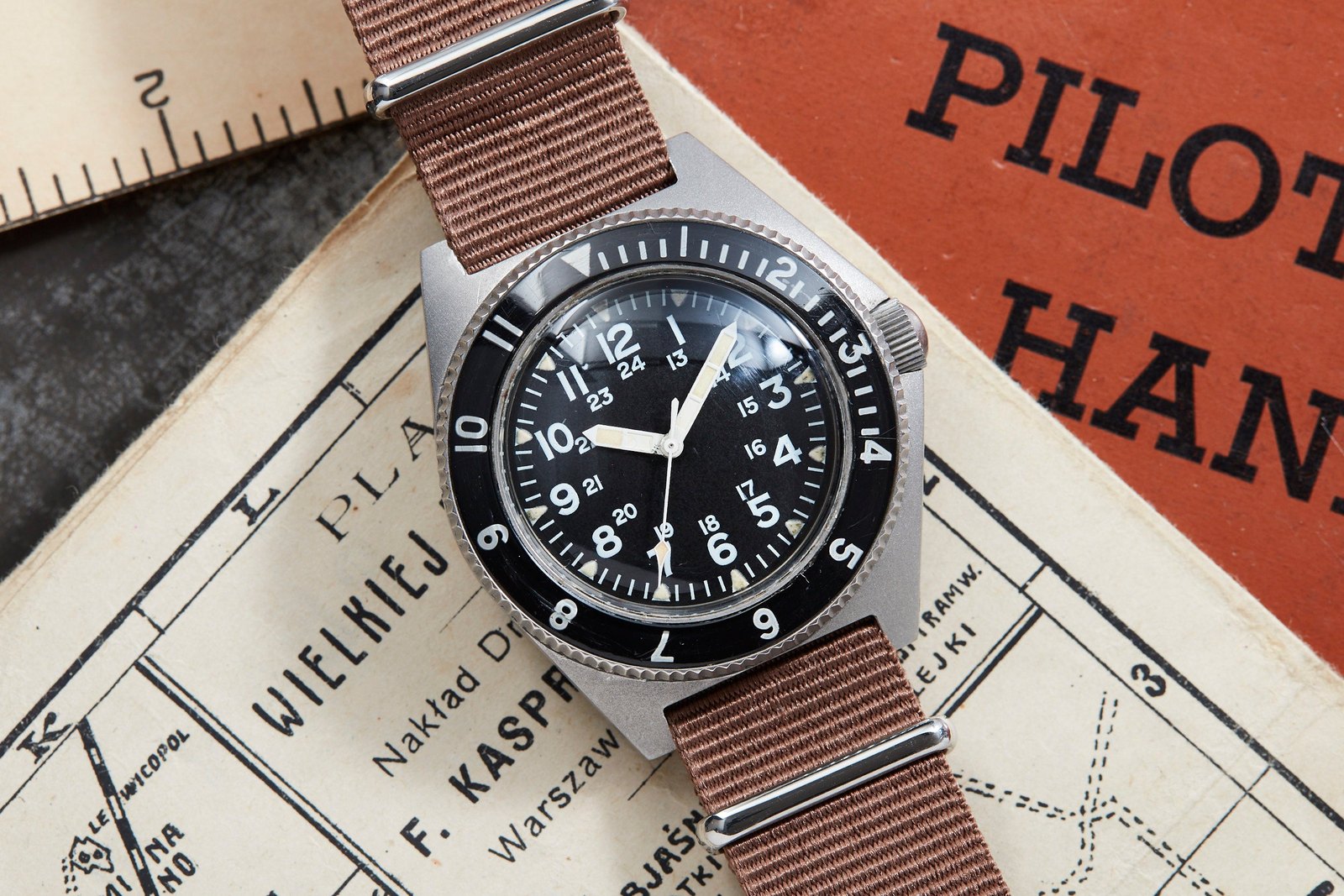
Benrus Type II Class A, 1979
- Maker / attribution
- Benrus (maker)
- Date
- 1979
- Historical period
- Quartz Revolution (1969 – 1990)
- Country of origin
- United States
- Object type
- Wristwatch
- Dimensions
- Case 43 mm
- Stock no.
- Product 140594479134
- Credit line
- Dealer listing, Analog/Shift (product 140594479134)
- Catalogue title (original)
- Benrus Type II Class A (English)
View the source record (dealer listing) ↗ (opens another website in a new tab)Suggest a correction
Record summary
Catalogued by Analog/Shift (dealer), New York (stock number Product 140594479134), this is a wristwatch by Benrus, made in United States, dated 1979. The Atlas places it in the Quartz Revolution period (1969 – 1990) of its Wristwatches collection. Recorded dimensions: Case 43 mm. The record is illustrated with 6 photographs.
Assembled from the source record's structured fields. Dates and attributions are given as the source states them; where a field is missing the Atlas leaves it blank rather than estimating.
Catalogue description
Dealer description — Analog/Shift
Military watches are universally awesome, but there’s a certain sub-species of military watches that are undeniably the coolest. We mean dive watches, of course. From the combat divers of the French Marine Nationale, to the members of Israel’s Shayatet 13, to the United States’s very own Navy SEALs, all required watches, and those watches were required to be one thing: robust. Blancpain started it all with the Fifty Fathoms, which was designed by the founder of France’s combat diver unit, Captain Bob Maloubier. Purpose-built to his exacting specifications, its revolutionary gasket system and spare, bare-bones appearance established a design lineage that’s carried across the Swiss watch industry. The Fifty Fathoms truly laid the blueprint for all dive watches to follow. Starting in the 1970s, the U.S. government issued MIL-W-50717, which set special specifications for watches destined for use by the Navy SEALS. As this was the height of the Vietnam War, thousands of these watches were needed to outfit military divers working in the Mekong Delta. At the time, Benrus was already known for supplying two classes of field watches to the U.S. military: one, the MIL-W-46374 field watch, meant for infantry, and the MIL-W-3818B for use by the Army, Navy, and Air Force. So it seemed fitting that Benrus would get the nod once more to supply watches to the military, this time to elite diving units like the SEALs. Thus, the Type II was born. Perfectly-suited to the needs of the SEALs, its asymmetrical 43mm corrosion-resistant steel case was rated to 1200 feet. Several thousand of these watches—around 9000—were made according to the specifications and were given the designation “Class A" — the highest grade that could be designated to military-issue equipment. This particular watch dates from 1979. With a correctly-notched screw down crown, it bears the requisite military engravings on the back. Possessing an appropriately-weathered look that suits its lineage, it’s the perfect military dive watch, combining robust internals with a military heritage that’s sure to impress.
Historical context
Quartz Revolution (1969 – 1990)
Seiko's Astron begins mass quartz timekeeping; traditional industries contract sharply.
Quartz and digital watches transformed the market after 1969. Swiss employment collapsed, Japanese and Hong Kong production soared, and the Swatch (1983) helped the Swiss industry recover; mechanical watches survived as luxury goods.
Read the period in the timelineMore wristwatches from this periodEarlier: Modern Mechanical Horology
Atlas type guide
Wristwatches
Bracelet watches were worn by women from the early nineteenth century — Breguet made one for Caroline Murat, Queen of Naples, in 1810–12 — but the wristwatch only became a man's instrument with military use and aviation in the early twentieth century. Between the World Wars it overtook the pocket watch; the 1920s and 1930s brought rectangular Art Deco cases, water-resistant cases and the first automatic winding systems.
After 1945 the wristwatch became a carrier of identity — dress watches, sports and dive watches, chronographs, calendars — produced by Swiss, American, Japanese, German, Soviet and Chinese industries. The quartz revolution after 1969 and the mechanical renaissance since the 1990s, including the rise of independent watchmakers, complete the story.
What to look for
- The reference number (between the lugs or inside the case back) and serial number, the starting point for dating.
- The calibre: its maker and number are often stamped under the dial or on the bridge.
- Originality of dial, hands and crown — refinished ('redial') dials are common.
- Case material marks: 18K/750, 14K/585, stainless steel, gold-filled, plated.
Dating clues
- Wire-lug cases: before c. 1925.
- Water-resistant screw-down cases: from 1926.
- Quartz movements: from 1969; sapphire crystals widespread after c. 1980.
General guidance written by the Atlas editors about this kind of object. It is not a statement about this particular piece; for that, rely on the source record above and on physical examination.
Related records
Wristwatches · c. 1960
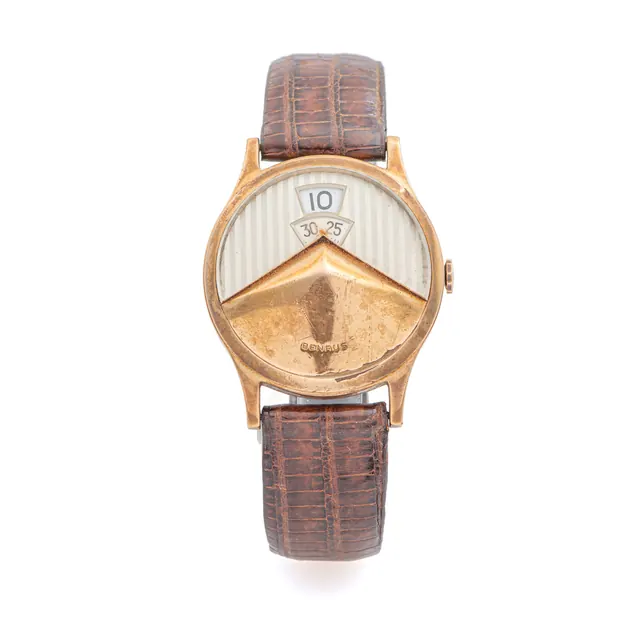
Benrus wristwatch, Dial-O-Rama Digital Jump Hour, circa 1960
Antiquorum auction archive, Geneva
Wristwatches · 1970s
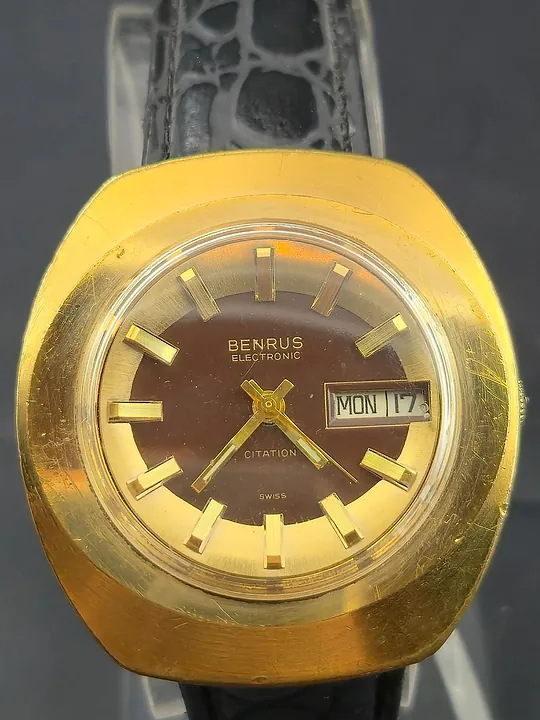
1970s Benrus Citation Electronic HS19 7J Day-Date Wristwatch, Gold-Tone Case, New Battery, Running
LiveAuctioneers auction archive
Wristwatches · 1950s
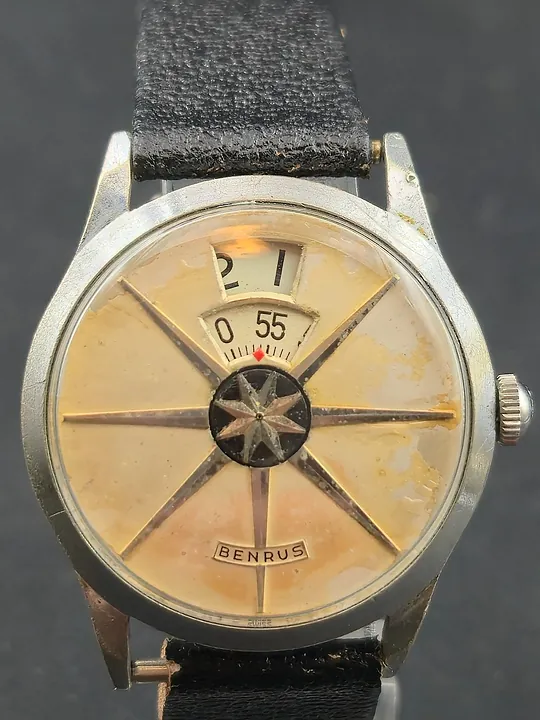
1950s Benrus “Dial-O-Rama” Jump Hour 17J Manual Wind Watch, 33 mm – Runs
LiveAuctioneers auction archive
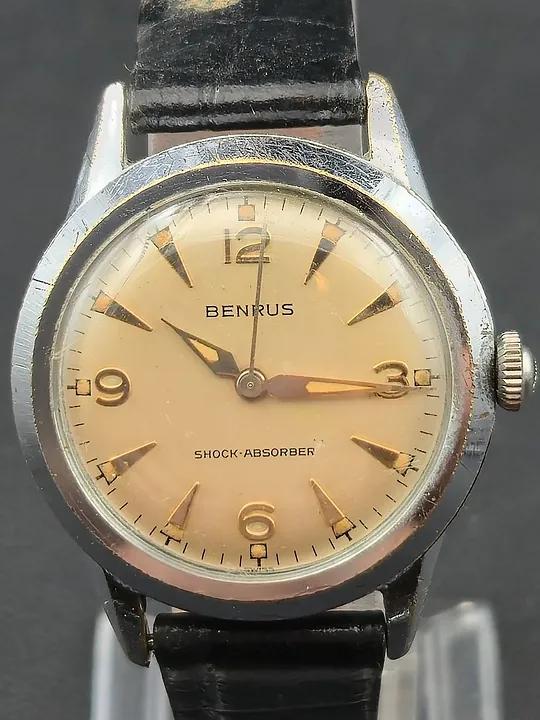
Wristwatches · 1940s
1940s Benrus Shock Absorber 17J U.S. Zone Germany 32mm Runs
LiveAuctioneers auction archive
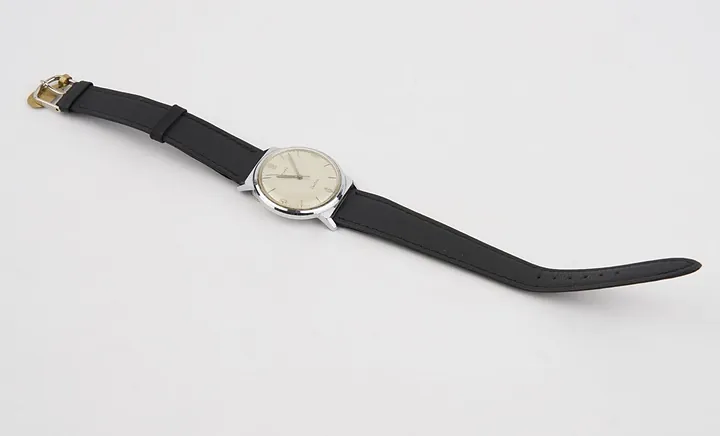
Wristwatches · 1949–1992
Timex `Electric' wristwatch, with electrically operated balance wheel mechanism, United States, 1949–1992
Science Museum Group, London
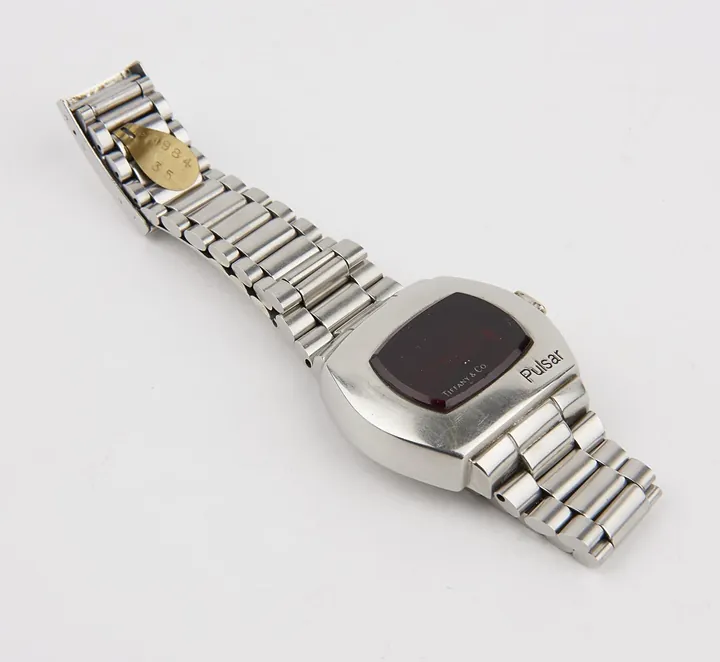
Wristwatches · 1972
Wristwatch by Hamilton Watch Company and Electro-Data Inc, United States, 1972
Science Museum Group, London
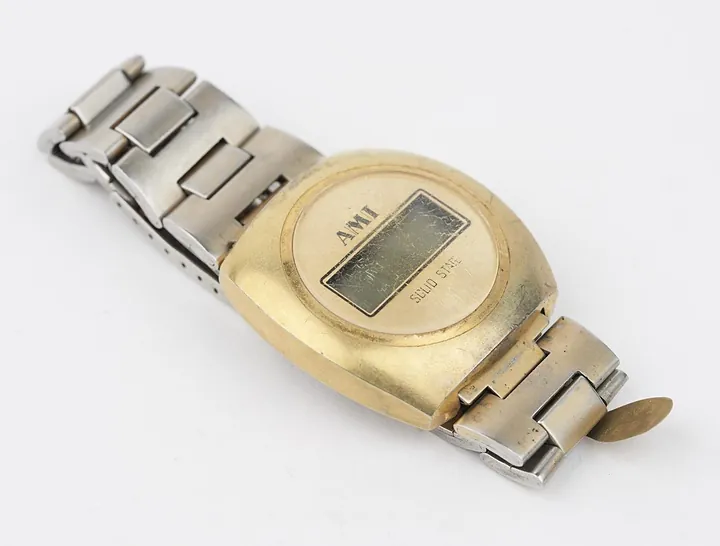
Wristwatches · 1973–1974
Quartz watch with liquid crystal digital display, made by American Microsystems Inc. (AMI) . 1973/74
Science Museum Group, London
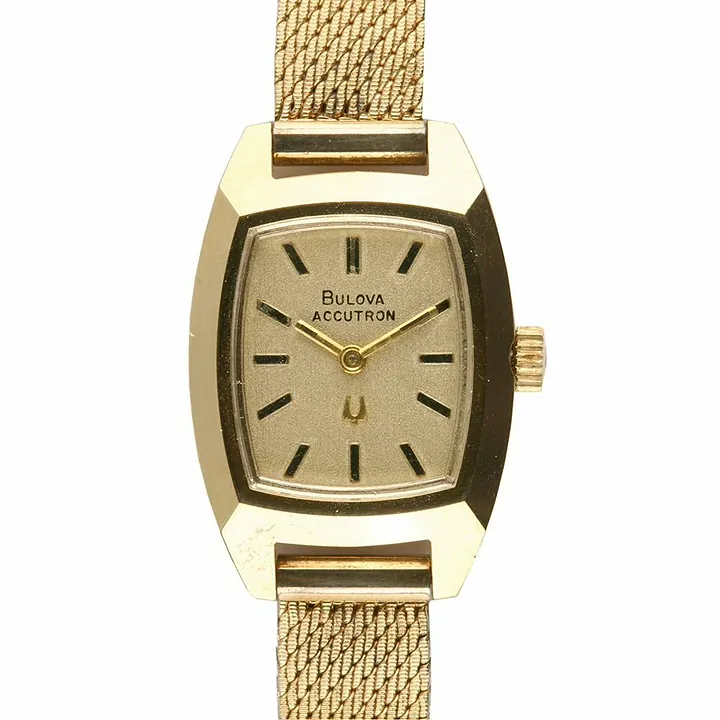
Wristwatches · c. 1973
Wristwatch by Josef Bulova, United States, c. 1973
German Clock Museum