
Wristwatches · Wristwatch
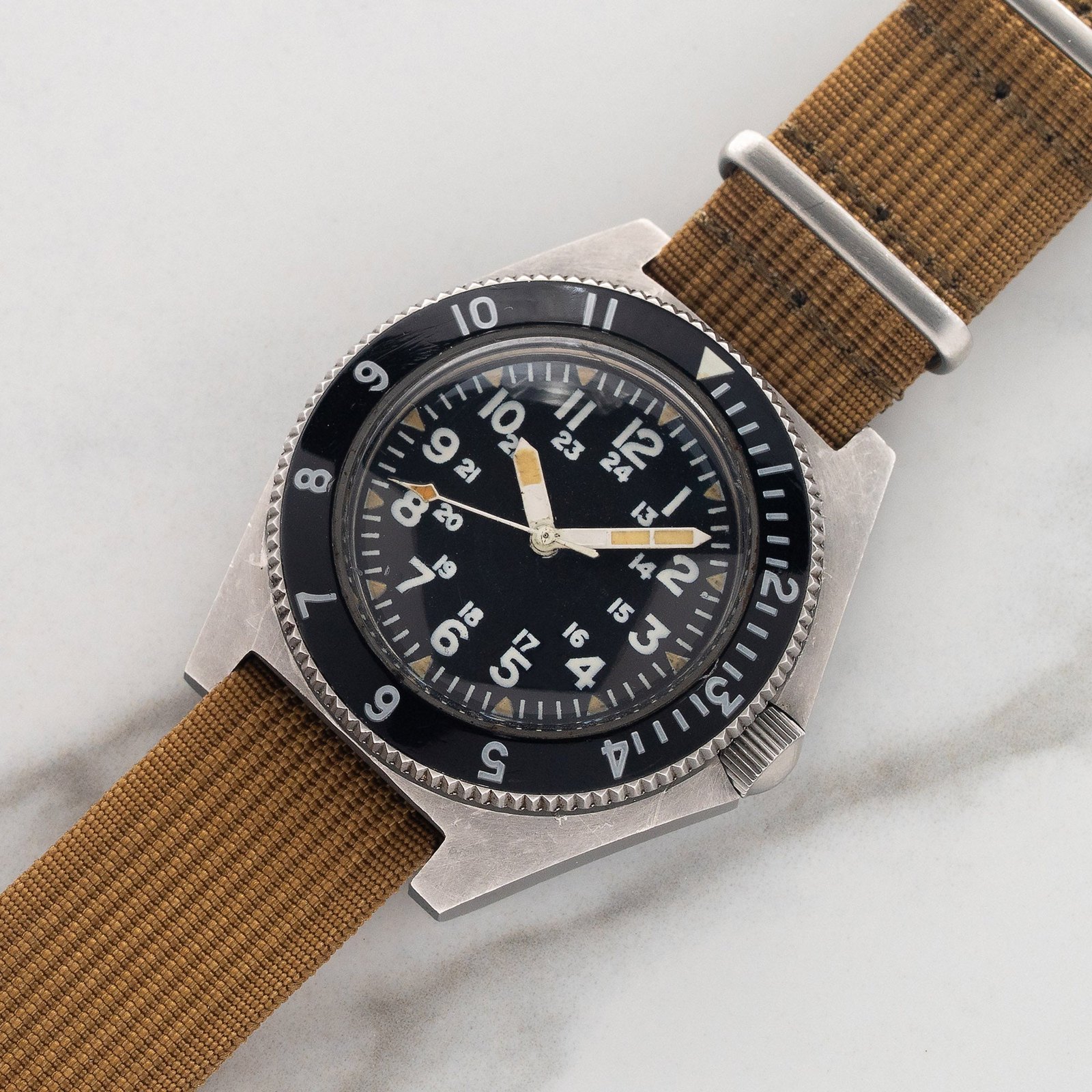
Benrus Type 2 with Striking Patina
- Maker / attribution
- Benrus (maker)
- Date
- 1976
- Historical period
- Quartz Revolution (1969 – 1990)
- Country of origin
- United States
- Object type
- Wristwatch
- Stock no.
- Product 10211458384148
- Credit line
- Dealer listing, Collectors Corner NY (product 10211458384148)
- Catalogue title (original)
- Benrus Type 2 w/Striking Patina (English)
View the source record (dealer listing) ↗ (opens another website in a new tab)Suggest a correction
Record summary
Catalogued by Collectors Corner NY (dealer), New York (stock number Product 10211458384148), this is a wristwatch by Benrus, made in United States, dated 1976. The Atlas places it in the Quartz Revolution period (1969 – 1990) of its Wristwatches collection. The record is illustrated with 5 photographs.
Assembled from the source record's structured fields. Dates and attributions are given as the source states them; where a field is missing the Atlas leaves it blank rather than estimating.
Catalogue description
Dealer description — Collectors Corner NY
When thinking of the most iconic military watches ever produced, it would be hard not to place the Benrus Type 1 in the t op 5 on the list (up there with the Rolex MilSub, Tornek-Rayville etc.) The unique and ergonomic asymmetrical case shape of these watches went on to influence later mil-spec pieces from the 70s to today. Perhaps most noteworthy is its pure and well-laid-out dial design, which we believe holds its own against the brilliance of the Rolex Explorer 1. While the Type 2 might not quite make the top 5, its larger production run makes them a bit more accessible to find today. Their main difference was the 24 hour/military time dial in addition to larger production run. This particular example was issued in November of 1976 and remains in nice vintage condition. The dial boasts a distinctive "custard" patina, matching the hands. The case has light signs of use and the "dimple"-signed crown is correct. The bezel insert also very well preserved and displays some light scratches but no cracks. For anyone looking for an attractive Type 2 this piece offers great character and is ready to enjoy for many missions to come.
Historical context
Quartz Revolution (1969 – 1990)
Seiko's Astron begins mass quartz timekeeping; traditional industries contract sharply.
Quartz and digital watches transformed the market after 1969. Swiss employment collapsed, Japanese and Hong Kong production soared, and the Swatch (1983) helped the Swiss industry recover; mechanical watches survived as luxury goods.
Read the period in the timelineMore wristwatches from this periodEarlier: Modern Mechanical Horology
Atlas type guide
Wristwatches
Bracelet watches were worn by women from the early nineteenth century — Breguet made one for Caroline Murat, Queen of Naples, in 1810–12 — but the wristwatch only became a man's instrument with military use and aviation in the early twentieth century. Between the World Wars it overtook the pocket watch; the 1920s and 1930s brought rectangular Art Deco cases, water-resistant cases and the first automatic winding systems.
After 1945 the wristwatch became a carrier of identity — dress watches, sports and dive watches, chronographs, calendars — produced by Swiss, American, Japanese, German, Soviet and Chinese industries. The quartz revolution after 1969 and the mechanical renaissance since the 1990s, including the rise of independent watchmakers, complete the story.
What to look for
- The reference number (between the lugs or inside the case back) and serial number, the starting point for dating.
- The calibre: its maker and number are often stamped under the dial or on the bridge.
- Originality of dial, hands and crown — refinished ('redial') dials are common.
- Case material marks: 18K/750, 14K/585, stainless steel, gold-filled, plated.
Dating clues
- Wire-lug cases: before c. 1925.
- Water-resistant screw-down cases: from 1926.
- Quartz movements: from 1969; sapphire crystals widespread after c. 1980.
General guidance written by the Atlas editors about this kind of object. It is not a statement about this particular piece; for that, rely on the source record above and on physical examination.
Related records
Wristwatches · c. 1960
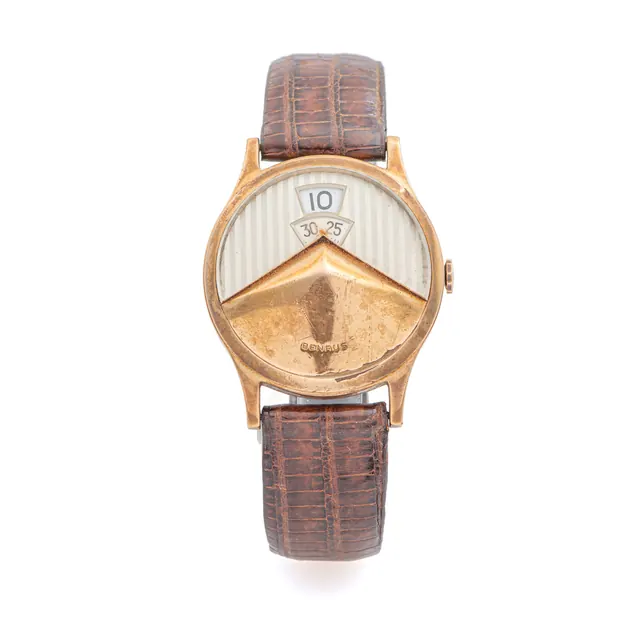
Benrus wristwatch, Dial-O-Rama Digital Jump Hour, circa 1960
Antiquorum auction archive, Geneva
Wristwatches · 1970s
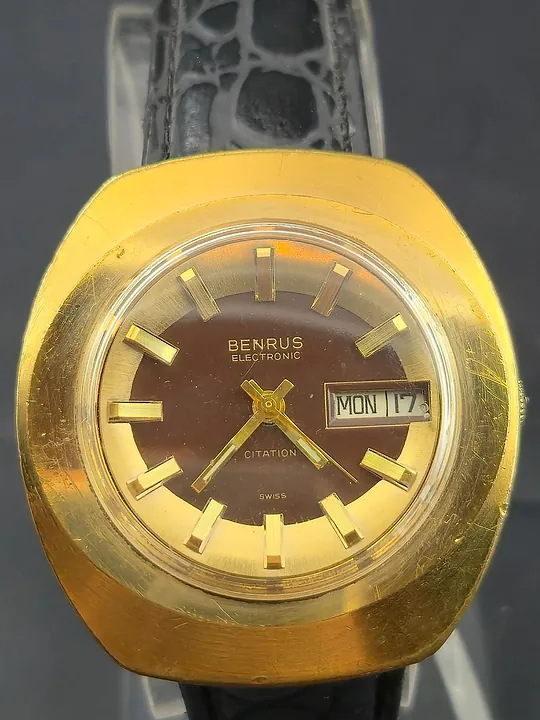
1970s Benrus Citation Electronic HS19 7J Day-Date Wristwatch, Gold-Tone Case, New Battery, Running
LiveAuctioneers auction archive
Wristwatches · 1950s
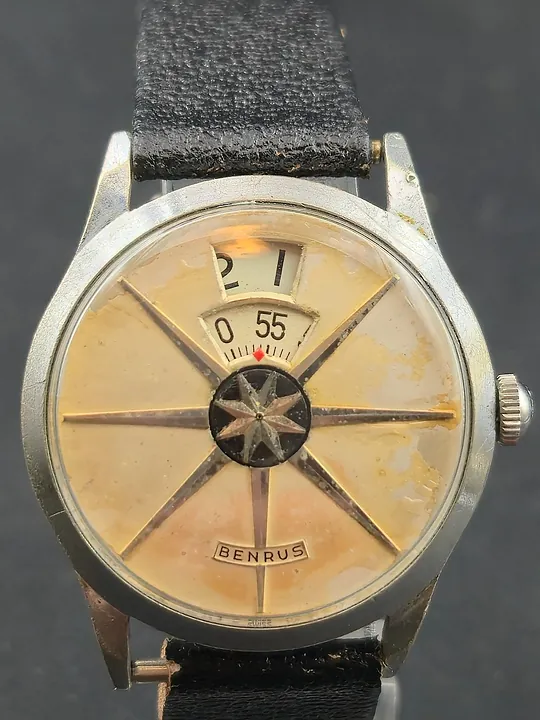
1950s Benrus “Dial-O-Rama” Jump Hour 17J Manual Wind Watch, 33 mm – Runs
LiveAuctioneers auction archive
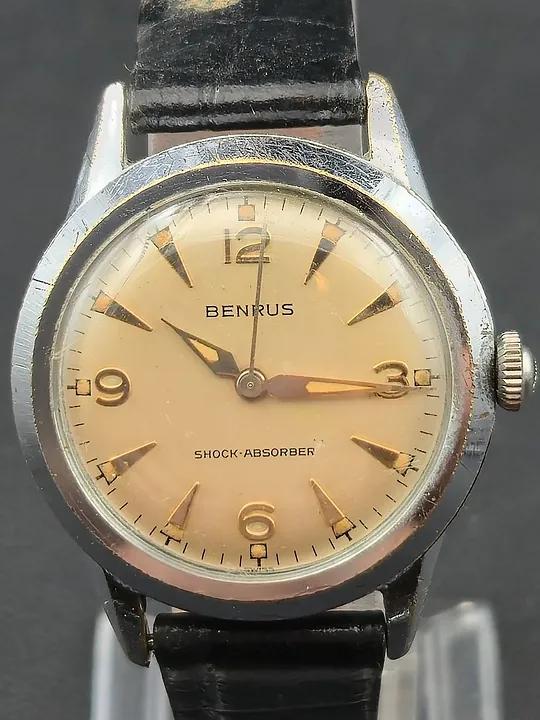
Wristwatches · 1940s
1940s Benrus Shock Absorber 17J U.S. Zone Germany 32mm Runs
LiveAuctioneers auction archive
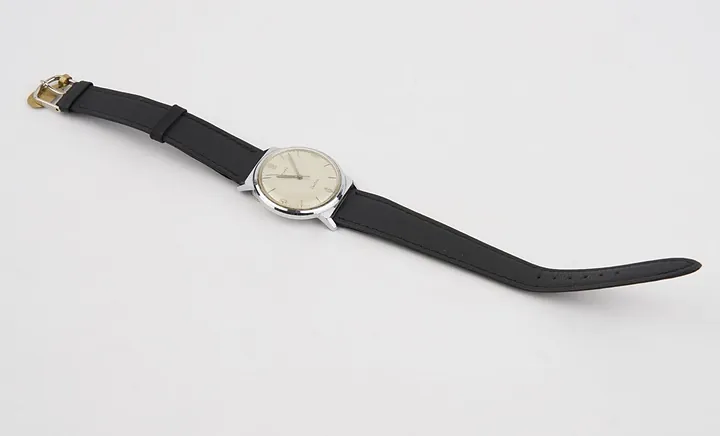
Wristwatches · 1949–1992
Timex `Electric' wristwatch, with electrically operated balance wheel mechanism, United States, 1949–1992
Science Museum Group, London
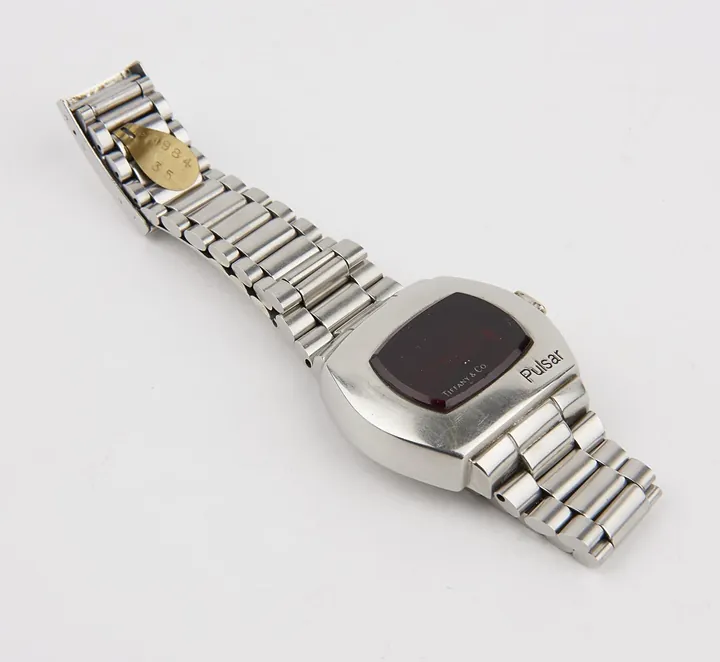
Wristwatches · 1972
Wristwatch by Hamilton Watch Company and Electro-Data Inc, United States, 1972
Science Museum Group, London
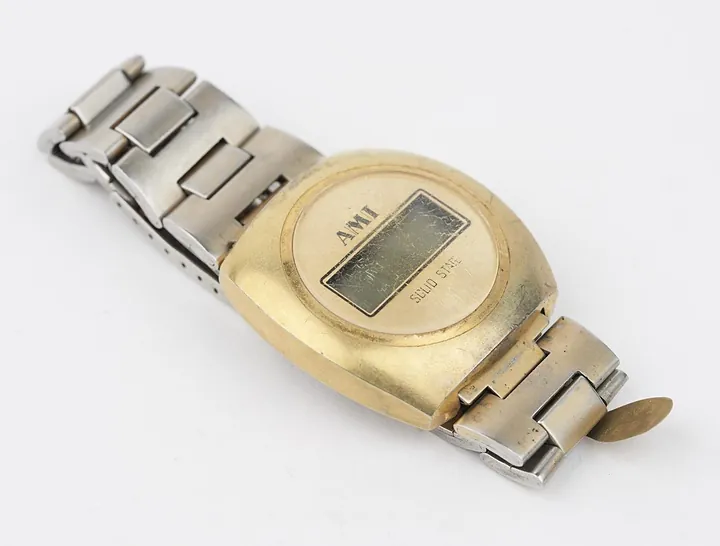
Wristwatches · 1973–1974
Quartz watch with liquid crystal digital display, made by American Microsystems Inc. (AMI) . 1973/74
Science Museum Group, London
Wristwatches · c. 1973
Wristwatch by Josef Bulova, United States, c. 1973
German Clock Museum