
Wristwatches · Wristwatch
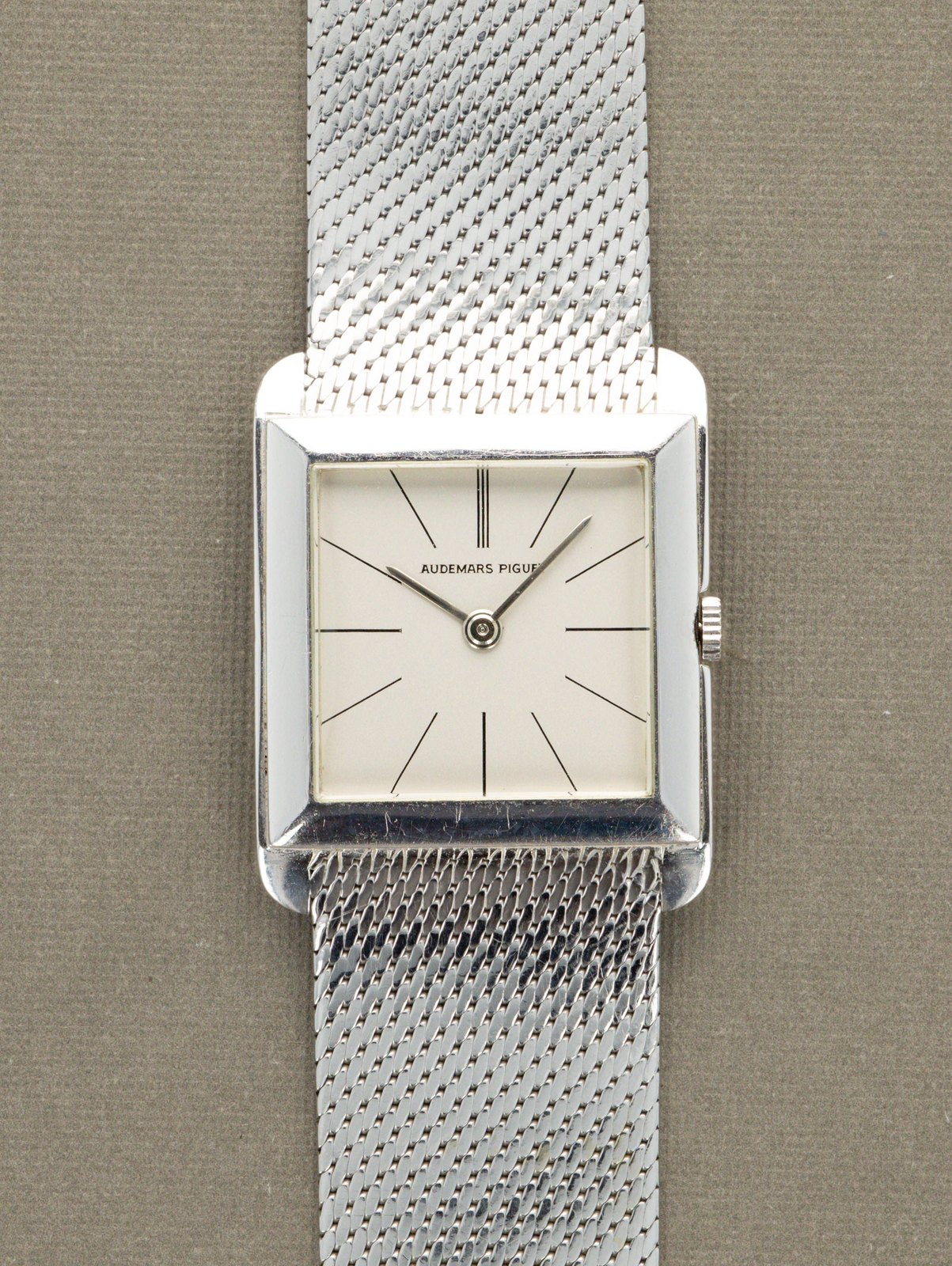
Audemars Piguet Platinum 'Tank', Circa 1950s
- Maker / attribution
- Audemars Piguet (maker)
- Date
- c. 1958
- Historical period
- Modern Mechanical Horology (1945 – 1969)
- Country of origin
- Switzerland
- Object type
- Wristwatch
- Materials / technique
- platinum
- Dimensions
- Case 24 mm
- Stock no.
- OC3069
- Credit line
- Dealer listing, Oliver & Clarke (OC3069)
- Catalogue title (original)
- Audemars Piguet Platinum 'Tank' - Circa 1950s (English)
View the source record (dealer listing) ↗ (opens another website in a new tab)Suggest a correction
Record summary
Catalogued by Oliver & Clarke (dealer), United Kingdom (stock number OC3069), this is a wristwatch by Audemars Piguet, made in Switzerland, dated c. 1958. The Atlas places it in the Modern Mechanical Horology period (1945 – 1969) of its Wristwatches collection. Materials and techniques recorded by the source: platinum. Recorded dimensions: Case 24 mm. The record is illustrated with 6 photographs.
Assembled from the source record's structured fields. Dates and attributions are given as the source states them; where a field is missing the Atlas leaves it blank rather than estimating.
Catalogue description
Dealer description — Oliver & Clarke
The year 1972 was the advent of what is undeniably Audemars Piguet's most famous, significant, and yes, iconic line of watches, the Royal Oak. It was also the year that the 'high-end dress watch' would forever change. Prior to 1972, ultra-thin and design-focused precious metal watches represented the pinnacle of the genre, not what appears to be an industrial-styled stainless steel sports watch with a bracelet. While the brand never stopped producing traditional dress watches, per-se, production of their new golden goose would dominate the rest of the lineup. And this is after considering that prior to the Royal Oak, AP made far fewer watches to start with... The piece that we have here is one of those pre-Royal Oak era watches. Without an official model name, this 'Tank'-style piece is something very special indeed. Dating to circa 1958, the case comes in at a wonderfully-sized 24mm x 30mm and is crafted out of platinum! The 'stepped' bezel sits on the mid-case, which features rounded lugs that gently curve downward making for a fantastic feel on the wrist. The silver dial inside is very of-its-era, with simple printed "Audemars Piguet" script, 'elongated' indices, and a 'pencil' handset to match. This svelte piece is powered by AP's Calibre 2003 manual-winding movement and is fitted to a white gold 'woven' bracelet with a locking clasp. This then, is a representation of a bygone era not just for Audemars Piguet, but for what a high-end dress watch used to be. Only in the last few years have collectors and enthusiasts alike started to pay a bit more attention to pieces like these and, we think, its long overdue.
Historical context
Modern Mechanical Horology (1945 – 1969)
Tool watches for divers, pilots and astronauts; electric watches anticipate the electronic age.
The classic era of the mechanical wristwatch: dive watches, chronographs for motor racing and space flight, GMT watches for jet travel, slim dress watches, automatic calendars, and the rise of Japanese manufacturers alongside Swiss, American, German and Soviet industries.
Read the period in the timelineMore wristwatches from this periodEarlier: Golden Age of Mechanical Watchmaking
Atlas type guide
Wristwatches
Bracelet watches were worn by women from the early nineteenth century — Breguet made one for Caroline Murat, Queen of Naples, in 1810–12 — but the wristwatch only became a man's instrument with military use and aviation in the early twentieth century. Between the World Wars it overtook the pocket watch; the 1920s and 1930s brought rectangular Art Deco cases, water-resistant cases and the first automatic winding systems.
After 1945 the wristwatch became a carrier of identity — dress watches, sports and dive watches, chronographs, calendars — produced by Swiss, American, Japanese, German, Soviet and Chinese industries. The quartz revolution after 1969 and the mechanical renaissance since the 1990s, including the rise of independent watchmakers, complete the story.
What to look for
- The reference number (between the lugs or inside the case back) and serial number, the starting point for dating.
- The calibre: its maker and number are often stamped under the dial or on the bridge.
- Originality of dial, hands and crown — refinished ('redial') dials are common.
- Case material marks: 18K/750, 14K/585, stainless steel, gold-filled, plated.
Dating clues
- Wire-lug cases: before c. 1925.
- Water-resistant screw-down cases: from 1926.
- Quartz movements: from 1969; sapphire crystals widespread after c. 1980.
General guidance written by the Atlas editors about this kind of object. It is not a statement about this particular piece; for that, rely on the source record above and on physical examination.
Related records
Clocks · c. 1990s
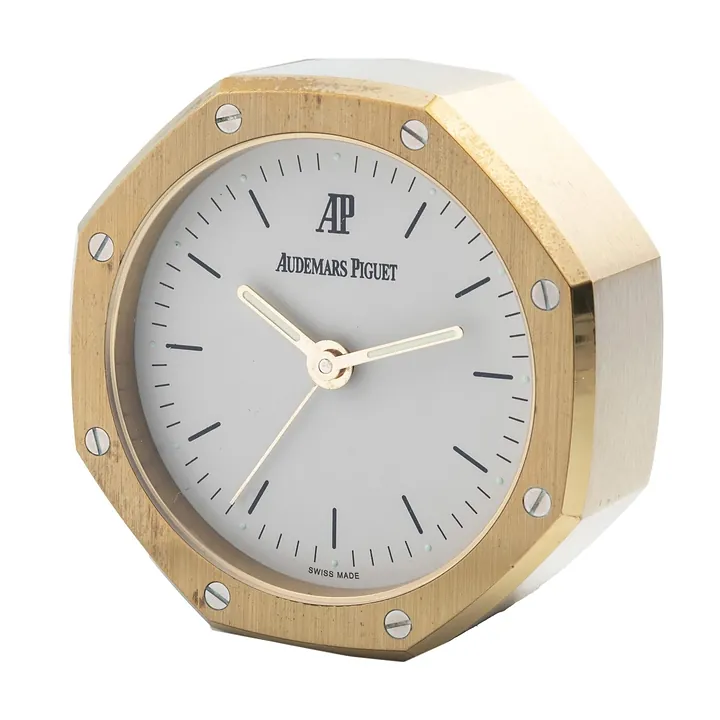
Audemars Piguet Royal Oak, c. 1990s
Antiquorum auction archive, Geneva
Pocket Watches · c. 1960
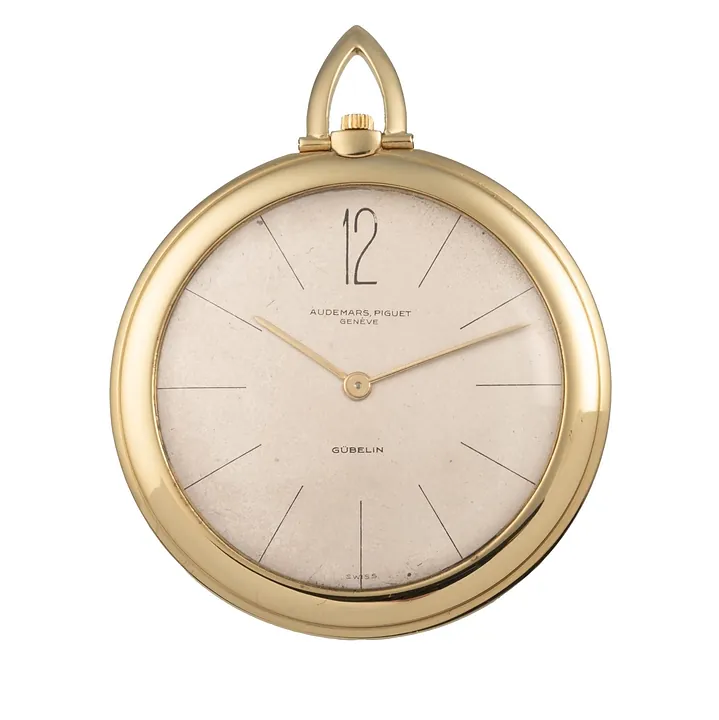
Audemars Piguet ''couteau'', c. 1960
Antiquorum auction archive, Geneva
Pocket Watches · originally sold in November 1961 (per the lot record)
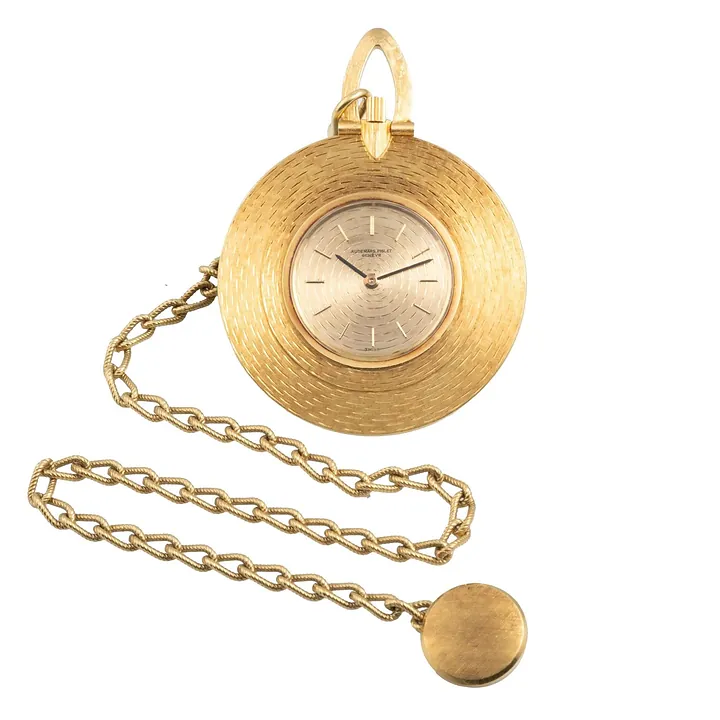
Audemars Piguet "extra Plate", ref. 5633 BA, originally sold in November 1961
Antiquorum auction archive, Geneva
Pocket Watches · c. 1980
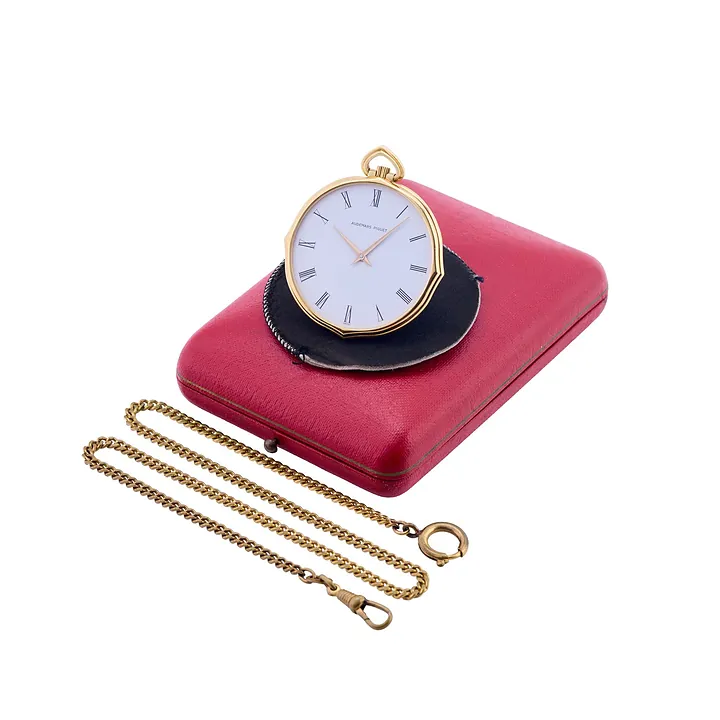
Audemars Piguet pocket watch, c. 1980
Antiquorum auction archive, Geneva

Wristwatches · 1945
Wristwatch by Eterna, 1945
Museum Rotterdam

Wristwatches · c. 1945
Breitling Premier, ref. 790, c. 1945
Antiquorum auction archive, Geneva

Wristwatches · c. 1945
Universal Genève Uni-Compax, ref. 22492, c. 1945
Antiquorum auction archive, Geneva

Wristwatches · c. 1950s
Baume & Mercier wristwatch, c. 1950s
Antiquorum auction archive, Geneva