
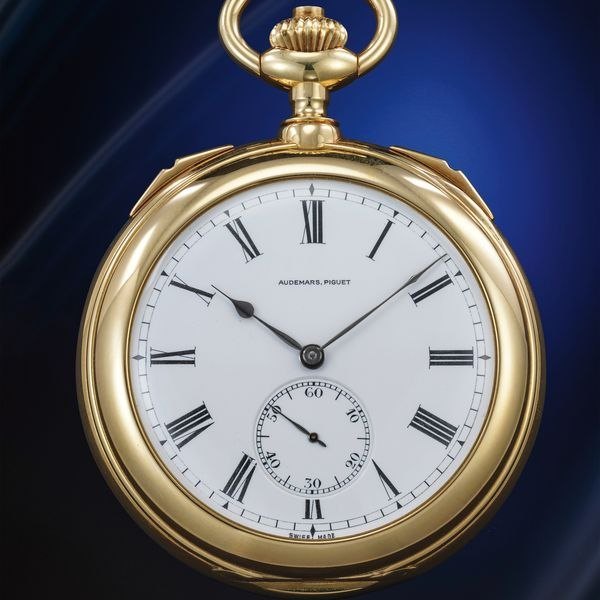
Pocket Watches · Open face grande and petite sonnerie minute repeating pocket watch
Audemars Piguet Grande et Petite Sonnerie Pocket Watch No.1 by Philippe Dufour
- Maker / attribution
- Philippe Dufour for Audemars Piguet (source attribution)
- Date
- 1982
- Historical period
- Quartz Revolution (1969 – 1990)
- Country of origin
- Switzerland
- Object type
- Open face grande and petite sonnerie minute repeating pocket watch
- Holding institution
- PHILLIPS
- Accession / object no.
- 127
- Credit line
- PHILLIPS
- Catalogue title (original)
- A Technical Overview Of Philippe Dufour's First Pocket Watch (English)
View the source record ↗ (opens another website in a new tab)Suggest a correction
Record summary
Held and catalogued by PHILLIPS (object number 127), this is an open face grande and petite sonnerie minute repeating pocket watch attributed to Philippe Dufour for Audemars Piguet, made in Switzerland, dated 1982. The Atlas places it in the Quartz Revolution period (1969 – 1990) of its Pocket Watches collection. The record is illustrated with 1 photograph.
Assembled from the source record's structured fields. Dates and attributions are given as the source states them; where a field is missing the Atlas leaves it blank rather than estimating.
Catalogue description
Original object description
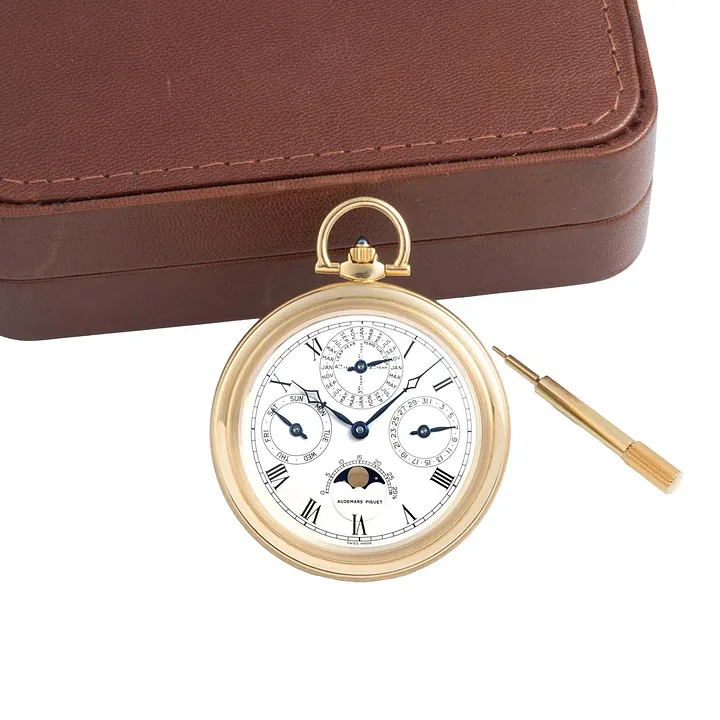
Representing the premiere commercial pocket watch constructed by master horologist Philippe Dufour, this 18k yellow gold open-face timepiece was completed in 1982 and retailed via Asprey London. It stands as the premier entry in a five-piece series commissioned by Audemars Piguet, distinguished as the only one bearing Dufour's name engraved upon a dial-side plate, accompanied by the "AUDEMARS PIGUET" signature across the dial. The 61 mm case incorporates an oval bow, a fluted winding crown, an engraved inner cuvette, and two slide levers set into the band for operating the silence setting, sonnerie functions, and minute repeater. Timekeeping and striking mechanisms—sounding grande and petite sonneries on twin gongs regulated by a built-in governor—are driven by two separate barrels and gear trains within the hand-wound movement. Decorative hand-finishing spans anglage, Côtes de Genève striping, an L-shaped bridge, and intricate inner and outer beveled edges. The fired white enamel dial displays fine Roman numerals, a peripheral minutes track, blued spade hands, and a sunken sub-seconds dial positioned at 6 o'clock.
Inscriptions & marks
No. 1
Historical context
Quartz Revolution (1969 – 1990)
Seiko's Astron begins mass quartz timekeeping; traditional industries contract sharply.
Quartz pocket watches and inexpensive novelty watches appeared, while traditional mechanical pocket watches survived mainly as collectibles and gifts.
Read the period in the timelineMore pocket watches from this periodEarlier: Modern Mechanical Horology
Atlas type guide
Repeating watches
Before electric light, telling the time in the dark was a real problem. Repeating watches strike the time on demand when a slide or push-piece is operated: quarter repeaters sound hours and quarters, minute repeaters hours, quarters and minutes. Edward Barlow and Daniel Quare disputed the invention in London in the 1680s. Early repeaters struck on a bell inside the case; Abraham-Louis Breguet introduced the gong (a coiled steel wire) around 1780, allowing thinner watches.
Repeaters require a separate train with racks, snails and a governor to control the striking speed, and are among the most demanding complications to make and adjust. Swiss makers of the Vallée de Joux specialised in repeating ébauches in the nineteenth century.
What to look for
- A slide on the case band or a push-piece through the pendant.
- Gongs encircling the movement (after c. 1780) or a bell in the case (earlier); pierced case for sound.
- The racks, snails and governor visible under the dial or on the movement.
- Terms such as 'Minutes', 'Quarts' or 'Répétition' on the dial or cuvette.
Dating clues
- Bell-striking quarter repeaters: c. 1690–1800.
- Gong repeaters and dumb repeaters (striking on the case): after c. 1780.
- Minute repeaters became more common after c. 1830 with Vallée de Joux ébauches.
General guidance written by the Atlas editors about this kind of object. It is not a statement about this particular piece; for that, rely on the source record above and on physical examination.
Read next:Minute repeater
Related records
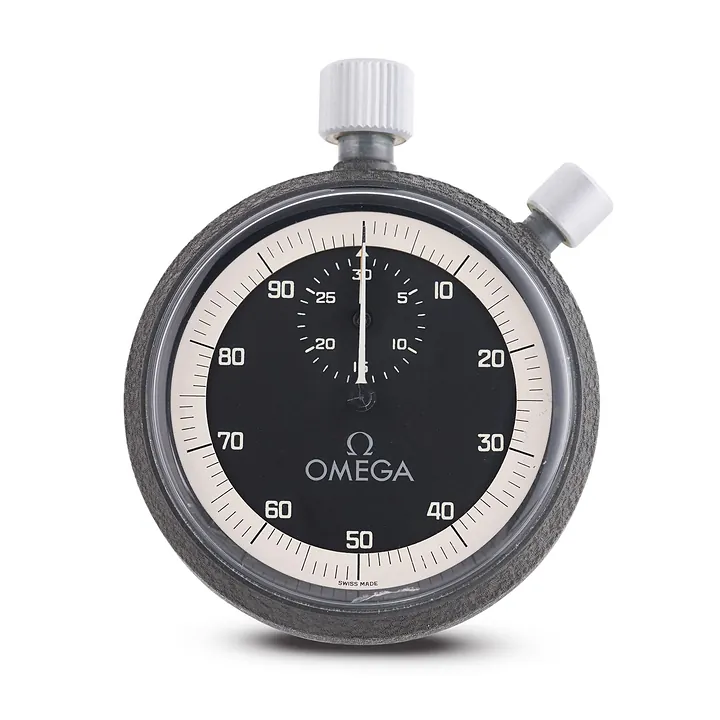
Pocket Watches · c. 1970s
Omega Stop Watch, c. 1970s
Antiquorum auction archive, Geneva
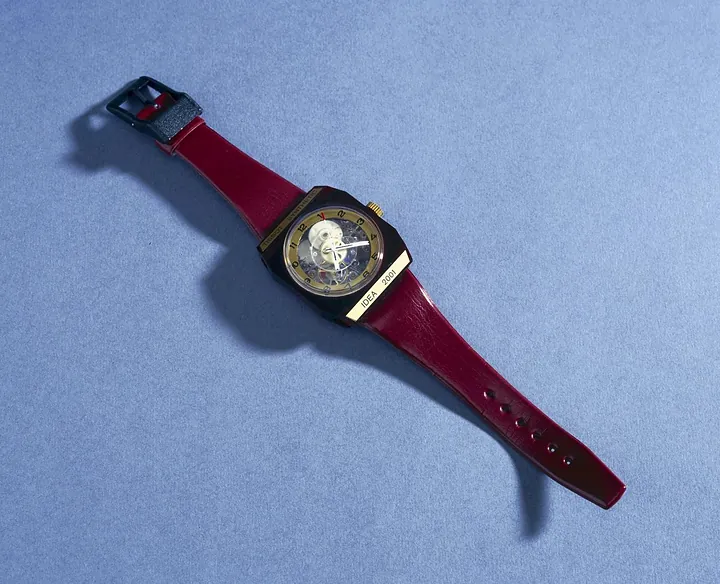
Pocket Watches · 1971–2001
"Tissot synthetic idea 2001" the first plastic watch, introduced in 1971
Science Museum Group, London
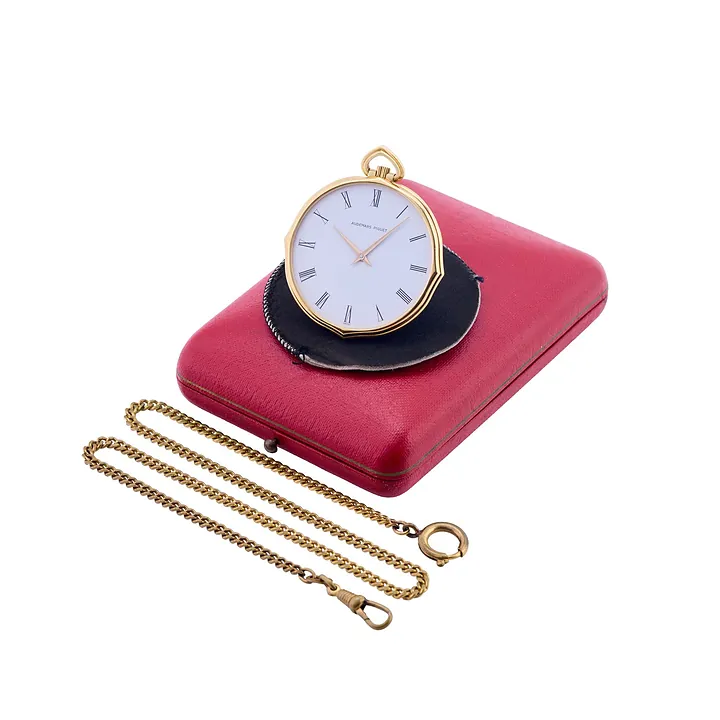
Pocket Watches · c. 1980
Audemars Piguet pocket watch, c. 1980
Antiquorum auction archive, Geneva
Pocket Watches · 1980s
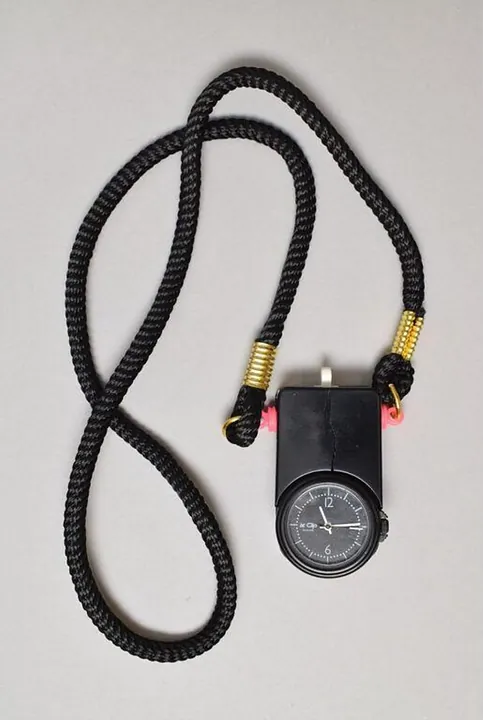
Clip-on plastic watch with cord, made in Switzerland, 1980s
Victoria and Albert Museum, London
Pocket Watches · c. 1980
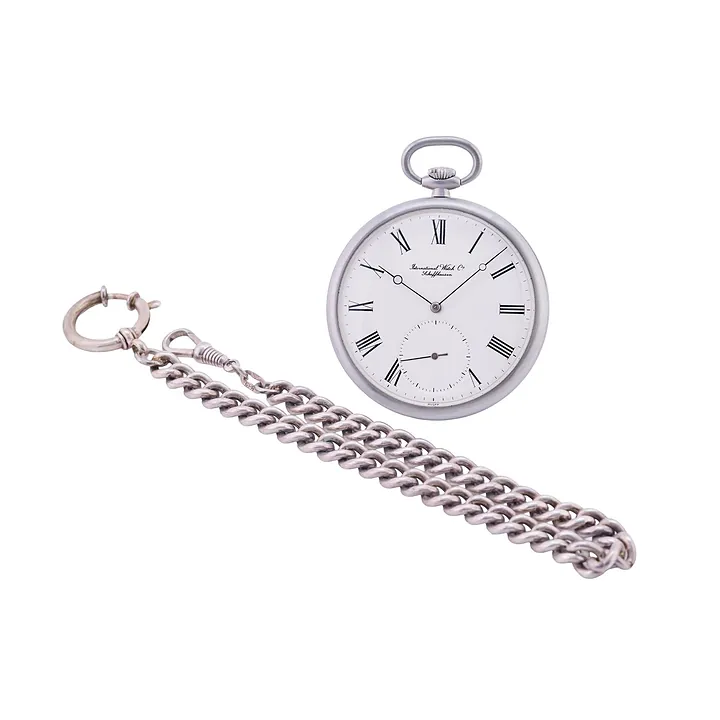
IWC pocket watch, ref. 5301, c. 1980
Antiquorum auction archive, Geneva
Pocket Watches · c. 1980s
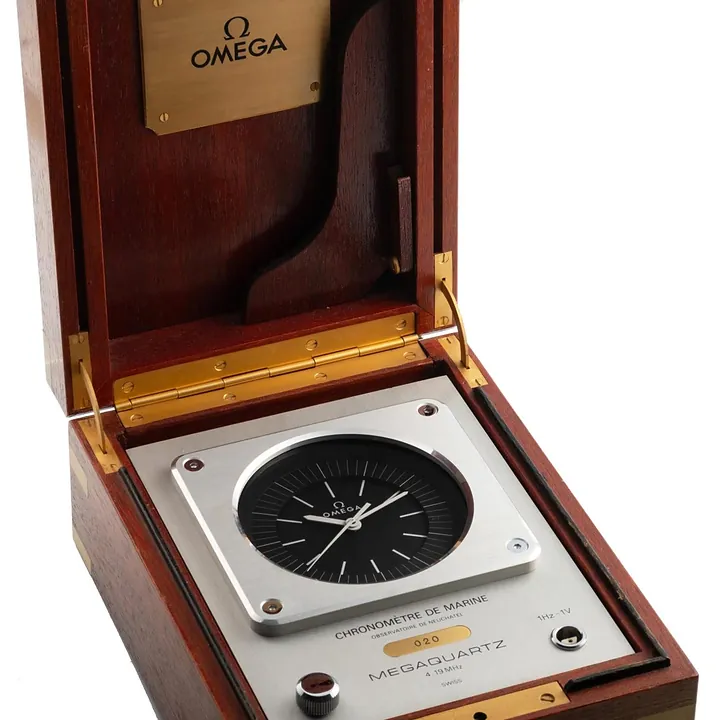
Omega Chronometre de Marine Megaquartz, ref. PE 5806, c. 1980s
Antiquorum auction archive, Geneva
Pocket Watches · c. 1980
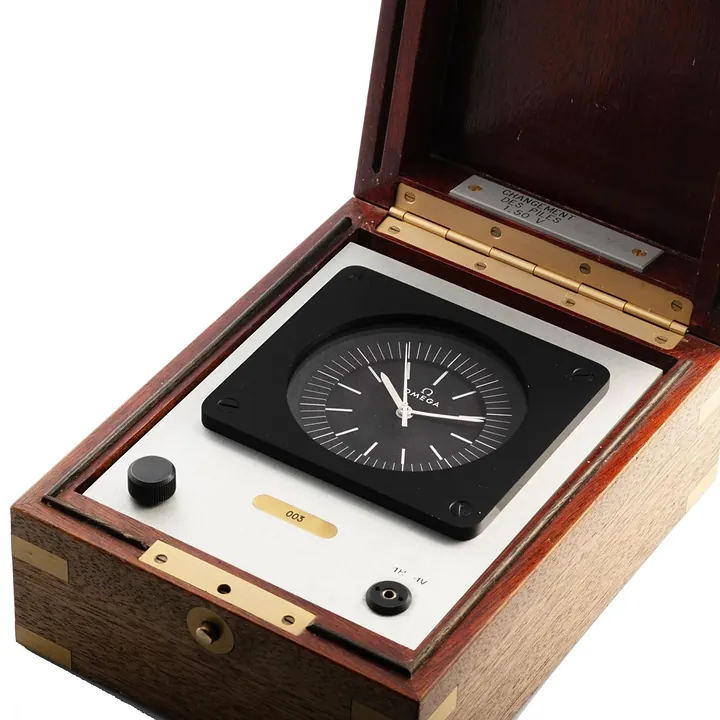
Omega Marine Chronometer Megaquartz, ref. PE 5806, c. 1980
Antiquorum auction archive, Geneva
Pocket Watches · c. 1985
Audemars Piguet pocket watch, ref. BA5555, c. 1985
Antiquorum auction archive, Geneva