
Wristwatches · Wristwatch
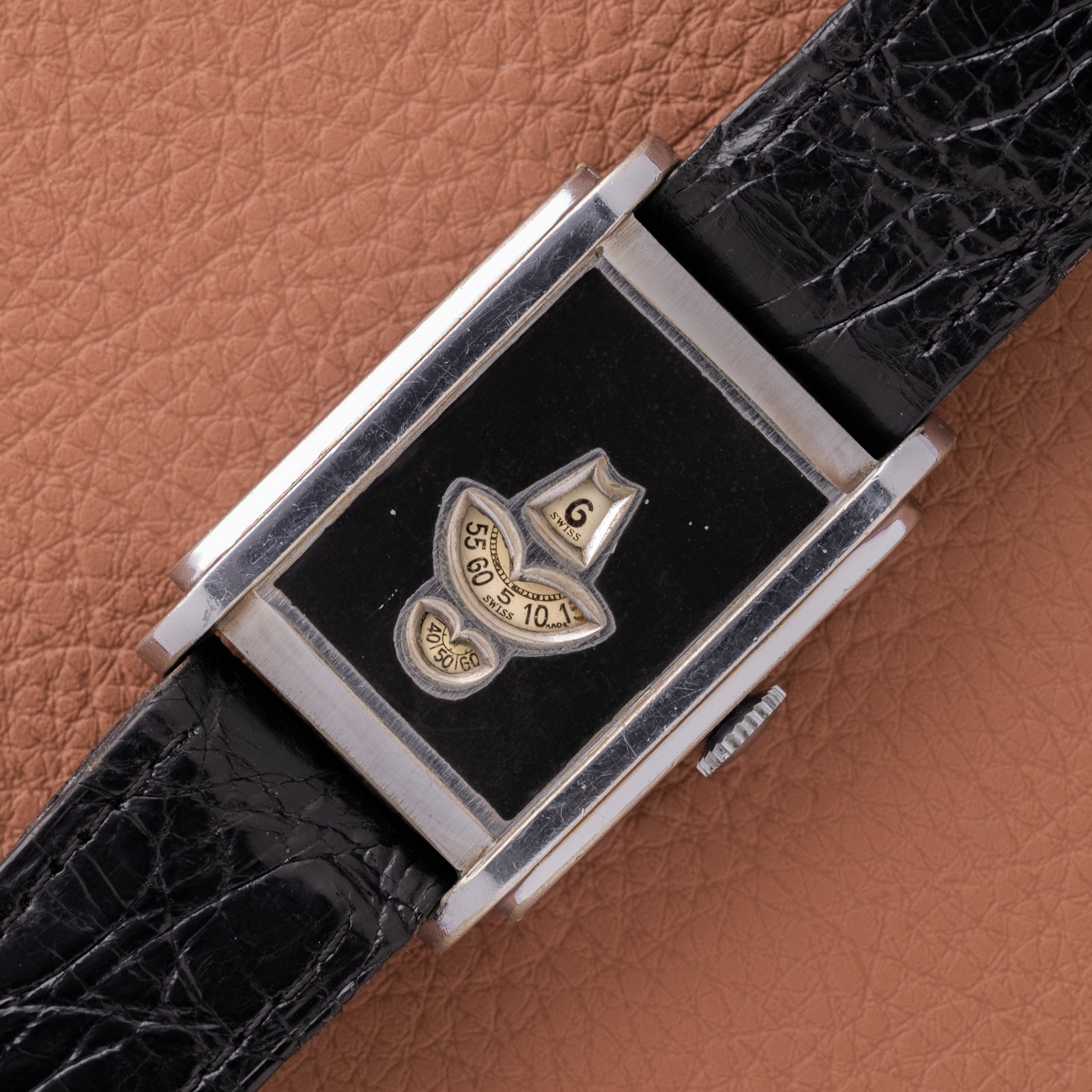
Anonymous Swiss Jump Hour Black Lacquer Case (Ref. 1775), 1930s
- Maker / attribution
- Unrecorded in source
- Date
- 1930s
- Historical period
- Golden Age of Mechanical Watchmaking (1900 – 1945)
- Country of origin
- Switzerland
- Object type
- Wristwatch
- Dimensions
- Case 25 mm
- Stock no.
- Product 8817256595639
- Credit line
- Dealer listing, Huntington Company (product 8817256595639)
- Catalogue title (original)
- 1930s Anonymous Swiss Jump Hour Black Lacquer Case (Ref. 1775) (English)
View the source record (dealer listing) ↗ (opens another website in a new tab)Suggest a correction
Record summary
Catalogued by Huntington Company (dealer) (stock number Product 8817256595639), this is a wristwatch, made in Switzerland, dated 1930s. The Atlas places it in the Golden Age of Mechanical Watchmaking period (1900 – 1945) of its Wristwatches collection. Recorded dimensions: Case 25 mm. The record is illustrated with 6 photographs.
Assembled from the source record's structured fields. Dates and attributions are given as the source states them; where a field is missing the Atlas leaves it blank rather than estimating.
Catalogue description
Dealer description — Huntington Company
History and Significance Few vintage watches are more interesting than the ones that arrive with a mystery attached. This 1930s Swiss jump hour has spent decades associated with Rolex, including an auction appearance in 1989 where it was cataloged as a Rolex reference 1775. The case is engraved 1775, and an interior RWCo marking has also helped fuel that attribution. Those details make the Rolex connection understandable, but they do not make it definitive. The problem is that the evidence becomes less convincing once the watch is examined beyond those markings. There is no confirmation that Rolex produced a reference 1775 jump hour in this configuration, and there is similarly no established evidence connecting Rolex to nickel-plated cases of this type. Most importantly, the movement itself is unsigned. Although RWCo can immediately bring Rolex Watch Co. to mind, initials alone are not enough to establish authorship, particularly during an era populated by countless small Swiss manufacturers, assemblers, and case makers. A more conservative interpretation is that RWCo belonged to another manufacturer whose history has largely disappeared. Countless Swiss watch companies operated during the first half of the twentieth century, and many left behind little documentation after closing. That possibility is less glamorous than assigning a Rolex signature to the watch, but it also makes the object more intriguing. The surviving watch becomes evidence of a company and period that may no longer have a neat historical record. The watch itself hardly needs the Rolex attribution to be compelling. Jumping-hour displays were a wonderfully unconventional expression of Art Deco watchmaking, replacing traditional hour hands with a numerical aperture and turning the act of telling time into something mechanical and graphic. The elongated case suits that approach beautifully, while the black lacquer inlay across the top surface adds a decorative element that immediately situates it within the period's design language. At 25mm by 38mm, the proportions give the watch substantial presence despite its narrow width. Most importantly, the mystery has followed this particular watch for decades. Its 1989 auction appearance as a Rolex reference 1775 demonstrates that the attribution is not a recent attempt to manufacture a story around an anonymous watch. Whether that earlier identification was based on lost information or simply the same RWCo and 1775 markings remains impossible to establish from the available evidence. What survives today is a beautifully unusual Swiss jump hour with a genuinely fascinating history, recently serviced and running properly, with enough unanswered questions to make it more interesting rather than less. Writer’s Thoughts The best way to approach this watch is to resist the temptation to make the story cleaner than the evidence allows. Calling it a Rolex would certainly make the headline more exciting, but the uncertainty is actually the most compelling part. The reference 1775 engraving, RWCo marking, and 1989 auction attribution provide legitimate grounds for the historical association, while the unsigned movement and lack of corroborating Rolex documentation provide equally valid grounds for caution. That tension gives the watch a story that another definitively signed example simply would not have. The design is strong enough to stand entirely on its own. The jumping-hour display, long Art Deco case, and black lacquer inlay create an object that feels much more architectural than a conventional 1930s wristwatch. The fresh service makes the mechanical side of the experience equally satisfying. Rolex or not, this is an impressive surviving Swiss jump hour from an era when watchmakers were willing to experiment with how a wristwatch could look and display time. Our Promise Every watch is thoroughly vetted, carefully described with complete transparency, and guaranteed authentic. Each piece is offered in honest condition, ensuring collectors receive a timepiece that reflects both originality and integrity. Specifications Brand: Anonymous Swiss Model: Jump Hour Reference: 1775 case engraving, attribution unconfirmed Year: 1930s Case Material: Nickel-plated Case Size: 25mm x 38mm Dial: Three-disk jump-hour display with black lacquer case inlay on case Movement: Unsigned Swiss manual-wind jump-hour movement, recently serviced Strap/Buckle: Generic leather strap Buckle/Clasp: Generic buckle Contents: Watch only Condition Case: Nickel-plated case presents with visible wear, aging, and surface marks consistent with its age. The distinctive black lacquer inlay remains present and gives the case much of its Art Deco character. Dial: Jump-hour display has three rotating disks that present attractively with visible aging consistent with a 1930s watch. Hands: Hands present with age and wear consistent with the watch. Crystal: Crystal presents well overall with surface wear consistent with age and use. Strap/Buckle: Generic leather strap presents well and is suitable for continued wear. Buckle/Clasp: Generic buckle presents well with light signs of use.
Historical context
Golden Age of Mechanical Watchmaking (1900 – 1945)
The wristwatch displaces the pocket watch; waterproof cases, self-winding and grand complications.
The wristwatch overtook the pocket watch. Military use in the First World War, aviation, water-resistant cases (1926), automatic winding (1923–31), rectangular Art Deco designs and early chronographs and calendars defined the period.
Read the period in the timelineMore wristwatches from this periodEarlier: Industrial Revolution
Atlas type guide
Wristwatches
Bracelet watches were worn by women from the early nineteenth century — Breguet made one for Caroline Murat, Queen of Naples, in 1810–12 — but the wristwatch only became a man's instrument with military use and aviation in the early twentieth century. Between the World Wars it overtook the pocket watch; the 1920s and 1930s brought rectangular Art Deco cases, water-resistant cases and the first automatic winding systems.
After 1945 the wristwatch became a carrier of identity — dress watches, sports and dive watches, chronographs, calendars — produced by Swiss, American, Japanese, German, Soviet and Chinese industries. The quartz revolution after 1969 and the mechanical renaissance since the 1990s, including the rise of independent watchmakers, complete the story.
What to look for
- The reference number (between the lugs or inside the case back) and serial number, the starting point for dating.
- The calibre: its maker and number are often stamped under the dial or on the bridge.
- Originality of dial, hands and crown — refinished ('redial') dials are common.
- Case material marks: 18K/750, 14K/585, stainless steel, gold-filled, plated.
Dating clues
- Wire-lug cases: before c. 1925.
- Water-resistant screw-down cases: from 1926.
- Quartz movements: from 1969; sapphire crystals widespread after c. 1980.
General guidance written by the Atlas editors about this kind of object. It is not a statement about this particular piece; for that, rely on the source record above and on physical examination.
Related records

Wristwatches · 1931
Rolex 'Oyster Perpetual' rotor self-winding wrist-watch, lever escapement, in steel case with glass in back, Montres Rolex SA, Geneva, Switzerland, 1931
Science Museum Group, London

Wristwatches · 1900–1999
Wristwatch by Certina, Switzerland, 1900–1999
Nordic Museum Foundation
Wristwatches · 1900–1999
Wristwatch by Omega, Västerås, 1900–1999
Nordic Museum Foundation
Wristwatches · 1900–1999
Wristwatch by Universal, Switzerland, 1900–1999
Nordic Museum Foundation
Wristwatches · c. 1900
Wristwatch, probably Switzerland, c. 1900 (no. 57124)
German Clock Museum
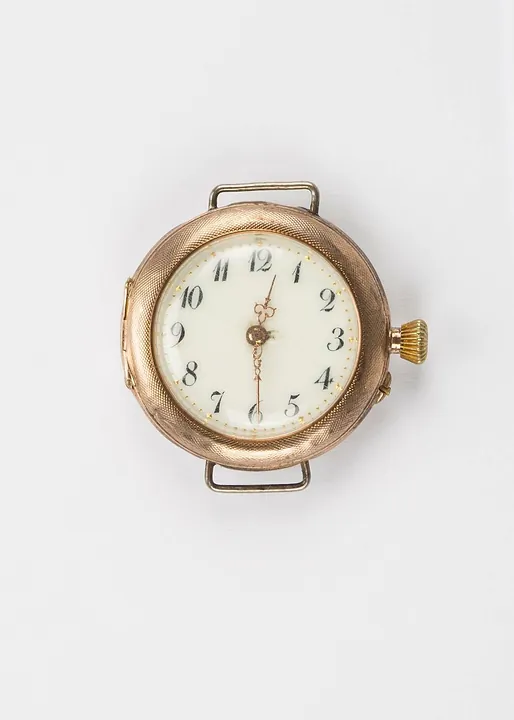
Wristwatches · c. 1900
Wristwatch, probably Switzerland, c. 1900 (no. 57216)
German Clock Museum
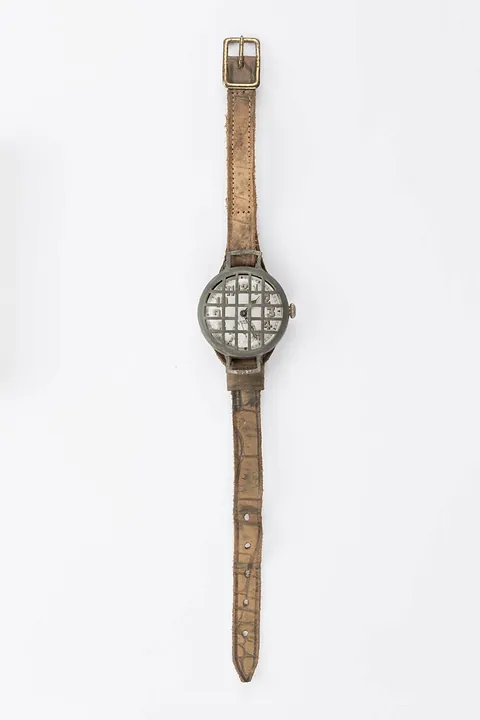
Wristwatches · c. 1915
Wristwatch by S.S.und Co., Stauffer, Son und Co., Switzerland, c. 1915
German Clock Museum
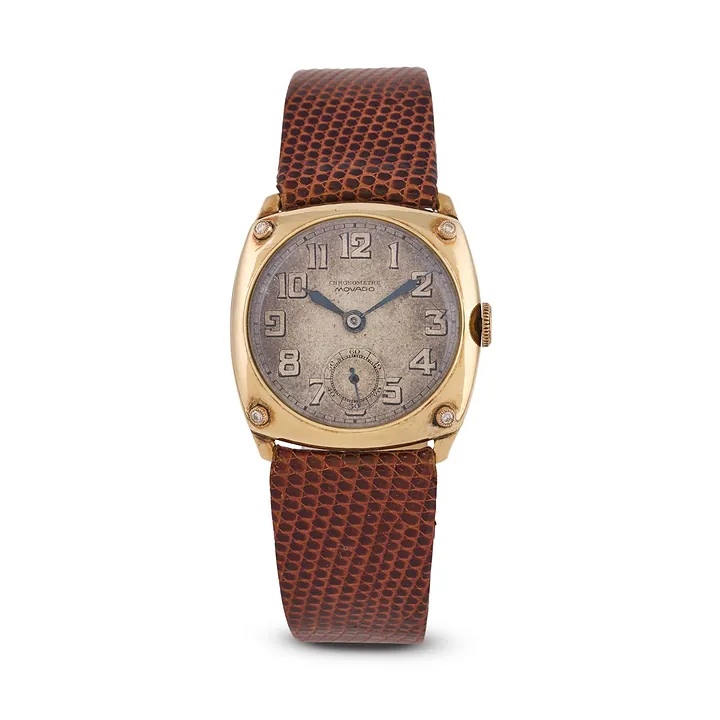
Wristwatches · c. 1920s
Movado Chronometre, ref. 41536, c. 1920s
Antiquorum auction archive, Geneva