Clocks · Alarm table-clock
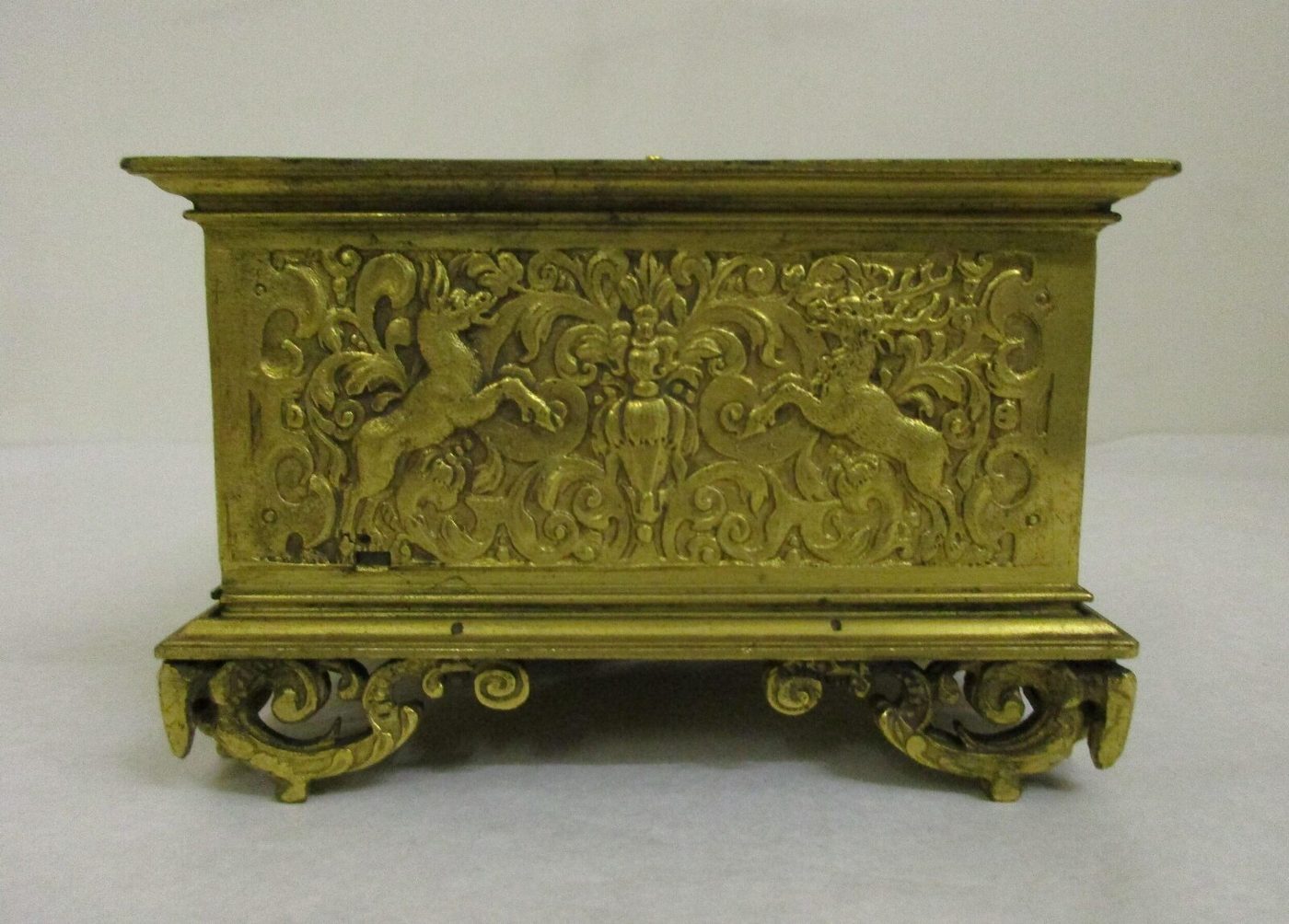
Alarm Table-Clock, German, late 16th century.
- Maker / attribution
- Unrecorded in source
- Date
- 1575-1600
- Historical period
- Renaissance Horology (1400 – 1600)
- Country of origin
- Germany
- Place
- Germany
- Object type
- Alarm table-clock
- Materials / technique
- Brass case, brass fusee, iron great wheel.
- Dimensions
- Width: 11.7 cm; Height: 7.6 cm; :
- Holding institution
- Victoria and Albert Museum, London
- Accession / object no.
- M.174-1938
- Credit line
- Given by W.E.Miller FSA
Record summary
Held and catalogued by Victoria and Albert Museum, London (object number M.174-1938), this is an alarm table-clock, made in Germany, dated 1575-1600. The Atlas places it in the Renaissance Horology period (1400 – 1600) of its Clocks collection. Materials and techniques recorded by the source: Brass case, brass fusee, iron great wheel. Recorded dimensions: Width: 11.7 cm; Height: 7.6 cm; :. The record is illustrated with 3 photographs.
Assembled from the source record's structured fields. Dates and attributions are given as the source states them; where a field is missing the Atlas leaves it blank rather than estimating.
Catalogue description
V&A — Summary
A gilt brass alarm table clock engraved with fruit and strapwork, with a maker's mark AM W stamped in a cartouche on the bottom plate, German, 17th century and later
V&A — Physical description
Case: Brass case of square plan, supported on four two-sided feet of cast scrollwork and decorated on each side with a panel cast in relief with a stag and a griffin rampant confronting on a field of arabesques. The spandrels formed by the square top of the caseand the dial are filled with engraved masks; a ring of engraved strapwork with fruit separates the timer from the alarm dial which is itself decorated with two faces amidst strap-work. Dial: Horizontal dial, with engraved chapter ring 10.2 cm diameter with Roman hours and half- and quarter-hour marks and pegs for night reading. Central rotating alarm dial 5.1 cm diameter with hours in arabic numerals. Rectangular hole outside X1/2 for inspecting the count-wheel. The spandrels include chased masks, and a ring of engraved strapwork with fruit lies between the chapter-ring and the alarm disc, which is itself decorated with two masks amidst strapwork. Movement: Movement plates 10.2 cm square. Movement plates, pillars, and spring barrels of brass. Going train with brass fusee and wheels (except the great wheel, which is of iron). Verge escapement, brass balance-wheel, probably a renewal, and now with a steel balance-spring and regulator of Tompion type. Formerly with a bristle regulator, but this now removed. Pierced balance-cock. Locking-plate striking train, with resting-barrel, decoratively pierced detent, brass count-wheel and fanfly, the remaining wheels of iron. The count-wheel co-axial withe the great wheel of this train, and outside the backplate. The works are engraved with two openwork dolphins. The alarm train now entirely missing. The movement bottom-plate signed in a very small escutcheon "AM W".
V&A — Object history
This is one of group of fourteen sun dials and clocks given by W.E.Miller in 1938
V&A — Production note
Nuremberg and Augsburg, renowned for their metalworking industries, became centres for clock and watchmaking in the 17th century. By 1620 there were forty master clockmakers in Augsburg and their reputation was acknowledged accross Europe, with time-pieces exported to distant foreign markets. The Italian Garzoni wrote ' a great number of German craftsmen excel in the art of horology and all the best and most precise timekeepers actually come from Germany'.Garzoni, T , La Piazza Universale di tutte le professioni del mondo , Venice, 1595 'Tuching manuall arts, the Dutch are a people more industrious then the Garmans and excell them in all arts and trades...howsoever I must confesse that the Germans of Nuremberg in those parts are esteemed the best workman for clockes and some like thinges' Fynes Moryson, Itinerary , ed. C.Hughes, London, 1903 Both quoted in Carlo M.Cipolla, Clocks and Culture, 1300-1700 , 1967, p.62.
Inscriptions & marks
AM W
Historical context
Renaissance Horology (1400 – 1600)
Spring power makes clocks portable; Nuremberg and Augsburg produce the first watches; the Prague Orloj is built.
Spring power made the domestic clock portable. Augsburg and Nuremberg produced gilt-brass table clocks, often with astronomical dials and alarms; weight-driven Gothic wall clocks and English lantern clocks served households. Clocks of this period have foliot or balance-wheel control and usually only an hour hand.
Read the period in the timelineMore clocks from this periodEarlier: Medieval Period
Atlas type guide
Bracket, table and spring-driven clocks
Spring-driven clocks freed timekeeping from the hanging weight. The coiled mainspring, documented from the fifteenth century, made portable table clocks possible; to even out its declining force, makers used the fusee, a conical pulley connected to the barrel by a gut line or chain. Renaissance table clocks from Augsburg and Nuremberg — drum-shaped, square or tower-shaped in gilt brass — were luxury scientific objects, often with astronomical dials and alarms.
After the pendulum, English makers developed the bracket clock: a wooden case with a carrying handle, a short pendulum with a verge escapement, and often repeating work to sound the hours on demand at night. Later examples use the anchor escapement. In the nineteenth century, 'table clock' became a broad term for spring clocks of every nationality.
What to look for
- A fusee in the movement (cone-shaped pulley) and the type of line — gut or chain.
- Verge escapement with a short bob pendulum, often with a decoratively engraved backplate.
- Repeat cords or buttons that make the clock strike again on demand.
- Gilt-brass engraved cases and horizontal dials on Renaissance pieces.
- Case shapes: inverted bell, bell top, break-arch, lancet or balloon.
Dating clues
- Drum and tower table clocks: c. 1520–1650.
- Ebony veneered English bracket clocks with verge escapements: c. 1670–1800.
- Engraved backplates were usual on English clocks until c. 1800, then generally plain.
General guidance written by the Atlas editors about this kind of object. It is not a statement about this particular piece; for that, rely on the source record above and on physical examination.
Read next:Anchor (recoil) escapement
Related records
Clocks · 1400–1499
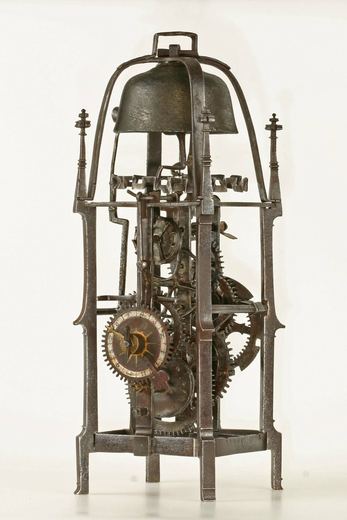
Alarm clock, Germany, 1400–1499
German Clock Museum
Clocks · 1400-1499
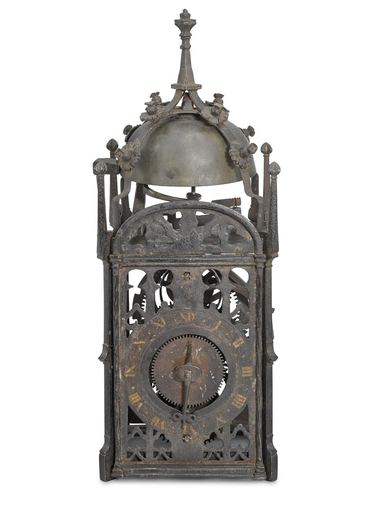
Lantern clock, Germany, 1400-1499
Science Museum Group, London
Clocks · 1500–1599
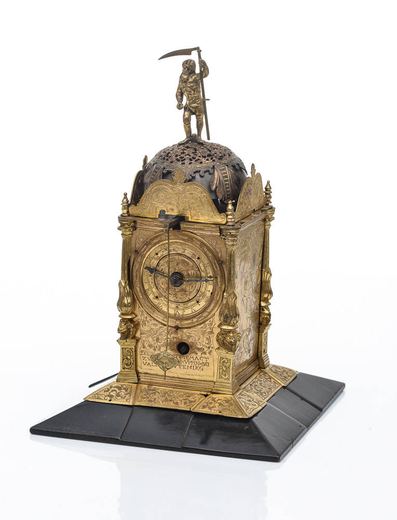
Table clock by Rutenieg, Valentin (um 1550) (Uhrmacher), Germany, 1500–1599
City Museum Berlin
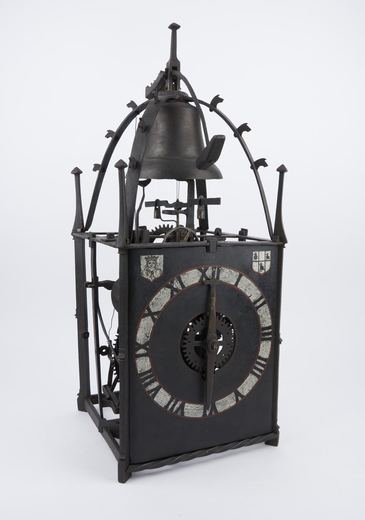
Clocks · 1501-1600
German 16th century iron chamber clock
Science Museum Group, London
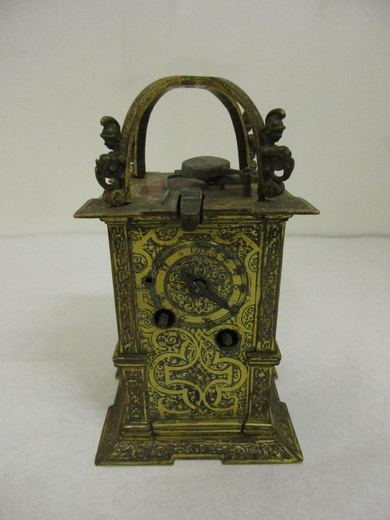
Clocks · ca.1550
Clock, a striking alarm clock in a gilt brass case, Germany, ca.1550.
Victoria and Albert Museum, London
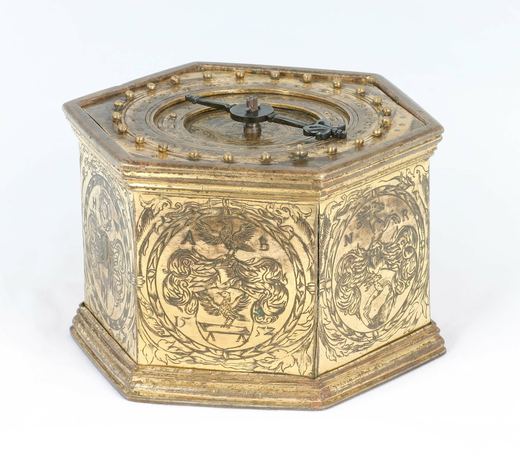
Clocks · 1552
Carriage / travel clock, Germany, 1552
German Clock Museum
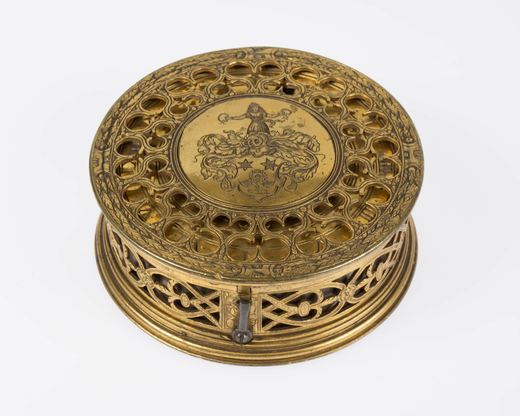
Clocks · 1560
Carriage / travel clock by HG, Germany, 1560
German Clock Museum
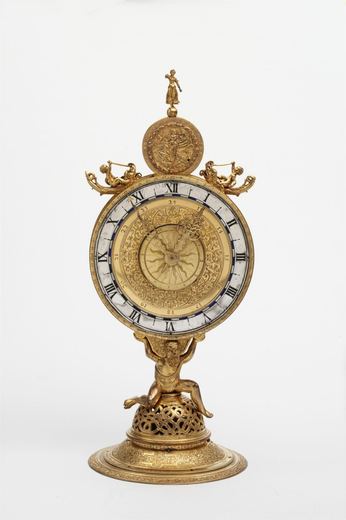
Clocks · 1564
Clock, gilt brass with enamelled silver dial ring, signed by Jeremias Metzger, Augsburg, southern Germany, dated 1564
Victoria and Albert Museum, London