
Wristwatches · Wristwatch
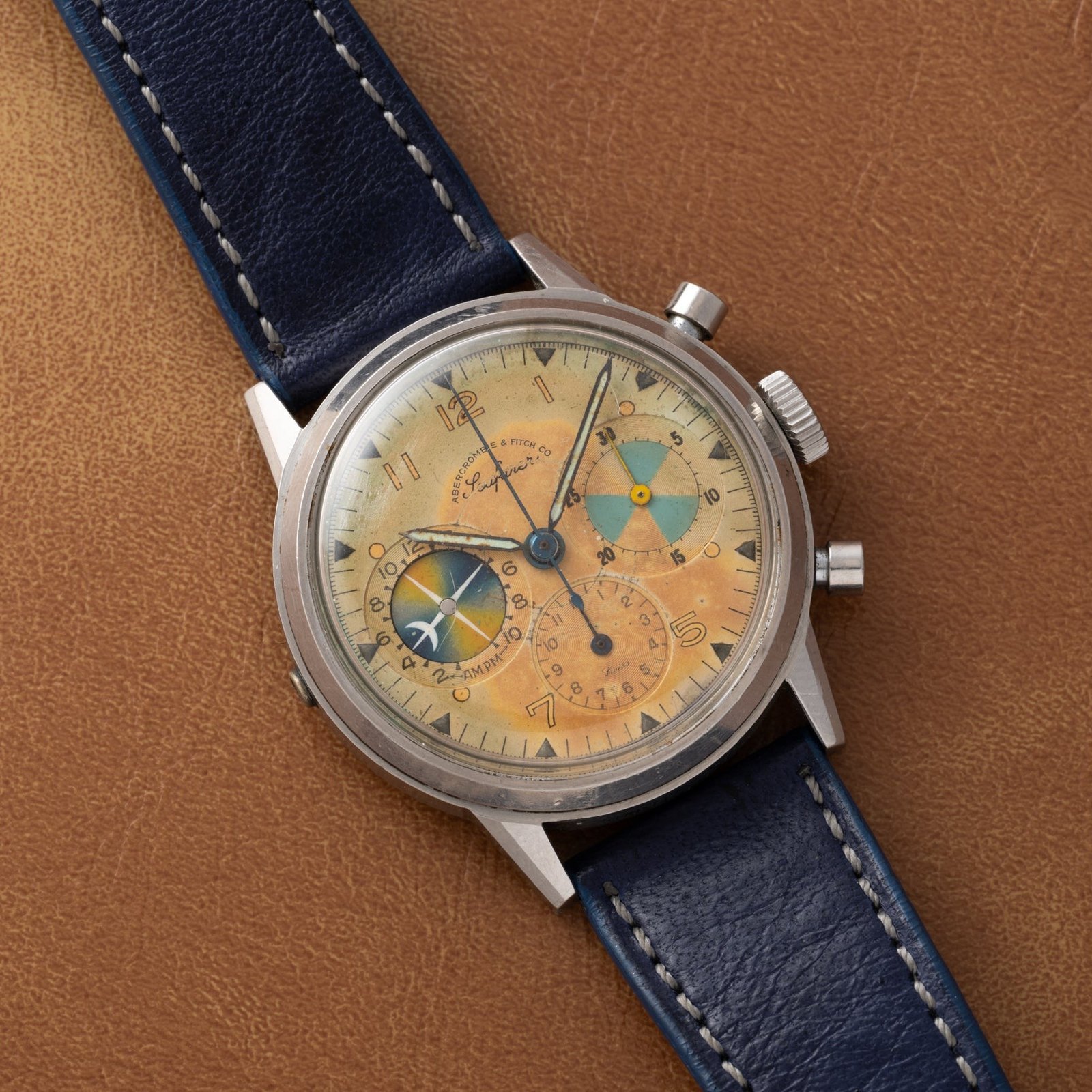
Abercrombie & Fitch Seafarer 'MKII', c. 1950s
- Maker / attribution
- Heuer (maker)
- Date
- c. 1950s
- Historical period
- Modern Mechanical Horology (1945 – 1969)
- Country of origin
- Switzerland
- Object type
- Wristwatch
- Dimensions
- Case 38 mm
- Stock no.
- 40991369
- Credit line
- Dealer listing, Analog/Shift (40991369)
- Catalogue title (original)
- Abercrombie & Fitch Seafarer 'MKII' (English)
View the source record (dealer listing) ↗ (opens another website in a new tab)Suggest a correction
Record summary
Catalogued by Analog/Shift (dealer), New York (stock number 40991369), this is a wristwatch by Heuer, made in Switzerland, dated c. 1950s. The Atlas places it in the Modern Mechanical Horology period (1945 – 1969) of its Wristwatches collection. Recorded dimensions: Case 38 mm. The record is illustrated with 6 photographs.
Assembled from the source record's structured fields. Dates and attributions are given as the source states them; where a field is missing the Atlas leaves it blank rather than estimating.
Catalogue description
Dealer description — Analog/Shift
Founder's Select Few watches capture the whimsy of timekeeping like a tidal indicator - and few retailers capture the imagination of vintage collectors like Abercrombie & Fitch. Combine these ingredients, add a dash of jaw-dropping patina, garnish with an unpolished case, and presto: ready to serve up, red hot! James Lamdin In life, there are no constants but time and the tides, and no one feels the relationship between time and tide more than fishermen. While publications like the Farmers’ Almanac have long attempted to give fishermen insight into the best time to fish, the results have been mixed. And watch companies, eager to dive into the post-war sporting boom of the late 1940s and early 1950s, sought to develop a watch that would be the definitive sportsman’s tool. Such is the case of this watch, the Seafarer, and its time-only ancestor, the Solunar. The timepiece that resulted from that inquiry, the Solunar, was “the only watch in the world that tells both SOLAR (sun) time, and LUNAR (moon) time”— or so an ad ran upon its release in 1949. However, the Solunar was a niche product, and saw a limited run of just 1,000 pieces before being discontinued. However, the spirit of the Solunar would live on in the Seafarer. The tidal dial of the Solunar would be married, in true Heuer fashion, with that most versatile of complications: a chronograph. The Seafarer had the hour and minute counters of a standard chrono, but instead of running seconds, the tidal indicator was nestled comfortably in the register at 9 o’clock. First, a fisherman would set the time (or, in Heuer parlance, “Solar Time”). Then he would set the “Lunar Dial” according to tide tables using the pusher on the left side of the case until the tide markers aligned with the proper time. At midnight, the tide dial would advance. The Seafarer came in several executions, sharing cases with other chronographs from Heuer’s catalog; produced from the 1950s to the 1970s, surviving examples are relatively rare. We’ve counted ourselves lucky to find just a handful in all our years in business. This particular Seafarer, a Reference 2443 Mark II, dates to circa the 1950s, and features a smaller hour totalizer than that of its predecessor, the Reference 346. Coming in with what would have been considered an 'oversized' 38mm stainless steel case with dual barrel pushers, an acrylic crystal, an unsigned crown, and a tidal corrector at 9 o’clock, it features a beautiful, heavily patinated white dial with gold-foil 'Arabic' indices and Radium plots, a colorful 30-minute totalizer at 3 o’clock, a 12-hour totalizer at 6 o’clock, the model family’s signature tide indicator at 9 o’clock, and a later Tritium handset. Inside is a modified, hand-wound Valjoux 72 movement with a bridge signed “Abercrombie & Fitch.” Imbued with the enterprising spirit of 20th century exploration and sportsmanship, this is a true collector’s piece. Seafarers, like the Flying Dutchman , emerge so rarely on the collector circuit, and are many collectors’ white whales — catch this one before it sinks back into the deep!
Historical context
Modern Mechanical Horology (1945 – 1969)
Tool watches for divers, pilots and astronauts; electric watches anticipate the electronic age.
The classic era of the mechanical wristwatch: dive watches, chronographs for motor racing and space flight, GMT watches for jet travel, slim dress watches, automatic calendars, and the rise of Japanese manufacturers alongside Swiss, American, German and Soviet industries.
Read the period in the timelineMore wristwatches from this periodEarlier: Golden Age of Mechanical Watchmaking
Atlas type guide
Wristwatches
Bracelet watches were worn by women from the early nineteenth century — Breguet made one for Caroline Murat, Queen of Naples, in 1810–12 — but the wristwatch only became a man's instrument with military use and aviation in the early twentieth century. Between the World Wars it overtook the pocket watch; the 1920s and 1930s brought rectangular Art Deco cases, water-resistant cases and the first automatic winding systems.
After 1945 the wristwatch became a carrier of identity — dress watches, sports and dive watches, chronographs, calendars — produced by Swiss, American, Japanese, German, Soviet and Chinese industries. The quartz revolution after 1969 and the mechanical renaissance since the 1990s, including the rise of independent watchmakers, complete the story.
What to look for
- The reference number (between the lugs or inside the case back) and serial number, the starting point for dating.
- The calibre: its maker and number are often stamped under the dial or on the bridge.
- Originality of dial, hands and crown — refinished ('redial') dials are common.
- Case material marks: 18K/750, 14K/585, stainless steel, gold-filled, plated.
Dating clues
- Wire-lug cases: before c. 1925.
- Water-resistant screw-down cases: from 1926.
- Quartz movements: from 1969; sapphire crystals widespread after c. 1980.
General guidance written by the Atlas editors about this kind of object. It is not a statement about this particular piece; for that, rely on the source record above and on physical examination.
Related records
Pocket Watches · c. 1960
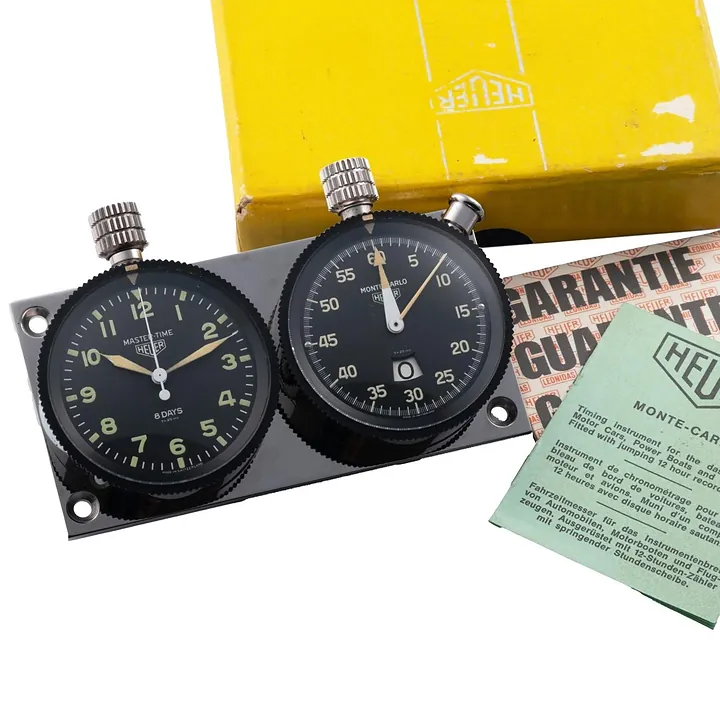
Heuer Racing SET, c. 1960
Antiquorum auction archive, Geneva
Wristwatches · c. 1980
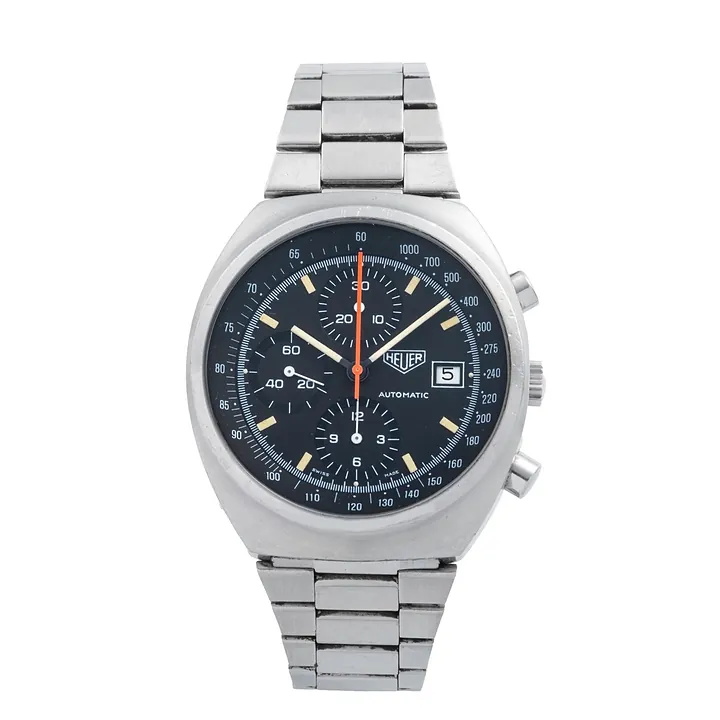
Heuer Pasadena, ref. 750.501-3, c. 1980
Antiquorum auction archive, Geneva
Wristwatches · c. 1970s
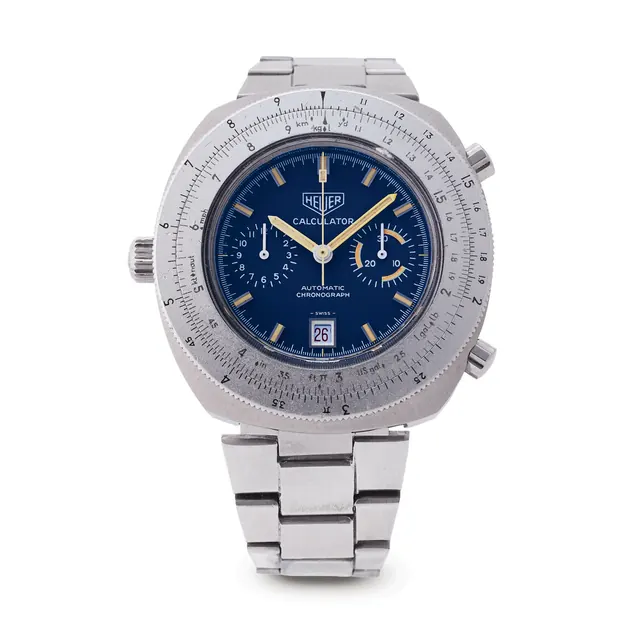
Heuer wristwatch, ref. 110.633, Calculator, circa 1970s
Antiquorum auction archive, Geneva
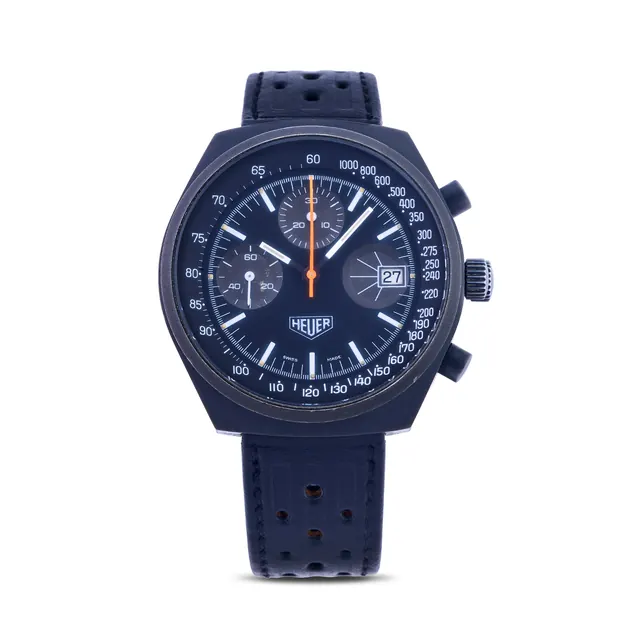
Wristwatches · c. 1975
Heuer wristwatch, ref. 13/1, circa 1975
Antiquorum auction archive, Geneva

Wristwatches · 1945
Wristwatch by Eterna, 1945
Museum Rotterdam

Wristwatches · c. 1945
Breitling Premier, ref. 790, c. 1945
Antiquorum auction archive, Geneva

Wristwatches · c. 1945
Universal Genève Uni-Compax, ref. 22492, c. 1945
Antiquorum auction archive, Geneva

Wristwatches · c. 1950s
Baume & Mercier wristwatch, c. 1950s
Antiquorum auction archive, Geneva