
Wristwatches · Wristwatch
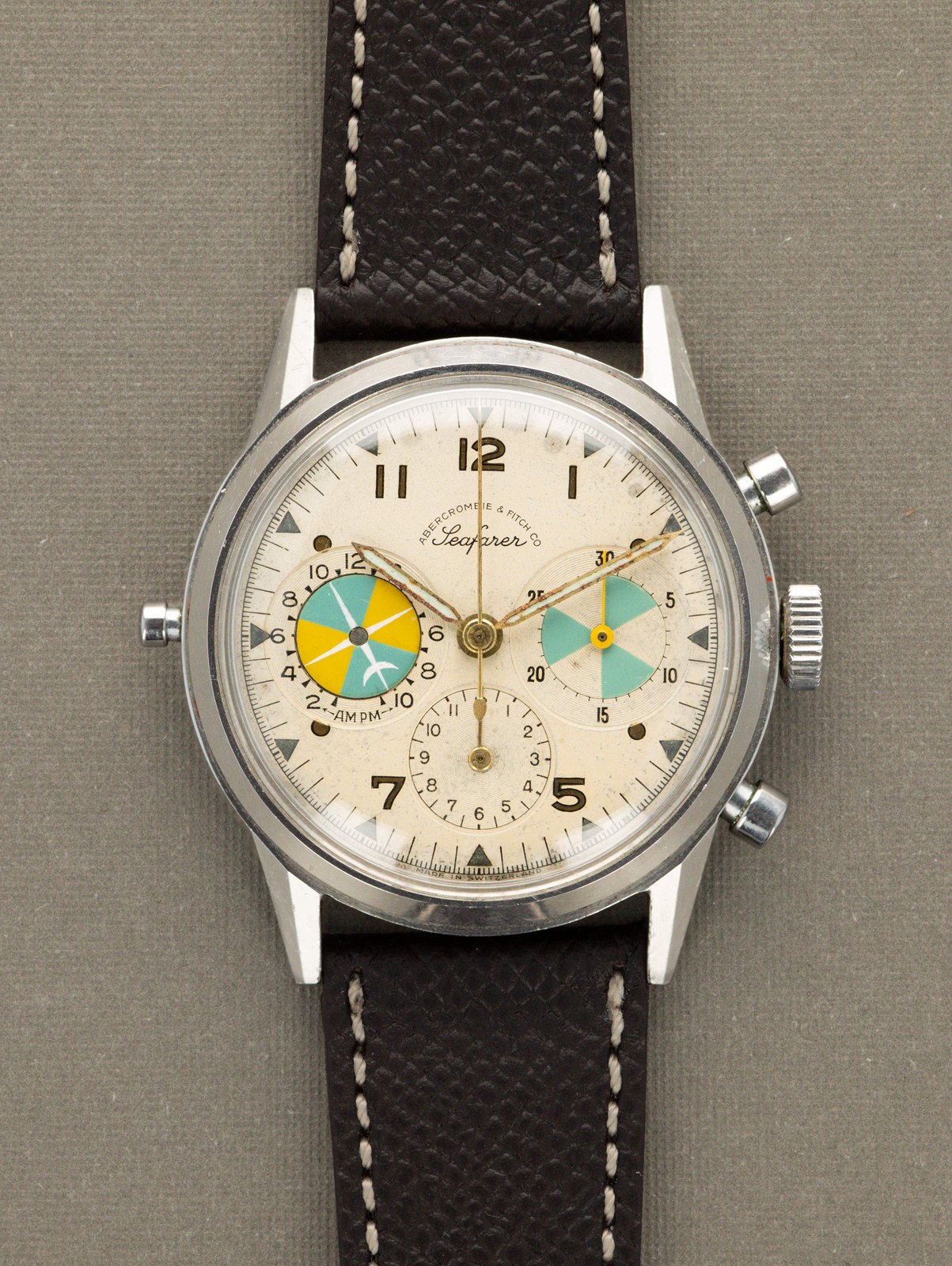
Abercrombie & Fitch Co. Seafarer ref. 2443 'Second Execution', Silver Dial
- Maker / attribution
- Abercrombie & Fitch Co. (maker)
- Date
- 1950s
- Historical period
- Modern Mechanical Horology (1945 – 1969)
- Country of origin
- Unrecorded in source
- Object type
- Wristwatch
- Materials / technique
- silver
- Dimensions
- Case 38 mm
- Stock no.
- OC3196
- Credit line
- Dealer listing, Oliver & Clarke (OC3196)
- Catalogue title (original)
- Abercrombie & Fitch Co. Seafarer Ref. 2443 'Second Execution' - Silver Dial Unpolished (English)
View the source record (dealer listing) ↗ (opens another website in a new tab)Suggest a correction
Record summary
Catalogued by Oliver & Clarke (dealer), United Kingdom (stock number OC3196), this is a wristwatch by Abercrombie & Fitch Co., dated 1950s. The Atlas places it in the Modern Mechanical Horology period (1945 – 1969) of its Wristwatches collection. Materials and techniques recorded by the source: silver. Recorded dimensions: Case 38 mm. The record is illustrated with 6 photographs.
Assembled from the source record's structured fields. Dates and attributions are given as the source states them; where a field is missing the Atlas leaves it blank rather than estimating.
Catalogue description
Dealer description — Oliver & Clarke
Abercrombie & Fitch Co., long before its modern reinvention, was one of America’s preeminent sporting outfitters. From its midtown Manhattan flagship, the firm supplied serious outdoorsmen with the finest equipment available, often commissioning bespoke products from respected manufacturers to meet the specific demands of its clientele. Watches were no exception. By the mid-20th century, A&F had begun offering co-branded timepieces tailored to sportsmen, and when customers began requesting a watch capable of tracking the tides, the company turned to one Charles-Edouard Heuer to bring the idea to life. Commissioned at A&F’s request, the Solunar was introduced in 1949 and advertised as the only watch to display both 'Solar' and 'Lunar' time. Produced in a limited run of just around 1,000 pieces, it was a highly specialized instrument and ultimately a niche offering. Still, its innovation laid the groundwork for the Seafarer, which paired the original tidal display with one of Heuer’s signature complications: the chronograph. Retaining traditional hour and minute counters, the Seafarer replaced the running seconds register with a tide indicator at 9 o’clock, which was directly adjustable via a left-side pusher and synchronized using published tide tables. Produced from the 1950s through the 1970s in several case configurations shared with other Heuer chronographs, the Seafarer remained a distinctive but specialized entry within the broader catalog and saw a handful of different variations over that time. The example that we have here, a Ref. 2443, dates to the 1950s and is offered in excellent, beautifully-preserved condition. The case comes in at 38mm in diameter and features nice thick lugs with sharp undersides, along with small 'pump' pushers, and a 'stepped' top case. Inside, the silver dial shows light aging throughout, retaining nice colors in within the subsidiary registers and beautiful gold 'foil' indices with a correct gold-tone handset. The movement powering this piece is a modified version of the famous Valjoux 72 which of course, is manually-wound. For the most part, all Abercrombie & Fitch Co. timepieces have become collectible to an extent, but it is the Seafarer that is at the front of the pack in both desirability and collectability. This is the first time we have had the pleasure of offering on for sale on the website and we could not be more happy about it.
Historical context
Modern Mechanical Horology (1945 – 1969)
Tool watches for divers, pilots and astronauts; electric watches anticipate the electronic age.
The classic era of the mechanical wristwatch: dive watches, chronographs for motor racing and space flight, GMT watches for jet travel, slim dress watches, automatic calendars, and the rise of Japanese manufacturers alongside Swiss, American, German and Soviet industries.
Read the period in the timelineMore wristwatches from this periodEarlier: Golden Age of Mechanical Watchmaking
Atlas type guide
Wristwatches
Bracelet watches were worn by women from the early nineteenth century — Breguet made one for Caroline Murat, Queen of Naples, in 1810–12 — but the wristwatch only became a man's instrument with military use and aviation in the early twentieth century. Between the World Wars it overtook the pocket watch; the 1920s and 1930s brought rectangular Art Deco cases, water-resistant cases and the first automatic winding systems.
After 1945 the wristwatch became a carrier of identity — dress watches, sports and dive watches, chronographs, calendars — produced by Swiss, American, Japanese, German, Soviet and Chinese industries. The quartz revolution after 1969 and the mechanical renaissance since the 1990s, including the rise of independent watchmakers, complete the story.
What to look for
- The reference number (between the lugs or inside the case back) and serial number, the starting point for dating.
- The calibre: its maker and number are often stamped under the dial or on the bridge.
- Originality of dial, hands and crown — refinished ('redial') dials are common.
- Case material marks: 18K/750, 14K/585, stainless steel, gold-filled, plated.
Dating clues
- Wire-lug cases: before c. 1925.
- Water-resistant screw-down cases: from 1926.
- Quartz movements: from 1969; sapphire crystals widespread after c. 1980.
General guidance written by the Atlas editors about this kind of object. It is not a statement about this particular piece; for that, rely on the source record above and on physical examination.
Related records
Wristwatches · 1960s
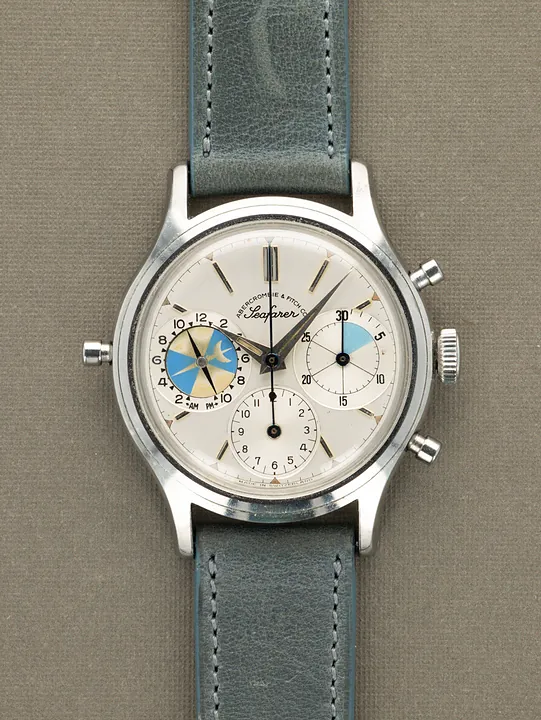
Abercrombie & Fitch Co. Seafarer ref. 2444 'Second Execution', Silver Dial
Oliver & Clarke (dealer), United Kingdom

Wristwatches · 1945
Wristwatch by Eterna, 1945
Museum Rotterdam

Wristwatches · c. 1945
Breitling Premier, ref. 790, c. 1945
Antiquorum auction archive, Geneva

Wristwatches · c. 1945
Universal Genève Uni-Compax, ref. 22492, c. 1945
Antiquorum auction archive, Geneva
Wristwatches · c. 1950s
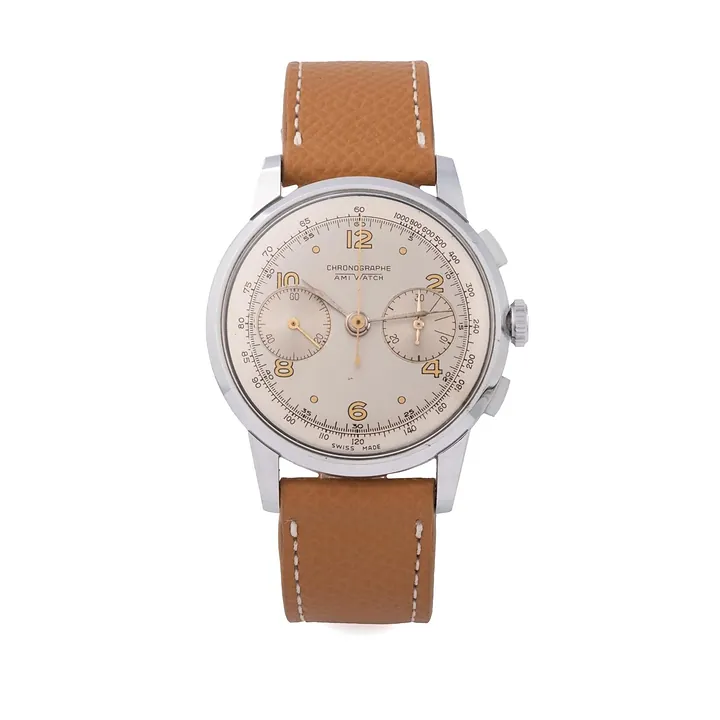
Ami Watch Chronographe, c. 1950s
Antiquorum auction archive, Geneva

Wristwatches · c. 1950s
Baume & Mercier wristwatch, c. 1950s
Antiquorum auction archive, Geneva
Wristwatches · c. 1955
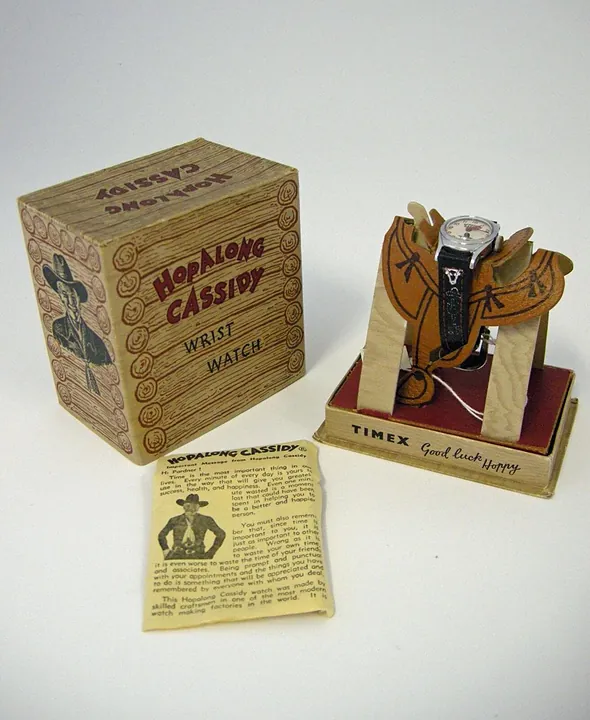
Child's wrist watch by Timex, Dundee, c. 1955
Victoria and Albert Museum, London
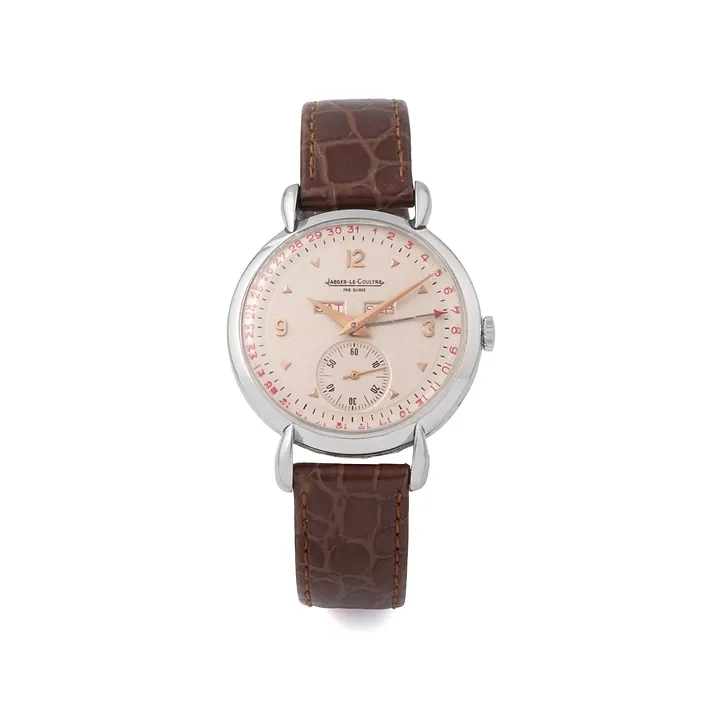
Wristwatches · c. 1950
Jaeger Lecoultre Triple Calendar, c. 1950
Antiquorum auction archive, Geneva