
Clocks · Electric clock
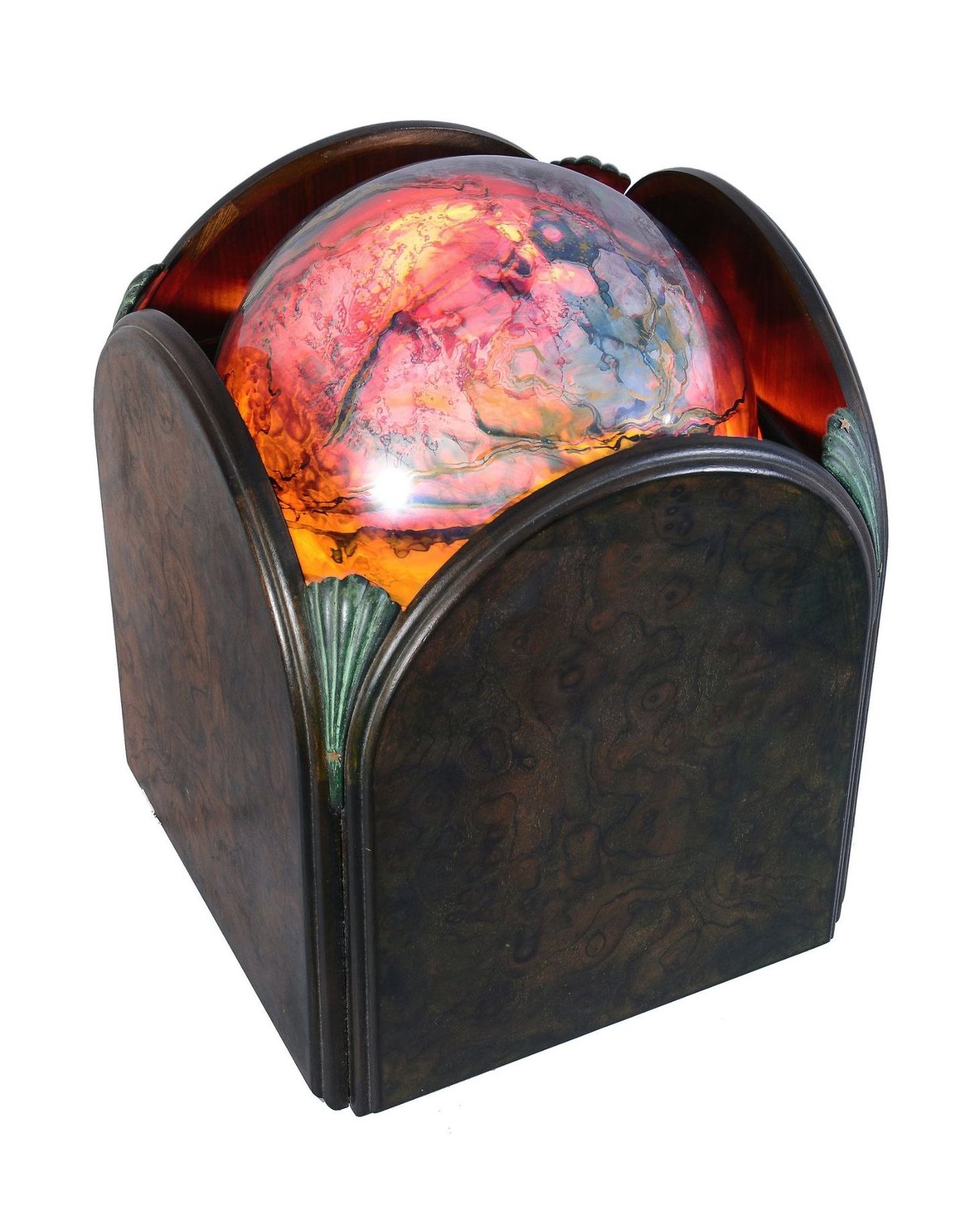
A unique burr walnut, brass, porcelain and glass electric Solar Timepiece
- Maker / attribution
- Sandra Campbell, Oliver Hood and Karen Wagstaff (source attribution)
- Date
- 1976
- Historical period
- Quartz Revolution (1969 – 1990)
- Country of origin
- United Kingdom
- Object type
- Electric clock
- Dimensions
- 28 cm (11 inches)
- Auction house
- Dreweatts
- Lot
- 76
- Credit line
- Dreweatts
- Catalogue title (original)
- A unique burr walnut, brass, porcelain and glass electric Solar Timepiece Sandra Campbell, Oliver (English)
View the source record (auction lot) ↗ (opens another website in a new tab)Suggest a correction
Record summary
Catalogued by Dreweatts (lot 76), this is an electric clock attributed to Sandra Campbell, Oliver Hood and Karen Wagstaff, made in United Kingdom, dated 1976. The Atlas places it in the Quartz Revolution period (1969 – 1990) of its Clocks collection. Recorded dimensions: 28 cm (11 inches). The record is illustrated with 1 photograph.
Assembled from the source record's structured fields. Dates and attributions are given as the source states them; where a field is missing the Atlas leaves it blank rather than estimating.
Catalogue description
Original object description
Produced in 1976 for Raymond M. Burton, this bespoke electric solar clock was conceived and built by Sandra Campbell, Oliver Hood, and Karen Wagstaff whilst enrolled at the Royal College of Art. Accompanying the piece are historical papers covering its development, operating instructions, construction guide, and financial correspondence. The mechanism is enclosed within a stained burr walnut sleeve case edged in brass, featuring caddy mouldings and four arched elevations. Patinated bronze fan-shaped mounts adorn the corners with applied gilt stars, showing one star at three junctions and two at the top to mark twelve o'clock for timekeeping reference. A brass plaque fixed to the control unit records the year 1976 and the makers' names. Within the brass posted frame are housed a Horstmann Y-MK2 calendar time-switch, an electric motor geared to the motion work, and a six-toggle control console. Flanking the drive system, a pair of internally illuminated, turning tinted glass cylinders simulate the transition between day and night. Readings are registered by two concentric revolving domes: an interior hour-revolution minute dome of textured, light-permeable porcelain marked with a deep purple stripe, and a twelve-hour outer dome showing a marbled multi-coloured pattern split by a gilded fissure line.
Historical context
Quartz Revolution (1969 – 1990)
Seiko's Astron begins mass quartz timekeeping; traditional industries contract sharply.
Quartz movements and digital displays made accurate clocks cheap and ubiquitous after the early 1970s. LED and LCD clocks, clock radios and radio-controlled clocks appeared, while traditional mechanical clockmaking contracted sharply in Germany, France and Britain.
Read the period in the timelineMore clocks from this periodEarlier: Modern Mechanical Horology
Atlas type guide
Electric and synchronous clocks
Alexander Bain patented the electric clock in 1841, and through the later nineteenth century electricity was used both to drive pendulums and to distribute time. Master clocks sent impulses every half-minute or minute to subsidiary ('slave') dials across factories, schools, railway stations and post offices; Matthäus Hipp's toggle (1842) kept pendulums swinging with minimal interference. William Hamilton Shortt's free-pendulum clock (1921), with a slave pendulum doing the mechanical work, became the most accurate mechanical clock ever made in series.
In the 1920s and 1930s synchronous motor clocks, which count the alternating-current cycles of the mains supply (50 or 60 Hz), arrived in homes; Telechron in the United States and Smiths 'Sectric' and Ferranti in Britain made them in great numbers. Battery clocks such as the Bulle, Eureka and ATO used electromagnetic impulsing of balances or pendulums.
What to look for
- Electromagnets, contacts and coils in place of springs or weights.
- Cables, terminal blocks and labels for voltage or frequency.
- Master/subsidiary systems: a subsidiary dial has a stepping mechanism and no escapement.
- Brand names such as Synchronome, Gent, Magneta, Telechron, Smiths, Ferranti.
Dating clues
- Bain and Hipp clocks: from the 1840s.
- Synchronome master clocks: from 1895.
- Synchronous mains clocks: from the late 1920s (UK grid frequency standardised in the 1930s).
General guidance written by the Atlas editors about this kind of object. It is not a statement about this particular piece; for that, rely on the source record above and on physical examination.
Related records
Clocks · late 20th century
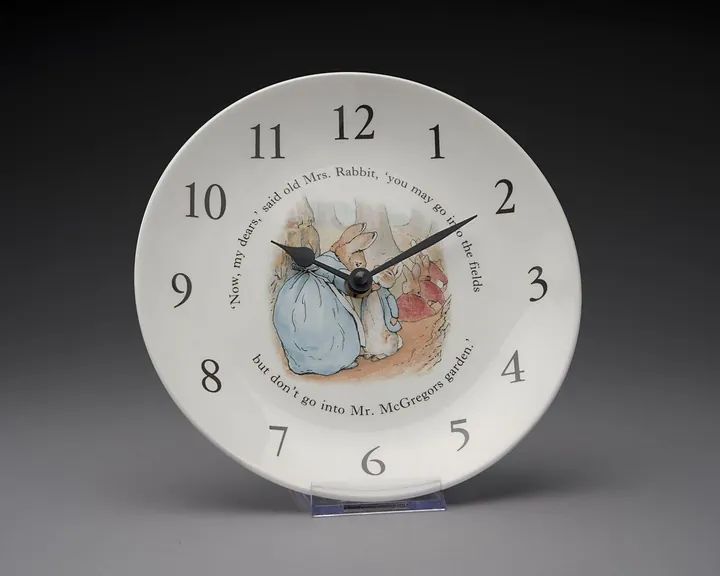
Clock, 'Peter Rabbit', Queen's ware, transfer printing, Josiah Wedgwood and Sons, Barlaston, late 20th century (V&A WE.17466-2014)
Victoria and Albert Museum, London
Clocks · late 20th century
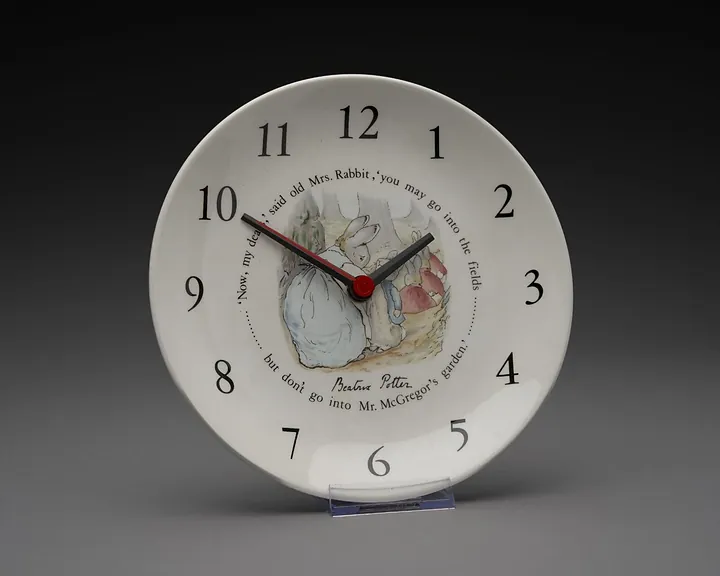
Clock, 'Peter Rabbit', Queen's ware, transfer printing, Josiah Wedgwood and Sons, Barlaston, late 20th century (V&A WE.18029-2014)
Victoria and Albert Museum, London
Clocks · late 20th century
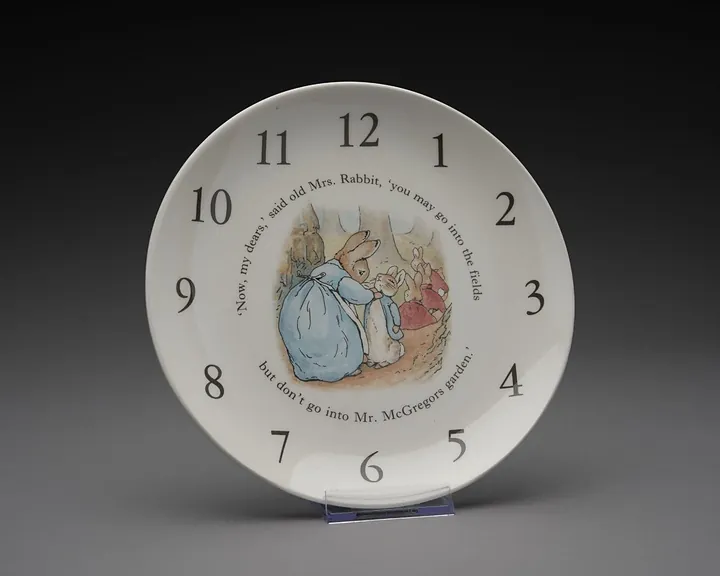
Clock, 'Peter Rabbit', glazed earthenware, transfer printing, Josiah Wedgwood and Sons, Barlaston, late 20th century
Victoria and Albert Museum, London
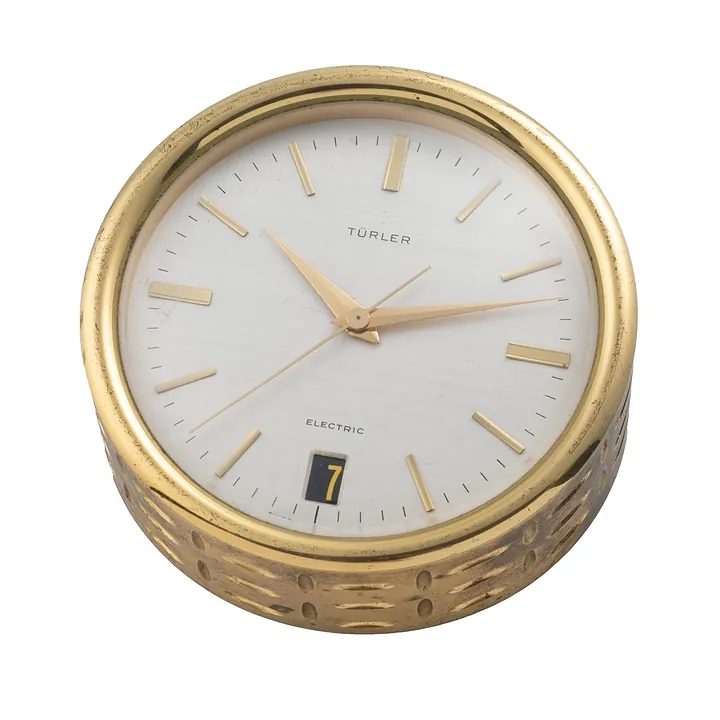
Clocks · c. 1960-1970s
Anonymous clock, c. 1960-1970s
Antiquorum auction archive, Geneva
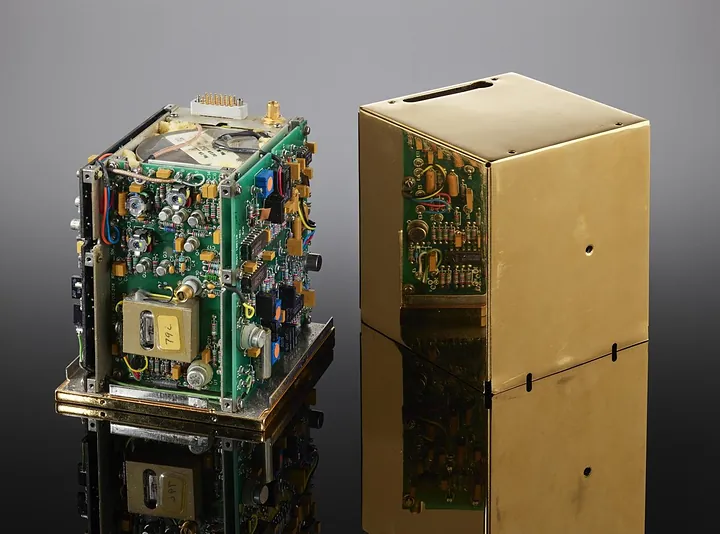
Clocks · 1960–1996
Electric clock by Efratom GmbH, Germany, 1960–1996
Science Museum Group, London
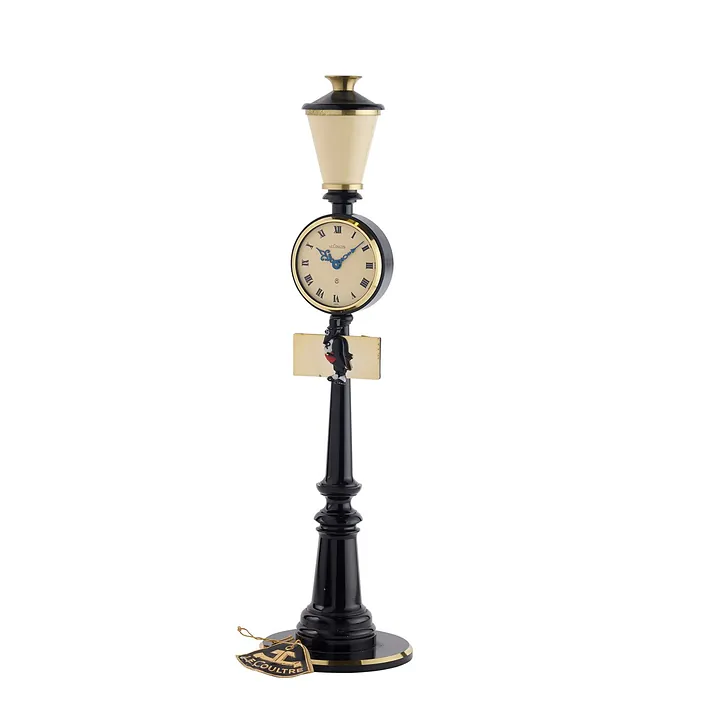
Clocks · c. 1960-1970s
Lecoultre Street Light Lamp, ref. 397, c. 1960-1970s
Antiquorum auction archive, Geneva
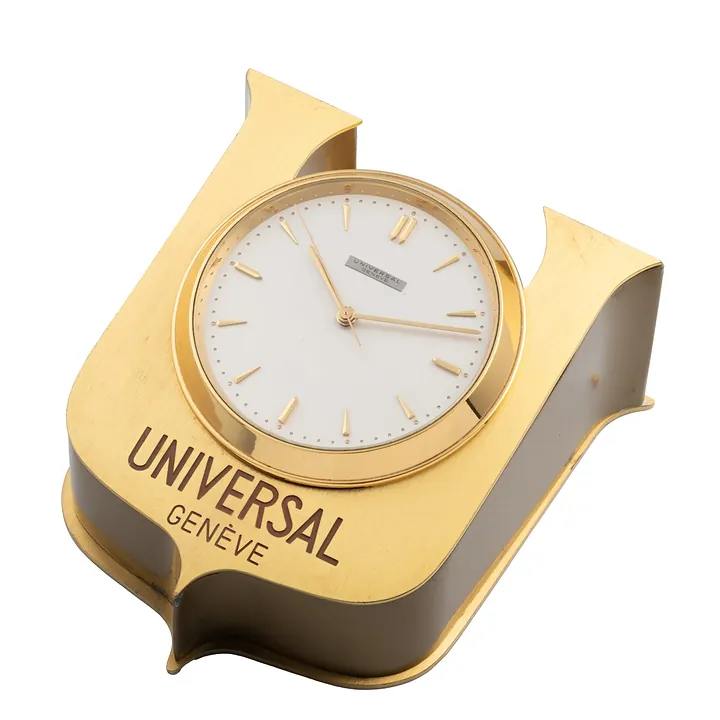
Clocks · c. 1960-1970s
Universal Genève clock, ref. 999.116.01, c. 1960-1970s
Antiquorum auction archive, Geneva
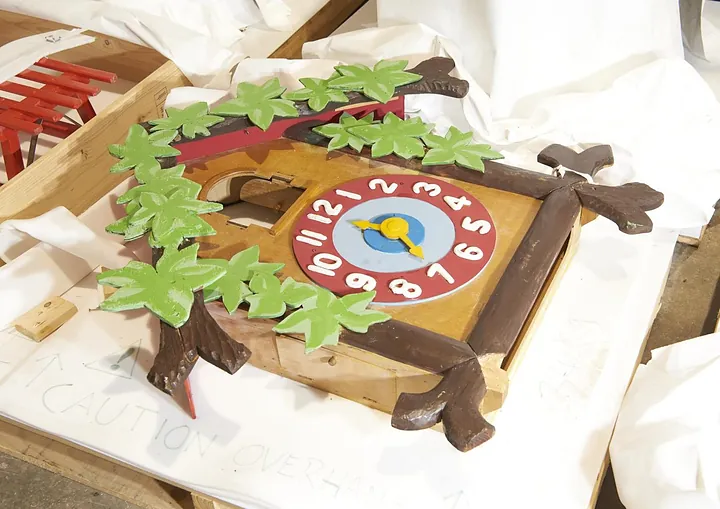
Clocks · 1964–1988
The clock from BBC children's television series 'Playschool', c 1977
Science Museum Group, London