
Wristwatches · Wristwatch
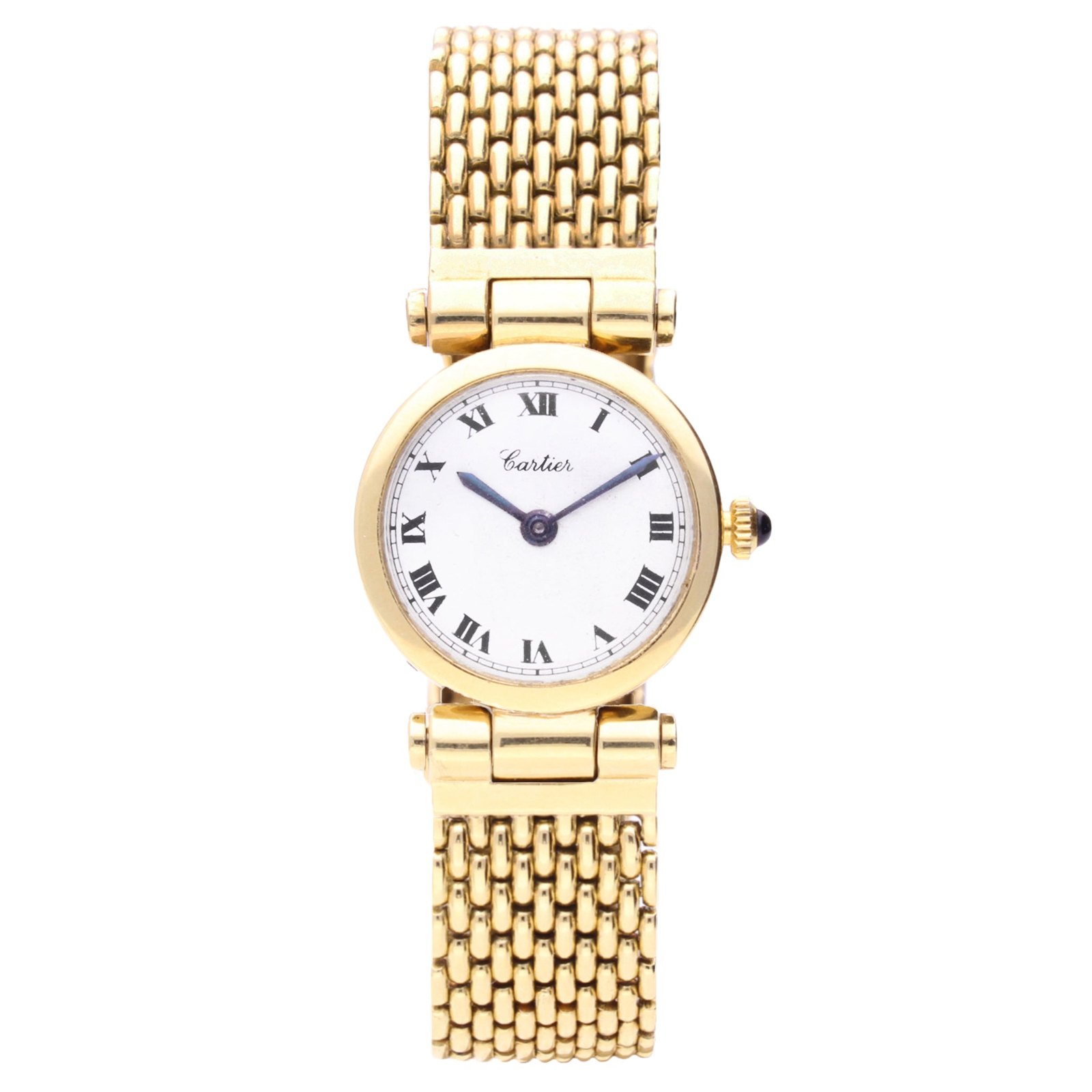
18ct yellow gold Cartier bracelet watch, 1944
- Maker / attribution
- Cartier (maker)
- Date
- 1944
- Historical period
- Golden Age of Mechanical Watchmaking (1900 – 1945)
- Country of origin
- France
- Object type
- Wristwatch
- Materials / technique
- yellow gold
- Dimensions
- Case 23 mm
- Stock no.
- G2293
- Credit line
- Dealer listing, Somlo Antiques (G2293)
- Catalogue title (original)
- 18ct yellow gold Cartier bracelet watch. Made 1944 (English)
View the source record (dealer listing) ↗ (opens another website in a new tab)Suggest a correction
Record summary
Catalogued by Somlo Antiques (dealer), London (stock number G2293), this is a wristwatch by Cartier, made in France, dated 1944. The Atlas places it in the Golden Age of Mechanical Watchmaking period (1900 – 1945) of its Wristwatches collection. Materials and techniques recorded by the source: yellow gold. Recorded dimensions: Case 23 mm. The record is illustrated with 2 photographs.
Assembled from the source record's structured fields. Dates and attributions are given as the source states them; where a field is missing the Atlas leaves it blank rather than estimating.
Catalogue description
Dealer description — Somlo Antiques
Cartier is a brand that has forever been associated with Opulence, class and sophistication. The company was founded by Louis-François Cartier in 1847 as an ‘ Atelier de Haute Joaillerie ’ after he took over the workshop of his Master, Adolphe Picard. He was succeeded in 1874 by his own son Alfred who continued to uphold the high standards set down by his father. It was not until 25 years later, in 1899 when Alfred’s three sons took over the business and transformed Cartier into a global luxury brand, opening boutiques in London and New York. Cartier’s dalliance with horology started in 1904 when Louis Cartier befriended the aviation pioneer Alberto Santos-Dumont. Santos-Dumont complained about the difficulties of checking a pocket watch mid-flight, so Louis Cartier designed a wristwatch with a distinctive flat profile that would henceforth be known as the Cartier Santos-Dumont. This was the first men’s wristwatch made by Cartier and established the foundation of every watch they have produced to this day. It is considered by many to be the pioneer of modern wristwatch design. Today vintage Cartier collectors have the choice of different designs and models from London, Paris and New York houses. Brand: Cartier Made: 1944 Model: N/A Reference: N/A Calibre: P838 Movement: Manual Material: 18ct yellow gold Features/complications: Round case with hinged lugs Dial: Off-white dial with outer minute track featuring black printed Roman numeral hour markers and blued steel sword shaped hands Case dimensions: 23mm Bracelet/strap: 18ct yellow gold 'rice link' bracelet with deployant buckle Accessories: N/A SKU: 2293
Historical context
Golden Age of Mechanical Watchmaking (1900 – 1945)
The wristwatch displaces the pocket watch; waterproof cases, self-winding and grand complications.
The wristwatch overtook the pocket watch. Military use in the First World War, aviation, water-resistant cases (1926), automatic winding (1923–31), rectangular Art Deco designs and early chronographs and calendars defined the period.
Read the period in the timelineMore wristwatches from this periodEarlier: Industrial Revolution
Atlas type guide
Wristwatches
Bracelet watches were worn by women from the early nineteenth century — Breguet made one for Caroline Murat, Queen of Naples, in 1810–12 — but the wristwatch only became a man's instrument with military use and aviation in the early twentieth century. Between the World Wars it overtook the pocket watch; the 1920s and 1930s brought rectangular Art Deco cases, water-resistant cases and the first automatic winding systems.
After 1945 the wristwatch became a carrier of identity — dress watches, sports and dive watches, chronographs, calendars — produced by Swiss, American, Japanese, German, Soviet and Chinese industries. The quartz revolution after 1969 and the mechanical renaissance since the 1990s, including the rise of independent watchmakers, complete the story.
What to look for
- The reference number (between the lugs or inside the case back) and serial number, the starting point for dating.
- The calibre: its maker and number are often stamped under the dial or on the bridge.
- Originality of dial, hands and crown — refinished ('redial') dials are common.
- Case material marks: 18K/750, 14K/585, stainless steel, gold-filled, plated.
Dating clues
- Wire-lug cases: before c. 1925.
- Water-resistant screw-down cases: from 1926.
- Quartz movements: from 1969; sapphire crystals widespread after c. 1980.
General guidance written by the Atlas editors about this kind of object. It is not a statement about this particular piece; for that, rely on the source record above and on physical examination.
Related records

Clocks · 1863
Clock by Albert-Ernest Carrier-Belleuse, France, 1863
The Metropolitan Museum of Art, New York

Clocks · c. 1980s
Cartier "art Deco", c. 1980s
Antiquorum auction archive, Geneva

Clocks · c. 2000s
Cartier Desk Clock with Alarm, c. 2000s
Antiquorum auction archive, Geneva

Clocks · c. 2000s
Cartier Lacquer Arched Desk Clock with Alarm, ref. W0100037, c. 2000s
Antiquorum auction archive, Geneva
Wristwatches · c. 1936
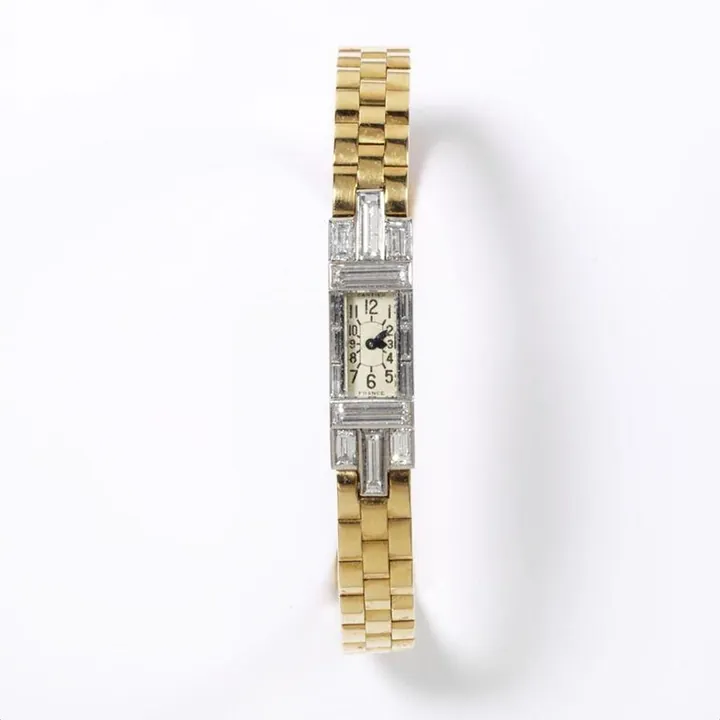
Watch with diamond-set platinum case and gold link bracelet, Cartier, Paris, c. 1936.
Victoria and Albert Museum, London
Wristwatches · c. 1920
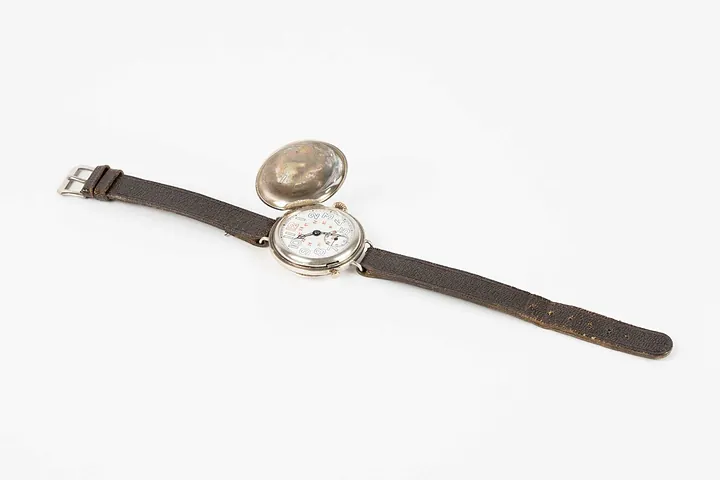
Wristwatch by dazwischen Schwert J S, France, c. 1920
German Clock Museum
Wristwatches · 1928
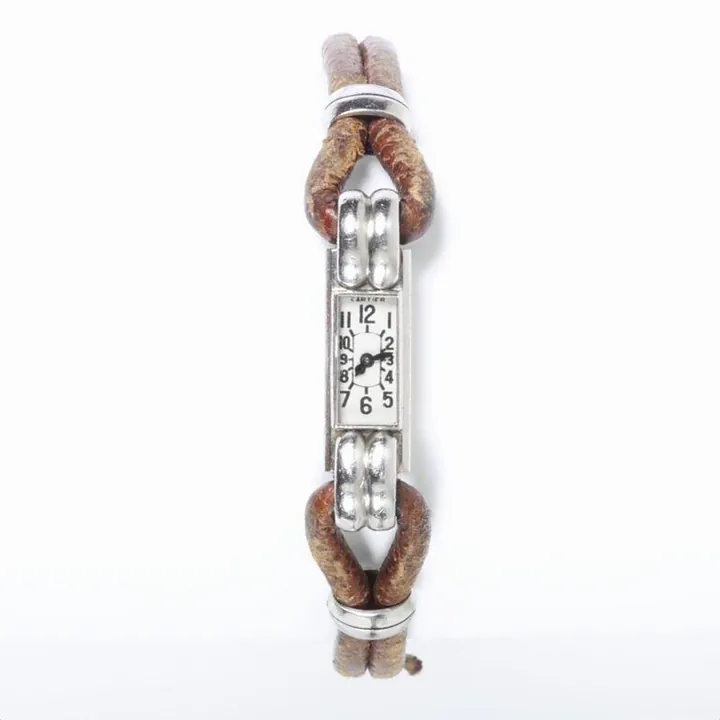
Platinum watch with leather strap with gold deployant buckle, Cartier, Paris, mark of Edmond Jaeger, 1928
Victoria and Albert Museum, London
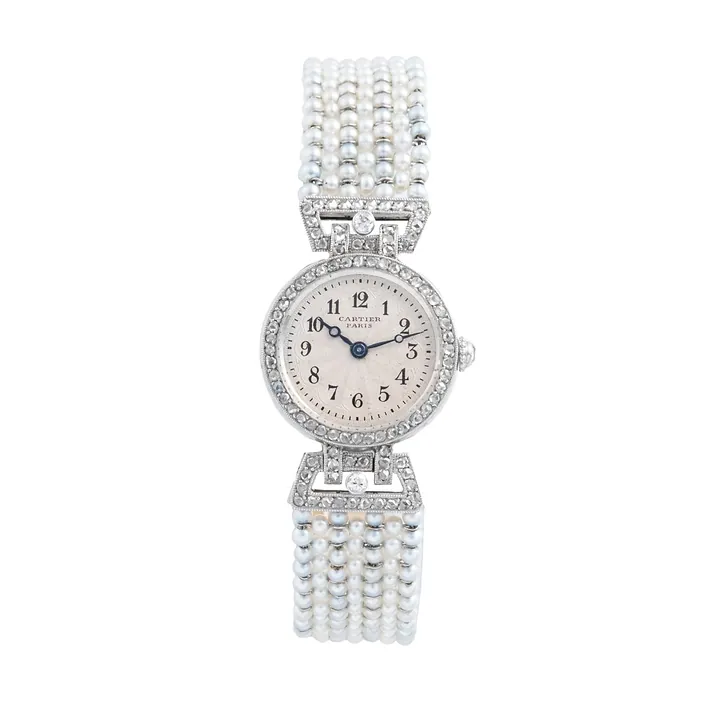
Wristwatches · c. 1930s
Cartier wristwatch, c. 1930s
Antiquorum auction archive, Geneva