
Wristwatches · Wristwatch
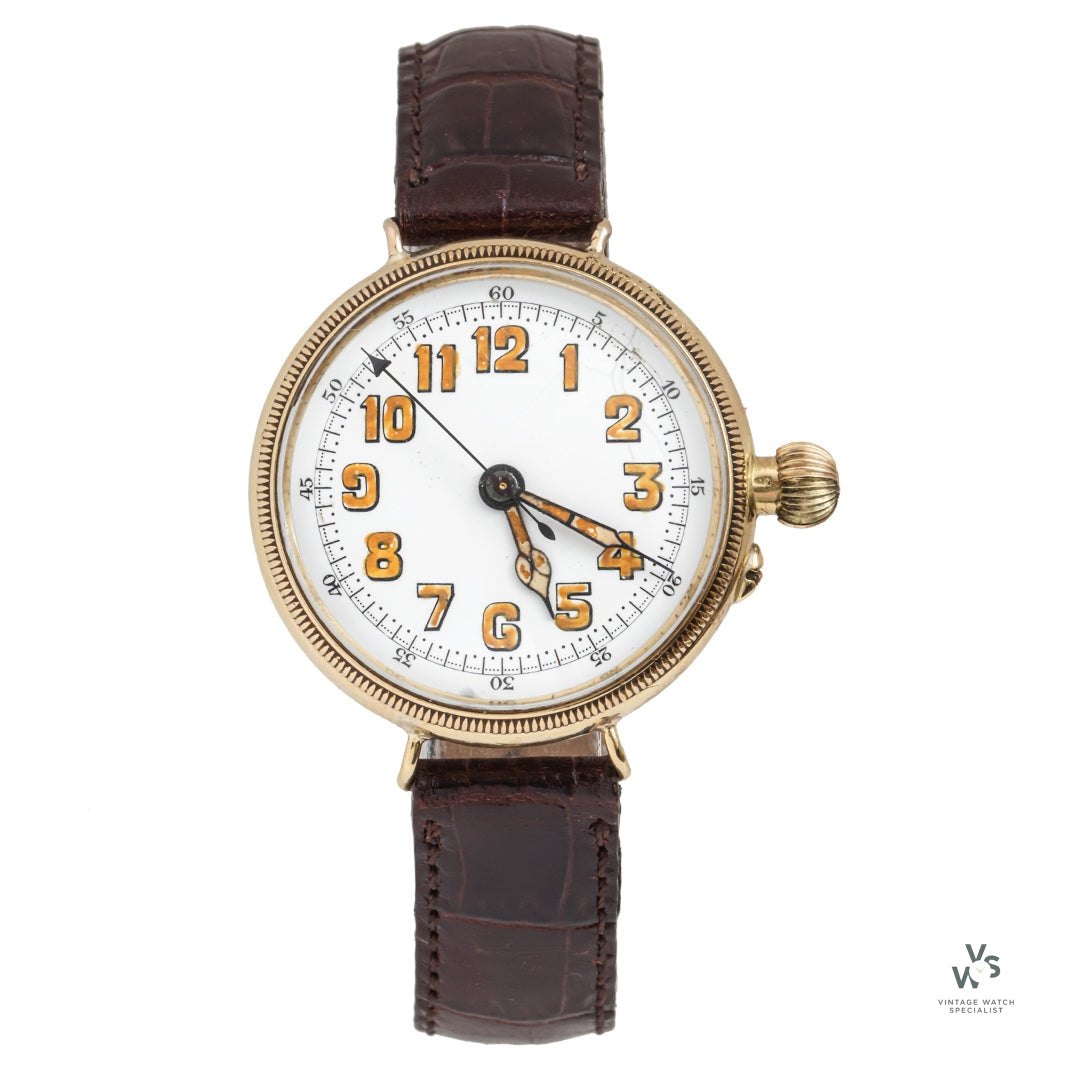
18ct Gold Military Trench Watch, Borgel Case, Military Provenance, circa 1915
- Maker / attribution
- Unrecorded in source
- Date
- c. 1915
- Historical period
- Golden Age of Mechanical Watchmaking (1900 – 1945)
- Country of origin
- Unrecorded in source
- Object type
- Wristwatch
- Materials / technique
- gold
- Stock no.
- vws2523cs
- Credit line
- Dealer listing, Vintage Watch Specialist (vws2523cs)
- Catalogue title (original)
- Vintage 18ct Gold Military Trench Watch - Borgel Case - Military Provenance - c.1915 (English)
View the source record (dealer listing) ↗ (opens another website in a new tab)Suggest a correction
Record summary
Catalogued by Vintage Watch Specialist (dealer), United Kingdom (stock number vws2523cs), this is a wristwatch, dated c. 1915. The Atlas places it in the Golden Age of Mechanical Watchmaking period (1900 – 1945) of its Wristwatches collection. Materials and techniques recorded by the source: gold. The record is illustrated with 6 photographs.
Assembled from the source record's structured fields. Dates and attributions are given as the source states them; where a field is missing the Atlas leaves it blank rather than estimating.
Catalogue description
Dealer description — Vintage Watch Specialist
An Utterly Charming 18ct Gold Borgel Cased Military Trench Watch From (approx) 1915 with Military Engravings and Military Provenance The Trench watch (wristlet) was a type of watch that came into use by the military during World War I, as pocket watches were not practical in combat. It was a transitional design between pocket watches and wristwatches, incorporating features of both. What’s On Offer This trench watch is housed in an 18ct gold Borgel case (with London hallmarks) and boasts a beautifully preserved enamelled dial which is in wonderful condition with original lume on the Arabic numerals and cathedral hands which has evenly aged to a beautiful caramel colour. In such beautiful condition and at such an age, this watch is a very rare find and a joy to offer for sale, especially given the provenance outlined below! The gold caseback bears the regimental mark of the Kings Own Yorkshire Light Infantry and is underwritten by the initials GKS which we believe to be related to George Kingston Sullivan who was born in Ireland on 6th June 1876 and led a military life as a career soldier. He served in the South Africa War of 1899 to 1902 being at times employed in mounted infantry operations and in other operations in Orange River Colony, Cape Colony and the Transvaal. He was awarded the Queens SA medal with 3 clasps and the Kings SA medal with 2 clasps. Prior to 1914 he served with the Ist KOYLI including in Hong Kong and during the Great War with the 5th Battalion as Captain and Adjutant subsequently moving between Regiments and ranks in both France and Belgium. He transferred to the 2/10 London Regiment as a temporary Lt.Colonel then back to the KOYLI as a Major. He was wounded, mentioned in despatches and awarded the Military Cross,(1916) and O.B.E. He retired as a Lt. Colonel. He married Frances Helen Skipton of Loversal Hall in September 1917 in Doncaster. after the war they lived in Flaxton, North Yorkshire where he served as the Secretary to the West Riding Territorial Army. He died 14th December 1961 aged 85 and was buried at Brodsworth, Yorkshire. This watch has clearly been well looked after and treasured, it still runs and is absolutely wearable - a beautiful and rare piece of British military history. Additional information Made from Case: 18ct Gold Dial: White Crystal: Acrylic Bracelet: Leather Pin Buckle Strap Technical specifications Winding: Manual Movement Type: Mechanical Calibre: Jewels: 15 Waterproof: Power reserve: Purchase details Condition: Excellent Model Reference: Date of issue: c.1915 Dimensions Width (without crown): Lug width: Lug height: (lug to lug) Wrist size:
Historical context
Golden Age of Mechanical Watchmaking (1900 – 1945)
The wristwatch displaces the pocket watch; waterproof cases, self-winding and grand complications.
The wristwatch overtook the pocket watch. Military use in the First World War, aviation, water-resistant cases (1926), automatic winding (1923–31), rectangular Art Deco designs and early chronographs and calendars defined the period.
Read the period in the timelineMore wristwatches from this periodEarlier: Industrial Revolution
Atlas type guide
Military, pilot and travel watches
The wristwatch owes much of its adoption by men to warfare and aviation. Wristlets — small pocket watches soldered with lugs and worn on a strap — were used in colonial campaigns and became standard equipment in the First World War, with protective grilles over the crystal ('shrapnel guards'). Louis Cartier's Santos (1904), designed for the aviator Alberto Santos-Dumont, is often cited as an early purpose-made pilot's watch.
In the Second World War governments specified watches in detail: the German B-Uhr observation watches, the American A-11, and the British 'W.W.W.' (the 'Dirty Dozen' set of 1945). After the war, jet travel brought GMT and world-time watches, which show two or more time zones at once — Louis Cottier's world-time mechanism and the Rolex GMT-Master (1955) are examples.
What to look for
- Military markings on the case back: broad arrow, issue numbers, 'W.W.W.', 'A.T.P.'
- High-legibility black dials with luminous Arabic numerals; oversized crowns for gloved hands.
- 24-hour hands and rotating 24-hour bezels or city rings on GMT/world-time watches.
- Wire lugs on early wristlets converted from pocket watches.
Dating clues
- Wire-lug wristlets: c. 1900–1925.
- Military specifications of the Second World War: 1939–1945.
- GMT and world-time wristwatches: mainly after 1950.
General guidance written by the Atlas editors about this kind of object. It is not a statement about this particular piece; for that, rely on the source record above and on physical examination.
Related records
Wristwatches · 1900–1999
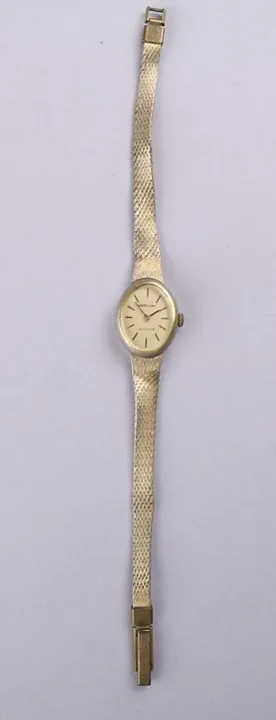
Wristwatch by Mercury, 1900–1999
Modemuseum Hasselt
Wristwatches · 1900–1999
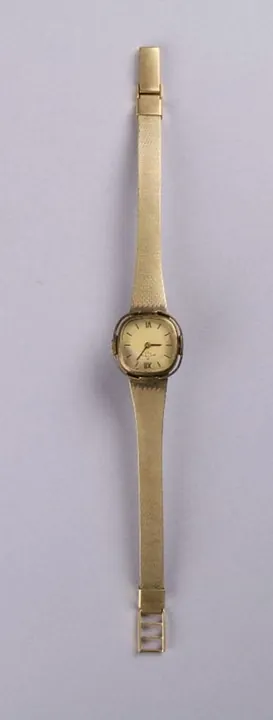
Wristwatch by Nutrix, 1900–1999
Modemuseum Hasselt

Wristwatches · 1920
Wristwatch, 1920
Modemuseum Hasselt

Wristwatches · 1931
Rolex 'Oyster Perpetual' rotor self-winding wrist-watch, lever escapement, in steel case with glass in back, Montres Rolex SA, Geneva, Switzerland, 1931
Science Museum Group, London
Wristwatches · c. 1936
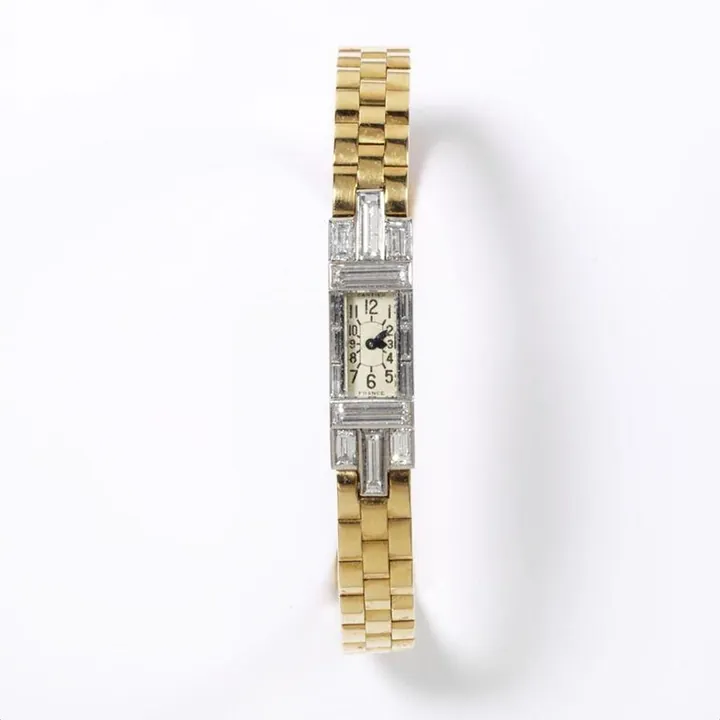
Watch with diamond-set platinum case and gold link bracelet, Cartier, Paris, c. 1936.
Victoria and Albert Museum, London
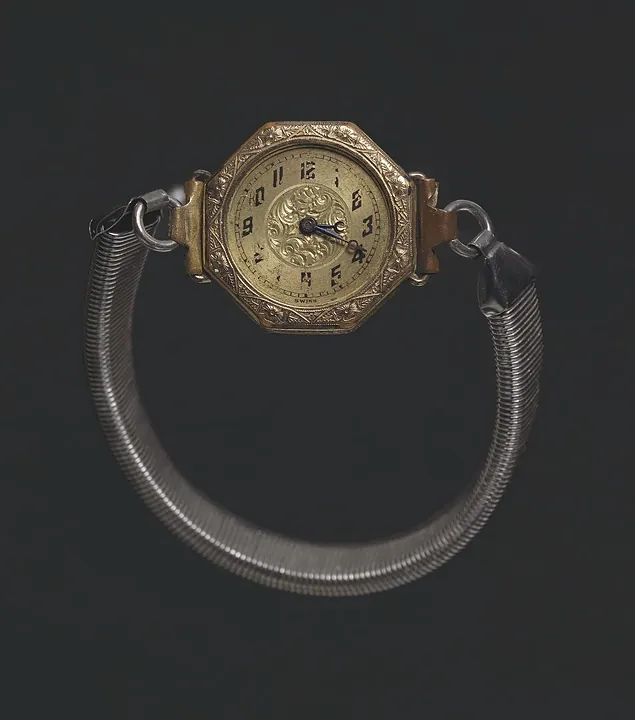
Wristwatches · early to mid 20th century
Woman's wristwatch worn by Harriette Vyda Simms Moore, early to mid 20th century
National Museum of African American History and Culture, Smithsonian Institution, Washington DC

Wristwatches · 1900–1999
Wristwatch by Certina, Switzerland, 1900–1999
Nordic Museum Foundation
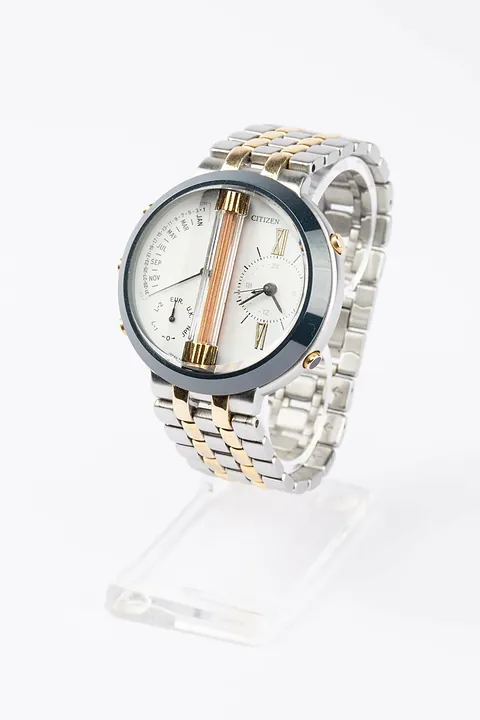
Wristwatches · 1900–1999
Wristwatch by Citizen, Japan, 1900–1999
German Clock Museum