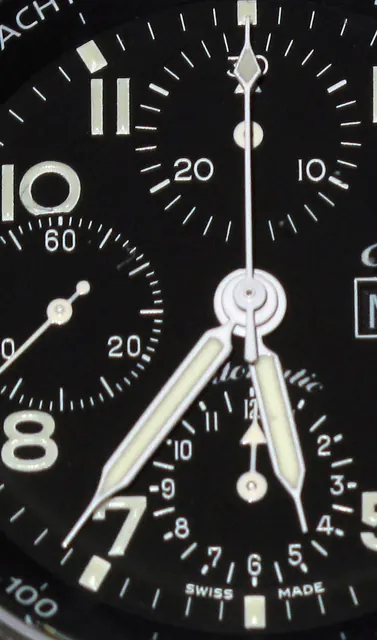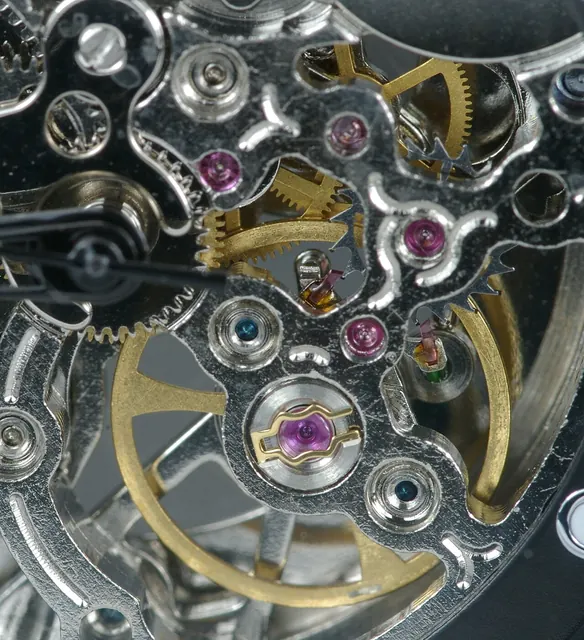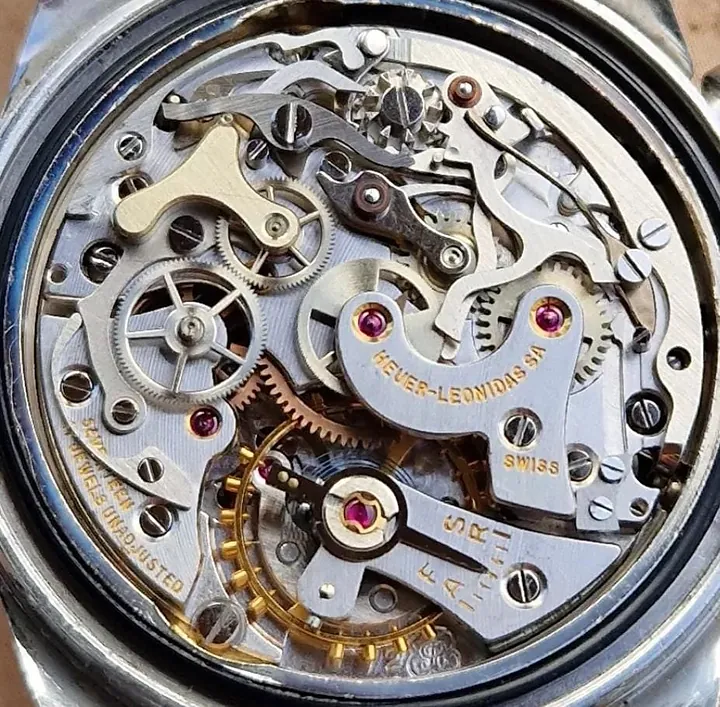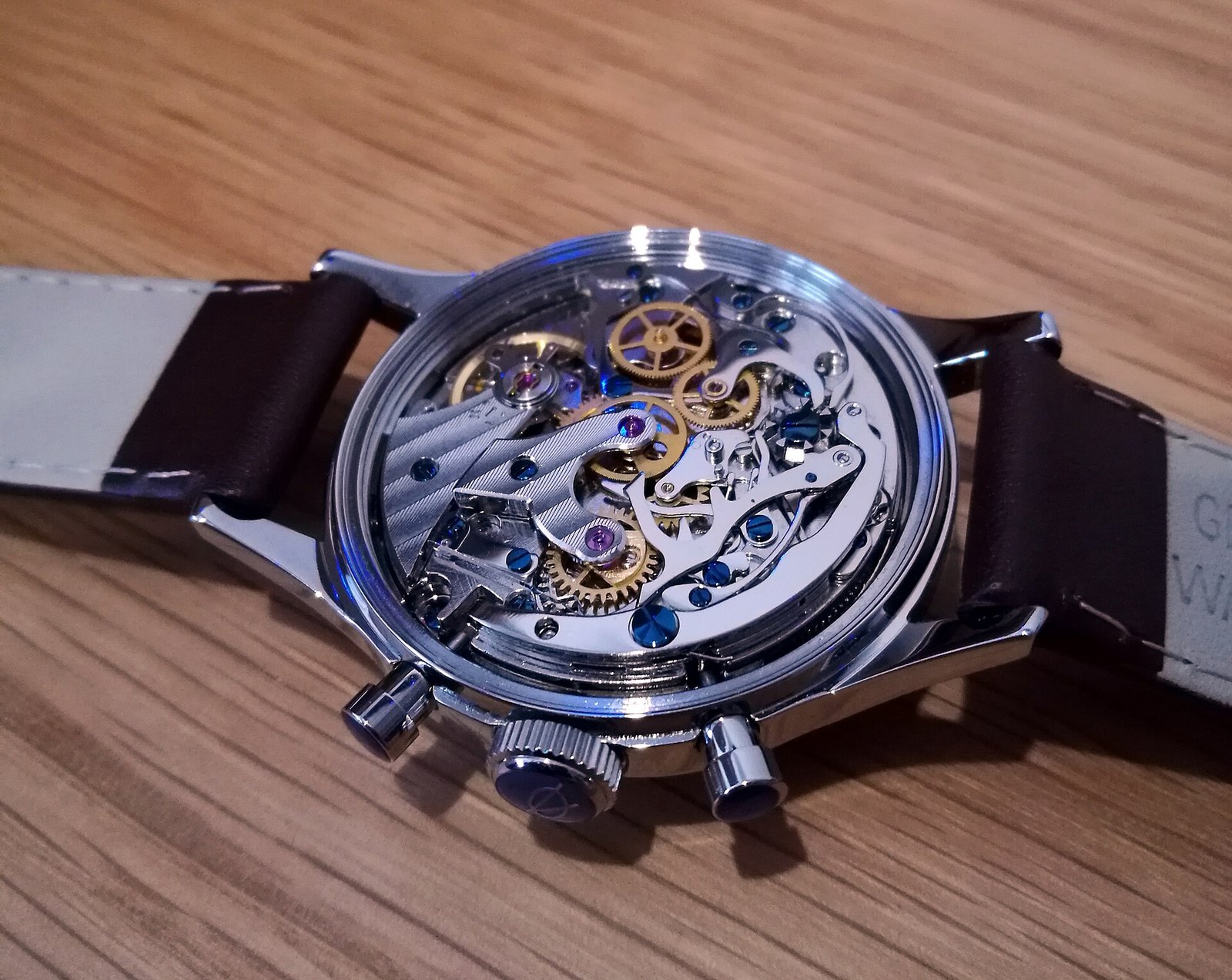
Calibre record · Hand-wound chronograph (automatic versions exist)
Sea-Gull ST19
China's column-wheel chronograph, developed from the tooling and designs of the Swiss Venus calibre 175 for the 1960s 'Project 304' air force chronograph, and today one of the few inexpensive column-wheel chronographs on the market.
- Manufacturer
- Tianjin Sea-Gull (formerly Tianjin Watch Factory)
- Type
- Hand-wound chronograph (automatic versions exist)
- Winding
- Manual (ST1940: automatic)
- Production
- 1963 (prototype)–present
- Country
- China
- Diameter
- 31.3 mm (13¾ lignes)
- Height
- c. 5.85–6.25 mm by version
- Jewels
- 19–23 by version
- Frequency
- 21,600 vph (3 Hz)
- Power reserve
- c. 50 h
- Oscillator / escapement
- Detached lever escapement
- Complications
- Column-wheel chronograph with 30-minute counter; small seconds; by version 12- or 24-hour hand, power reserve, moon phase
Figures are those commonly published for the standard version; individual versions and grades differ. “Undocumented here” means the value has not yet been confirmed for this record.
How it is built
An integrated (not modular) hand-wound chronograph controlled by a column wheel, with a 30-minute counter at 3 o'clock and small seconds at 9. It descends from the Swiss Venus 175, whose tooling and designs the Tianjin Watch Factory acquired in the early 1960s; Tianjin raised the jewel count from 17 to 19 and later ran the movement at 21,600 vibrations per hour.
Being integrated and column-wheel controlled, it has a smoother pusher action than most cam-switched chronographs, and watchmakers can service it as a single movement.
History
In 1961 the Chinese government's Project 304 asked the Tianjin Watch Factory to make a chronograph for air force pilots. Tianjin acquired the tooling and designs of the Venus 175, a 17-jewel Swiss column-wheel chronograph then going out of production, completed a 19-jewel prototype in 1963 — the year used in the name of today's '1963' reissues — and delivered a first batch of about 1,400 watches to the air force in 1966. Production resumed after the Tianjin Sea-Gull company was formed in 1992, and the family has since grown to include automatic, power-reserve and moon-phase versions.
Watches fitted with it
- Sea-Gull '1963' reissues of the Project 304 air force chronograph
- Many small brands' mechanical chronographs since the 2000s
The numbers explained
- 21,600 vibrations per hour means the balance makes 6 beats (ticks) every second — 3 complete back-and-forth oscillations, or 3 Hz.
- A sweeping seconds hand therefore advances in 6 small steps per second.
- That is 518,400 beats a day. A watch that gains one second a day is out by about 1 part in 86,400 — roughly 11.6 parts per million.
- Faster balances resist knocks and changes of position better but wear their pivots and need fresh oil sooner.
Convert beat rates and daily error with the Atlas tools · See a balance and escapement in the lab
How to recognise it
- A column wheel and chronograph levers visible through a display back, often with Geneva stripes or perlage.
- Sea-Gull or Tianjin markings; the calibre is also sold under the TY2900 numbers.
- On the ST1902 and ST1903, the sub-dial at 6 o'clock is a second hour hand (12- or 24-hour), not an elapsed-hours counter.
For collectors
Modern ST19 watches are inexpensive, but the original 1960s air force chronographs are rare and widely imitated. Check the chronograph's start, stop and reset, and treat 'vintage' military examples with caution unless their history is documented.
Versions and derivatives
| Calibre | Difference |
|---|---|
| ST1901 | Two registers: small seconds at 9, 30-minute counter at 3. |
| ST1902 | Adds a 12-hour hand at 6 that repeats the main hour hand. |
| ST1903 | Adds a 24-hour hand at 6. |
| ST1940 | Automatic version. |
Compared with related calibres
| Calibre | Type | Frequency | Jewels | Power reserve | Diameter | Production |
|---|---|---|---|---|---|---|
| Sea-Gull ST19 | Hand-wound chronograph (automatic versions exist) | 21,600 vph (3 Hz) | 19–23 by version | c. 50 h | 31.3 mm (13¾ lignes) | 1963 (prototype)–present |
| Valjoux 72 | Hand-wound chronograph | 18,000 vph (2.5 Hz) | 17 | c. 48 h | 29.5 mm (13 lignes) | 1938–1974 (some sources date its introduction to 1946) |
| Valjoux 7750 | Automatic chronograph | 28,800 vph (4 Hz) | 25 | c. 42–48 h | 30 mm (13¼ lignes) | 1974–present |