
International Horology · Historical feature
Clocks for Unequal Hours: Japanese Wadokei of the Edo Period
For more than two centuries Japanese clockmakers adapted the European mechanical clock to a time system in which the length of an hour changed with the seasons.
Atlas Editorial · · 8 min read
German Clock Museum · CC BY-SA — permission review · source (opens another website in a new tab)
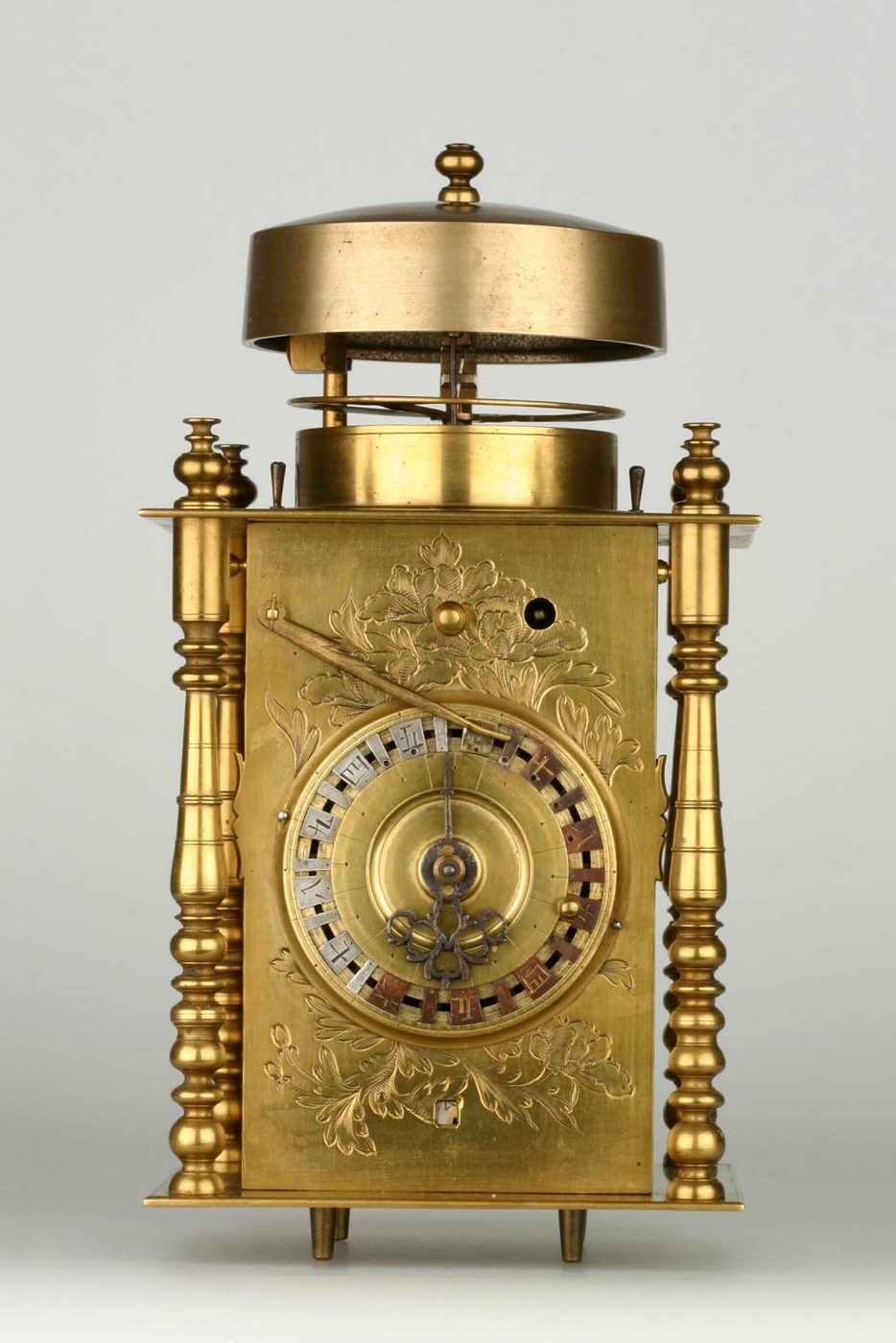
A European clock divides the day into twenty-four equal hours, and the hours keep the same length all year. Until 1873, Japan did not. Daytime, from dawn to dusk, was divided into six hours, and night-time into another six. In summer the daytime hours were long and the night-time hours short; in winter the reverse. A clock in Edo-period Japan therefore had to do something no European clock was designed for: change the length of its hours with the seasons, and in many cases between day and night every single day.
Japanese clockmakers met this challenge with a series of ingenious adaptations of imported European technology. The clocks they produced — usually called wadokei, 'Japanese clocks', to distinguish them from Western ones — are among the most distinctive objects in horology. This feature explains the time system they served, the mechanisms that made it work, the main forms of clock, and how the tradition ended.
European clocks arrive in Japan
Mechanical clocks reached Japan with Portuguese traders and Jesuit missionaries in the mid-16th century. The Jesuit Francis Xavier is recorded as presenting a clock to the regional lord Ōuchi Yoshitaka in 1551. Others followed as diplomatic gifts. One of the most celebrated survivors is a spring-driven table clock made in Madrid in 1581 and given to Tokugawa Ieyasu in 1611 by the Spanish viceroy of New Spain; it is preserved at the Kunōzan Tōshō-gū shrine in Shizuoka.
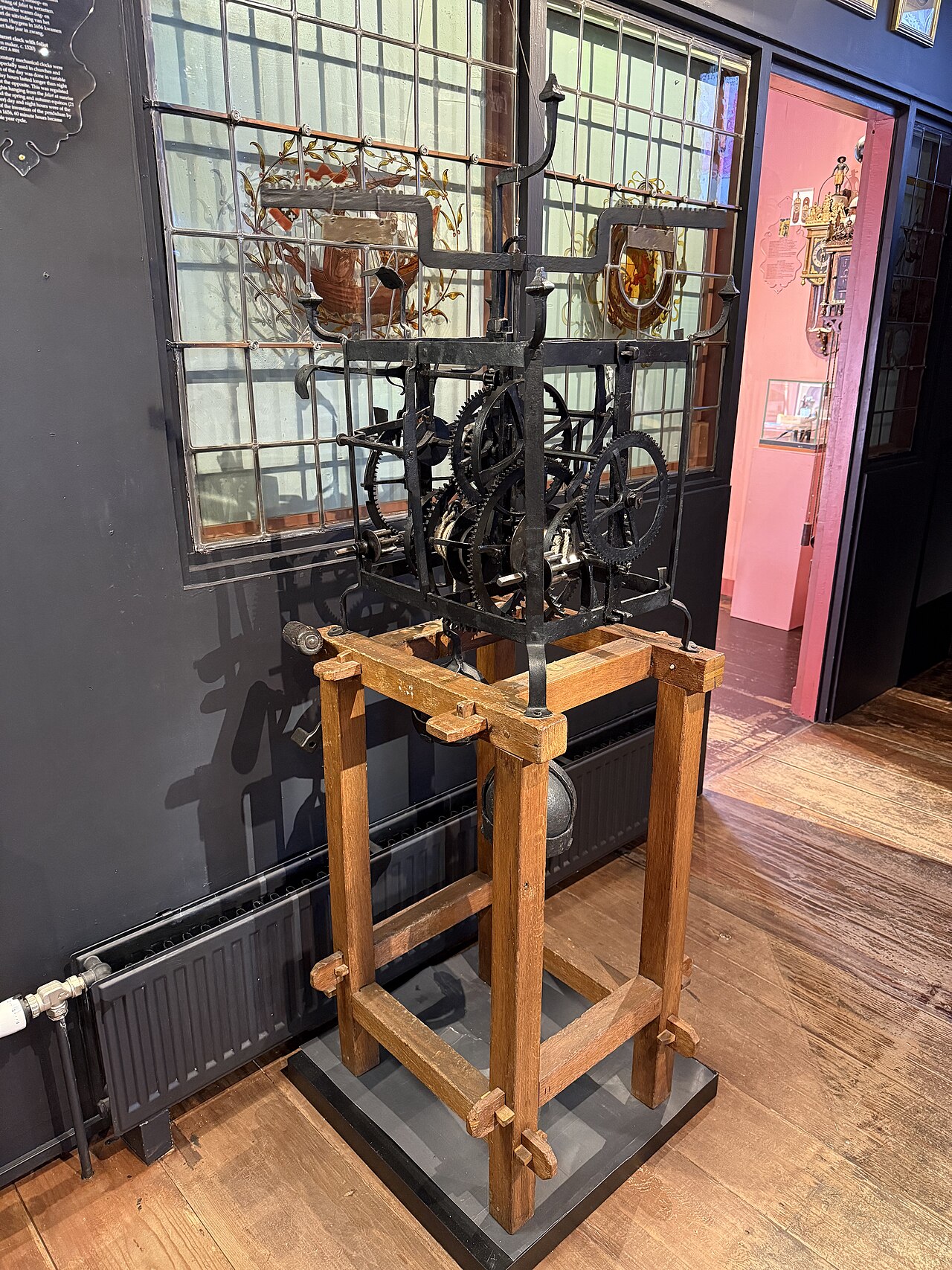
Japanese craftsmen learned to repair and copy these imports. After the Tokugawa shogunate restricted contact with Europeans in the 1630s, leaving only a tightly controlled Dutch trading post at Dejima in Nagasaki, Japanese clockmaking developed largely on its own. The basic mechanical vocabulary remained European — weight or spring drive, a verge escapement, a foliot or balance — but almost everything else was rethought for Japanese time.
How the Japanese hours worked
The twelve hours of the day and night were named after the twelve animals of the East Asian zodiac, starting with the Rat at midnight and reaching the Horse at noon. They were also counted with numbers, but not the numbers a European would expect. Midnight and noon were both 'nine'; the hours then counted down — eight, seven, six (around dawn or dusk), five, four — before returning to nine. The numbering is usually explained as the last digit of successive multiples of nine (9, 18, 27, 36, 45, 54). Temple bells struck the counts, so the numbers were what people heard.
| Zodiac name | Count | Approx. time at equinox | Notes |
|---|---|---|---|
| Rat (Ne) | 9 | Midnight | Start of the night count |
| Ox (Ushi) | 8 | c. 2 a.m. | |
| Tiger (Tora) | 7 | c. 4 a.m. | |
| Hare (U) | 6 | Dawn, c. 6 a.m. | 'Dawn six' — start of the daytime hours |
| Dragon (Tatsu) | 5 | c. 8 a.m. | |
| Snake (Mi) | 4 | c. 10 a.m. | |
| Horse (Uma) | 9 | Noon | |
| Sheep (Hitsuji) | 8 | c. 2 p.m. | |
| Monkey (Saru) | 7 | c. 4 p.m. | |
| Rooster (Tori) | 6 | Dusk, c. 6 p.m. | 'Dusk six' — start of the night hours |
| Dog (Inu) | 5 | c. 8 p.m. | |
| Boar (I) | 4 | c. 10 p.m. |
Dawn and dusk were defined by twilight rather than by sunrise and sunset, so the daytime was a little longer than the time the Sun was above the horizon. Because the boundaries moved through the year, the length of a single 'hour' ranged from well under two of our hours in winter nights and summer days to well over two hours in their opposites. A clock that ran at a constant rate could not show this time directly. It had to be adjusted, or built to adjust itself.
Three solutions in metal
Japanese clockmakers developed three main ways of reconciling a constant-rate mechanism with variable hours. They were sometimes combined in a single clock.
1. Changing the speed: the foliot weights
Early Japanese clocks used a foliot — a horizontal bar with small weights hung along it, swinging back and forth under the control of a verge escapement. Moving the weights outward slows the clock; moving them inward speeds it up. By moving the weights at dawn and dusk, the keeper of the clock could make it run slower for the long hours and faster for the short ones. It worked, but it needed attention twice a day and careful judgement through the seasons.
2. Two regulators: the double foliot
A more sophisticated solution, the double foliot, appeared in the 18th century. The clock had two foliots, one set for the day rate and one for the night rate, and the mechanism switched automatically from one to the other at dawn and dusk. The keeper only had to reset the foliot weights every couple of weeks, as the seasons changed. Clocks with two foliots are recognisable by the pair of horizontal bars at the top of the movement.
3. Changing the dial instead
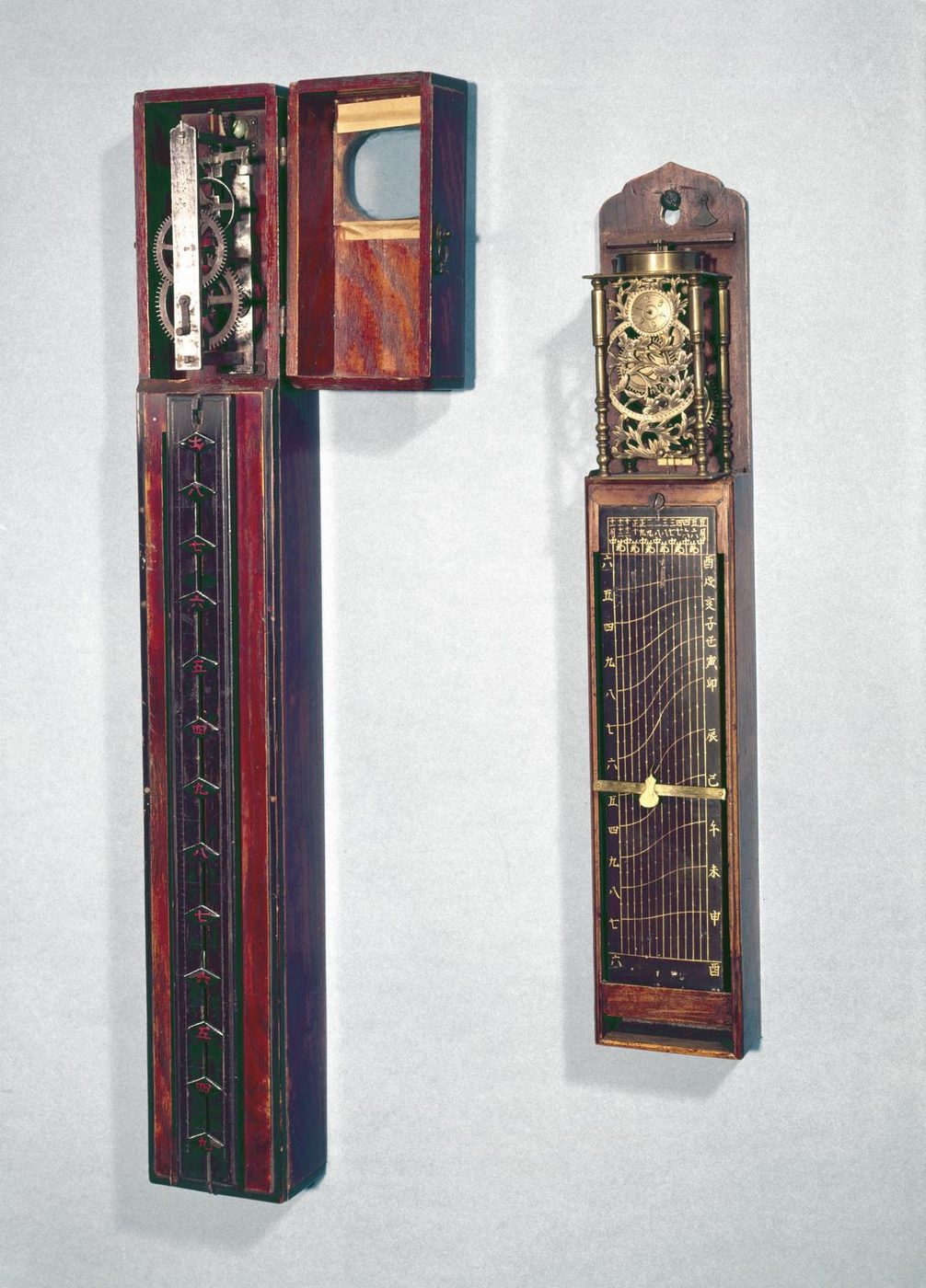
The third approach left the clock running at constant speed and adjusted the dial. On some clocks the hour numerals were mounted on small plates that could be slid around the chapter ring, closer together or further apart, to match the season. On the tall, narrow pillar clocks of the 19th century, a pointer attached to the descending weight moved down a vertical scale, and the hour markers on the scale could be repositioned. Some clocks had interchangeable scales for different periods of the year. Many lantern clocks had a rotating dial with a fixed hand, the reverse of European practice.
The main forms of Japanese clock
| Type | Japanese name | Description | Typical period |
|---|---|---|---|
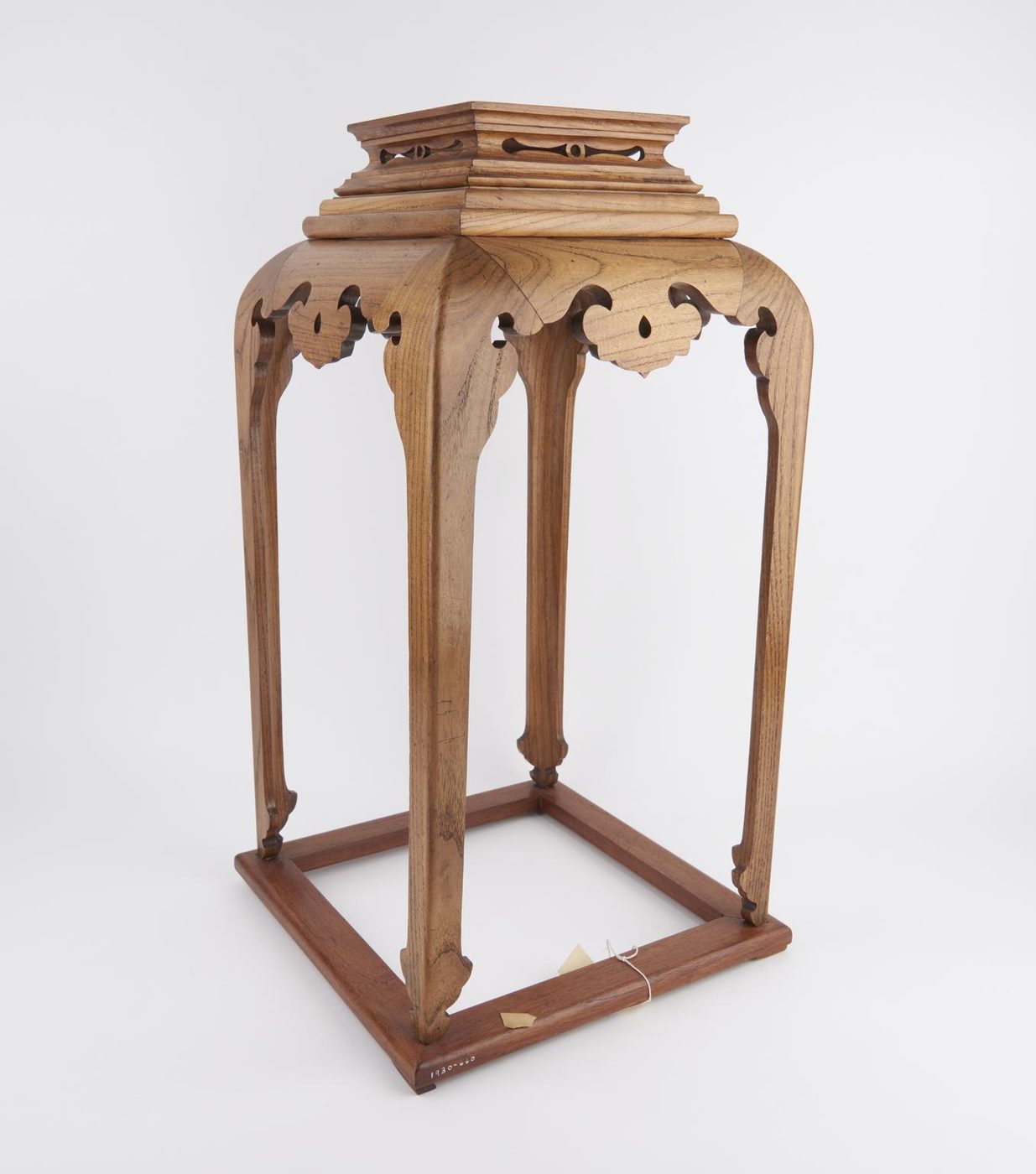
| Lantern clock on a stand | Yagura-dokei | Weight-driven clock in a brass or iron case, set on a tall wooden pyramid stand that hides the weights | 17th–19th century |
| Hanging lantern clock | Kake-dokei | A similar clock hung on a wall or bracket | 17th–19th century |
| Bracket or 'pillow' clock | Makura-dokei | Spring-driven table clock in a box-shaped case | 18th–19th century |
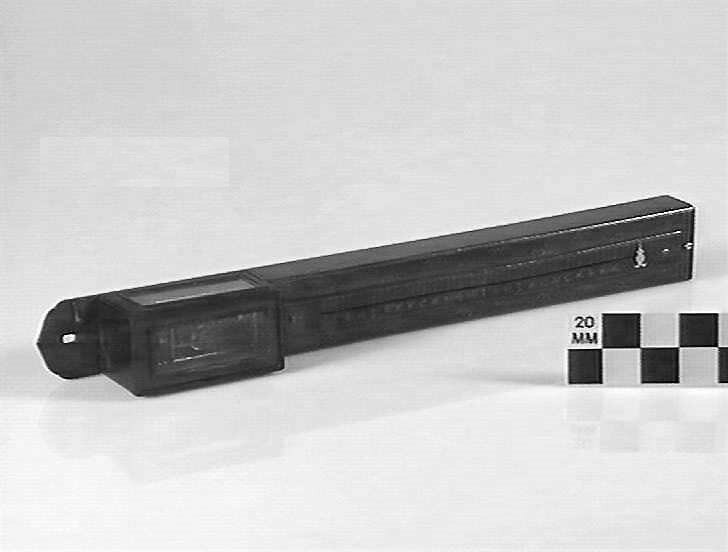
| Pillar clock | Shaku-dokei | Narrow wall clock showing time on a vertical scale with a weight pointer | Mainly 19th century |
| Portable clock | Inrō-dokei | Small spring-driven clock carried like an inrō (a small case worn from the sash) | Late 18th–19th century |
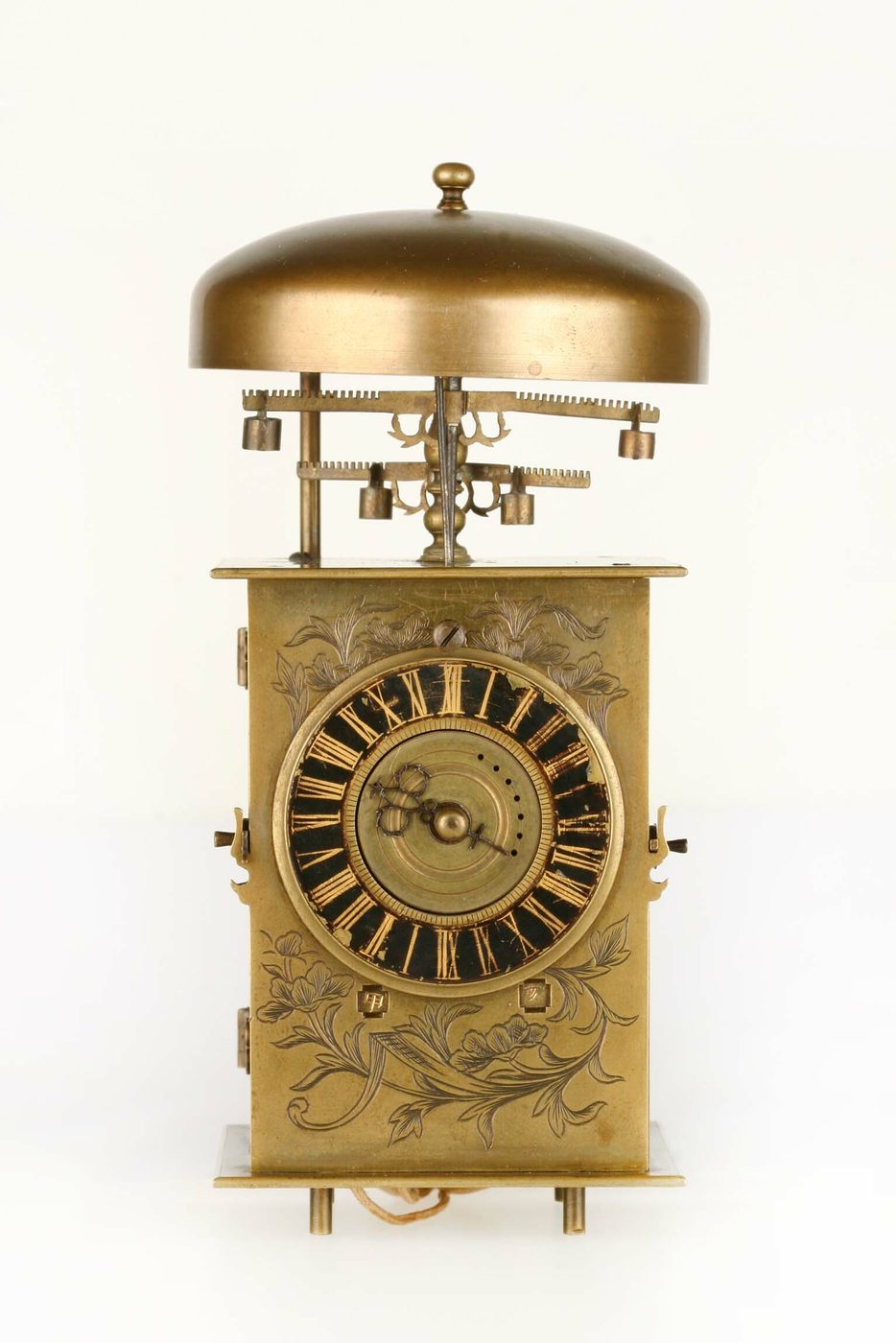
Japanese clocks were luxury objects. Many were made for daimyō, the regional lords, by clockmakers attached to their households, and decorated with engraved brass, lacquer and family crests. Signatures are uncommon, and few individual makers are documented in Western-language sources. The most famous Japanese clockmaker of the period, Tanaka Hisashige, built an elaborate 'Myriad-Year Clock' (Mannen Jimeishō) in 1851, with six dials showing Western and Japanese time, the day of the week, the zodiac and the phase of the Moon; his later workshop was one of the roots of the company that became Toshiba.
Telling time without a clock
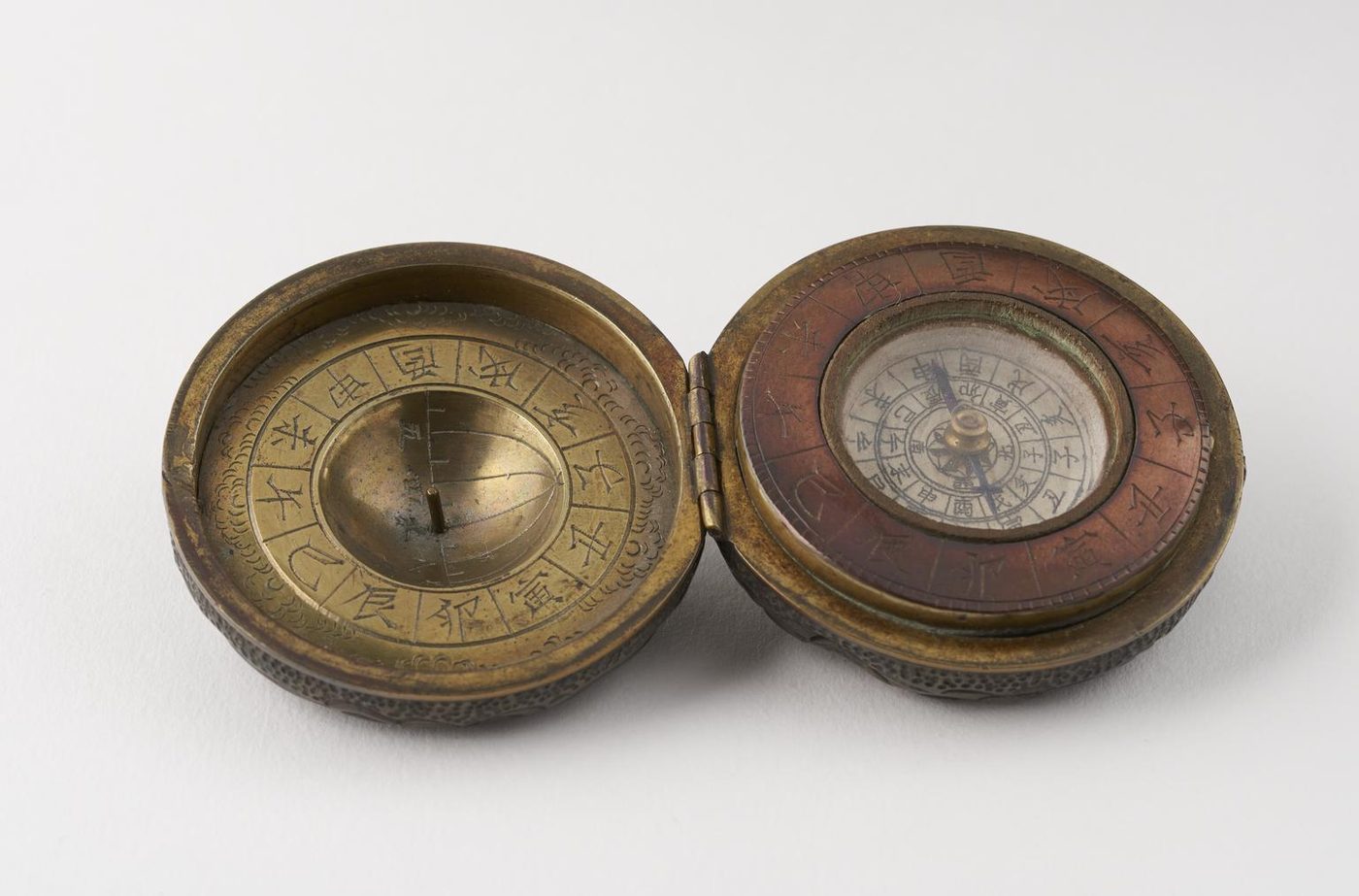
Most people in Edo-period Japan did not own a clock. Public time came from temple bells, which struck the hour counts, and from local timekeepers. Incense clocks, which measured time by the burning of powdered incense along a pattern, were also used, especially in temples and for timing services. Pocket sundials with a compass were made for travellers; examples survive with hour lines divided according to the Japanese system.
1873: the end of the temporal hours
After the Meiji Restoration of 1868 the new government set out to modernise Japan along Western lines. In late 1872 it announced the adoption of the Gregorian calendar and the Western system of twenty-four equal hours; the 3rd day of the 12th month of the fifth year of Meiji became 1 January 1873. Overnight, the wadokei became obsolete. Many were converted to Western time; others were put away or sold, and from the late 19th century collectors in Europe and the United States began to acquire them.
Clockmaking in Japan continued on Western lines. Factories produced wall and pillar clocks with equal-hour dials, and imported American and German clocks were widely sold. In 1881 Kintarō Hattori opened a watch and clock shop in Tokyo; in 1892 he founded the Seikosha factory, which made wall clocks before moving into pocket watches and, in 1913, Japan's first wristwatch, the Laurel. The company's later history — through the Grand Seiko line to the Quartz Astron of 1969 — is told elsewhere in the Atlas.
Looking at a Japanese clock today
- Count the foliots: two horizontal bars at the top usually mean an automatic day/night change.
- Look at the dial: movable hour plates, a rotating dial with a fixed hand, or a vertical scale are all characteristic.
- Read the hour marks: zodiac animal names and the counts 9 to 4 indicate the traditional system; Western numerals indicate a later clock or conversion.
- Check for conversion: many clocks were altered after 1873, with new dials or escapements.
- Be cautious with dates: few clocks are signed or dated, and catalogue dates are usually estimates based on construction and style.
A note on sources
N. H. N. Mody's Japanese Clocks (1932) remains the classic English-language survey and is still widely cited, though later research has refined many of its attributions. Museum catalogues are the best source for individual objects. Explanations of the hour system in popular sources sometimes give simplified times; the Atlas uses equinoctial times only as an illustration, and object dates are given as the holding museum records them.
Sources & further reading
- Japanese Clocks — N. H. N. Mody, Kegan Paul (London), 1932.
- Revolution in Time: Clocks and the Making of the Modern World — David S. Landes, Harvard University Press, 1983.
- History of the Hour: Clocks and Modern Temporal Orders — Gerhard Dohrn-van Rossum, University of Chicago Press, 1996 (German original 1992).