
Horological History · Historical feature
The Sundial: A History of Telling Time by the Sun
For most of history, the sundial was the clock. From Egyptian shadow clocks to pocket dials and the heliochronometer, how people read time from the Sun — and why mechanical clocks still depended on them.
Atlas Editorial · · 8 min read
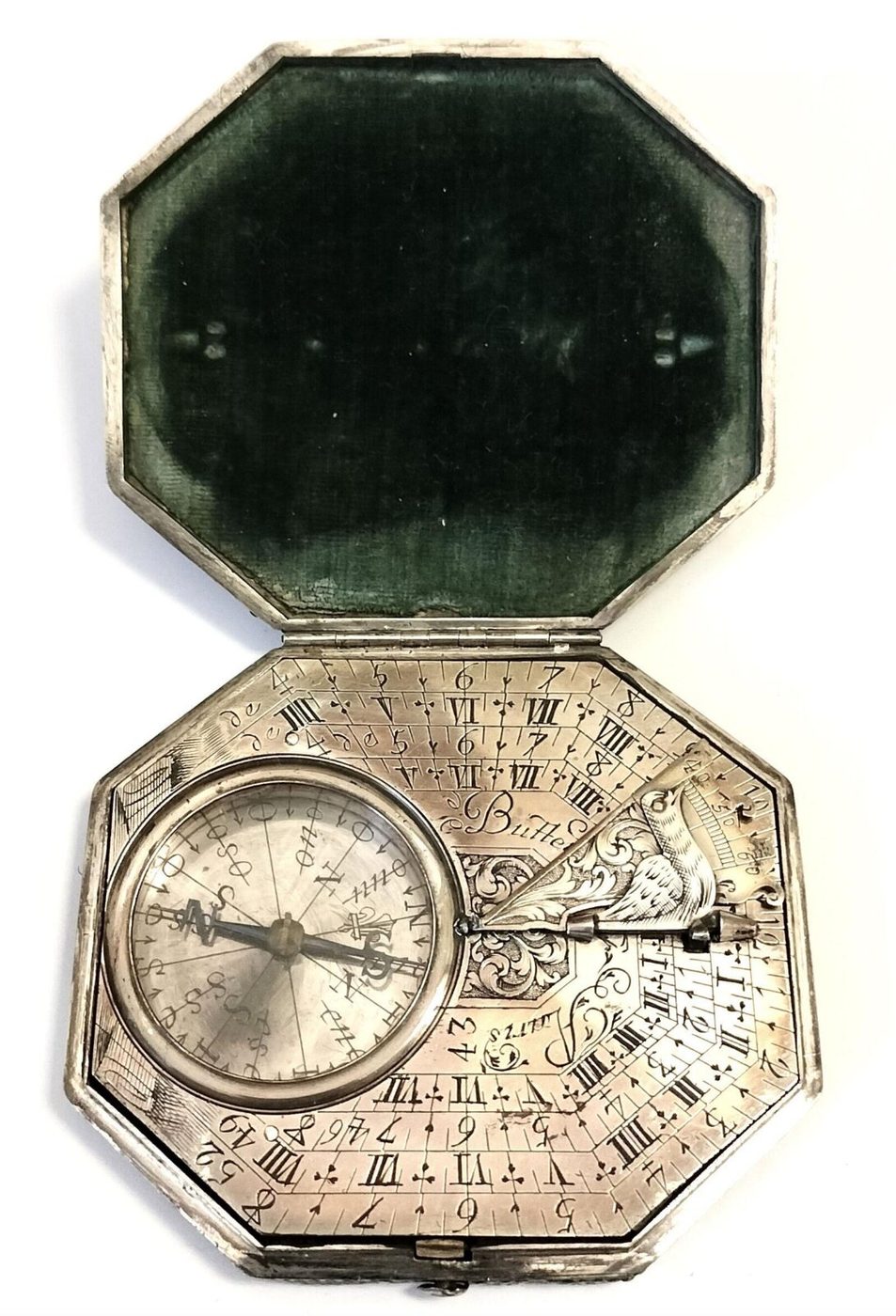
Victoria and Albert Museum, London · © Victoria and Albert Museum (non-commercial terms) — permission review · source (opens another website in a new tab)
A stick in the ground casts a shadow, and the shadow moves. That observation is the basis of the oldest scientific instrument for measuring time, and for thousands of years it was the most important one. Water clocks, candles and sandglasses measured intervals; the sundial measured the time of day itself, directly from the Sun. Even after mechanical clocks spread through Europe, they were set and corrected by sundials until the railway and the telegraph brought standard time in the 19th century.
This feature surveys the main kinds of sundial, the astronomy they rely on, and the objects that survive in museum collections, many of which can be explored in the Atlas catalogue.
How a sundial works
A sundial has two parts: the gnomon, which casts the shadow (or, in some dials, a small hole or bead that casts a spot of light), and the dial plate, marked with hour lines. As the Earth turns, the Sun appears to move across the sky about 15 degrees an hour, and the shadow moves with it. The difficulty is that the Sun's path also changes with the seasons — higher in summer, lower in winter — and with the observer's latitude. A dial made for one place and one style of hour will be wrong elsewhere.
The great simplification came with the polar-pointing gnomon: if the shadow-casting edge is set parallel to the Earth's axis, pointing at the celestial pole, the shadow's direction at a given time is the same all year, and equal hours can be marked. Such dials depend on latitude — the gnomon's angle equals the latitude — but they no longer depend on the season. Earlier dials more often showed temporal hours, dividing daylight into twelve parts whatever its length.
| Type | How it reads time | Typical use |
|---|---|---|
| Shadow clock | Length or position of a shadow on a straight scale | Ancient Egypt |
| Hemispherical / conical dial | Shadow tip inside a carved bowl or cone | Greek and Roman public dials |
| Vertical / scratch dial | Shadow on a wall, often with only a few lines for services | Medieval churches |
| Horizontal or vertical with polar gnomon | Shadow direction, equal hours | Gardens, buildings, from the late Middle Ages |
| Altitude dial (cylinder, ring) | Height of the Sun, set for the date | Portable dials for travellers and shepherds |
| Compass dial (diptych, Butterfield) | Polar gnomon aligned with a compass | Portable dials, 16th–18th century |
| Equinoctial / universal dial | Hour ring in the plane of the equator, adjustable for latitude | Precision portable dials, 17th–19th century |
| Analemmatic dial | Vertical gnomon moved along a date scale; hour points on an ellipse | Gardens and portable instruments |
| Heliochronometer | Corrected for the equation of time, reads clock time | Setting clocks, c. 1900 |
Egypt, Greece and Rome
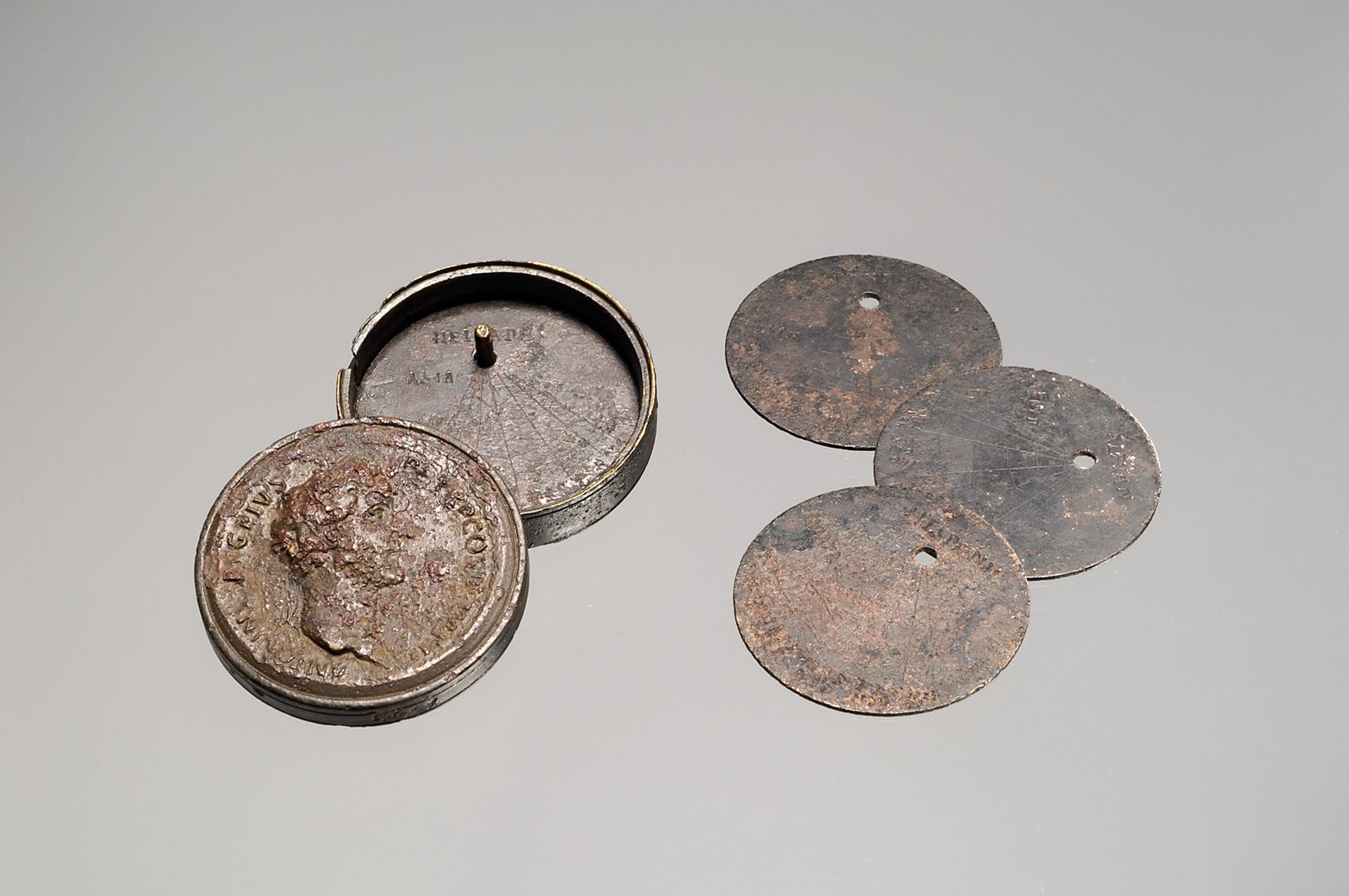
The oldest surviving instruments for measuring time from the Sun come from Egypt. Shadow clocks of the second millennium BCE consist of a horizontal bar with marks and a raised crosspiece that casts a shadow along it; they were turned to face east in the morning and west in the afternoon. Egyptian astronomers also used the merkhet, a sighting instrument for observing stars crossing the meridian at night.
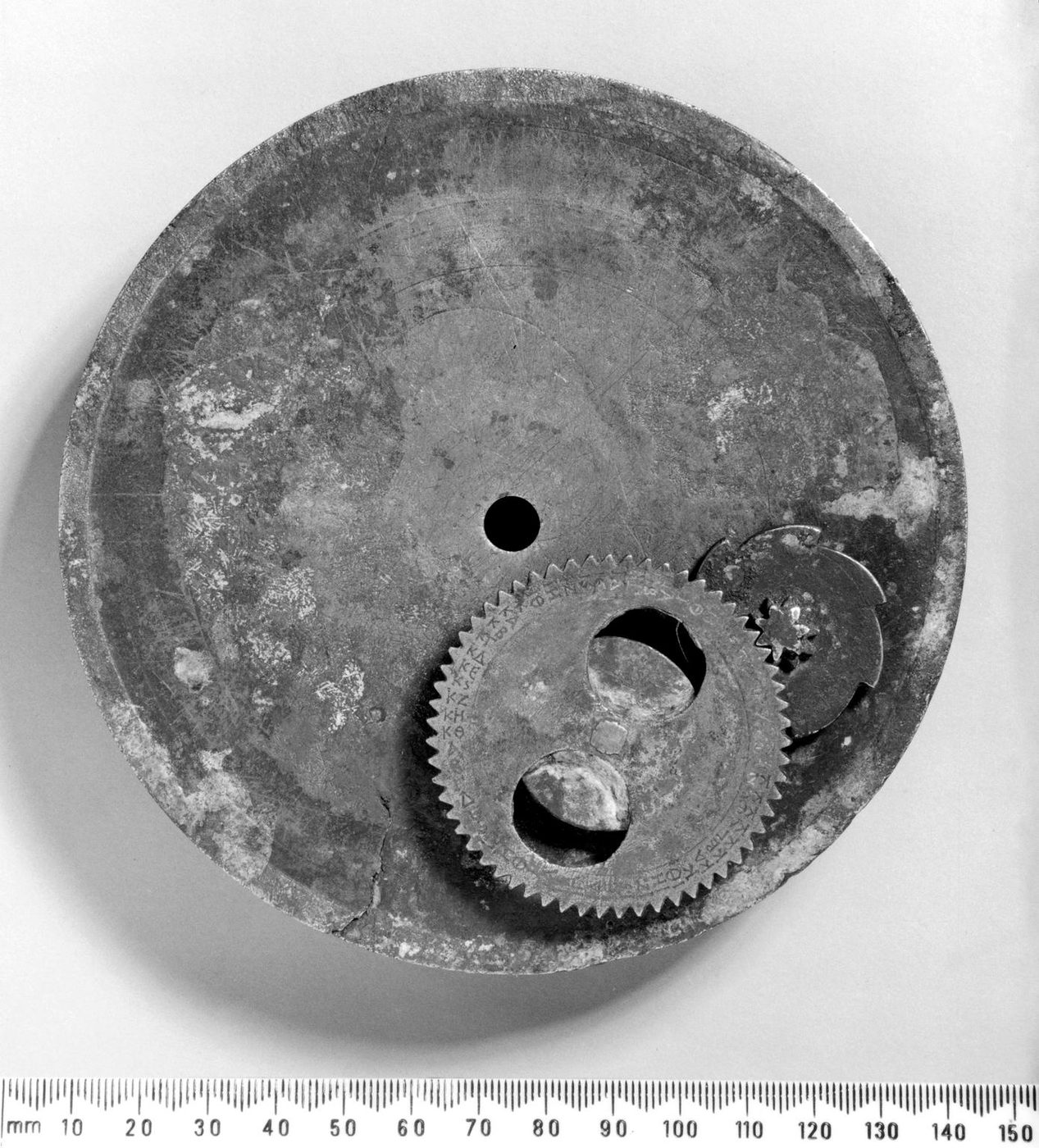
Greek astronomers turned the sundial into a geometric instrument. The Roman architect Vitruvius, writing in the late first century BCE, lists more than a dozen types of sundial and the people credited with inventing them, attributing the hemispherical dial to Berossus the Chaldean. The Tower of the Winds in Athens, built in the first century BCE, carries sundials on its eight faces and once housed a water clock. Pliny the Elder recorded that the first public sundial in Rome, brought from Catania in Sicily in 263 BCE, was made for a different latitude and showed the wrong time — yet the Romans used it for almost a century.
Islamic sundials and the time of prayer
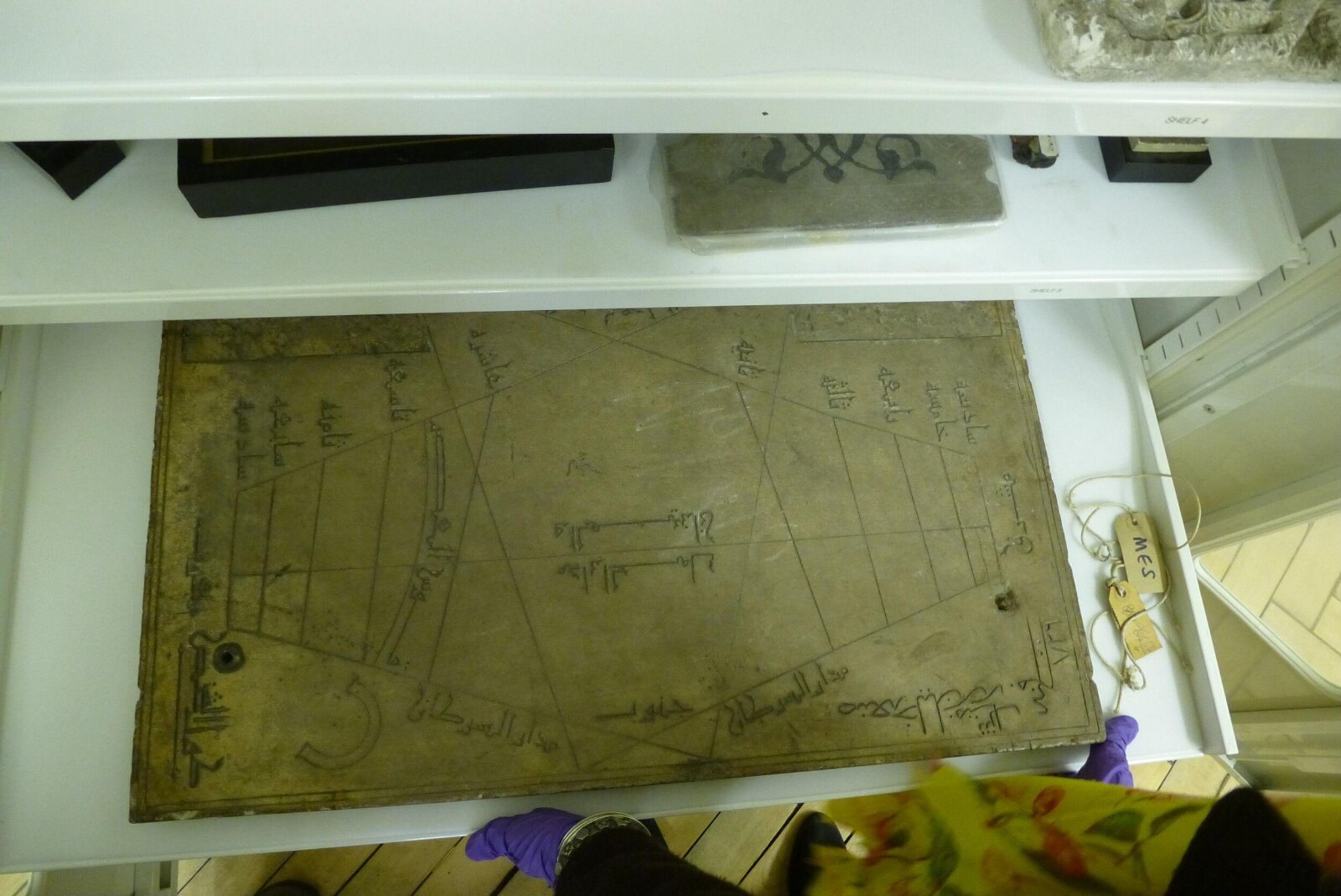
In the Islamic world, sundials were essential religious instruments. The times of the five daily prayers are defined by the Sun — the midday prayer begins after noon, the afternoon prayer when shadows reach a certain length — and mosque timekeepers (muwaqqits) used sundials, quadrants and astrolabes to determine them. Dials often carry special lines for the prayer times alongside the hour lines. The astronomer Ibn al-Shāṭir made a great marble sundial for the Umayyad Mosque in Damascus in 1371–72 with a gnomon parallel to the Earth's axis, one of the earliest known examples of the polar gnomon.
Medieval Europe: dials for the hours of prayer
In medieval Europe the commonest sundials were simple vertical dials scratched or carved on the south walls of churches — often called mass or scratch dials. They usually had a horizontal rod as gnomon and a semicircle of lines, some marked more heavily for the times of services. They were not precise instruments; they told a community when to gather. Similar dials appear in Anglo-Saxon England, Scandinavia and across the Continent.
The arrival of the mechanical clock around 1300 changed the purpose of the sundial rather than ending it. Early clocks were inaccurate by modern standards and drifted by many minutes a day. They had to be reset, and the only reference available was the Sun. Throughout the 15th to 18th centuries, sundials with polar gnomons — showing equal hours to match the clocks — were set up on buildings and in gardens, and every clock owner needed access to one.
The golden age of portable dials
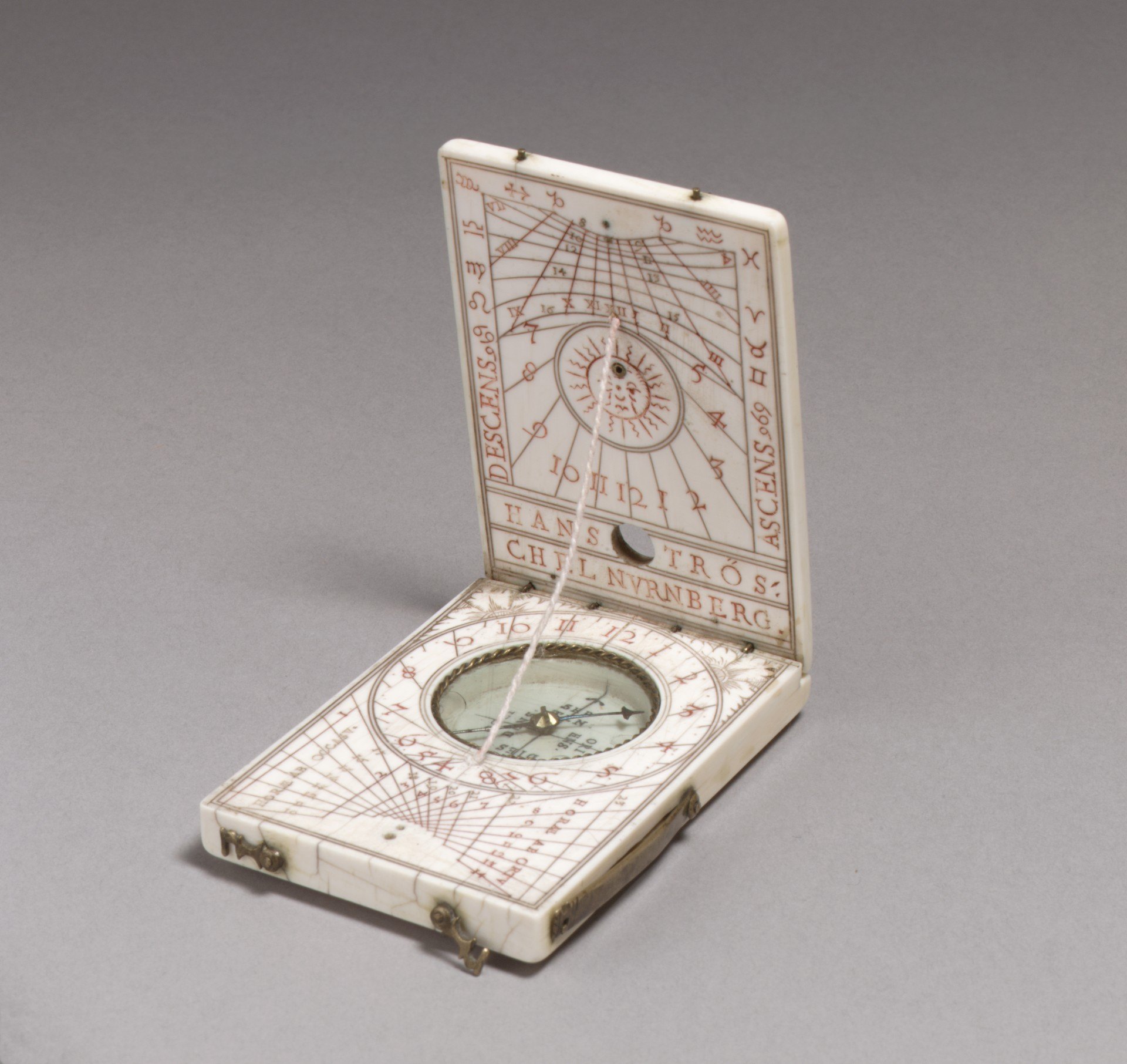
From the 16th century, instrument makers produced portable sundials in large numbers. Nuremberg was famous for ivory diptych dials: two hinged leaves with a string gnomon stretched between them and a magnetic compass in the lower leaf to align the dial with north. Makers such as Hans Tröschel and Paulus Reinmann signed and dated their work, and the leaves often carry several dials for different hour systems, lunar tables and lists of latitudes.
In Paris, the English-born instrument maker Michael Butterfield gave his name to a type of pocket dial with a folding gnomon whose angle could be set for latitude using a small bird-shaped pointer, and hour scales for several latitudes engraved on an octagonal plate. Butterfield dials were made from the late 17th century and widely copied by other Parisian makers.
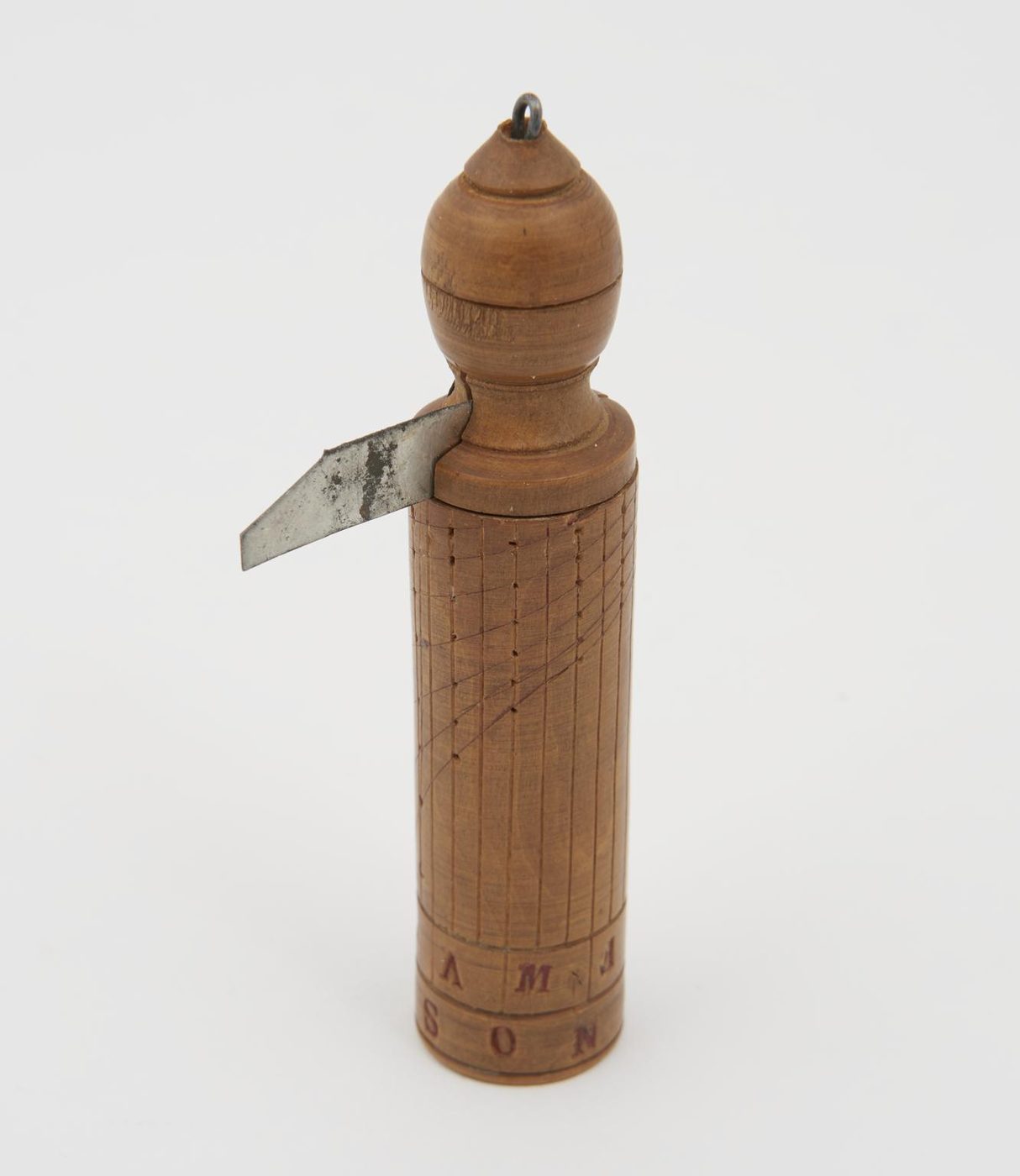
Other portable forms used the Sun's altitude rather than its direction, so no compass was needed. The cylinder or 'shepherd's' dial is a column with hour curves for each part of the year and a gnomon that is turned to the correct date; ring dials have a small hole through which a spot of light falls on an hour scale inside the ring. Both were cheap and remained in use in rural areas for a long time.
The most accurate portable dials were the universal equinoctial dials of the 18th century, especially those made in Augsburg. Their hour ring is set in the plane of the equator and can be tilted for any latitude, and a built-in compass and levelling feet allow careful alignment. Some 'mechanical' equinoctial dials carry a minute hand, geared to the gnomon, to read the time more finely.
Sun time and clock time: the equation of time
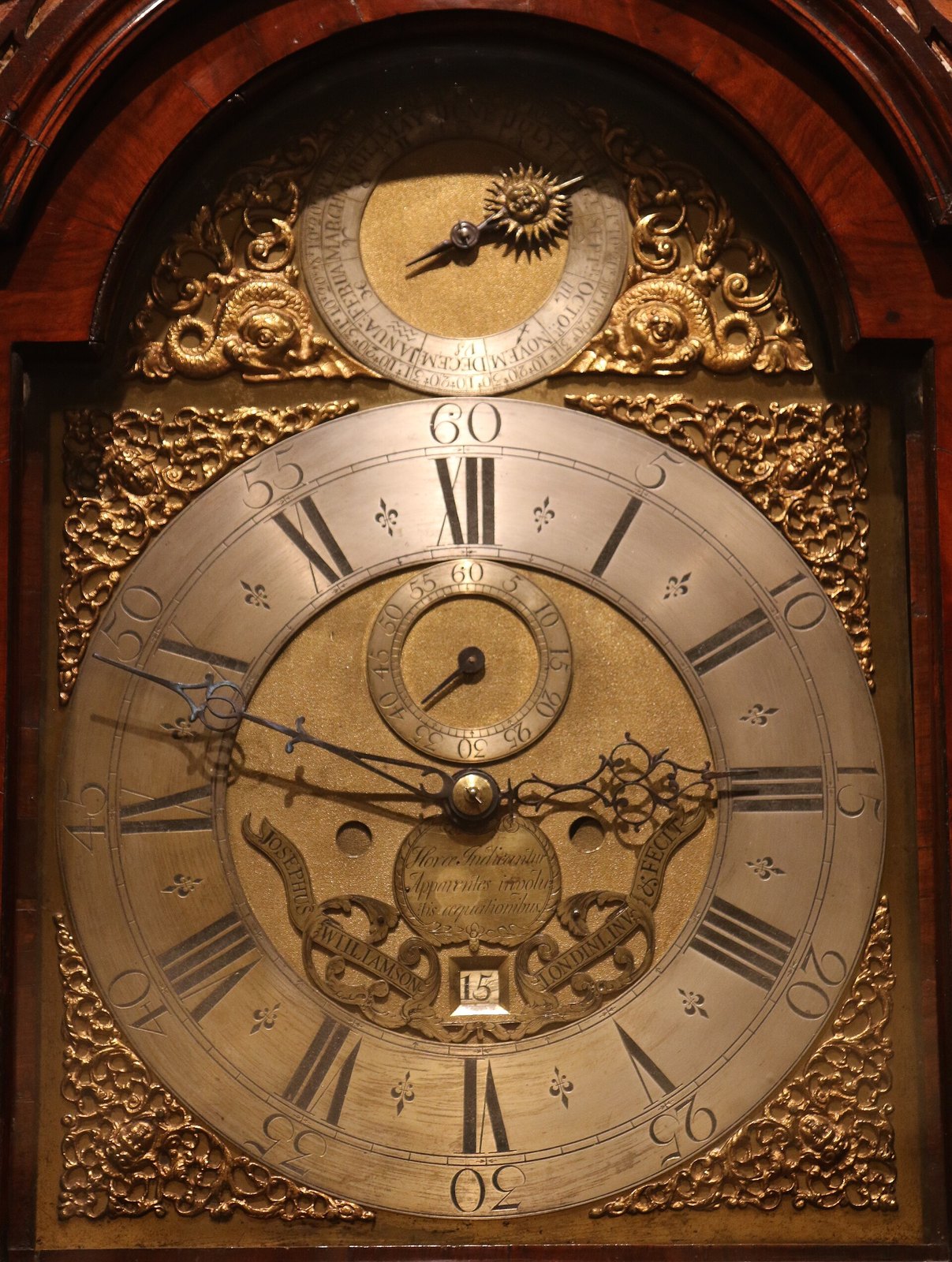
A sundial shows apparent solar time, set by the real Sun. A good clock keeps mean time, set by an imaginary Sun moving uniformly. Because the Earth's orbit is elliptical and its axis is tilted, the two drift apart and back again through the year: the sundial is up to about 14 minutes slow in February and up to about 16 minutes fast in early November. This difference is the equation of time. Once pendulum clocks became accurate enough in the late 17th century, the difference became obvious, and tables of the equation of time were printed for clock owners.
Monumental and precision dials
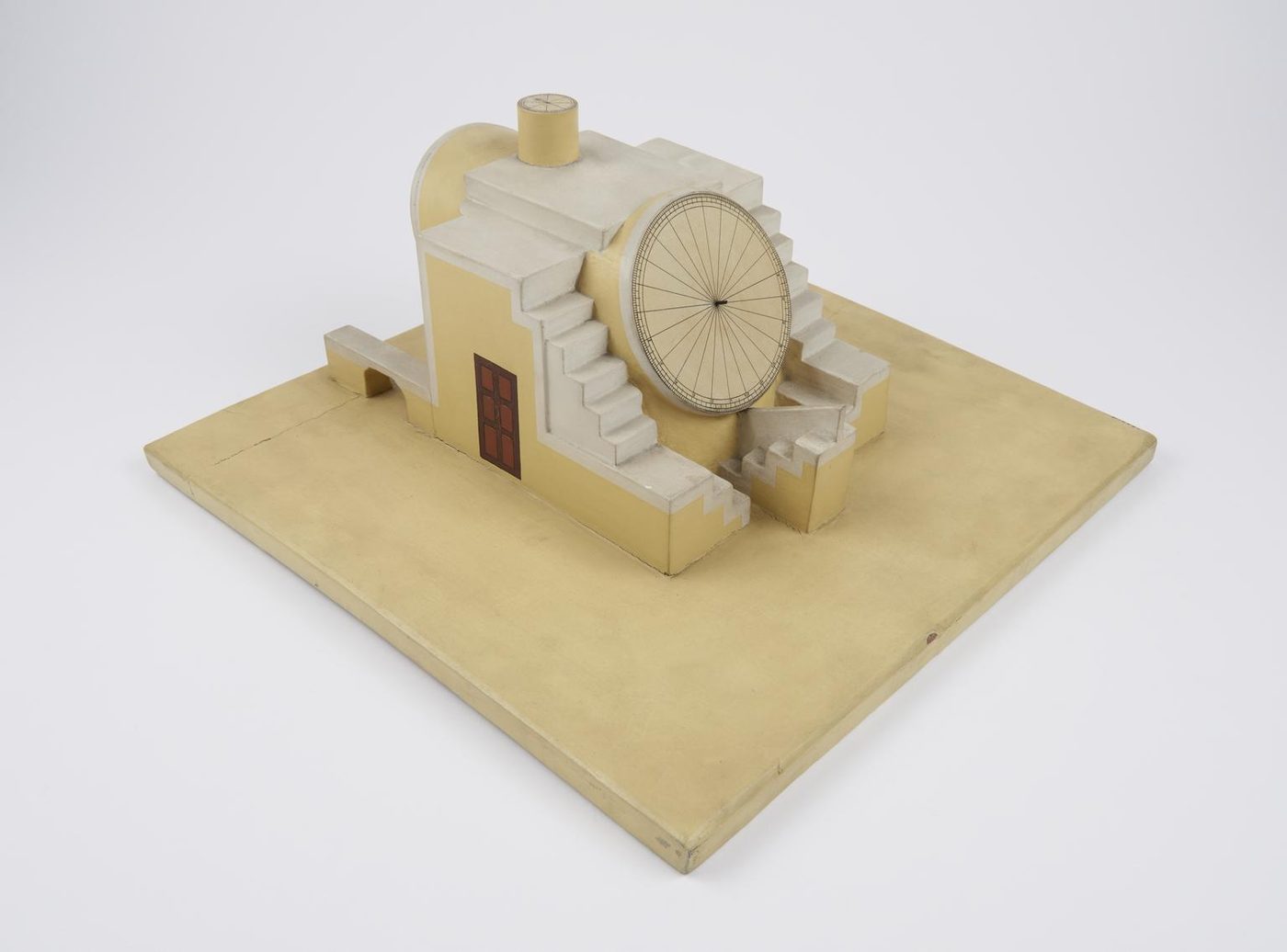
In the 1720s and 1730s the Maharaja Jai Singh II built astronomical observatories in several north Indian cities, of which the Jantar Mantar in Jaipur is the largest. Its Samrat Yantra is a giant equinoctial sundial with a gnomon about 27 metres high, whose shadow moves fast enough to read time to a few seconds. The observatory's Narivalaya, a double equinoctial dial, shows time on two faces for the northern and southern halves of the year.
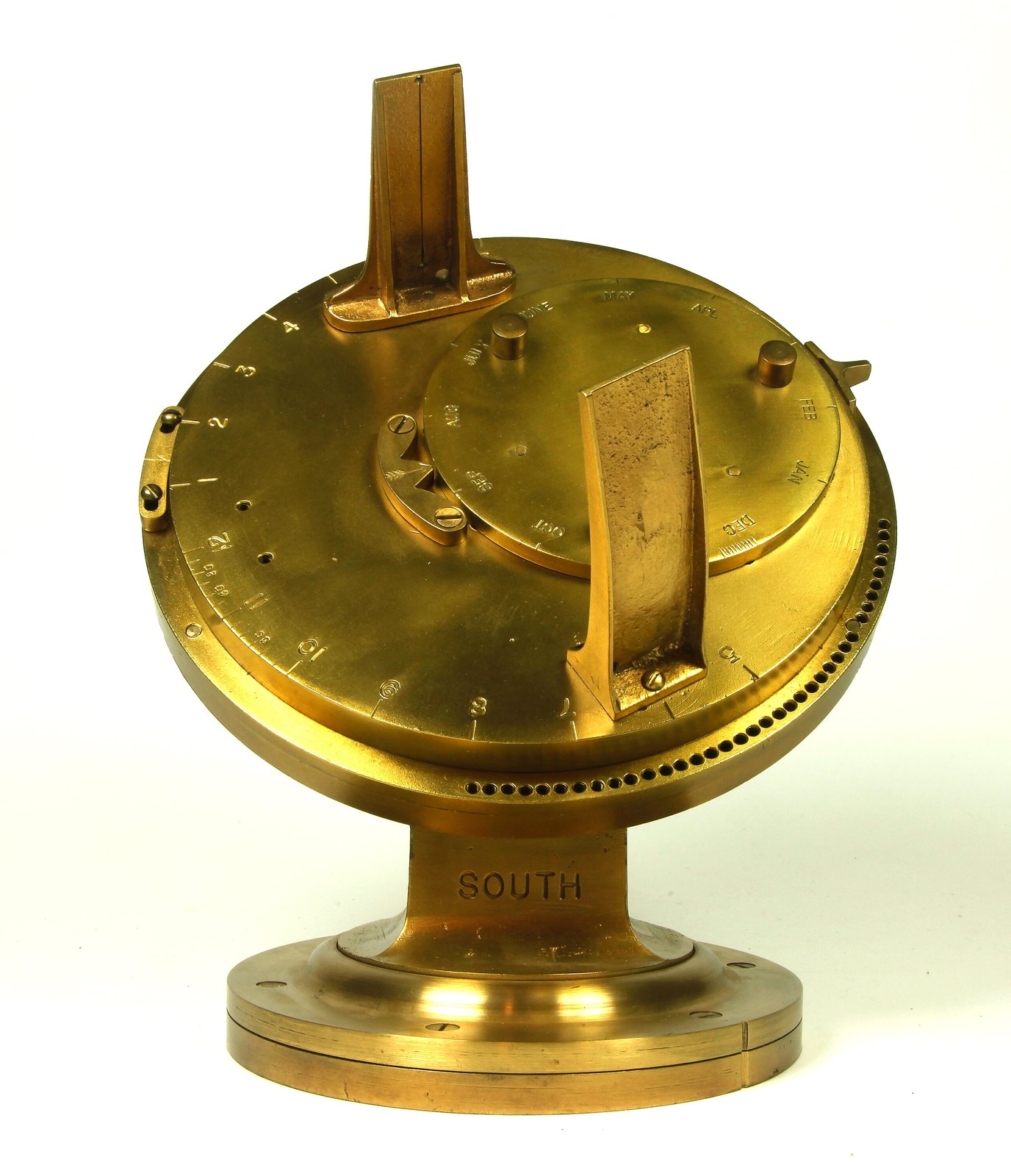
Other dials served practical needs. Noon guns, made especially in France and Britain from the late 18th century, used a burning lens to fire a small cannon at the moment of solar noon. Meridian lines — a hole in a church roof projecting the Sun's image onto a long brass line in the floor — gave astronomers and clock setters a precise measurement of noon. In the early 20th century, the heliochronometer of Pilkington & Gibbs in Preston built the equation of time into the dial, so that it read standard clock time directly.
Reading a sundial in a museum
- Find the gnomon's angle: a polar gnomon set at the local latitude indicates equal hours; a horizontal or vertical rod usually indicates an older or simpler dial.
- Look for latitude marks: portable dials often list cities and latitudes, which can point to where they were made or sold.
- Count the hour systems: diptych dials may show Italian, Babylonian and planetary hours as well as ordinary hours.
- Check for a compass: its needle may carry a mark for magnetic declination, which changed over time and can help date the dial.
- Look for signatures and dates on leaves and plates, and compare them with known makers.
Why sundials still matter
Sundials remind us that time was once local — every town had its own noon — and that mechanical clocks were instruments for keeping a time that the sky defined. Standard time zones, introduced for the railways and adopted internationally after the 1884 Meridian Conference, separated civil time from the local Sun, and atomic clocks have since separated it from the Earth's rotation altogether. But every sundial still tells the truth about where the Sun is, and the history of horology begins with it.
Sources & further reading
- Gears from the Greeks: The Antikythera Mechanism — Derek J. de Solla Price, Transactions of the American Philosophical Society 64 (7), 1974.
- In Synchrony with the Heavens: Studies in Astronomical Timekeeping and Instrumentation in Medieval Islamic Civilization — David A. King, Brill (Leiden), 2004–2005.
- History of the Hour: Clocks and Modern Temporal Orders — Gerhard Dohrn-van Rossum, University of Chicago Press, 1996 (German original 1992).
- Revolution in Time: Clocks and the Making of the Modern World — David S. Landes, Harvard University Press, 1983.