
Wristwatches · Wristwatch
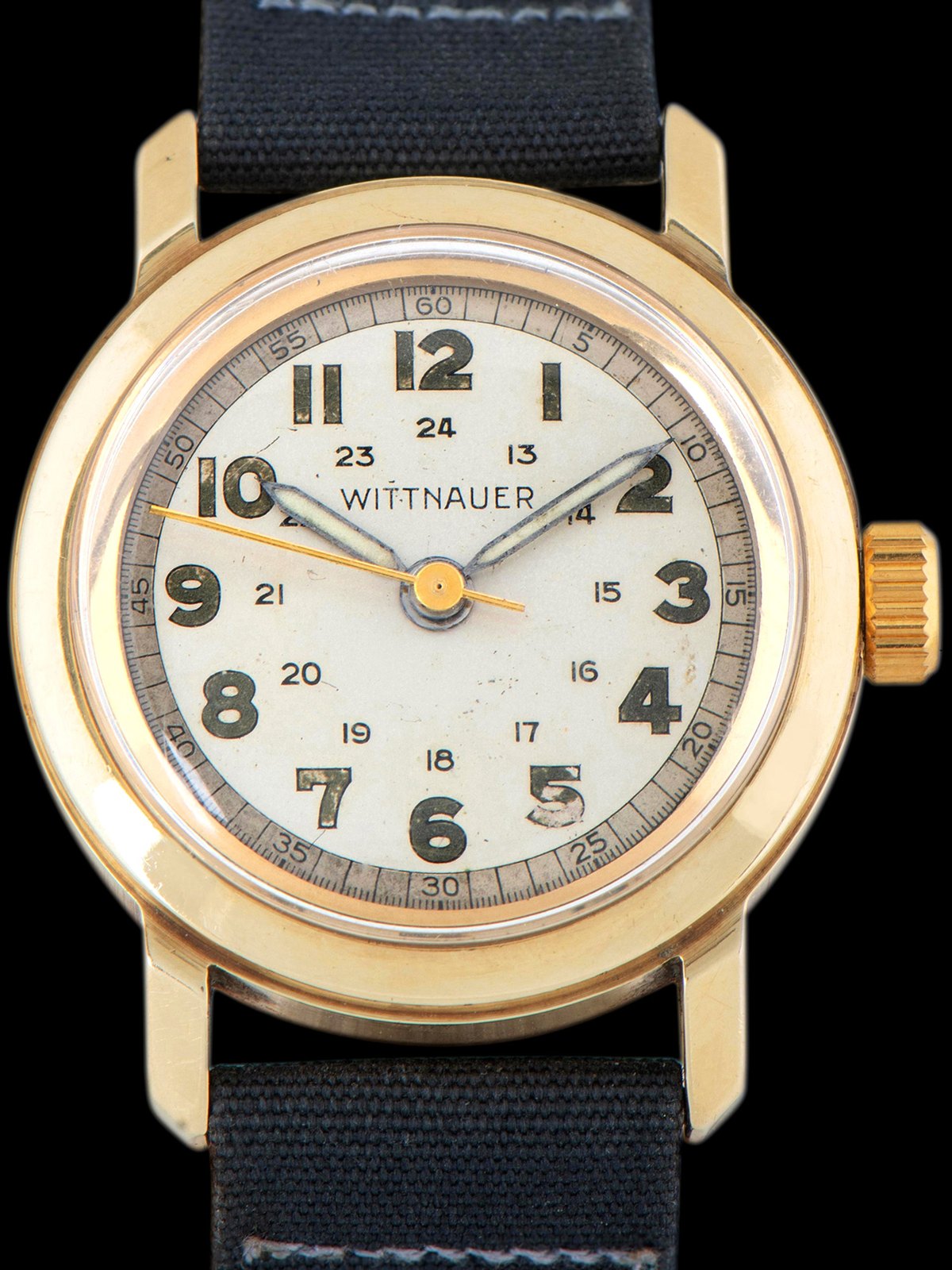
Wittnauer Dress Watch 14K YG "24hr Dial", 1940s
- Maker / attribution
- Wittnauer (maker)
- Date
- 1940s
- Historical period
- Golden Age of Mechanical Watchmaking (1900 – 1945)
- Country of origin
- Unrecorded in source
- Object type
- Wristwatch
- Dimensions
- Case 29 mm
- Stock no.
- WITTYGDW
- Credit line
- Dealer listing, Craft & Tailored (WITTYGDW)
- Catalogue title (original)
- 1940s Wittnauer Dress Watch 14K YG "24hr Dial" (English)
View the source record (dealer listing) ↗ (opens another website in a new tab)Suggest a correction
Record summary
Catalogued by Craft & Tailored (dealer), Los Angeles (stock number WITTYGDW), this is a wristwatch by Wittnauer, dated 1940s. The Atlas places it in the Golden Age of Mechanical Watchmaking period (1900 – 1945) of its Wristwatches collection. Recorded dimensions: Case 29 mm. The record is illustrated with 6 photographs.
Assembled from the source record's structured fields. Dates and attributions are given as the source states them; where a field is missing the Atlas leaves it blank rather than estimating.
Catalogue description
Dealer description — Craft & Tailored
While Wittnauer certainly isn’t one of the commonly known watch brands, it certainly has the history to rival just about any other out there. Founded in 1885 in New York by Swiss immigrant Albert Wittnauer, the eponymous company set out to craft timepieces designed for exploration and adventure, especially in aviation and sea navigation. In fact, Neil Armstrong wore a Wittnauer for the Gemini 8 mission. In addition to those purpose-built pieces, the brand also crafted some incredibly beautiful dress watches, like this 14k gold number from the 1940s. Featuring a stout, gender-neutral 29mm case with thick lugs and an aged silver 24-hour dial with Arabic numerals, this one strikes a fantastic balance between dressy and sporty, and would look equally appropriate in just about any situation. SPECS Stock # WITTYGDW Brand Wittnauer Style Dress Watch Model N/A Serial 56XXXX Size Men's Material 14K Yellow Gold Dial Silver Millimeters 29 Strap 2pc Canvas Strap CASE & BRACELET The impressive 14K yellow gold case measures a modest 29mm in diameter but the large lugs extend out to give the watch more wrist presence than the measurements would imply. The case itself exhibits evidence of minimal polishing in the past with the original dimensions remaining present while displaying gentle signs of use. The oversized unsigned crown is likely an early replacement but era and style appropriate. The case back is incredibly clean with just a few marks from wear. The watch comes supplied on a two-piece canvas strap with a gold plaque hardware. DIAL & HANDS The aged silver dial is in exceptionally well-preserved vintage condition, featuring a handsome warm patina throughout and only minor marks from age. The lume-filled Arabic numeral hour markers have aged to a dark grey patina with some of the lume lost from the 5 o'clock marker. The syringe-style hands are original to the watch, however, the lume appears to have been previously restored in the past. ACCESSORIES None. The service history is unknown and is ready for service. The service can be provided upon request at the time of service.
Historical context
Golden Age of Mechanical Watchmaking (1900 – 1945)
The wristwatch displaces the pocket watch; waterproof cases, self-winding and grand complications.
The wristwatch overtook the pocket watch. Military use in the First World War, aviation, water-resistant cases (1926), automatic winding (1923–31), rectangular Art Deco designs and early chronographs and calendars defined the period.
Read the period in the timelineMore wristwatches from this periodEarlier: Industrial Revolution
Atlas type guide
Wristwatches
Bracelet watches were worn by women from the early nineteenth century — Breguet made one for Caroline Murat, Queen of Naples, in 1810–12 — but the wristwatch only became a man's instrument with military use and aviation in the early twentieth century. Between the World Wars it overtook the pocket watch; the 1920s and 1930s brought rectangular Art Deco cases, water-resistant cases and the first automatic winding systems.
After 1945 the wristwatch became a carrier of identity — dress watches, sports and dive watches, chronographs, calendars — produced by Swiss, American, Japanese, German, Soviet and Chinese industries. The quartz revolution after 1969 and the mechanical renaissance since the 1990s, including the rise of independent watchmakers, complete the story.
What to look for
- The reference number (between the lugs or inside the case back) and serial number, the starting point for dating.
- The calibre: its maker and number are often stamped under the dial or on the bridge.
- Originality of dial, hands and crown — refinished ('redial') dials are common.
- Case material marks: 18K/750, 14K/585, stainless steel, gold-filled, plated.
Dating clues
- Wire-lug cases: before c. 1925.
- Water-resistant screw-down cases: from 1926.
- Quartz movements: from 1969; sapphire crystals widespread after c. 1980.
General guidance written by the Atlas editors about this kind of object. It is not a statement about this particular piece; for that, rely on the source record above and on physical examination.
Related records
Wristwatches · c. 1960
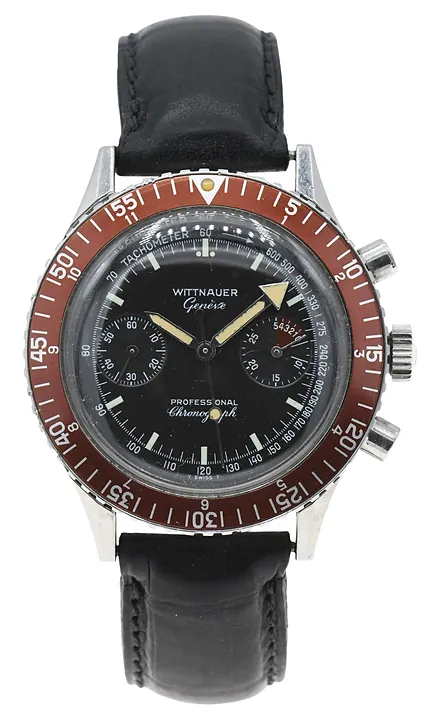
Wittnauer Professional Chronograph, Ref. 7004A, Stainless Steel Wristwatch, circa 1960's
LiveAuctioneers auction archive
Wristwatches · 1960s
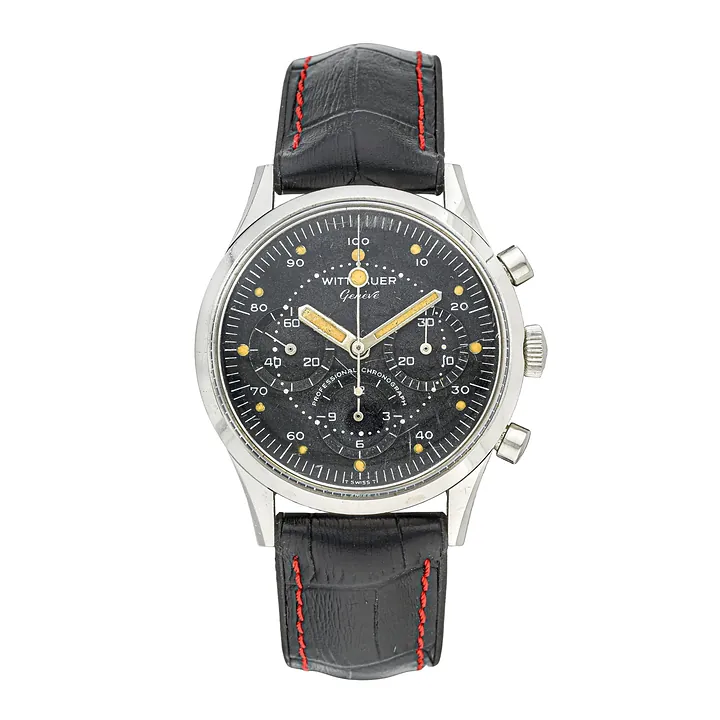
Wittnauer 242T Chronograph in Steel, 1960s
LiveAuctioneers auction archive
Wristwatches · c. 1970
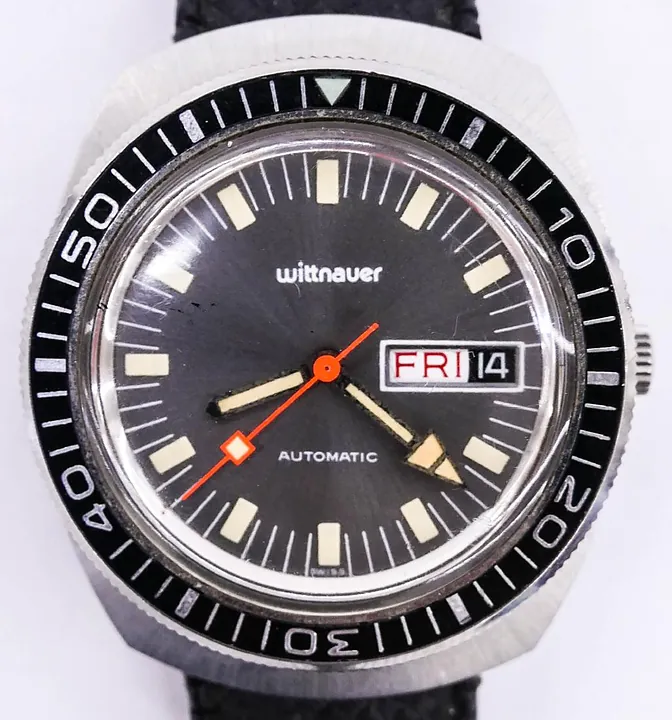
Vintage Wittnauer Diver Chronograph Wrist Watch, c. 1970
LiveAuctioneers auction archive
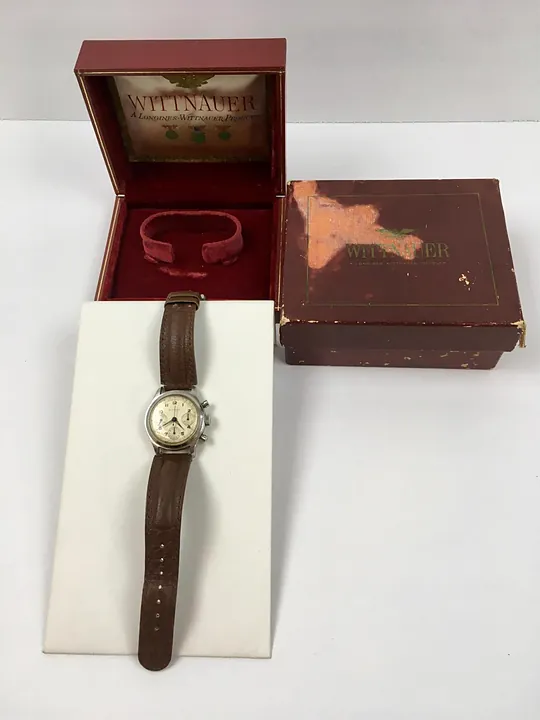
Wristwatches · c. 1950
Vintage Wittnauer chronograph wrist watch, c. 1950
LiveAuctioneers auction archive
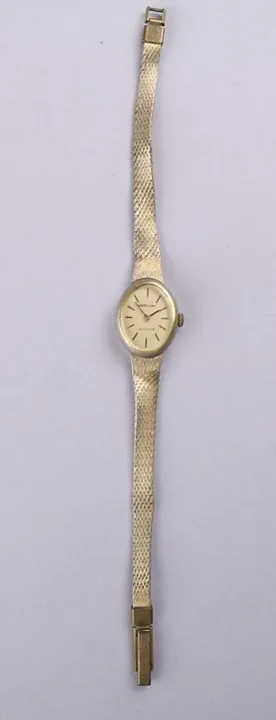
Wristwatches · 1900–1999
Wristwatch by Mercury, 1900–1999
Modemuseum Hasselt
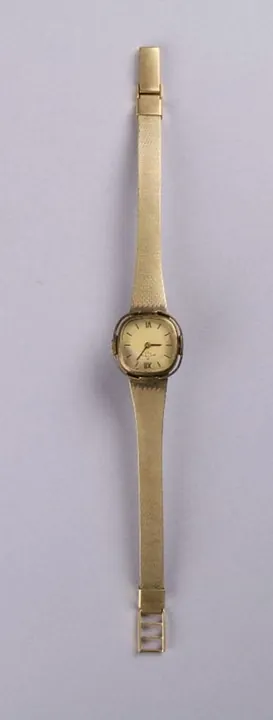
Wristwatches · 1900–1999
Wristwatch by Nutrix, 1900–1999
Modemuseum Hasselt

Wristwatches · 1920
Wristwatch, 1920
Modemuseum Hasselt

Wristwatches · 1931
Rolex 'Oyster Perpetual' rotor self-winding wrist-watch, lever escapement, in steel case with glass in back, Montres Rolex SA, Geneva, Switzerland, 1931
Science Museum Group, London