
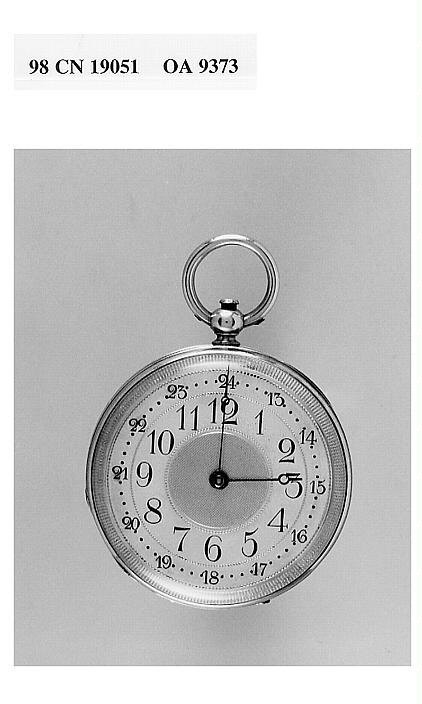
Pocket Watches · Watch
Watch, Switzerland, 1850–1900
- Maker / attribution
- Unrecorded in source
- Date
- 1850–1900
- Historical period
- Industrial Revolution (1850 – 1900)
- Country of origin
- Switzerland
- Place
- Suisse, Switzerland
- Object type
- Watch
- Materials / technique
- gold, silver, brass
- Dimensions
- thickness 0,9 cm; height 4,7 cm; length 4 cm
- Holding institution
- Musée du Louvre, Paris
- Accession / object no.
- OA 9373
- Credit line
- Musée du Louvre, Département des Objets d'art du Moyen Age, de la Renaissance et des temps modernes
- Catalogue title (original)
- Montre ronde (French)
View the source record ↗ (opens another website in a new tab)Suggest a correction
Record summary
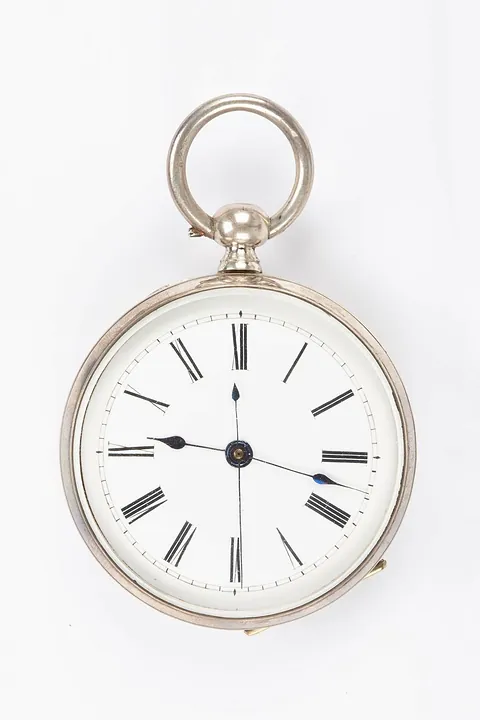
Held and catalogued by Musée du Louvre, Paris (object number OA 9373), this is a watch, made in Suisse, Switzerland, dated 1850–1900. The Atlas places it in the Industrial Revolution period (1850 – 1900) of its Pocket Watches collection. Materials and techniques recorded by the source: gold, silver, brass. Recorded dimensions: thickness 0,9 cm; height 4,7 cm; length 4 cm. The record is illustrated with 4 photographs.
Assembled from the source record's structured fields. Dates and attributions are given as the source states them; where a field is missing the Atlas leaves it blank rather than estimating.
Catalogue description
Catalogue description — Musée du Louvre (French)
Sur le fond de la montre un décor gravé représente une allégorie de la République : femme nue à mi-corps tenant les attributs des Sciences et des Arts au-devant d'un champ de blé, sous une arcature entourée de fleurs et de rinceaux. Sur la cuvette sont gravés les noms de trois héros polonais, Kosciuszko, Dombrowski, Poniatowski sous une couronne étoilée et au-dessus de deux drapeaux marqués d'inscriptions patriotiques : LIBERTE/ORDRE PUBLIC et LIBERTE INTEGRITE INDEPENDANCE. Le cadran en argent poli et guilloché porte des chiffres arabes niellés pour les heures et les minutes.
Shown in the original language of the source catalogue. An editor-reviewed English translation has not yet been published; we do not publish machine translations as authoritative text.
Dating and period as catalogued (French)
Date de création/fabrication : 1850 - 1900
Shown in the original language of the source catalogue. An editor-reviewed English translation has not yet been published; we do not publish machine translations as authoritative text.
Materials and techniques as catalogued (French)
Matériau : or · Matériau : argent · Matériau : laiton · Technique : niellé (techniques métal) · Technique : techniques métal (orfèvrerie)
Shown in the original language of the source catalogue. An editor-reviewed English translation has not yet been published; we do not publish machine translations as authoritative text.
Inscriptions & marks
Poinçon : ; sur la bélière: petite garantie, tête d'aigle, Paris, depuis 1838 ; Suisse, après 1835
Provenance
Legs de Madame Bijasson de Turenne (1864-1942) en 1943 ; déposé du musée des Arts décoratifs de Paris le 19 novembre 1943, ratifié par un arrêté de dépôt du 30 juin 1944 ; rentré au musée du Louvre par arrêté de fin de dépôt du 7 juillet 1983
Historical context
Industrial Revolution (1850 – 1900)
American interchangeable-parts manufacture; railroad time standards; Swiss and German factory systems.
Machine production with interchangeable parts, pioneered by Waltham (1850s) and adopted by Elgin, Longines, Omega and others, made reliable lever watches widely affordable. Keyless winding became standard, railroad watch standards were introduced (1890s), and Swiss and American industries competed globally.
Read the period in the timelineMore pocket watches from this periodEarlier: Precision & Scientific Horology
Atlas type guide
Pocket watches
The pocket watch was the dominant personal timekeeper from the late seventeenth century until the First World War. Its development tracks the history of the escapement: verge watches with fusees until the late eighteenth century; Thomas Mudge's lever escapement (c. 1755) and the cylinder escapement popularised by George Graham and later by Swiss makers; and the Swiss and English lever watches of the nineteenth century. Lépine's bar-bridge calibre and keyless winding made watches thinner and easier to use.
Industrialisation transformed the trade: American factories such as Waltham (from 1850) and Elgin produced interchangeable parts by machine, and Swiss makers responded with their own mechanisation after the 1876 Philadelphia Exhibition. By 1900 a reliable watch was affordable to millions; the finest makers continued to produce complications and precision watches.
What to look for
- The escapement: verge (crown wheel), cylinder, duplex, English or Swiss lever.
- Key winding (a square arbor in dial or back) or keyless crown winding.
- Signatures and serial numbers on the movement, dial and inside case back.
- Hallmarks, case maker's marks and gold or silver standards stamped in the case.
- Dial material: enamel, silver, gold, later printed metal.
Dating clues
- Verge watches dominate before c. 1800; cylinder watches c. 1770–1900; lever watches after c. 1820.
- Keyless winding: increasingly common after c. 1860.
- Manufacturer serial number lists exist for Waltham, Elgin, Longines, Omega, Patek Philippe and others.
General guidance written by the Atlas editors about this kind of object. It is not a statement about this particular piece; for that, rely on the source record above and on physical examination.
Read next:Verge escapementDetached lever escapementFuseeIdentification Centre
Related records
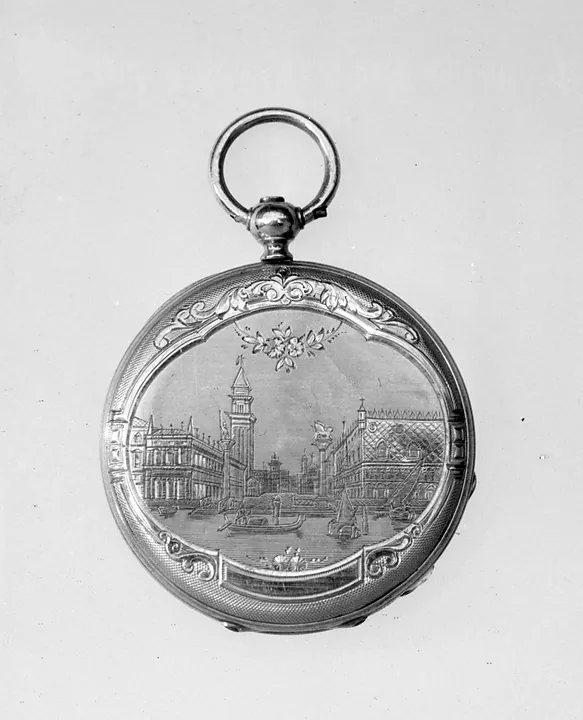
Pocket Watches · c. 1850
Watch by Eugène Bornand, Switzerland, c. 1850
The Metropolitan Museum of Art, New York
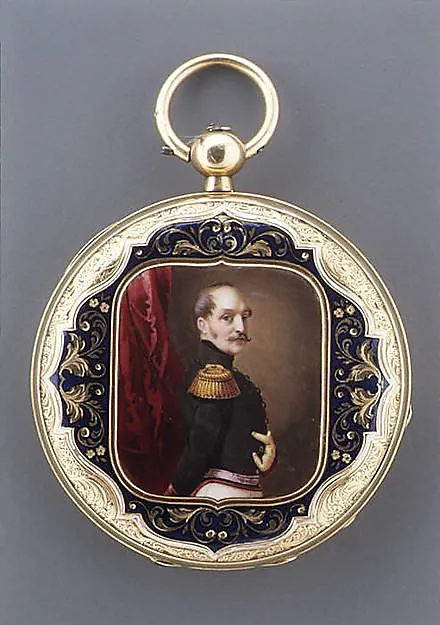
Pocket Watches · probably c. 1850–55
Watch by Firm of Perret & Cie, Switzerland, probably c. 1850–55
The Metropolitan Museum of Art, New York
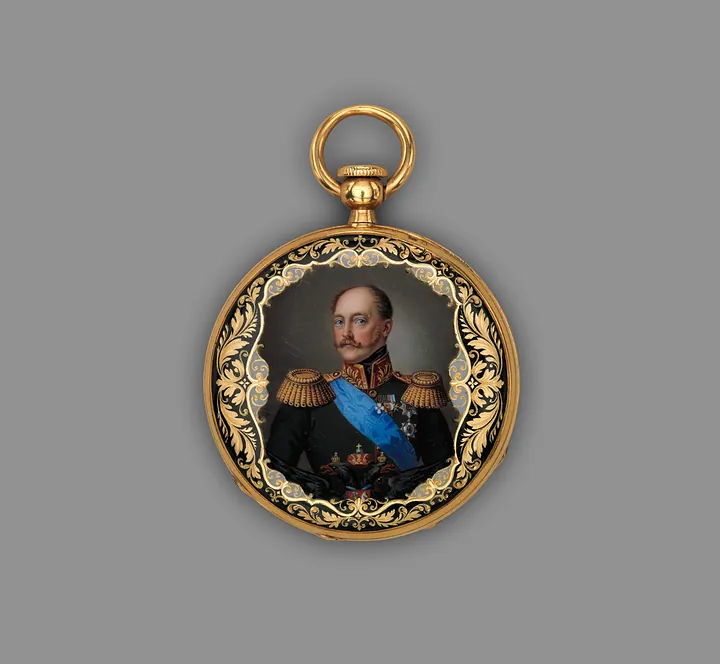
Pocket Watches · c. 1850–55
Watch by François Czapek, c. 1850–55
The Metropolitan Museum of Art, New York
Pocket Watches · c. 1850
Pocket watch by D Bachelard et Fils, Switzerland, c. 1850
German Clock Museum
Pocket Watches · 1850–1899
Pocket watch by GT, Switzerland, 1850–1899
Science Museum Group, London
Pocket Watches · c. 1850
Pocket watch by Perret et Cie., Switzerland, c. 1850
German Clock Museum
Pocket Watches · c. 1850
Pocket watch, probably Switzerland, c. 1850 (no. 58079)
German Clock Museum
Pocket Watches · c. 1850
Pocket watch, Switzerland, c. 1850 (no. 58081)
German Clock Museum