Pocket Watches · Watch
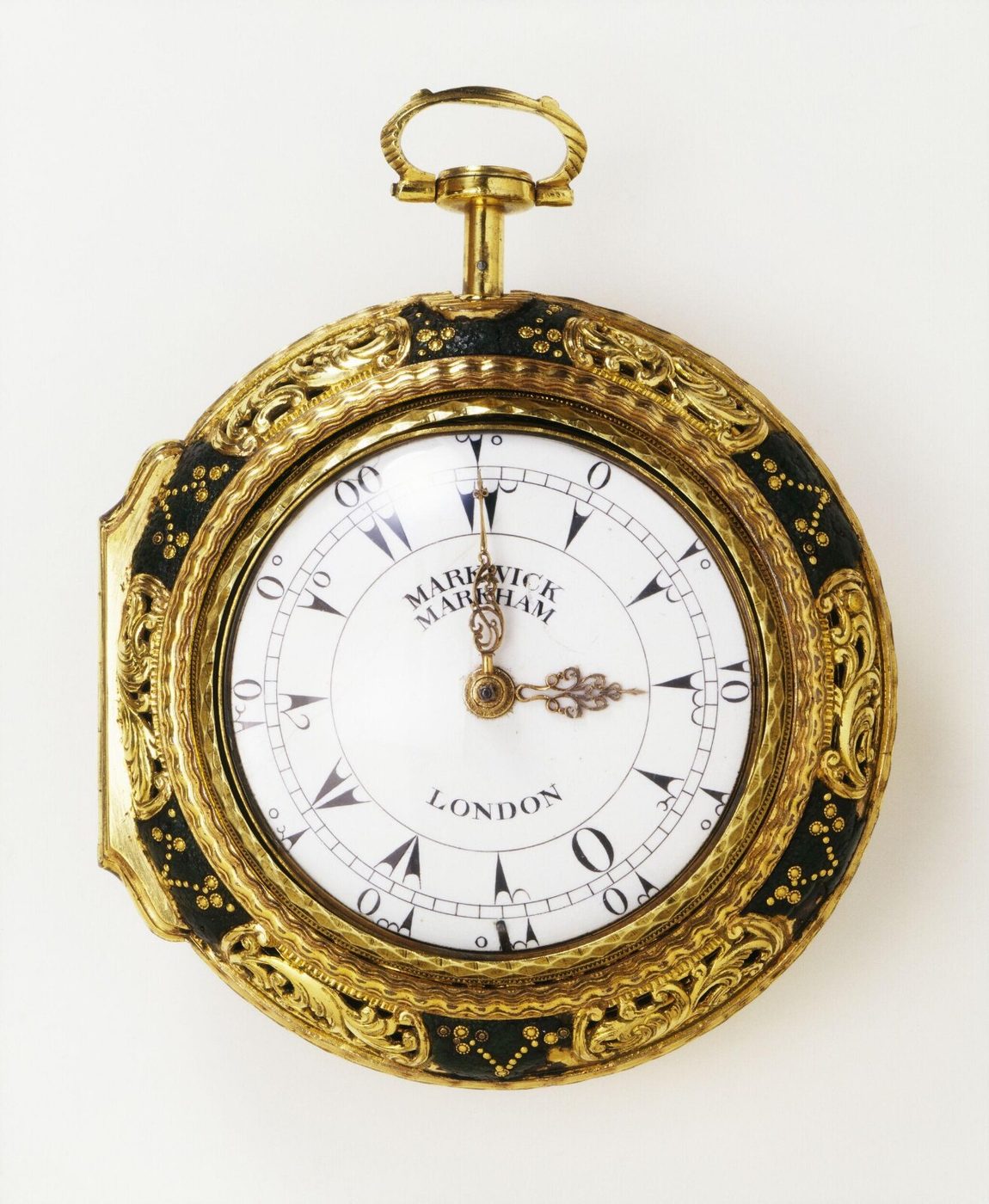
Watch made for the Turkish market
- Maker / attribution
- Markwick & Markham (maker)
- Date
- 1750-1775
- Historical period
- Precision & Scientific Horology (1750 – 1850)
- Country of origin
- England
- Place
- London
- Object type
- Watch
- Materials / technique
- Clockwatch with quarter-repeating movement, verge escapement and enamel dial; gilt-metal cases, the outer case embossed, chased and decorated with gold piqué work on leather
- Dimensions
- Height: 12 cm; Width: 9 cm; Depth: 4.3 cm
- Holding institution
- Victoria and Albert Museum, London
- Accession / object no.
- 365 to B-1897
Record summary
Held and catalogued by Victoria and Albert Museum, London (object number 365 to B-1897), this is a watch by Markwick & Markham, made in London, England, dated 1750-1775. The Atlas places it in the Precision & Scientific Horology period (1750 – 1850) of its Pocket Watches collection. Materials and techniques recorded by the source: Clockwatch with quarter-repeating movement, verge escapement and enamel dial; gilt-metal cases, the outer case embossed, chased and decorated with gold piqué work on leather. Recorded dimensions: Height: 12 cm; Width: 9 cm; Depth: 4.3 cm. The record is illustrated with 4 photographs.
Assembled from the source record's structured fields. Dates and attributions are given as the source states them; where a field is missing the Atlas leaves it blank rather than estimating.
Catalogue description
V&A — Summary
Object Type This watch has an enamelled dial with Arabic numerals and an elaborate set of cases, indicating that although it was made in London, it was designed for the Eastern market, probably Turkey. Makers It is signed Markwick Markham London, and is numbered 14103. James Markwick and Robert Markham specialised in clocks and watches for the Turkish market, and a partnership under their joint names was in business in London from about 1725 to 1805. Mechanism & Manufacture The watch's mechanism comprises a going train with fusee and train, a verge escapement, steel balance and spring. It is fitted with Turkish gradations. It strikes the hours and quarters on a silver bell. Design Large watches of this form are known as clock-watches. Their large size allowed them to be hung from a hook in a room and used as a clock when travelling. The gilt-metal case is pierced and engraved with foliage. One of the two outer cases is similarly decorated. An extra outer case is pierced in openwork with Rococo scrolls and foliage and with panels of shagreen decorated with piqué in gold. The Arabic numerals on the dial, the complicated chiming mechanism and multiple elaborately decorated outer cases were deliberately designed to appeal to the taste of Turkish clients for 'exotic' ornamental mechanisms from Europe.
V&A — Object history
Made in London by the firm of Markwick and Markham (active about 1725-1805) Purchased in Istanbul in 1897 from Mrs Alice Whitaker, daughter and heir of William Henry Wrench (1836-96). Wrench was British consul in the city when he died, and he had formed a significant collection of Ottoman and Iranian objects while in the consular service.
V&A gallery label
British Galleries: London was the centre of a thriving clockmaking industry and its watches were exported throughout Europe and beyond. The Arabic numerals and ornate casing on this watch are typical of the highly decorative work produced in London for Turkey, where clocks and watches were relatively rare.
Inscriptions & marks
Signed 'Markwick Markham London 14103'
Historical context
Precision & Scientific Horology (1750 – 1850)
Harrison solves longitude; Mudge invents the lever; Breguet's Paris workshop defines the modern watch.
From 1750 to 1850 the watch became a precision instrument. Mudge's lever escapement, the cylinder escapement, Lépine's thin bar calibre, Breguet's innovations (overcoil, tourbillon, perpétuelle) and the pocket chronometer of Arnold and Earnshaw all date from this period, while verge watches remained common in cheaper production.
Read the period in the timelineMore pocket watches from this periodEarlier: Early Modern Horology
Atlas type guide
Watches for the Chinese and Ottoman markets
From the late eighteenth century English and Swiss makers produced watches specifically for export to China and the Ottoman Empire. For China, Fleurier houses such as Bovet, Juvet and Vrard made matching pairs of watches with richly engraved and decorated movements, often with the duplex escapement whose centre seconds hand jumps in full seconds. For Ottoman buyers, London makers such as George Prior and Markwick Markham supplied verge watches with Turkish numerals in triple or quadruple cases of tortoiseshell and silver.
These watches reflect global trade networks and the tastes of distant markets, and are important evidence for cross-cultural exchange in horology.
What to look for
- Engraved, fully decorated movements visible under a glass back.
- Duplex escapement with a jumping centre seconds hand.
- Chinese characters on the movement (e.g. the maker's name in transliteration).
- Turkish (Ottoman) numerals on the dial and multiple protective outer cases.
Dating clues
- Chinese-market Fleurier watches: c. 1820–1900.
- English Ottoman-market watches: c. 1770–1850.
General guidance written by the Atlas editors about this kind of object. It is not a statement about this particular piece; for that, rely on the source record above and on physical examination.
Related records
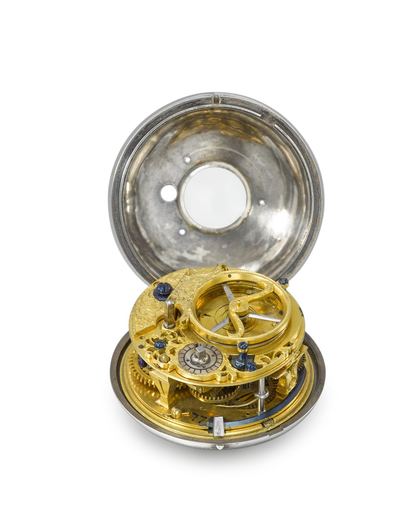
Pocket Watches · 1700-1815
Pocket watch by Debaufre, Peter, England, 1700-1815
Science Museum Group, London
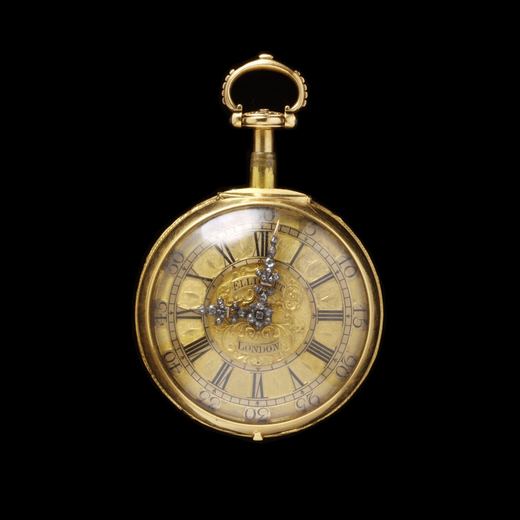
Pocket Watches · ca. 1753
Gold watch, signed 'Jno. Ellicott, London, 3719', the inner case pierced and engraved, with a casemaker's mark 'JB', London, about 1753
Victoria and Albert Museum, London
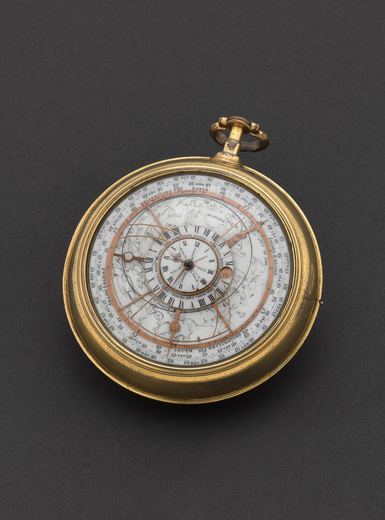
Pocket Watches · 1750-1810
Astronomical watch by George Margetts No.3043 in pair case, 1750-1810
Science Museum Group, London
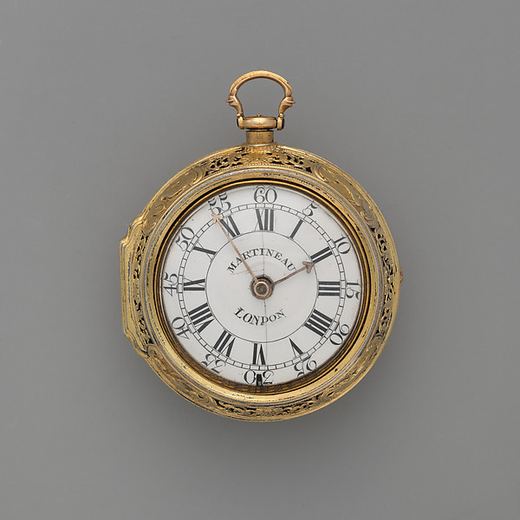
Pocket Watches · ca. 1760
Clock-watch by Joseph Martineau, Sr., England, ca. 1760
The Metropolitan Museum of Art, New York
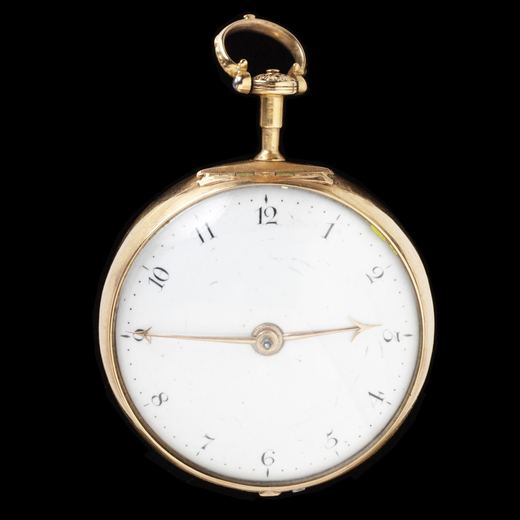
Pocket Watches · 1760-1770
Enamelled gold watch, movement with verge escapement signed 'Jams Tregent, London, 350', England, 1760-1770
Victoria and Albert Museum, London
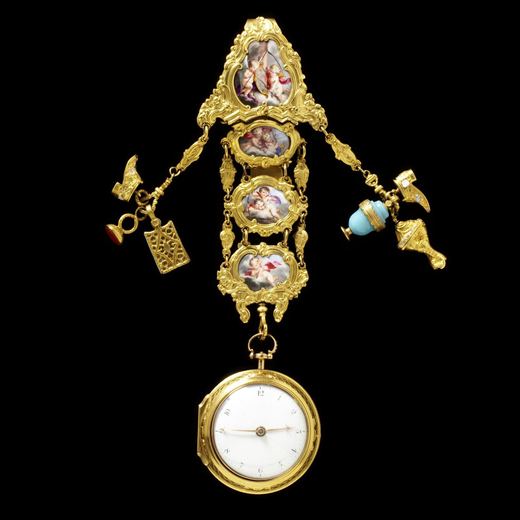
Pocket Watches · 1760-1770
Gilded metal and gold chatelaine, enamelled with cupids; with gold, glass, ivory and carnelian charms. England, 1760-1770
Victoria and Albert Museum, London
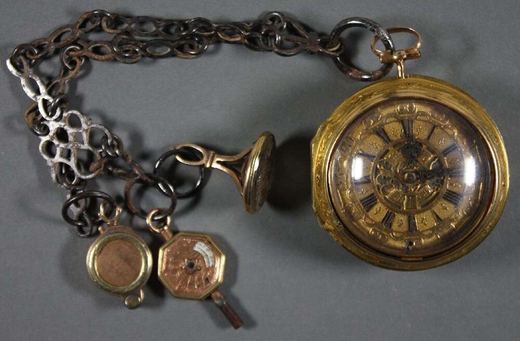
Pocket Watches · 1760
Pocket watch by Cabrier London, England, 1760
City Museum Zutphen
Pocket Watches · ca. 1765
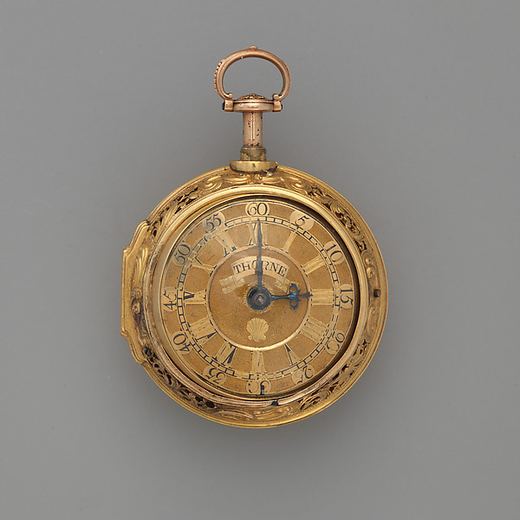
Repeating watch by Robert Thorne, England, ca. 1765
The Metropolitan Museum of Art, New York