Clocks · Wall clock
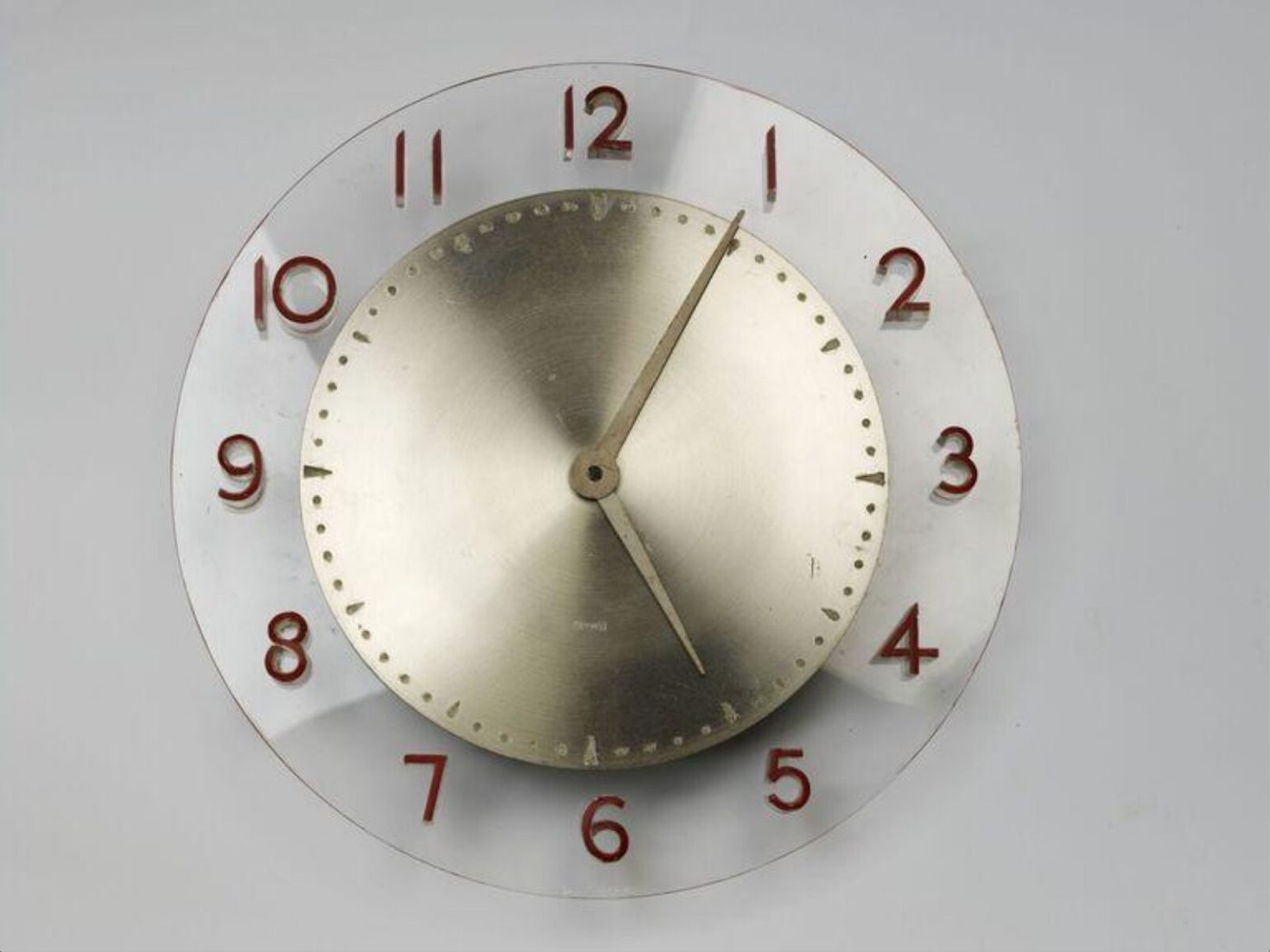
Wall clock, painted acrylic with metal dial, designed by Christopher Nicholson, manufactured by Ferranti Ltd, 1946
- Maker / attribution
- Christopher Nicholson (designer); Ferranti Ltd (manufacturer)
- Date
- 1946
- Historical period
- Modern Mechanical Horology (1945 – 1969)
- Country of origin
- United Kingdom
- Place
- Great Britain, Great Britain
- Object type
- Wall clock
- Materials / technique
- Acrylic, lacquered metal, painted
- Dimensions
- Diameter: 33.5 cm; Depth: 5 cm
- Holding institution
- Victoria and Albert Museum, London
- Accession / object no.
- W.4-1998
Record summary
Held and catalogued by Victoria and Albert Museum, London (object number W.4-1998), this is a wall clock by Christopher Nicholson, made in Great Britain, Great Britain, United Kingdom, dated 1946. The Atlas places it in the Modern Mechanical Horology period (1945 – 1969) of its Clocks collection. Materials and techniques recorded by the source: Acrylic, lacquered metal, painted. Recorded dimensions: Diameter: 33.5 cm; Depth: 5 cm. The record is illustrated with 1 photograph.
Assembled from the source record's structured fields. Dates and attributions are given as the source states them; where a field is missing the Atlas leaves it blank rather than estimating.
Catalogue description
V&A — Summary
This clock was designed by Nicholson for a stand representing a television research engineer’s office shown at the 1946 V&A exhibition ‘Britain Can Make It’. This exhibition was arranged by the newly formed government-funded Council of Industrial Design, and it aimed to boost domestic morale and encourage export trade. The entire glass supply of London was supposedly diverted for two months to fix the Museum's broken windows in preparation for the exhibition, taking up the ground floor. Attended by nearly one and a half million visitors, 'Britain Can Make It' was dubbed 'Britain Can't Have It' by the press because a large number of exhibits were at the prototype stage and unavailable to the buying public. This clock was made by Ferranti, for whom Nicholson designed radios (see W.3-1998), but was never put into production. The wall clock remained in Nicholson’s office after the exhibition until his death in 1948.
V&A — Physical description
The clock is round with an outer ring of acrylic (perspex). Three dimensional acrylic numbers have been adhered to the ring and are edged in red, painted by hand. The outer rim is considerably worn but significant amounts of red paint survive there too. The inner dial is metal (possibly aluminium) onto which the minute and hour markers appear to have been hand-stamped. The Ferranti logo is at the bottom of the face, but is upside down as the face has been rotated 180 degrees. The reason for the rotation of the inner face is because the acrylic ring is broken below the number 12 at the top. Four holes pierce the acylic to allow for the fixing of the metal face; the top one has suffered damage and this is probably when the inner face was rotated. The acrylic is 2-3 mm thick and the damage is not visible from the front. The clock is fitted with a standard electric clock, labelled Ferranti, which originally had mains wiring. Although the aesthetic is machine made, the elements and construction of the wall clock show a considerable degree of handwork as though the object were a prototype.
V&A — Object history
The wall clock, although apparently a prototype suited to production and made by Ferranti Ltd, did not go into production. It was designed by Nicholson for a stand representing a television research engineer's office, for the seminal 1946 V&A exhibition 'Britain Can Make It' (the design for this stand is in the RIBA Drawings Collection). Stylistically the clock looks back to the 1930s machine aesthetic and forwards to the plastic products of the 1950s. The clock remained in Nicholson's office, 110 Old Brompton Road, until his death in 1948 and was then owned by his family. The V&A acquired the clock in 1998 from Tim Nicholson, the designer's son, together with a radiogram, W.3-1998.
V&A — Production note
Reason For Production: Exhibition
V&A gallery label
Twentieth Century Study Gallery label text: Nicholson designed this clock for a stand representing a television research engineer's office shown at the 1946 V&A exhibition 'Britain Can Make It'. His drawing of the stand is in the RIBA Drawings Collection. It was made by Ferranti, for whom Nicholson designed radios, but was never put into production. The wall clock remained in Nicholson's office after the exhibition until his death in 1948.
Inscriptions & marks
'FERRANTI'; 'START / HANDS / PATENTS APPLIED FOR ... MADE IN ENGLAND / FERRANTI / 200-260V / 50 CYCLES'
Historical context
Modern Mechanical Horology (1945 – 1969)
Tool watches for divers, pilots and astronauts; electric watches anticipate the electronic age.
Post-war clocks combined new materials and industrial design: plastic and metal cases, battery-powered transistor movements from the late 1950s, and design classics by George Nelson, Max Bill and others. The first caesium atomic clock (1955) moved the definition of time from astronomy to physics.
Read the period in the timelineMore clocks from this periodEarlier: Golden Age of Mechanical Watchmaking
Atlas type guide
Regulators, wall and Vienna clocks
A regulator is a precision pendulum clock used as a time standard in observatories, workshops and railway offices. Typical features are a deadbeat or Graham escapement, a temperature-compensated pendulum (mercury jar, gridiron or later invar), maintaining power and a regulator dial that separates hours, minutes and seconds. George Graham's deadbeat escapement (c. 1715) and his mercury pendulum, together with Harrison's gridiron, set the pattern for two centuries.
Wall clocks span a much wider range: the elegant Viennese Laterndluhr and Dachluhr of the Biedermeier period, the Dutch stoelklok and staartklok, English 'dial' clocks used in schools, offices and railway stations, and mass-produced spring and weight wall clocks from Germany (Gustav Becker, Junghans, Kienzle) and America.
What to look for
- Deadbeat escapement and compensated pendulum (gridiron rods, mercury jar or wood rod).
- A regulator dial with a large central minute hand and separate hour and seconds dials.
- Vienna regulators: glazed cases, slender pendulum, small weights, enamel two-piece dials.
- German factory trademarks stamped on the backplate (e.g. Gustav Becker anchor and crown, Junghans star).
Dating clues
- Graham-type deadbeat regulators: from c. 1720.
- Viennese Laterndluhr: c. 1800–1850.
- German factory 'Vienna-style' regulators: c. 1870–1930; Gustav Becker serial numbers allow close dating.
General guidance written by the Atlas editors about this kind of object. It is not a statement about this particular piece; for that, rely on the source record above and on physical examination.
Related records
Clocks · circa 1954
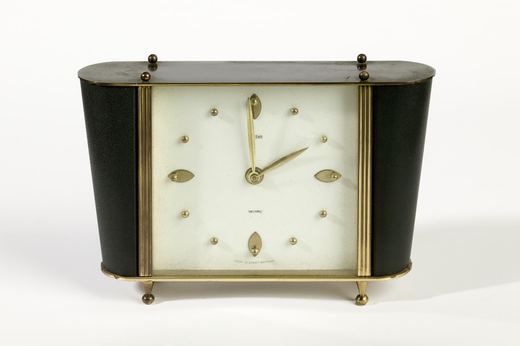
Electric mantelpiece clock, made by Smiths Clocks and Watches Ltd, c. 1954.
Science Museum Group, London
Clocks · 1950-1975
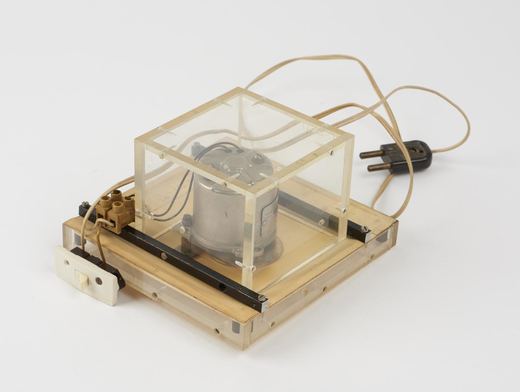
Sidereal clock, electrically driven
Science Museum Group, London
Clocks · 1956
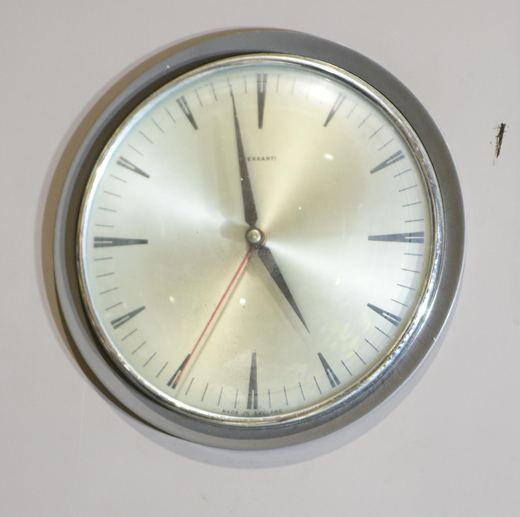
Electric clock for the prototype Pegasus computer, (attached to central processing unit), made by Ferranti Ltd's London laboratory, c. 1956.
Science Museum Group, London

Clocks · 1873–2021
Clock, Poland, 1873–2021
The International Center for Information Management Systems and Services
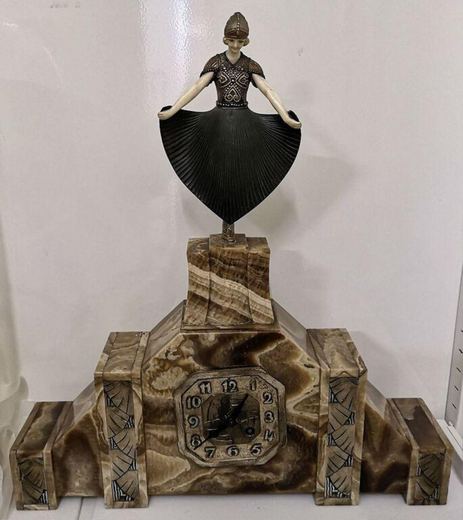
Clocks · 20th century
Base Metal, 20th c. Bronze, marble and ivory clock by Chiparus
Victoria and Albert Museum, London
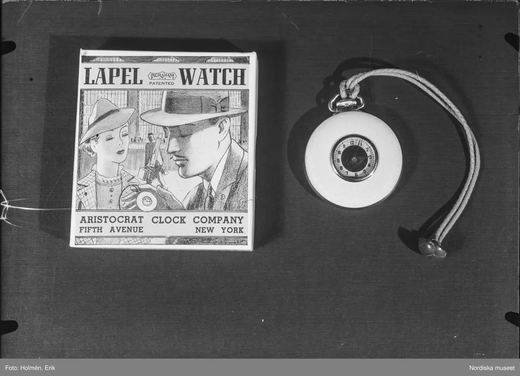
Clocks · 1900–1999
Clock by Erik Holmén, 1900–1999
Nordic Museum Foundation
Clocks · 1900–1999
Clock by Französisch (Schule), 1900–1999
Fine Arts Museum Vienna
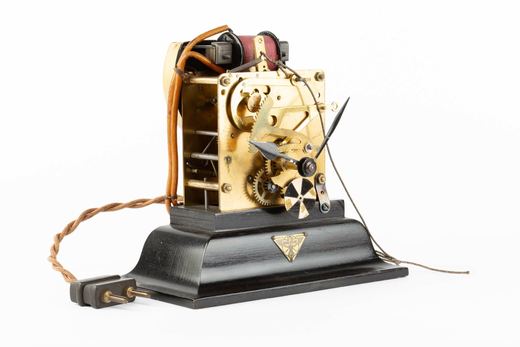
Clocks · 1900–1999
Clock by Friedrich Mauthe, Germany, 1900–1999 (German Clock Museum Museu_ProvidedCHO_museum_digital_59468__technical_number_)
German Clock Museum