
Wristwatches · Wristwatch
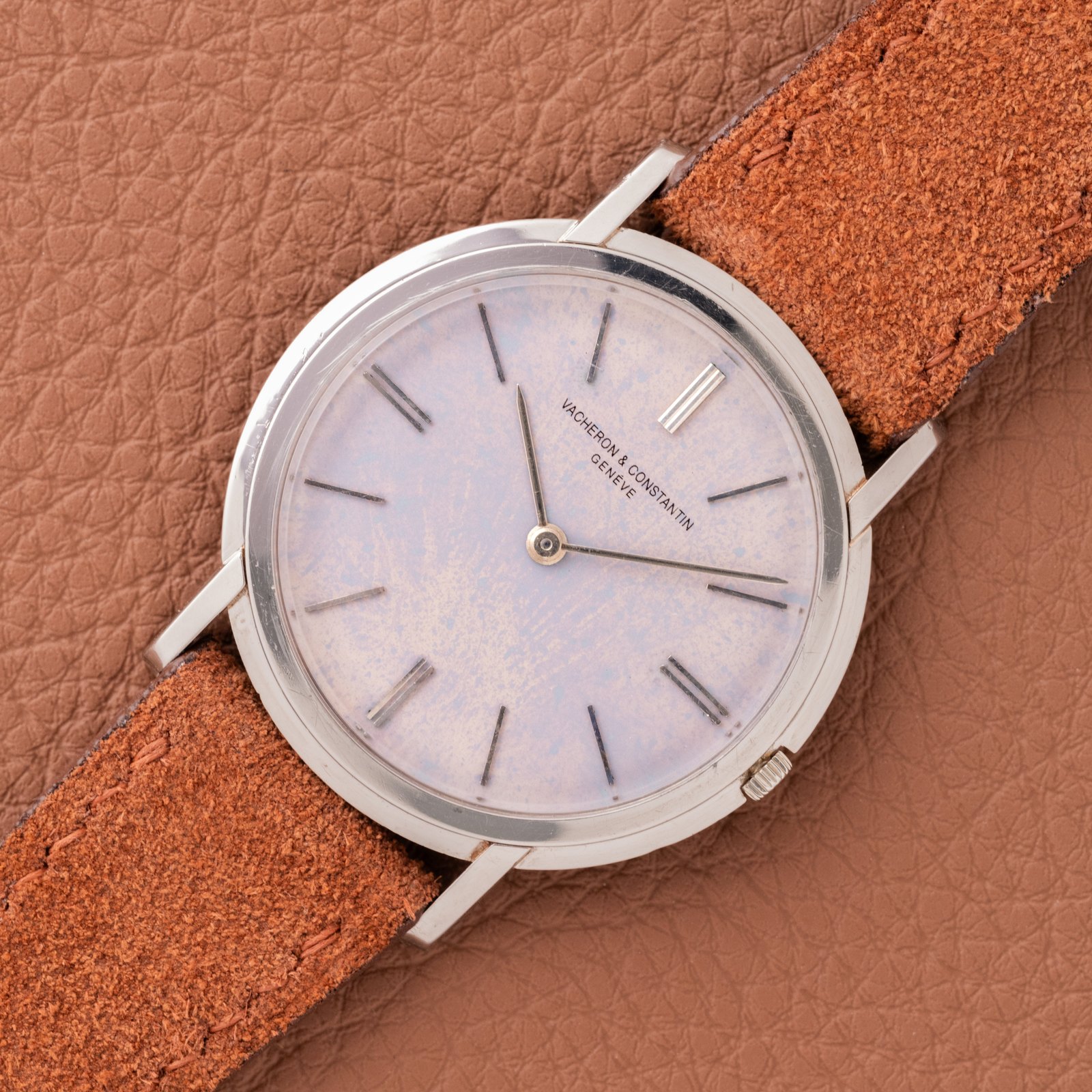
Vacheron Constantin Ultra-Thin Tropical Dial Dress Watch (Ref. 6100), 1950s
- Maker / attribution
- Vacheron Constantin (maker)
- Date
- 1950s
- Historical period
- Modern Mechanical Horology (1945 – 1969)
- Country of origin
- Switzerland
- Object type
- Wristwatch
- Dimensions
- Case 33.5 mm
- Stock no.
- Product 8834757329079
- Credit line
- Dealer listing, Huntington Company (product 8834757329079)
- Catalogue title (original)
- 1950s Vacheron Constantin Ultra-Thin Tropical Dial Dress Watch (Ref. 6100) (English)
View the source record (dealer listing) ↗ (opens another website in a new tab)Suggest a correction
Record summary
Catalogued by Huntington Company (dealer) (stock number Product 8834757329079), this is a wristwatch by Vacheron Constantin, made in Switzerland, dated 1950s. The Atlas places it in the Modern Mechanical Horology period (1945 – 1969) of its Wristwatches collection. Recorded dimensions: Case 33.5 mm. The record is illustrated with 6 photographs.
Assembled from the source record's structured fields. Dates and attributions are given as the source states them; where a field is missing the Atlas leaves it blank rather than estimating.
Catalogue description
Dealer description — Huntington Company
History and Significance Vacheron Constantin has produced some of the finest dress watches in Swiss watchmaking history, with a particular appreciation for elegant proportions and beautifully executed mechanical movements. Throughout the twentieth century, the manufacture developed a reputation for creating watches that combined technical sophistication with remarkably restrained designs. The 1950s were an especially interesting period, as traditional manufacturers continued refining the mechanical wristwatch while experimenting with increasingly slender cases and more contemporary styling. The reference 6100 belongs to this wonderful era of Vacheron Constantin production, when an elegant dress watch could represent the very highest level of traditional Swiss watchmaking. The pursuit of ultra-thin watchmaking was an important part of Vacheron Constantin's identity during the mid-twentieth century. Creating a slender mechanical wristwatch required considerable attention to movement construction, case design, and the relationship between the various components. Unlike complicated watches, where technical achievement is often immediately apparent through additional functions, ultra-thin watches demonstrate their sophistication through what has been removed. The result is a different kind of mechanical accomplishment, one that prioritizes refinement and discretion. The reference 6100 reflects this philosophy, belonging to a generation of watches that helped establish Vacheron Constantin's reputation for elegant, thin dress watches. Perhaps the most fascinating aspect of vintage watch collecting is the way certain watches develop characteristics that could never have been anticipated when originally produced. Tropical dials are a particularly interesting example, occurring when the original dial surface undergoes chemical changes through decades of exposure to environmental conditions and aging. These transformations can create unusual colors, patterns, and textures that distinguish individual watches from otherwise identical examples. While some tropical dials develop relatively uniform brown or champagne tones, others undergo far more dramatic changes. The result can be a dial that bears little resemblance to its original appearance, creating an entirely individual character that cannot be reproduced through conventional manufacturing. The dial on this particular reference 6100 is an extraordinary example of that phenomenon. Decades of natural aging have transformed the original surface into a remarkable combination of blues and pinks, with irregular patterns that resemble tie-dyed fabric or a colorful sunset filled with pink clouds. The shifting tones create an almost painterly appearance, with different areas of the dial taking on entirely different colors. Unlike a factory decorative dial, this transformation developed over time, making the appearance specific to this individual watch. It is an especially unusual example of tropical aging, far removed from the more familiar brown and black dial transformations commonly associated with vintage sports watches. Writer’s Thoughts Some watches are interesting because of their history, others because of their rarity, and occasionally a watch comes along that is simply impossible to ignore. This Vacheron Constantin reference 6100 belongs firmly in that last category. The dial looks almost like a miniature painting, with shades of blue and pink blending together in a way that resembles a sunset with clouds drifting across the sky. The transformation is so dramatic that it almost seems intentional, yet the entire appearance is the result of decades of natural aging. It is one of those rare examples where an imperfection has become the most extraordinary characteristic of the watch. Tropical dials have become an important part of vintage collecting, but examples with this kind of coloration are especially unusual. The familiar chocolate-brown tropical dial has a well-established place in the market, yet the blue and pink tones found on this reference 6100 offer something entirely different. The appearance is closer to a piece of abstract art than a conventional vintage dial, with a mixture of colors that changes the entire personality of the watch. There is no need for elaborate complications or unusual case construction when the dial itself is this interesting. Among vintage Vacheron Constantin dress watches, this is the kind of example that deserves a second look, and probably a third. Our Promise Every watch is thoroughly vetted, carefully described with complete transparency, and guaranteed authentic. Each piece is offered in honest condition, ensuring collectors receive a timepiece that reflects both originality and integrity. Specifications Brand: Vacheron Constantin Model: Ultra-Thin Dress Watch Reference: 6100 Year: Circa 1950s Case Material: 18k White Gold Case Size: 33.5mm Dial: Original Tropical Dial with Blue and Pink Patina Movement: Mechanical Manual Wind Strap/Buckle: Leather Strap Buckle/Clasp: Pin Buckle Contents: Watch only Condition Case: White gold case retains its attractive overall shape and elegant ultra-thin proportions. Dial: Original dial shows extraordinary tropical aging with a striking mixture of blue and pink tones resembling a colorful sunset. The extensive natural patina gives the watch its distinctive appearance. Hands: Vintage hands show aging consistent with the overall character of the watch. Crystal: Crystal remains in good overall condition. Strap/Buckle: Leather strap fitted to the watch is new. Buckle/Clasp: Pin buckle fitted to the strap is new.
Historical context
Modern Mechanical Horology (1945 – 1969)
Tool watches for divers, pilots and astronauts; electric watches anticipate the electronic age.
The classic era of the mechanical wristwatch: dive watches, chronographs for motor racing and space flight, GMT watches for jet travel, slim dress watches, automatic calendars, and the rise of Japanese manufacturers alongside Swiss, American, German and Soviet industries.
Read the period in the timelineMore wristwatches from this periodEarlier: Golden Age of Mechanical Watchmaking
Atlas type guide
Wristwatches
Bracelet watches were worn by women from the early nineteenth century — Breguet made one for Caroline Murat, Queen of Naples, in 1810–12 — but the wristwatch only became a man's instrument with military use and aviation in the early twentieth century. Between the World Wars it overtook the pocket watch; the 1920s and 1930s brought rectangular Art Deco cases, water-resistant cases and the first automatic winding systems.
After 1945 the wristwatch became a carrier of identity — dress watches, sports and dive watches, chronographs, calendars — produced by Swiss, American, Japanese, German, Soviet and Chinese industries. The quartz revolution after 1969 and the mechanical renaissance since the 1990s, including the rise of independent watchmakers, complete the story.
What to look for
- The reference number (between the lugs or inside the case back) and serial number, the starting point for dating.
- The calibre: its maker and number are often stamped under the dial or on the bridge.
- Originality of dial, hands and crown — refinished ('redial') dials are common.
- Case material marks: 18K/750, 14K/585, stainless steel, gold-filled, plated.
Dating clues
- Wire-lug cases: before c. 1925.
- Water-resistant screw-down cases: from 1926.
- Quartz movements: from 1969; sapphire crystals widespread after c. 1980.
General guidance written by the Atlas editors about this kind of object. It is not a statement about this particular piece; for that, rely on the source record above and on physical examination.
Related records
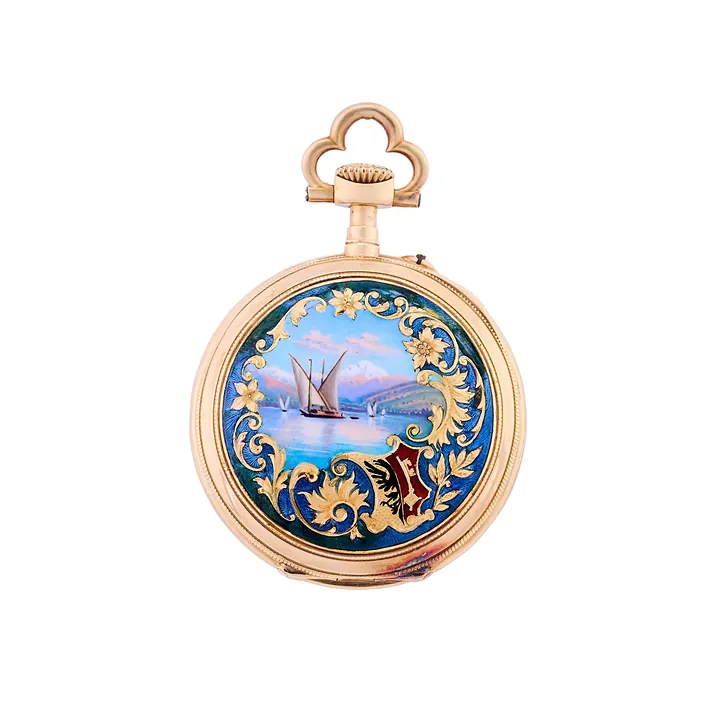
Pocket Watches · c. 1896
Vacheron Constantin “grand TIR de L’exposition Nationale, Genève 1896, c. 1896
Antiquorum auction archive, Geneva
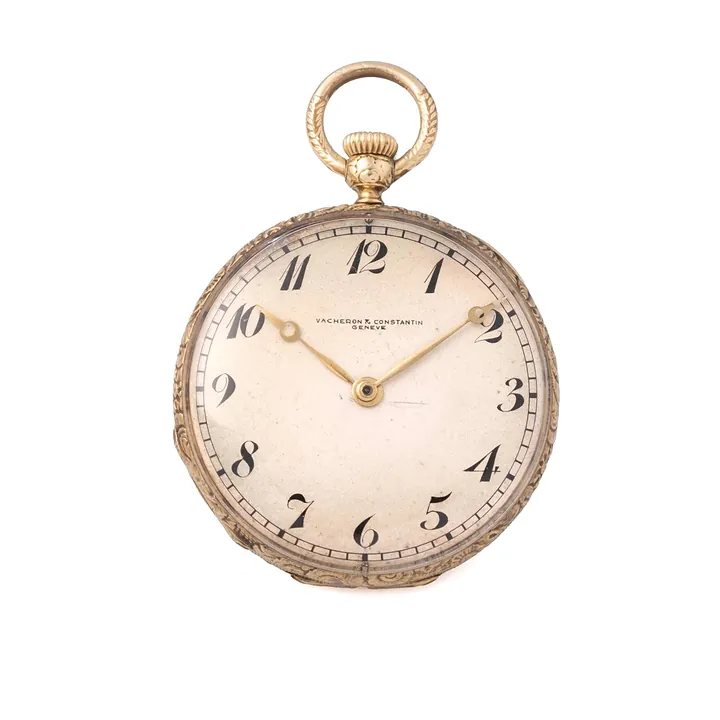
Pocket Watches · c. 1940
Vacheron Constantin pocket watch, ref. 345, c. 1940
Antiquorum auction archive, Geneva
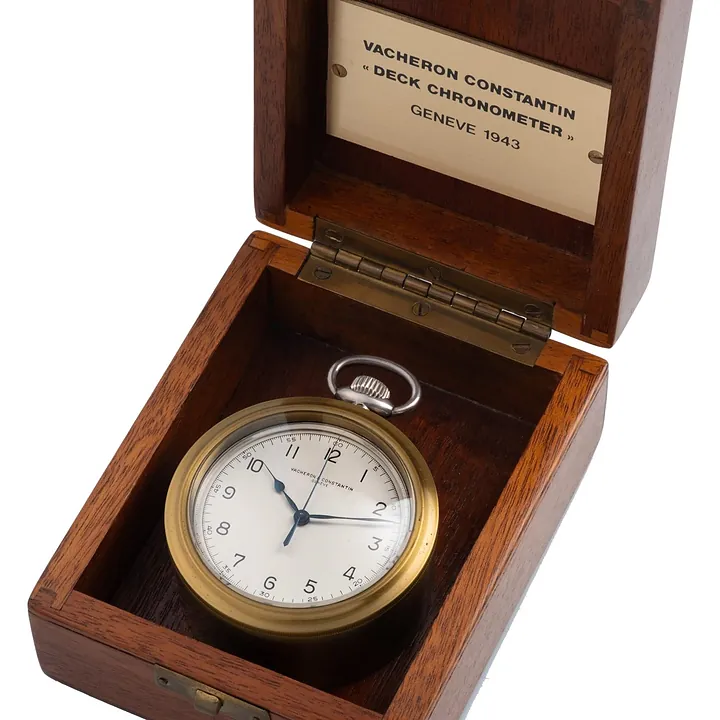
Pocket Watches · c. 1945
Vacheron Constantin pocket chronometer, c. 1945
Antiquorum auction archive, Geneva
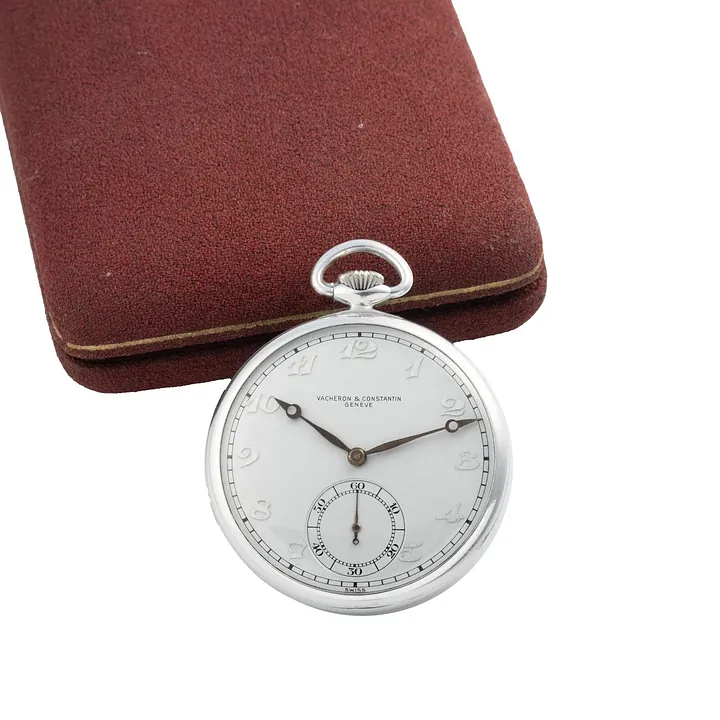
Pocket Watches · c. 1945
Vacheron Constantin watch, c. 1945
Antiquorum auction archive, Geneva

Wristwatches · 1945
Wristwatch by Eterna, 1945
Museum Rotterdam

Wristwatches · c. 1945
Breitling Premier, ref. 790, c. 1945
Antiquorum auction archive, Geneva

Wristwatches · c. 1945
Universal Genève Uni-Compax, ref. 22492, c. 1945
Antiquorum auction archive, Geneva

Wristwatches · c. 1950s
Baume & Mercier wristwatch, c. 1950s
Antiquorum auction archive, Geneva