
Wristwatches · Wristwatch
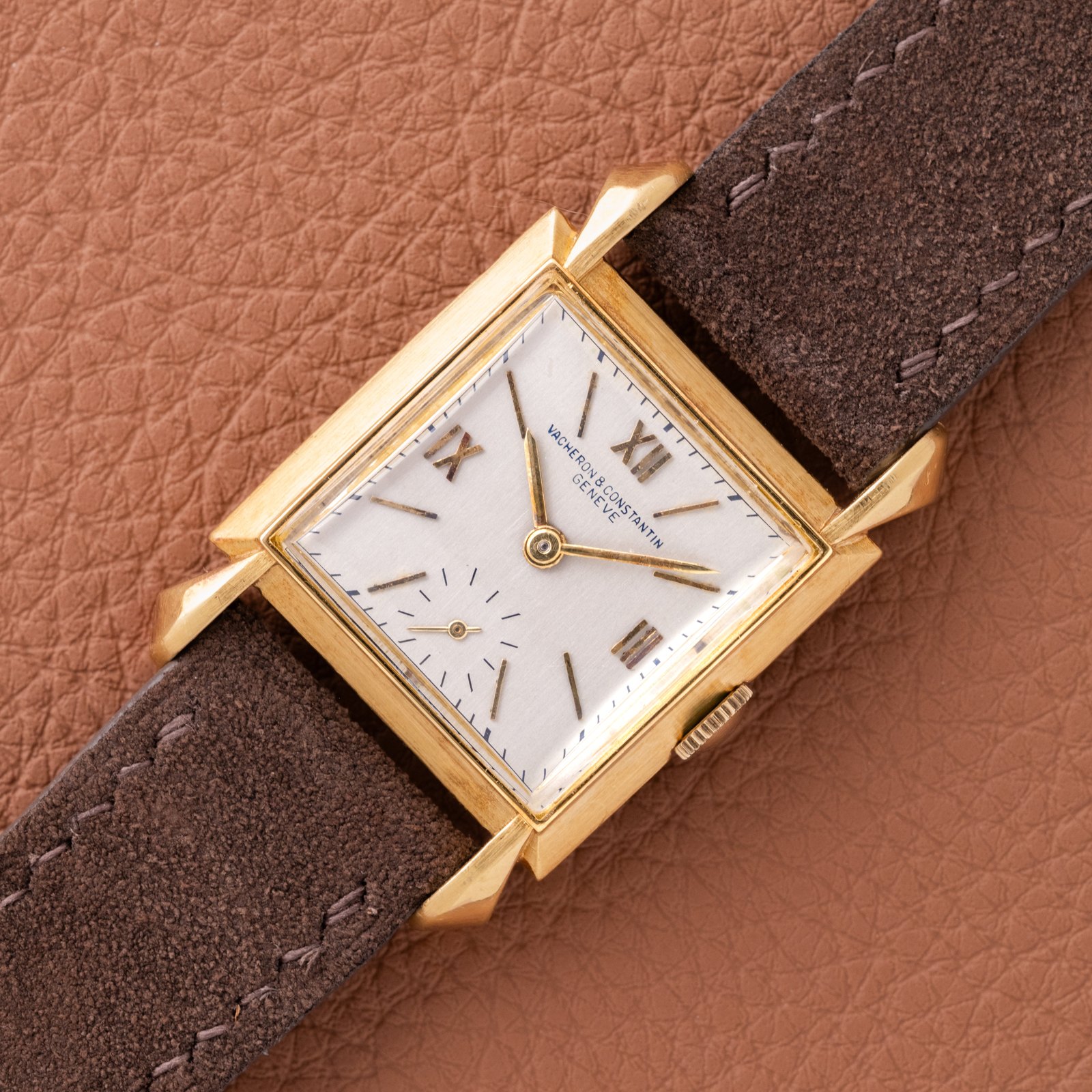
Vacheron Constantin Square Fancy Lugs (Ref. 4369), 1948
- Maker / attribution
- Vacheron Constantin (maker)
- Date
- 1948
- Historical period
- Modern Mechanical Horology (1945 – 1969)
- Country of origin
- Switzerland
- Object type
- Wristwatch
- Dimensions
- Case 25 mm
- Stock no.
- Product 8806097780919
- Credit line
- Dealer listing, Huntington Company (product 8806097780919)
- Catalogue title (original)
- 1948 Vacheron Constantin Square Fancy Lugs (Ref. 4369) (English)
View the source record (dealer listing) ↗ (opens another website in a new tab)Suggest a correction
Record summary
Catalogued by Huntington Company (dealer) (stock number Product 8806097780919), this is a wristwatch by Vacheron Constantin, made in Switzerland, dated 1948. The Atlas places it in the Modern Mechanical Horology period (1945 – 1969) of its Wristwatches collection. Recorded dimensions: Case 25 mm. The record is illustrated with 6 photographs.
Assembled from the source record's structured fields. Dates and attributions are given as the source states them; where a field is missing the Atlas leaves it blank rather than estimating.
Catalogue description
Dealer description — Huntington Company
History and Significance Vacheron Constantin's mid-century catalog is full of watches that make a strong case for looking beyond the familiar round dress watch. The reference 4369 is a perfect example, pairing a square case with an architectural set of fancy lugs that give the watch far more presence than its dimensions suggest. This was a period when case design itself could be a major point of expression, and Vacheron Constantin was particularly good at turning small dress watches into genuinely interesting objects. The reference 4369 captures that approach without becoming overly decorative. The lugs are really what define the design. Rather than extending straight from the case, they flare outward into sharply formed facets, creating a silhouette that changes considerably depending on the viewing angle. That geometry gives the reference 4369 an almost sculptural quality, particularly when the original edges and chamfers remain visible. Many surviving examples have been polished repeatedly over the decades, softening exactly the details that made the case interesting in the first place. The dial is equally thoughtful. Raised enamel text gives the Vacheron & Constantin signature a subtle dimensionality that is difficult to appreciate until viewed closely, while the combination of applied markers, Roman numerals, and subsidiary seconds keeps the design unmistakably rooted in the 1940s. Nothing is unnecessarily elaborate, yet nearly every element has some small detail worth examining. It is the kind of dial that becomes more interesting with time rather than relying on an immediately obvious flourish. At 25mm by 37mm, the reference 4369 also demonstrates why rectangular and square watches cannot be understood by width alone. The long case and projecting fancy lugs give it a much stronger wrist presence than a 25mm measurement would suggest. Those proportions are integral to the design rather than a compromise imposed by the period. The result is a distinctly vintage watch that still feels deliberate and wearable today. Writer's Thoughts There is an enormous amount of personality packed into the reference 4369. The combination of a square case, those exaggerated lugs, and the restrained dial makes it feel like something that could only have come from this particular period of Vacheron Constantin. Nothing about it needs to be loud because the architecture does all of the work. This is exactly the sort of vintage Vacheron that makes the deeper corners of the brand so rewarding. Sharpness matters tremendously with a watch like this. Once those facets and chamfers have been polished away, a large part of the original design disappears with them. Seeing the reference 4369 with its geometry still clearly defined makes the intention behind the case much easier to understand. It turns what could simply be another small 1940s dress watch into something genuinely special. The raised enamel signature might be the favorite detail. It is subtle enough to disappear from a distance, yet it adds another layer of craftsmanship when the dial is examined closely. Details like that are a reminder of how much effort once went into watches that were never intended to be complicated or ostentatious. The reference 4369 succeeds because nearly everything interesting about it reveals itself gradually. Our Promise Every watch is thoroughly vetted, carefully described with complete transparency, and guaranteed authentic. Each piece is offered in honest condition, ensuring collectors receive a timepiece that reflects both originality and integrity. Specifications Brand: Vacheron Constantin Model: Square Fancy Lugs Reference: 4369 Year: 1948 Case Material: 18k yellow gold Case Size: 25mm x 37mm Dial: Silver dial with raised enamel signature, applied markers, and subsidiary seconds Movement: Manual wind Strap/Buckle: Brown leather strap Buckle/Clasp: Generic buckle Contents: Watch only Condition Case: Yellow gold case remains exceptionally sharp for its age, with the distinctive fancy lugs retaining strong definition and visible chamfers. Dial: Silver dial remains attractive with its raised enamel text well preserved. Hands: Gold hands present well with age consistent with the watch. Crystal: Crystal presents well with light signs of age and use. Strap/Buckle: Brown leather strap presents well. Buckle/Clasp: Generic buckle presents well.
Historical context
Modern Mechanical Horology (1945 – 1969)
Tool watches for divers, pilots and astronauts; electric watches anticipate the electronic age.
The classic era of the mechanical wristwatch: dive watches, chronographs for motor racing and space flight, GMT watches for jet travel, slim dress watches, automatic calendars, and the rise of Japanese manufacturers alongside Swiss, American, German and Soviet industries.
Read the period in the timelineMore wristwatches from this periodEarlier: Golden Age of Mechanical Watchmaking
Atlas type guide
Wristwatches
Bracelet watches were worn by women from the early nineteenth century — Breguet made one for Caroline Murat, Queen of Naples, in 1810–12 — but the wristwatch only became a man's instrument with military use and aviation in the early twentieth century. Between the World Wars it overtook the pocket watch; the 1920s and 1930s brought rectangular Art Deco cases, water-resistant cases and the first automatic winding systems.
After 1945 the wristwatch became a carrier of identity — dress watches, sports and dive watches, chronographs, calendars — produced by Swiss, American, Japanese, German, Soviet and Chinese industries. The quartz revolution after 1969 and the mechanical renaissance since the 1990s, including the rise of independent watchmakers, complete the story.
What to look for
- The reference number (between the lugs or inside the case back) and serial number, the starting point for dating.
- The calibre: its maker and number are often stamped under the dial or on the bridge.
- Originality of dial, hands and crown — refinished ('redial') dials are common.
- Case material marks: 18K/750, 14K/585, stainless steel, gold-filled, plated.
Dating clues
- Wire-lug cases: before c. 1925.
- Water-resistant screw-down cases: from 1926.
- Quartz movements: from 1969; sapphire crystals widespread after c. 1980.
General guidance written by the Atlas editors about this kind of object. It is not a statement about this particular piece; for that, rely on the source record above and on physical examination.
Related records
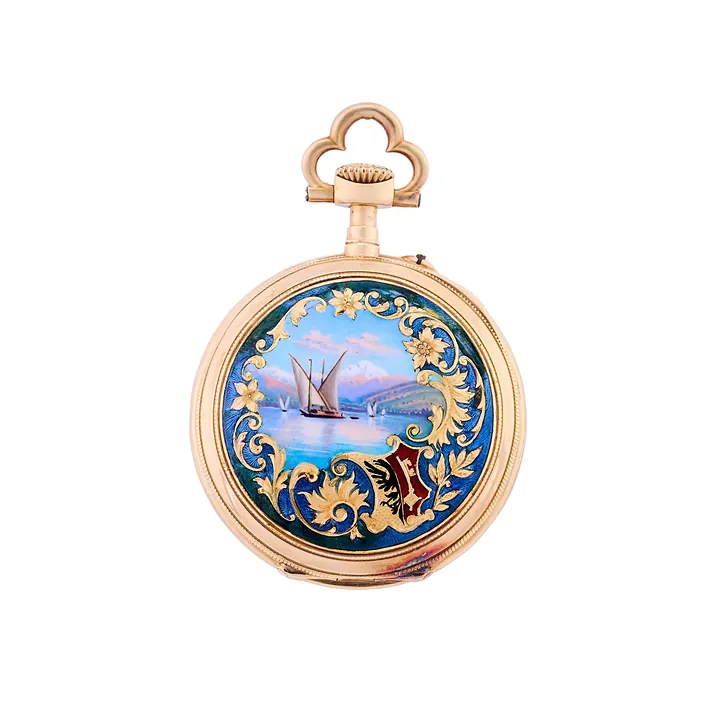
Pocket Watches · c. 1896
Vacheron Constantin “grand TIR de L’exposition Nationale, Genève 1896, c. 1896
Antiquorum auction archive, Geneva
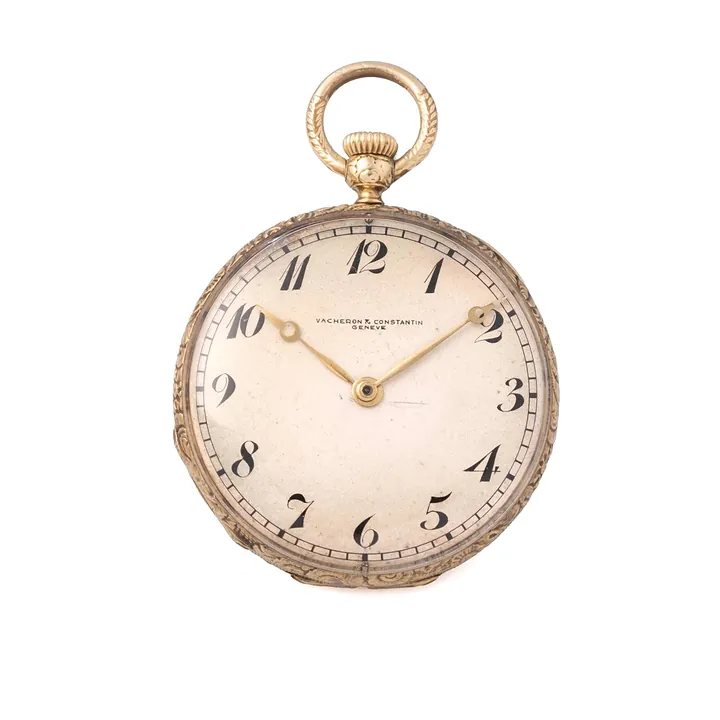
Pocket Watches · c. 1940
Vacheron Constantin pocket watch, ref. 345, c. 1940
Antiquorum auction archive, Geneva
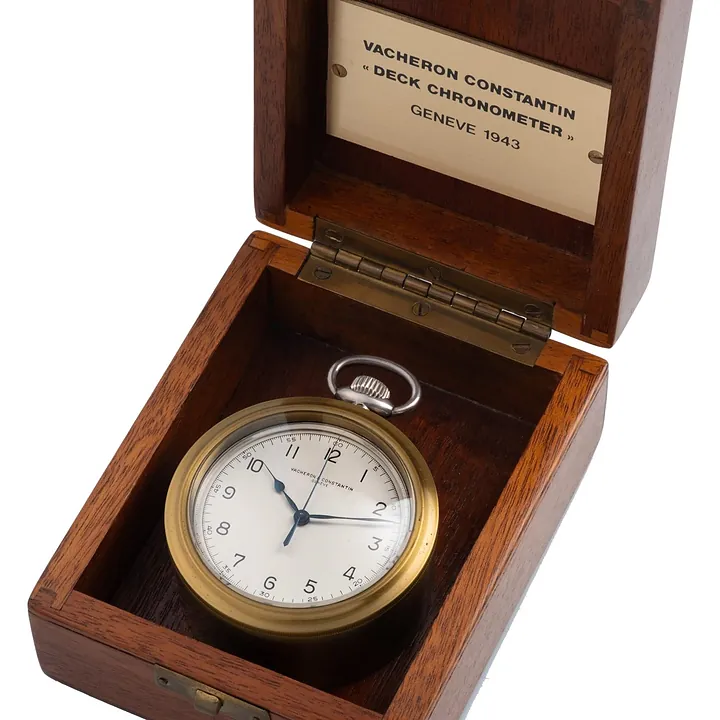
Pocket Watches · c. 1945
Vacheron Constantin pocket chronometer, c. 1945
Antiquorum auction archive, Geneva
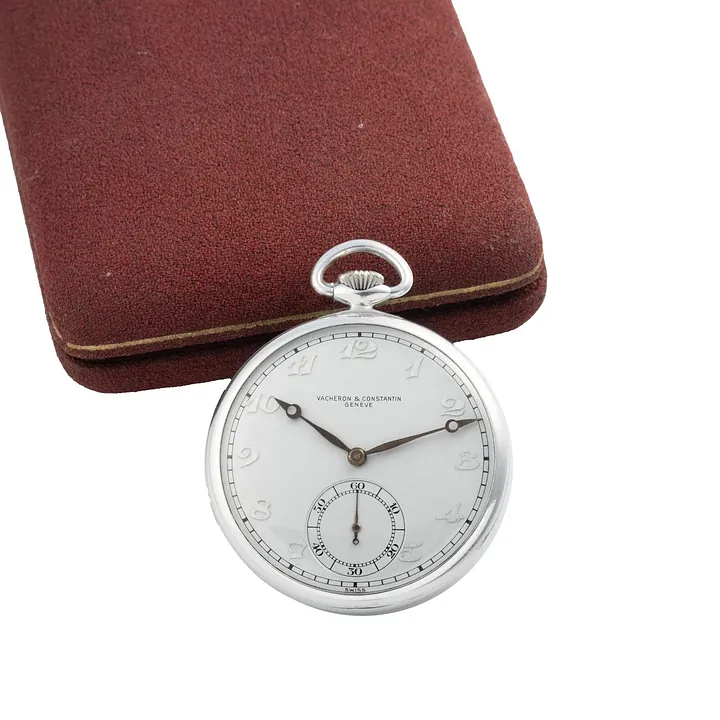
Pocket Watches · c. 1945
Vacheron Constantin watch, c. 1945
Antiquorum auction archive, Geneva

Wristwatches · 1945
Wristwatch by Eterna, 1945
Museum Rotterdam

Wristwatches · c. 1945
Breitling Premier, ref. 790, c. 1945
Antiquorum auction archive, Geneva

Wristwatches · c. 1945
Universal Genève Uni-Compax, ref. 22492, c. 1945
Antiquorum auction archive, Geneva

Wristwatches · c. 1950s
Baume & Mercier wristwatch, c. 1950s
Antiquorum auction archive, Geneva