
Wristwatches · Wristwatch
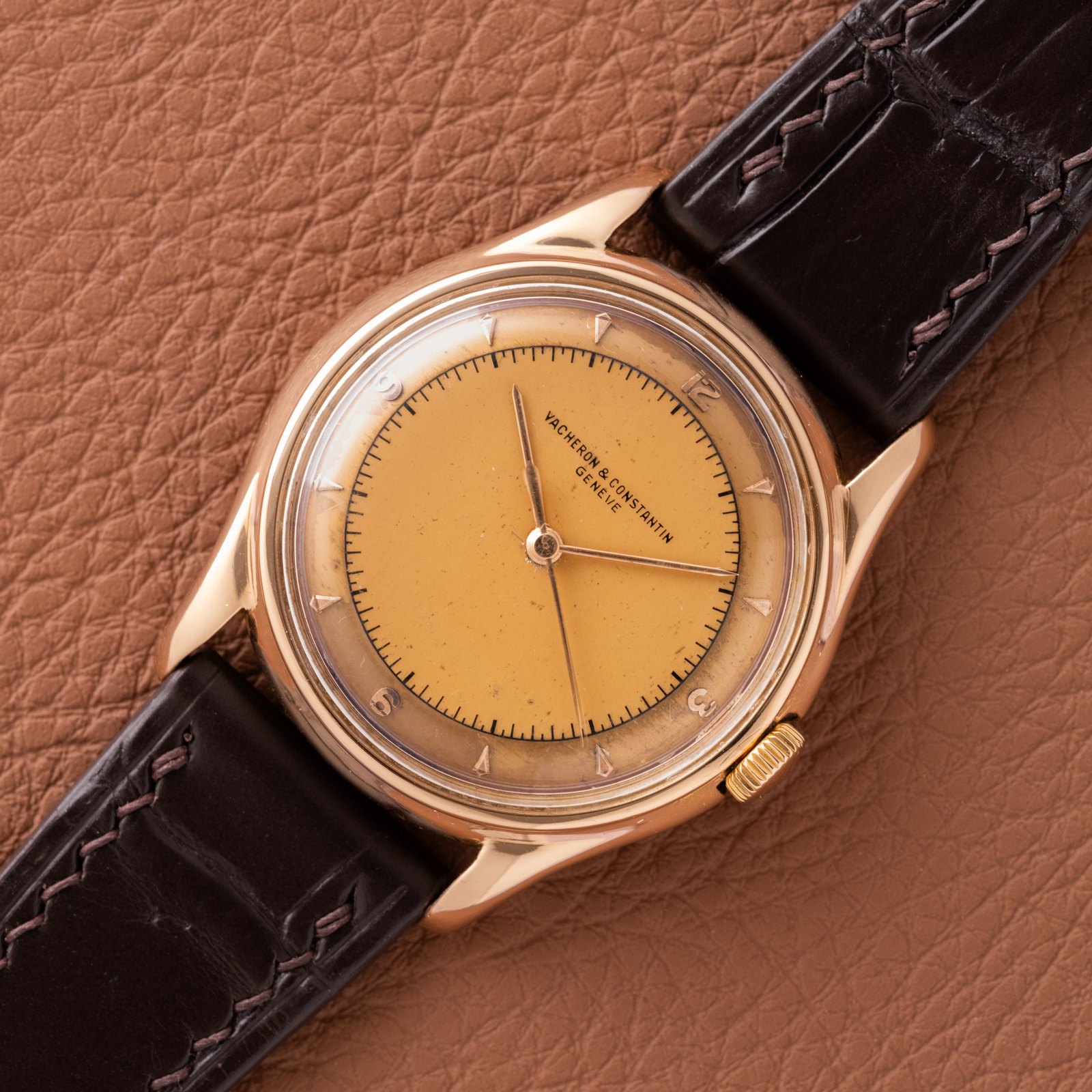
Vacheron Constantin Pink Gold Dress Watch, 1940s
- Maker / attribution
- Vacheron Constantin (maker)
- Date
- 1940s
- Historical period
- Golden Age of Mechanical Watchmaking (1900 – 1945)
- Country of origin
- Switzerland
- Object type
- Wristwatch
- Materials / technique
- gold
- Dimensions
- Case 32 mm
- Stock no.
- Product 8557900398775
- Credit line
- Dealer listing, Huntington Company (product 8557900398775)
- Catalogue title (original)
- 1940s Vacheron Constantin Pink Gold Dress Watch (English)
View the source record (dealer listing) ↗ (opens another website in a new tab)Suggest a correction
Record summary
Catalogued by Huntington Company (dealer) (stock number Product 8557900398775), this is a wristwatch by Vacheron Constantin, made in Switzerland, dated 1940s. The Atlas places it in the Golden Age of Mechanical Watchmaking period (1900 – 1945) of its Wristwatches collection. Materials and techniques recorded by the source: gold. Recorded dimensions: Case 32 mm. The record is illustrated with 6 photographs.
Assembled from the source record's structured fields. Dates and attributions are given as the source states them; where a field is missing the Atlas leaves it blank rather than estimating.
Catalogue description
Dealer description — Huntington Company
History and Significance Vacheron Constantin’s production in the 1940s represents one of the most important periods in the brand’s history, where case design, dial layout, and proportions were all being refined into what collectors now view as the foundation of the modern dress watch. This example is housed in an 18k rose gold case made by C.R. Spillmann, a case maker known for producing some of the most well-executed cases of the era. Spillmann cases are often associated with high-end Patek Philippe chronographs, but their work with Vacheron Constantin is just as notable. The case here reflects that quality, with defined lugs, a smooth bezel, and balanced proportions that wear larger than the stated 32mm. The dial is particularly compelling. The warm tone has aged evenly across the surface, giving it a deep, almost caramel coloration that contrasts subtly with the applied markers and numerals. The outer track and inner sector layout add structure without feeling busy, which is characteristic of Vacheron’s restrained design approach during this period. Writer’s Thoughts The case has presence despite the size, and the lugs give it a stance that feels closer to something larger on the wrist. The dial is what makes it. The color and the overall tone give it a lot of character. You can never go wrong with a pink on pink gold watch. It feels like a watch that has lived a full life but still presents in a way that makes sense today. Our Promise Every watch is thoroughly vetted, carefully described with complete transparency, and guaranteed authentic. Each piece is offered in honest condition, ensuring collectors receive a timepiece that reflects both originality and integrity. Specifications Brand: Vacheron Constantin Model: Dress Watch Year: circa 1940s Case Material: 18k rose gold Case Size: 32mm Bezel: Smooth rose gold bezel Dial: Warm pink aged dial with applied markers and Arabic numerals at quarters Movement: Manual wind Vacheron Constantin caliber Strap/Bracelet: Brown leather strap Buckle/Clasp: Generic tang buckle Contents: Watch only Condition Case: Light surface wear present with some softening consistent with age. Dial: Evenly aged with a warm patina and visible spotting throughout; retains strong legibility and original raised enamel print. Hands: Original hands with light aging consistent with the dial. Crystal: Acrylic crystal with light surface wear and minor scratches. Strap/Bracelet: Leather strap is new.
Historical context
Golden Age of Mechanical Watchmaking (1900 – 1945)
The wristwatch displaces the pocket watch; waterproof cases, self-winding and grand complications.
The wristwatch overtook the pocket watch. Military use in the First World War, aviation, water-resistant cases (1926), automatic winding (1923–31), rectangular Art Deco designs and early chronographs and calendars defined the period.
Read the period in the timelineMore wristwatches from this periodEarlier: Industrial Revolution
Atlas type guide
Wristwatches
Bracelet watches were worn by women from the early nineteenth century — Breguet made one for Caroline Murat, Queen of Naples, in 1810–12 — but the wristwatch only became a man's instrument with military use and aviation in the early twentieth century. Between the World Wars it overtook the pocket watch; the 1920s and 1930s brought rectangular Art Deco cases, water-resistant cases and the first automatic winding systems.
After 1945 the wristwatch became a carrier of identity — dress watches, sports and dive watches, chronographs, calendars — produced by Swiss, American, Japanese, German, Soviet and Chinese industries. The quartz revolution after 1969 and the mechanical renaissance since the 1990s, including the rise of independent watchmakers, complete the story.
What to look for
- The reference number (between the lugs or inside the case back) and serial number, the starting point for dating.
- The calibre: its maker and number are often stamped under the dial or on the bridge.
- Originality of dial, hands and crown — refinished ('redial') dials are common.
- Case material marks: 18K/750, 14K/585, stainless steel, gold-filled, plated.
Dating clues
- Wire-lug cases: before c. 1925.
- Water-resistant screw-down cases: from 1926.
- Quartz movements: from 1969; sapphire crystals widespread after c. 1980.
General guidance written by the Atlas editors about this kind of object. It is not a statement about this particular piece; for that, rely on the source record above and on physical examination.
Related records
Pocket Watches · c. 1896
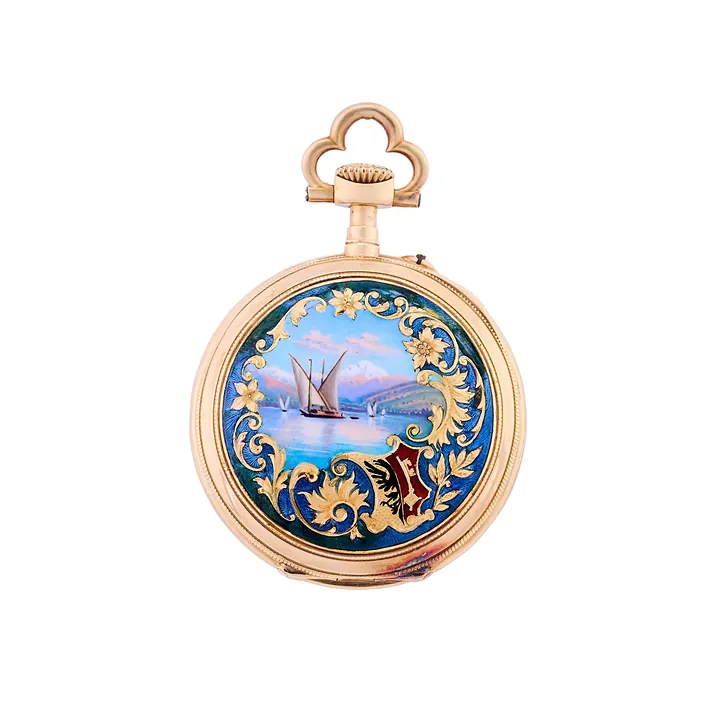
Vacheron Constantin “grand TIR de L’exposition Nationale, Genève 1896, c. 1896
Antiquorum auction archive, Geneva
Pocket Watches · c. 1940
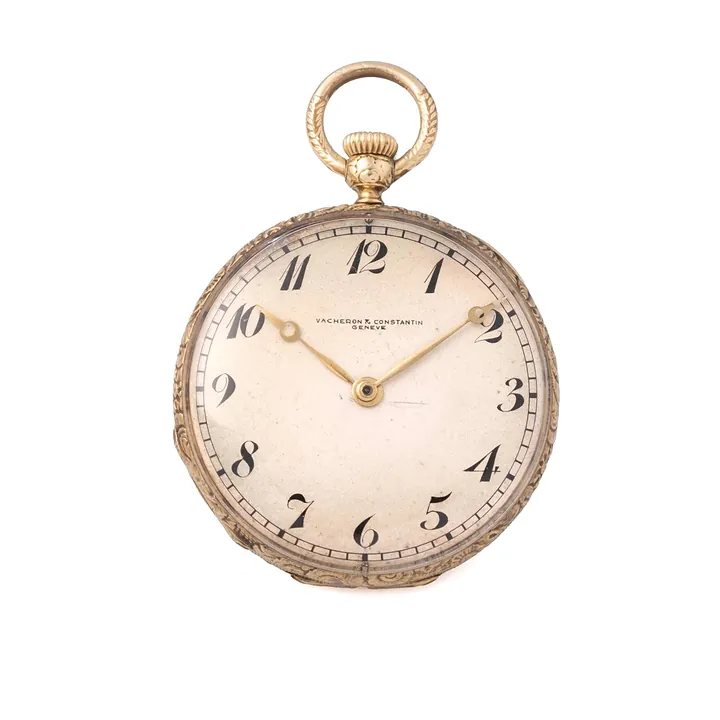
Vacheron Constantin pocket watch, ref. 345, c. 1940
Antiquorum auction archive, Geneva
Pocket Watches · c. 1945
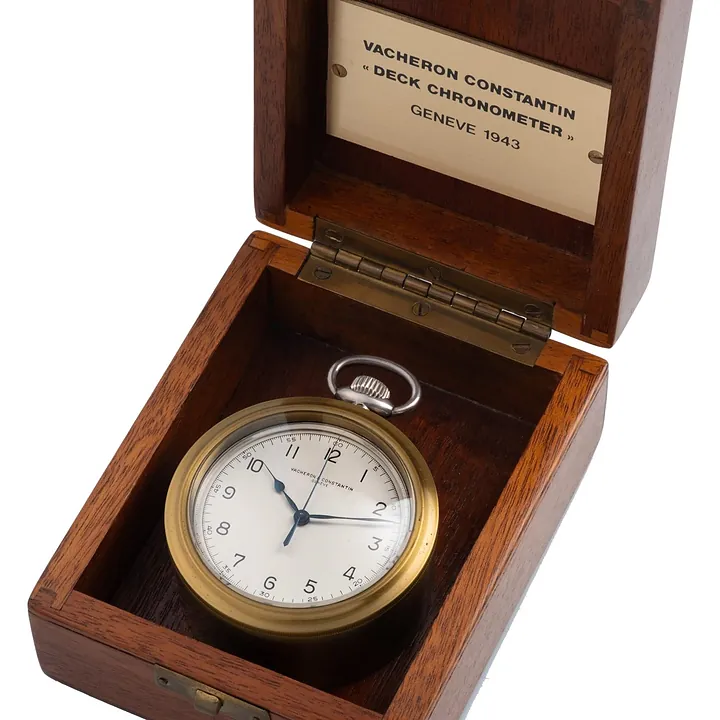
Vacheron Constantin pocket chronometer, c. 1945
Antiquorum auction archive, Geneva
Pocket Watches · c. 1945
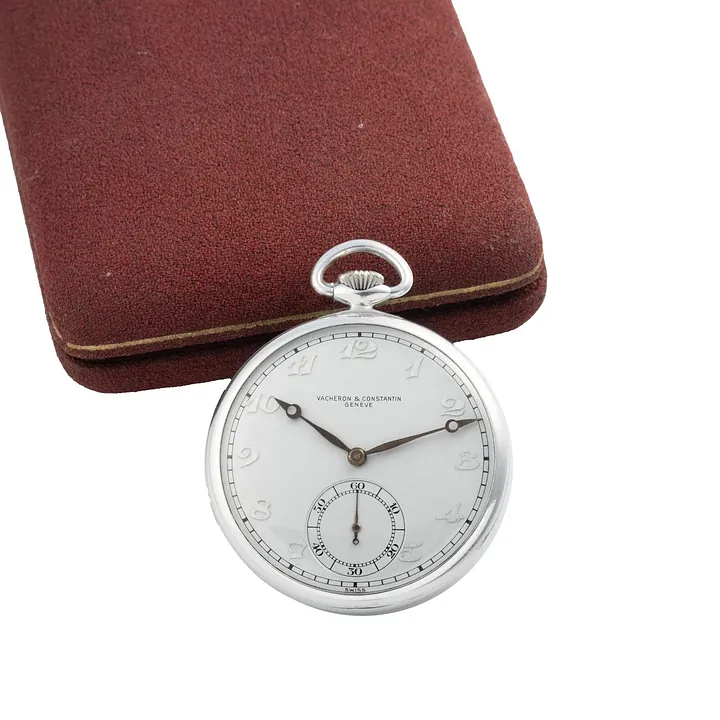
Vacheron Constantin watch, c. 1945
Antiquorum auction archive, Geneva

Wristwatches · 1931
Rolex 'Oyster Perpetual' rotor self-winding wrist-watch, lever escapement, in steel case with glass in back, Montres Rolex SA, Geneva, Switzerland, 1931
Science Museum Group, London

Wristwatches · 1900–1999
Wristwatch by Certina, Switzerland, 1900–1999
Nordic Museum Foundation

Wristwatches · 1900–1999
Wristwatch by Omega, Västerås, 1900–1999
Nordic Museum Foundation

Wristwatches · 1900–1999
Wristwatch by Universal, Switzerland, 1900–1999
Nordic Museum Foundation