
Wristwatches · Wristwatch
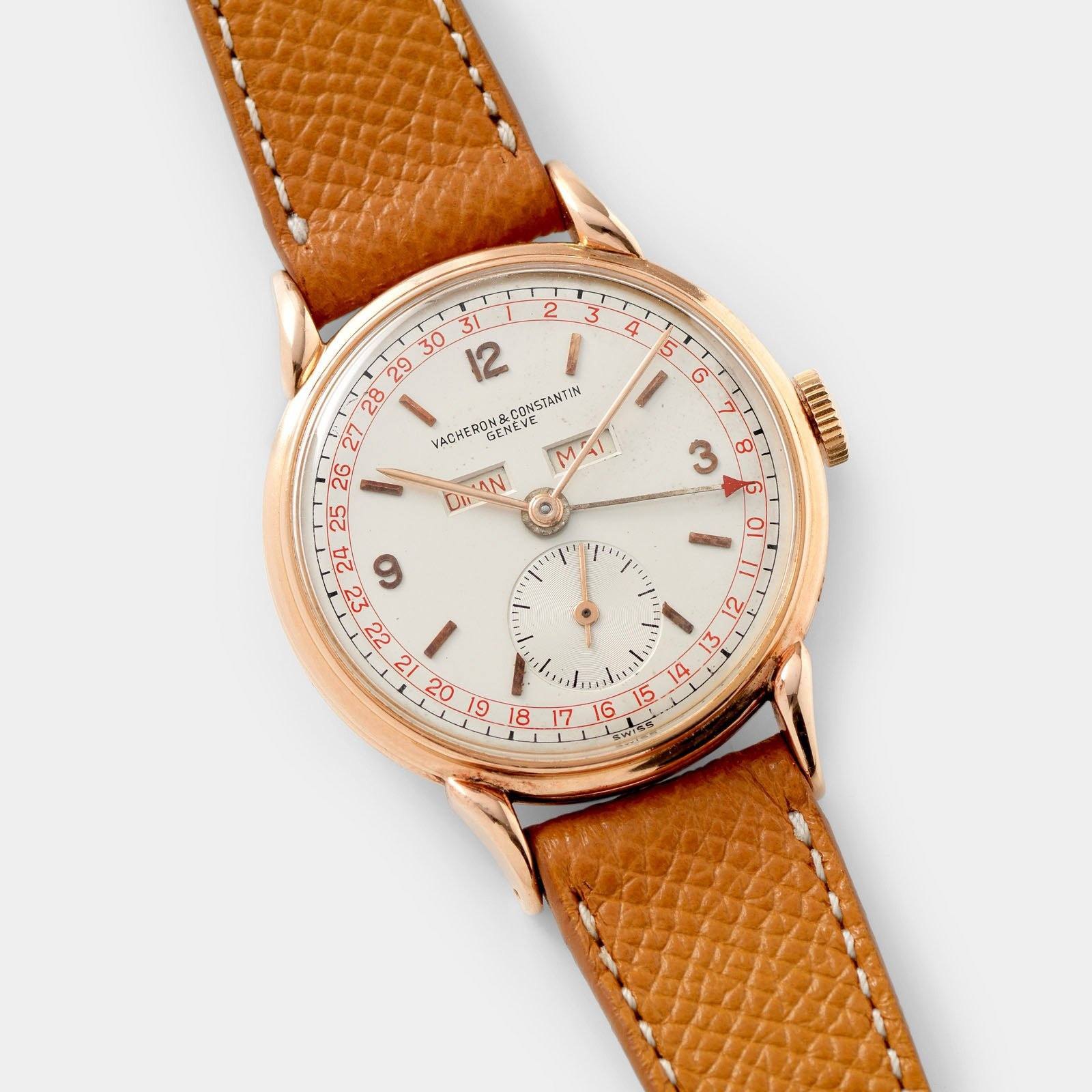
Vacheron and Constantin Triple Date Calendar 4240 Pink Gold, early 1940s
- Maker / attribution
- Vacheron & Constantin (maker)
- Date
- early 1940s
- Historical period
- Golden Age of Mechanical Watchmaking (1900 – 1945)
- Country of origin
- Switzerland
- Object type
- Wristwatch
- Materials / technique
- gold
- Dimensions
- Case 35 mm
- Stock no.
- W-838
- Credit line
- Dealer listing, Bulang & Sons (W-838)
- Catalogue title (original)
- Vacheron and Constantin Triple Date Calendar 4240 Pink Gold (English)
View the source record (dealer listing) ↗ (opens another website in a new tab)Suggest a correction
Record summary
Catalogued by Bulang & Sons (dealer), Copenhagen (stock number W-838), this is a wristwatch by Vacheron & Constantin, made in Switzerland, dated early 1940s. The Atlas places it in the Golden Age of Mechanical Watchmaking period (1900 – 1945) of its Wristwatches collection. Materials and techniques recorded by the source: gold. Recorded dimensions: Case 35 mm. The record is illustrated with 6 photographs.
Assembled from the source record's structured fields. Dates and attributions are given as the source states them; where a field is missing the Atlas leaves it blank rather than estimating.
Catalogue description
Dealer description — Bulang & Sons
The heavy pink with red triple date This calendar watch is rare, stunning and heavy - when you strap this on your wrist you know about it- You feel important so to say !The finishing on the pink gold case is beautiful with bands running around the circumference of the case, giving the effects of layers (please see the pictures), and applied claw lugs. The dial is in awesome condition, especially considering it is nearly 80 years old. The silver non-lume dial has an eye-catching red date chapter ring with two windows – one for the day and one for the month. Minute and hour hands are in pink gold, as is the hand on the small sub-seconds dial. The date arrow hand has a red tip, which perfectly complements the date ring. The manul wind Vacheron & Constantin calibre 455 movement has been fully serviced by our watchmaker. The overall condition of this highly prized watch is incredible! Specifications - Vacheron & Constantin Triple Date - 35mm pink gold case - Dates to the early 1940s - Silver dial with red accents - Day and month windows and date chapter ring - Manual wind VC calibre 455 movement - Comes on a Bulang and Sons strap - Fully serviced by our watchmaker - Includes a handmade single leather watch pouch
Historical context
Golden Age of Mechanical Watchmaking (1900 – 1945)
The wristwatch displaces the pocket watch; waterproof cases, self-winding and grand complications.
The wristwatch overtook the pocket watch. Military use in the First World War, aviation, water-resistant cases (1926), automatic winding (1923–31), rectangular Art Deco designs and early chronographs and calendars defined the period.
Read the period in the timelineMore wristwatches from this periodEarlier: Industrial Revolution
Atlas type guide
Calendar, moon-phase and perpetual calendar watches
Calendar complications range from a simple date to the perpetual calendar, which automatically allows for months of different lengths and leap years until 2100. Pocket watches with perpetual calendars were made in the eighteenth and nineteenth centuries; Patek Philippe made the first perpetual calendar wristwatch in 1925, and series production followed in 1941. The annual calendar (Patek Philippe, 1996) needs correction only once a year.
Moon-phase displays use a disc with two moons and 59 teeth advanced daily, approximating the 29.5-day lunation; more precise trains reduce the error to one day in over a century.
What to look for
- Apertures or subsidiary dials for day, date, month and leap year.
- Moon disc under a 'bosom' shaped aperture.
- Recessed correctors on the case band for setting the calendar.
Dating clues
- Triple-date wristwatches: popular c. 1940–1955.
- Perpetual calendar wristwatches: from 1925 (unique) and 1941 (series).
General guidance written by the Atlas editors about this kind of object. It is not a statement about this particular piece; for that, rely on the source record above and on physical examination.
Related records
Movements & Components · 1800–1899
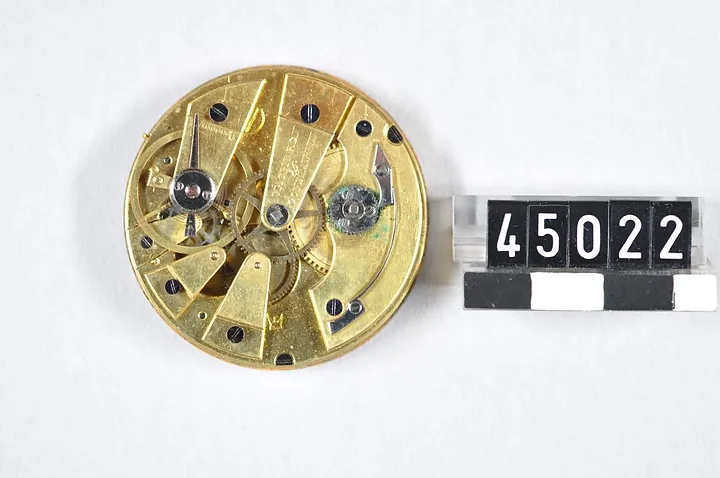
Watch movement by Vacheron & Constantin, 1800–1899
Swedish National Museum of Science and Technology
Instruments · c. 1940
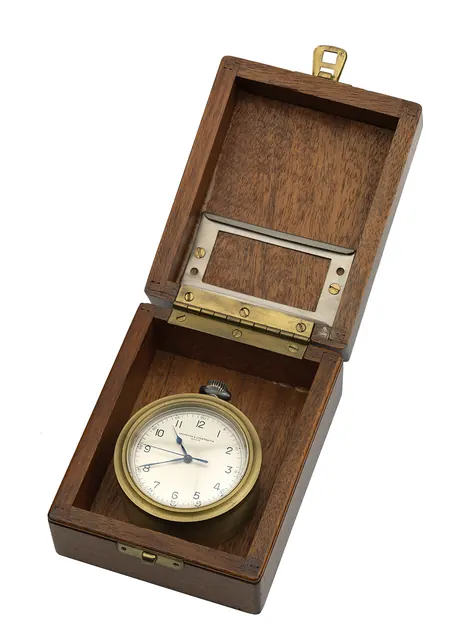
Deck watch no. 54965 by Vacheron & Constantin
Royal Museums Greenwich
Instruments · c. 1943
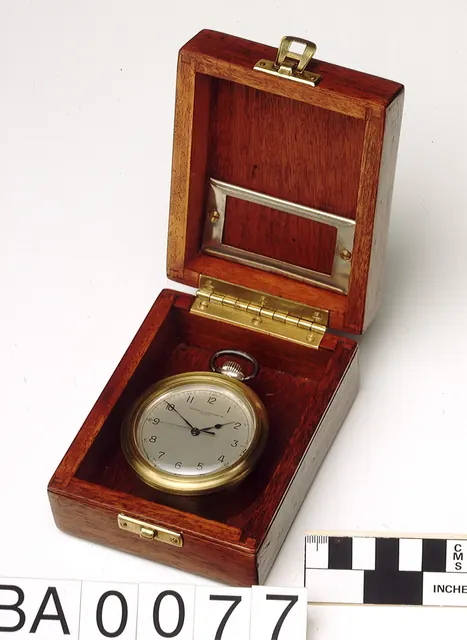
Deck watch no. 54847 by Vacheron & Constantin
Royal Museums Greenwich
Instruments · 1930
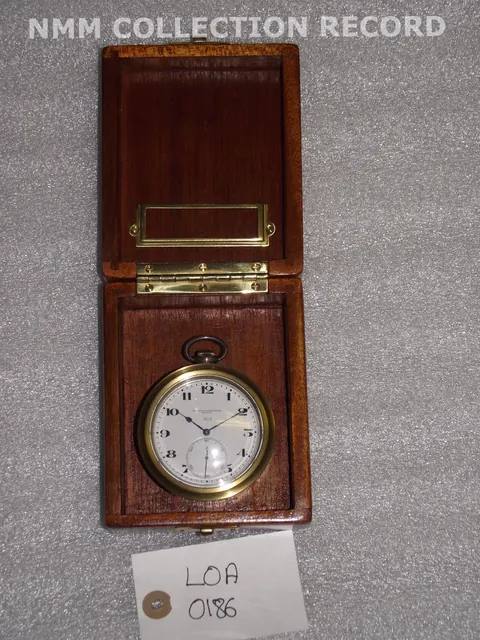
Deck watch no. 9612 by Vacheron & Constantin
Royal Museums Greenwich

Wristwatches · 1931
Rolex 'Oyster Perpetual' rotor self-winding wrist-watch, lever escapement, in steel case with glass in back, Montres Rolex SA, Geneva, Switzerland, 1931
Science Museum Group, London

Wristwatches · 1900–1999
Wristwatch by Certina, Switzerland, 1900–1999
Nordic Museum Foundation

Wristwatches · 1900–1999
Wristwatch by Omega, Västerås, 1900–1999
Nordic Museum Foundation

Wristwatches · 1900–1999
Wristwatch by Universal, Switzerland, 1900–1999
Nordic Museum Foundation