
Wristwatches · Wristwatch
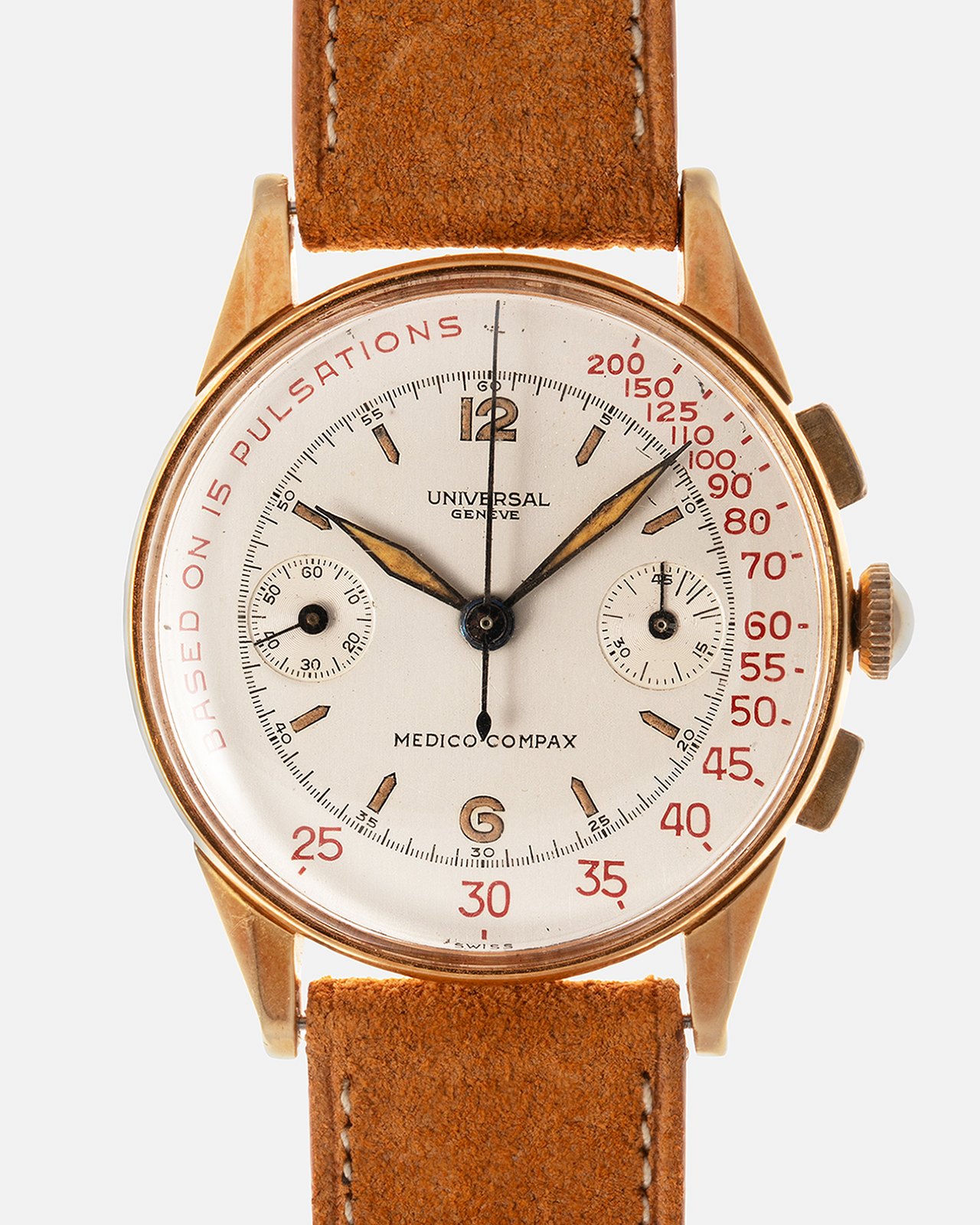
Universal Geneve Medico Compax Jeanneret Case, 1950s
- Maker / attribution
- Universal Genève (maker)
- Date
- 1950s
- Historical period
- Modern Mechanical Horology (1945 – 1969)
- Country of origin
- Switzerland
- Object type
- Wristwatch
- Dimensions
- Case 35 mm
- Stock no.
- Product 6890329145431
- Credit line
- Dealer listing, S.Song Watches (product 6890329145431)
- Catalogue title (original)
- Universal Geneve Medico Compax Jeanneret Case (English)
View the source record (dealer listing) ↗ (opens another website in a new tab)Suggest a correction
Record summary
Catalogued by S.Song Watches (dealer), Seattle (stock number Product 6890329145431), this is a wristwatch by Universal Genève, made in Switzerland, dated 1950s. The Atlas places it in the Modern Mechanical Horology period (1945 – 1969) of its Wristwatches collection. Recorded dimensions: Case 35 mm. The record is illustrated with 6 photographs.
Assembled from the source record's structured fields. Dates and attributions are given as the source states them; where a field is missing the Atlas leaves it blank rather than estimating.
Catalogue description
Dealer description — S.Song Watches
Founded in Le Locle in 1894, Universal Genève established itself from its earliest days as a manufacturer of in-house movements of exceptional quality. They were also famed for making elegant and complicated wristwatches back in their heyday- becoming known as a more accessible alternative to Patek Philippe. It’s not hard to see why, with famed models such as the Tri-Compax and their Compax line in general. Offered here today is a remarkable example of a wristwatch that remains relatively uncommon in today's collecting landscape. This is the Universal Genève Medico-Compax Ref. 12426, a rare variant of the esteemed Compax line. Introduced during the late 1940s, this two-register chronograph was specifically crafted to cater to the needs of medical professionals, allowing them to obtain more accurate pulse readings from patients. I’d go as far as to say that to see a Medico-Compax in the wild is truly an extraordinary occurrence, considering the rarity and distinctive (almost obscure) purpose of these wrist watches. The Medico-Compax showcases a beautifully patina’d silver dial adorned with a pulsation scale in vibrant red, positioned along its periphery. Notably, the scale's calculations are based on a standard of ‘15 pulsations’, extending from approximately the 8 o'clock to 12 o'clock positions. Complementing this distinctive feature, the dial follows a classic two sub-dial chronograph layout, featuring a running seconds sub-dial situated at 9 o'clock and a 45-minute totalizer positioned at 3 o'clock. To provide a contextual understanding of operating a pulsometer and determining a patient's pulse, it's important to note that a pulsometer is designed to measure the number of heartbeats per minute. The scale typically ranges from 15 to 30 heartbeats. To utilize this feature effectively, the user would pause the chronograph precisely at either the 15 th or 30 th heartbeat (in this case of the Medico-Compax, it would be the 15 th heartbeat) of the patient. Subsequently, the dial of the watch would directly display the patient's pulse rate without requiring any further computations. While finding Universal Geneve Medico Compaxes are difficult, finding them in such excellent condition is even harder as most were put to use for their intended purposes. Furthermore, what makes this particular example even more special and above and belong other Universal Geneve’s is that in comes encased in a very rare case produced by famed case maker Jeanneret. Back in the day, it was common practice for brands to outsource case making, with one of the most collectable Universal cases being those made by Spillman. In a similar vein, while more under the radar, Jenneret cases are incredibly difficult to come by and is made distinctive by it’s dual-faceted angular lugs, giving the watch a very nice presence. Encased within its beautiful 35mm 18-carat yellow gold case is Universal Genève’s very own 17-jeweled, manual-winding Cal. 285, a beautiful column-wheel chronograph movement which was first introduced in the early 1940s. Throughout our journey of amassing vintage watches for our site, we have encountered various Universal Genève Compax models with diverse dial configurations and variants. However, this particular Medico-Compax stands out as one of the most captivating timepieces we have had the pleasure of handling thus far. To be able to offer this extraordinary Medico-Compax on our site today is a real delight.
Historical context
Modern Mechanical Horology (1945 – 1969)
Tool watches for divers, pilots and astronauts; electric watches anticipate the electronic age.
The classic era of the mechanical wristwatch: dive watches, chronographs for motor racing and space flight, GMT watches for jet travel, slim dress watches, automatic calendars, and the rise of Japanese manufacturers alongside Swiss, American, German and Soviet industries.
Read the period in the timelineMore wristwatches from this periodEarlier: Golden Age of Mechanical Watchmaking
Atlas type guide
Wristwatches
Bracelet watches were worn by women from the early nineteenth century — Breguet made one for Caroline Murat, Queen of Naples, in 1810–12 — but the wristwatch only became a man's instrument with military use and aviation in the early twentieth century. Between the World Wars it overtook the pocket watch; the 1920s and 1930s brought rectangular Art Deco cases, water-resistant cases and the first automatic winding systems.
After 1945 the wristwatch became a carrier of identity — dress watches, sports and dive watches, chronographs, calendars — produced by Swiss, American, Japanese, German, Soviet and Chinese industries. The quartz revolution after 1969 and the mechanical renaissance since the 1990s, including the rise of independent watchmakers, complete the story.
What to look for
- The reference number (between the lugs or inside the case back) and serial number, the starting point for dating.
- The calibre: its maker and number are often stamped under the dial or on the bridge.
- Originality of dial, hands and crown — refinished ('redial') dials are common.
- Case material marks: 18K/750, 14K/585, stainless steel, gold-filled, plated.
Dating clues
- Wire-lug cases: before c. 1925.
- Water-resistant screw-down cases: from 1926.
- Quartz movements: from 1969; sapphire crystals widespread after c. 1980.
General guidance written by the Atlas editors about this kind of object. It is not a statement about this particular piece; for that, rely on the source record above and on physical examination.
Related records
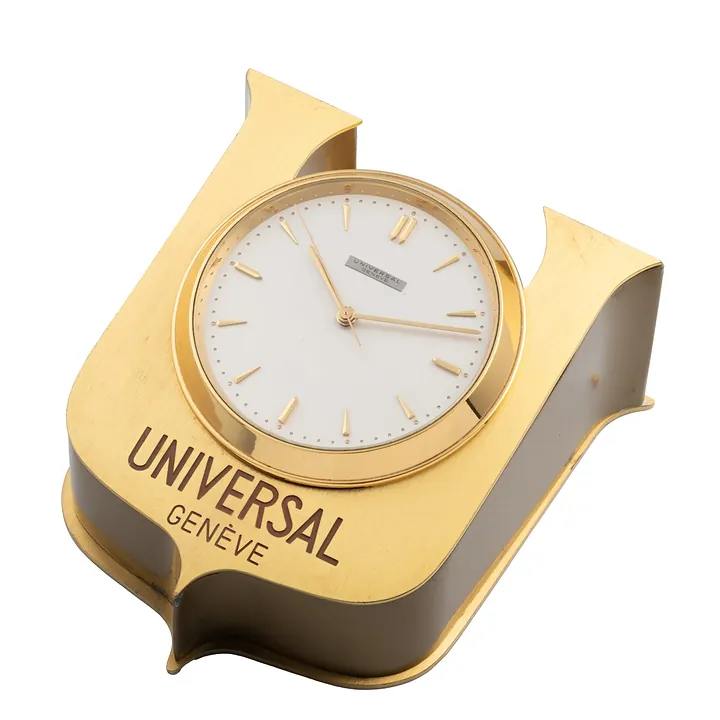
Clocks · c. 1960-1970s
Universal Genève clock, ref. 999.116.01, c. 1960-1970s
Antiquorum auction archive, Geneva
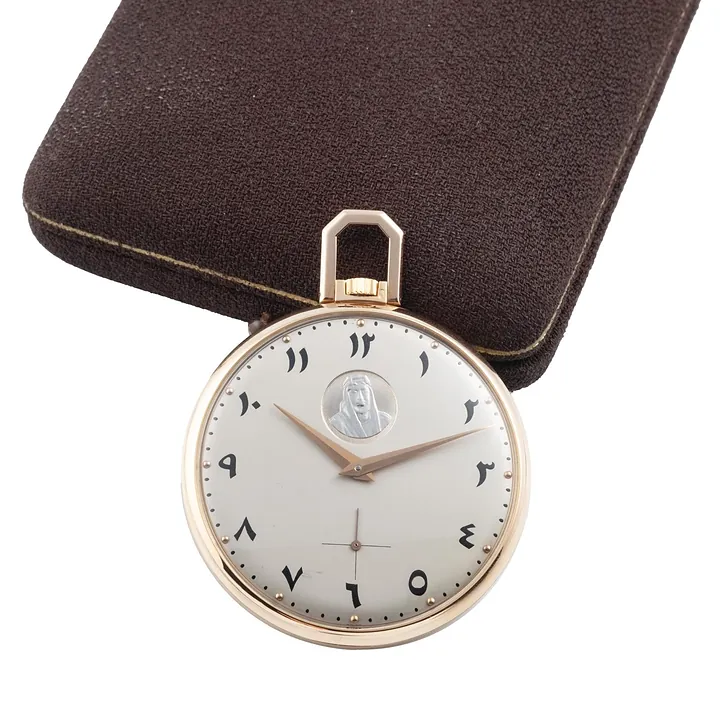
Pocket Watches · c. 1950s
Universal Genève pocket watch, ref. 11746 3/ 11746 1, c. 1950s
Antiquorum auction archive, Geneva
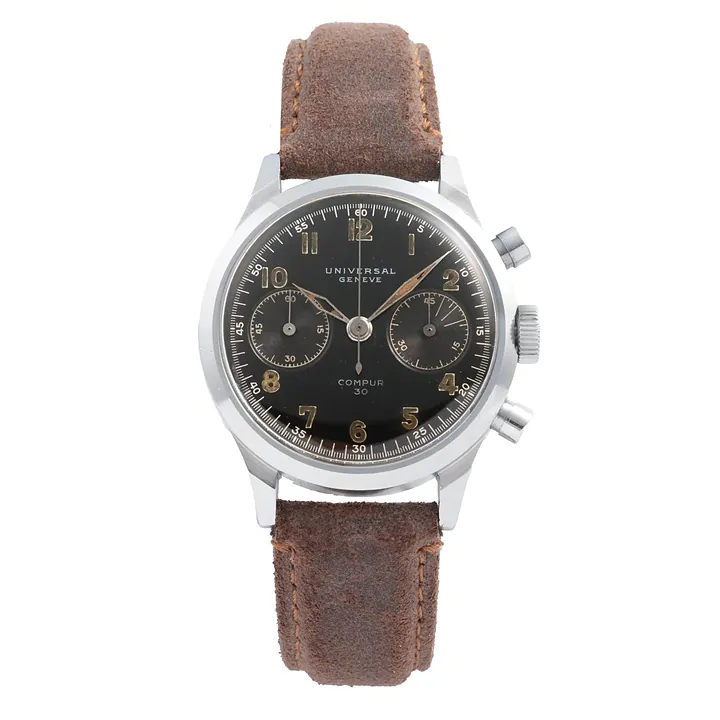
Wristwatches · c. 1941
Universal Genève Compur 30, ref. 22409, c. 1941
Antiquorum auction archive, Geneva

Wristwatches · c. 1945
Universal Genève Uni-Compax, ref. 22492, c. 1945
Antiquorum auction archive, Geneva

Wristwatches · 1945
Wristwatch by Eterna, 1945
Museum Rotterdam

Wristwatches · c. 1945
Breitling Premier, ref. 790, c. 1945
Antiquorum auction archive, Geneva

Wristwatches · c. 1950s
Baume & Mercier wristwatch, c. 1950s
Antiquorum auction archive, Geneva
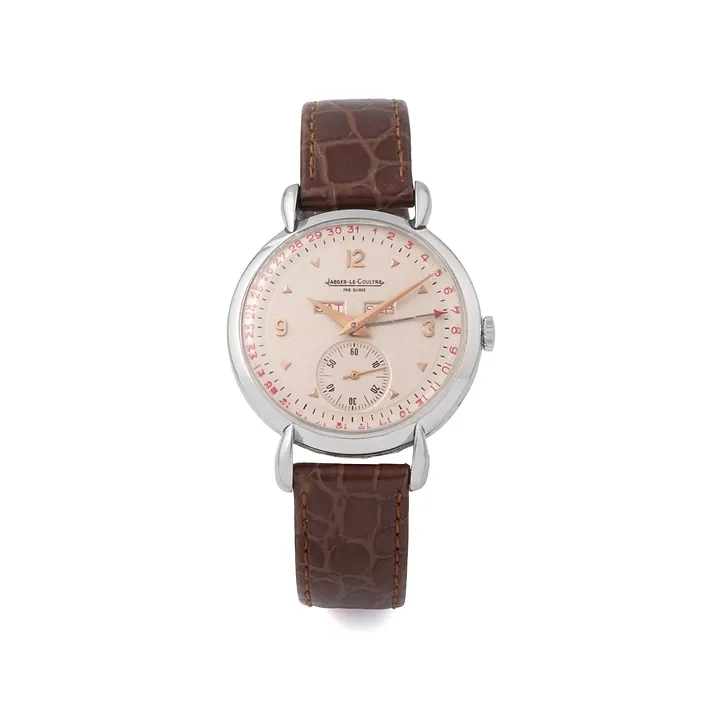
Wristwatches · c. 1950
Jaeger Lecoultre Triple Calendar, c. 1950
Antiquorum auction archive, Geneva