
Wristwatches · Wristwatch
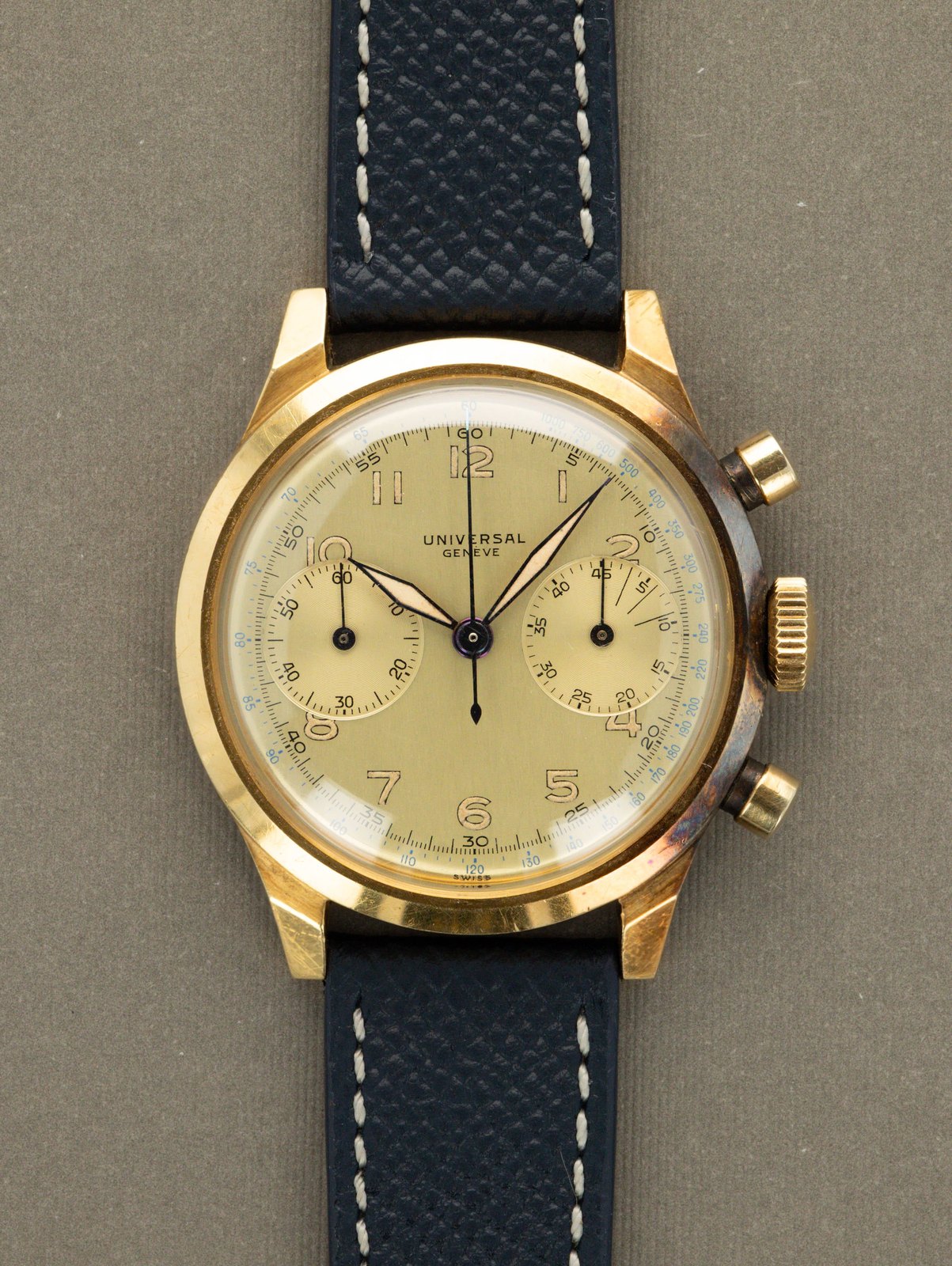
Universal Genève Compur ref. 12482, 'Spillman'
- Maker / attribution
- Universal Genève (maker)
- Date
- c. 1942
- Historical period
- Golden Age of Mechanical Watchmaking (1900 – 1945)
- Country of origin
- Switzerland
- Object type
- Wristwatch
- Dimensions
- Case 38 mm
- Stock no.
- OC2879
- Credit line
- Dealer listing, Oliver & Clarke (OC2879)
- Catalogue title (original)
- Universal Genève Compur Ref. 12482 - 'Spillman' Unpolished (English)
View the source record (dealer listing) ↗ (opens another website in a new tab)Suggest a correction
Record summary
Catalogued by Oliver & Clarke (dealer), United Kingdom (stock number OC2879), this is a wristwatch by Universal Genève, made in Switzerland, dated c. 1942. The Atlas places it in the Golden Age of Mechanical Watchmaking period (1900 – 1945) of its Wristwatches collection. Recorded dimensions: Case 38 mm. The record is illustrated with 6 photographs.
Assembled from the source record's structured fields. Dates and attributions are given as the source states them; where a field is missing the Atlas leaves it blank rather than estimating.
Catalogue description
Dealer description — Oliver & Clarke
Universal Genève was one of the many great brands that succumbed to the quartz crisis of the 1970s. While they disappeared, it was not for their lack of impressive watches. To underscore that fact, keep in mind that Henri Stern Watch Agency in their nearly 80-year history has only ever sold two brands: Patek Philippe, and Universal Genève. The piece that we have here hails from the early 1940s — a time when the world was at war. Predating the more recognizable ‘Compax’ line of watches were a few different chronographs produced with specific use-cases in mind (e.g., Film-Compax, Medico-Compax, Dato-Compax, etc.) this 'Compur' chronograph was a relatively straightforward two-register chronograph in the family. Far simpler than their perhaps better known high complication ‘Tri-Compax,' the Compur were still offered with a variety of cases and dial variants and utilized in-house Universal Genève calibres. This particular Reference 12482 is quite simply the finest yellow gold example that we have ever seen. Dating to circa 1942, the 38mm 'Spillman' case remains in unpolished condition. It is hard to imagine seeing a nicer one. It shows normal signs of wear from age, with thick and prominent sculptured lugs, a screw-down caseback, 'pump' pushers, and a striking, deep oxidation on the right side. Inside, the champagne dial is also in flat-out exceptional condition. Beautifully preserved throughout, the surface is clean and clear, seemingly devoid of any major wear and touts a subtly 'brushed' finishing. The text, 'concentric' finishing within the subsidiary registers, and the Radium numerals are all in fantastic condition. The correct blued-steel 'kite' handset has likely been professionally color-matched to the dial with Tritium — a very tasteful and necessary touch. Powering this piece is UG's Cal. 285 manual-winding movement. Whats more, this piece is enhanced by an always alluring and particularly stunning engraving on its caseback. Design details like the dynamic and perfectly-sized case, the two-register dial layout with cropped indices, and that elegant gold dial amount to a piece that clearly shows why Universal Genève was ultimately considered to be one of the finest manufactures in the era. Examples in condition like this with a desirable configuration simply do not surface on the open market all that often... and with the recent re-launch of the brand, collectors seem to be holding on to pieces like this, making for a great opportunity to grab this one.
Historical context
Golden Age of Mechanical Watchmaking (1900 – 1945)
The wristwatch displaces the pocket watch; waterproof cases, self-winding and grand complications.
The wristwatch overtook the pocket watch. Military use in the First World War, aviation, water-resistant cases (1926), automatic winding (1923–31), rectangular Art Deco designs and early chronographs and calendars defined the period.
Read the period in the timelineMore wristwatches from this periodEarlier: Industrial Revolution
Atlas type guide
Wristwatches
Bracelet watches were worn by women from the early nineteenth century — Breguet made one for Caroline Murat, Queen of Naples, in 1810–12 — but the wristwatch only became a man's instrument with military use and aviation in the early twentieth century. Between the World Wars it overtook the pocket watch; the 1920s and 1930s brought rectangular Art Deco cases, water-resistant cases and the first automatic winding systems.
After 1945 the wristwatch became a carrier of identity — dress watches, sports and dive watches, chronographs, calendars — produced by Swiss, American, Japanese, German, Soviet and Chinese industries. The quartz revolution after 1969 and the mechanical renaissance since the 1990s, including the rise of independent watchmakers, complete the story.
What to look for
- The reference number (between the lugs or inside the case back) and serial number, the starting point for dating.
- The calibre: its maker and number are often stamped under the dial or on the bridge.
- Originality of dial, hands and crown — refinished ('redial') dials are common.
- Case material marks: 18K/750, 14K/585, stainless steel, gold-filled, plated.
Dating clues
- Wire-lug cases: before c. 1925.
- Water-resistant screw-down cases: from 1926.
- Quartz movements: from 1969; sapphire crystals widespread after c. 1980.
General guidance written by the Atlas editors about this kind of object. It is not a statement about this particular piece; for that, rely on the source record above and on physical examination.
Related records
Clocks · c. 1960-1970s
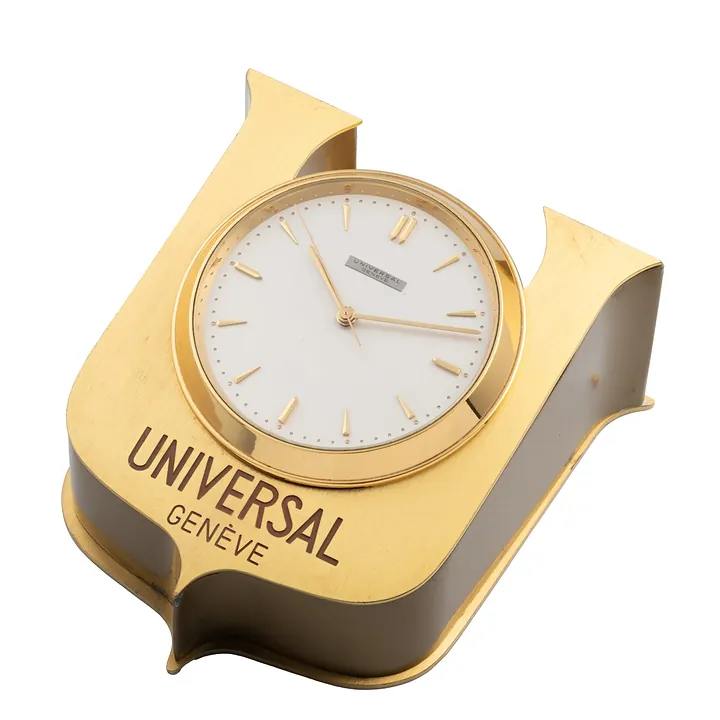
Universal Genève clock, ref. 999.116.01, c. 1960-1970s
Antiquorum auction archive, Geneva
Pocket Watches · c. 1950s
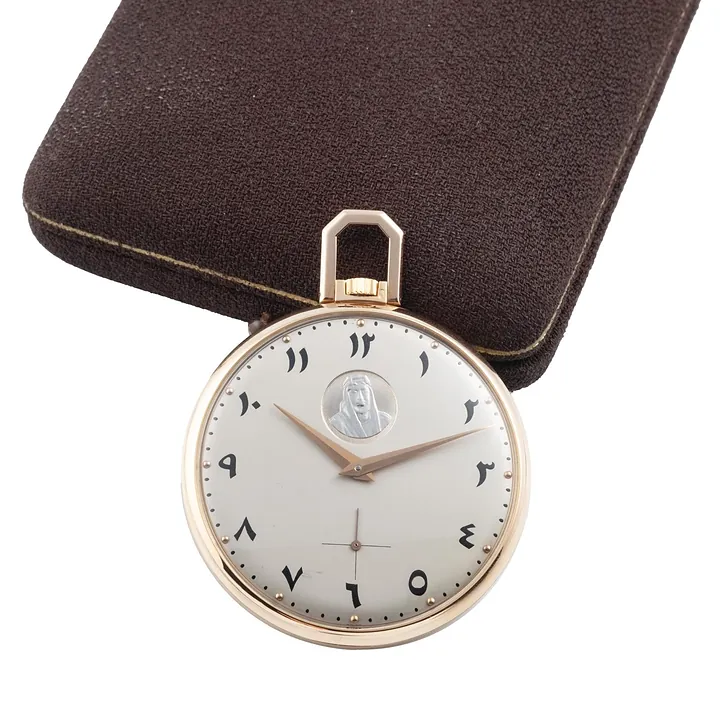
Universal Genève pocket watch, ref. 11746 3/ 11746 1, c. 1950s
Antiquorum auction archive, Geneva
Wristwatches · c. 1941
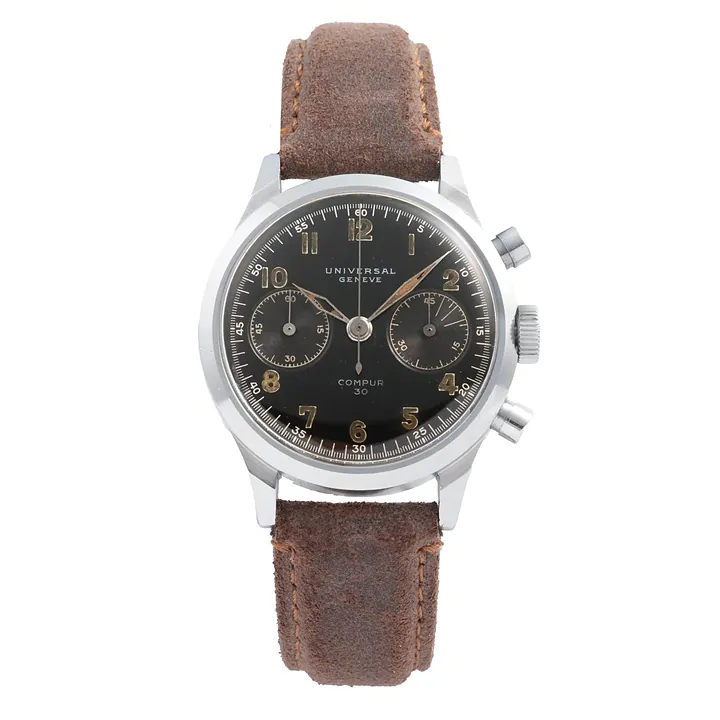
Universal Genève Compur 30, ref. 22409, c. 1941
Antiquorum auction archive, Geneva

Wristwatches · c. 1945
Universal Genève Uni-Compax, ref. 22492, c. 1945
Antiquorum auction archive, Geneva

Wristwatches · 1931
Rolex 'Oyster Perpetual' rotor self-winding wrist-watch, lever escapement, in steel case with glass in back, Montres Rolex SA, Geneva, Switzerland, 1931
Science Museum Group, London

Wristwatches · 1900–1999
Wristwatch by Certina, Switzerland, 1900–1999
Nordic Museum Foundation

Wristwatches · 1900–1999
Wristwatch by Omega, Västerås, 1900–1999
Nordic Museum Foundation

Wristwatches · 1900–1999
Wristwatch by Universal, Switzerland, 1900–1999
Nordic Museum Foundation