
Wristwatches · Wristwatch
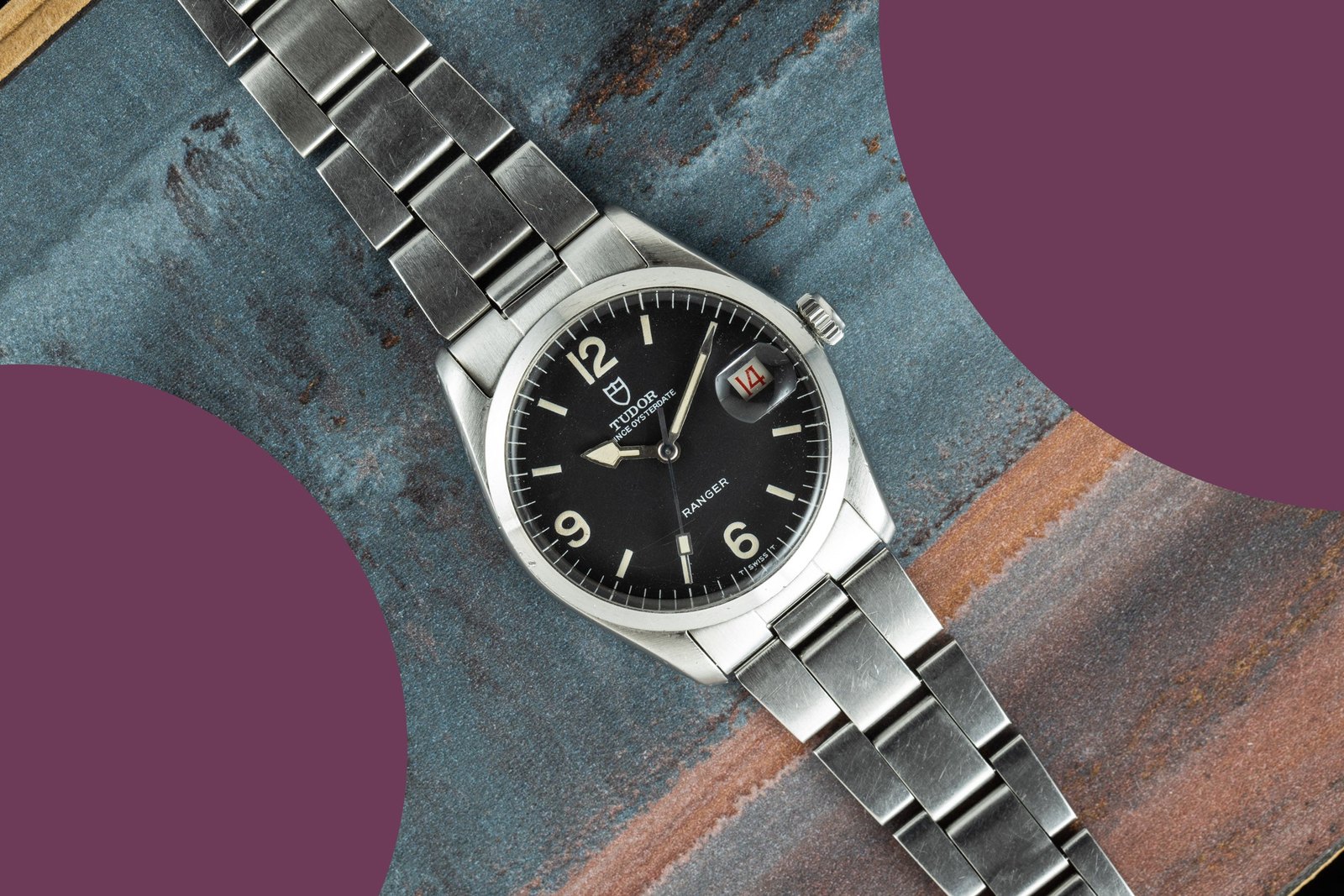
Tudor Ranger Date, c. 1966
- Maker / attribution
- Tudor (maker)
- Date
- c. 1966
- Historical period
- Modern Mechanical Horology (1945 – 1969)
- Country of origin
- Switzerland
- Object type
- Wristwatch
- Dimensions
- Case 35 mm
- Stock no.
- 40990027
- Credit line
- Dealer listing, Analog/Shift (40990027)
- Catalogue title (original)
- Tudor Ranger Date (English)
View the source record (dealer listing) ↗ (opens another website in a new tab)Suggest a correction
Record summary
Catalogued by Analog/Shift (dealer), New York (stock number 40990027), this is a wristwatch by Tudor, made in Switzerland, dated c. 1966. The Atlas places it in the Modern Mechanical Horology period (1945 – 1969) of its Wristwatches collection. Recorded dimensions: Case 35 mm. The record is illustrated with 6 photographs.
Assembled from the source record's structured fields. Dates and attributions are given as the source states them; where a field is missing the Atlas leaves it blank rather than estimating.
Catalogue description
Dealer description — Analog/Shift
Why We Love It Make no mistake - original Tudor Rangers are truly rare. Like their Rolex cousins - the venerable Reference 1016 - these early Ranger models feature matte black dials with painted Tritium luminous indices and Arabic 'quadrants' that are more commonly referred to as Explorer dials. These Tudors were sized slightly smaller than the ExplorerI - 35mm vs. 36mm - and were produced in limited production with both time-only and time and date displays, the latter being something never offered on the Explorer I. Powered by off the shelf Swiss made movements instead of in-house Rolex calibres, the Ranger models also have a thinner case profile, resulting in a nearly 1:1 wearing experience. They also feature a stylized 'arrow' hour hand - a design cue carried forward on the much larger Ranger Heritage models currently available in the Tudor catalog. The marketplace for these rare models is complicated by an overwhelming number of fakes and 'Frankens' on the market - likely outnumbering the genuine article 5 or 10 to 1. In all of our years collecting and dealing vintage watches, we have only been able to offer a half dozen correct, authentic examples! This particular example, a Reference 7966/0, dates to circa 1966 and features a roulette date display, magnified acrylic crystal, and folded-link Oyster bracelet with a 1970 date stamp. The case and bracelet remain strong with normal sign of wear, and the dial is simply exquisite, with rich even patination across the indices and handset - its a looker! Don't snooze on this one - there's no telling when we might be able to procure another example! The Tudor Story Although it started as Rolex’s gateway brand, the quality of Tudor’s products are by no means inferior to Rolex’s. Tudors were in many ways Rolexes in all but name, with the same waterproof Oyster cases and similar styling. However, in order to keep costs down, Tudor used off the shelf Swiss movements rather than their own in-house calibres. What resulted were watches that were more affordable than Rolexes to the consumer, but still uniformly tough and reliable. Hans Wilsdorf created Tudor for the everyman, for miners, construction workers and every sort of tradesman. Rolex was meant for the explorer and the businessman, where Tudor was to be a different creature entirely. For your everyday person Rolex was, and often still is out of reach. Today Tudor has certainly defeated any impression of being the redheaded stepchild of the Rolex family, and their current timepiece collection – as well as their vintage counterparts – are getting the recognition and respect they most rightfully deserve.
Historical context
Modern Mechanical Horology (1945 – 1969)
Tool watches for divers, pilots and astronauts; electric watches anticipate the electronic age.
The classic era of the mechanical wristwatch: dive watches, chronographs for motor racing and space flight, GMT watches for jet travel, slim dress watches, automatic calendars, and the rise of Japanese manufacturers alongside Swiss, American, German and Soviet industries.
Read the period in the timelineMore wristwatches from this periodEarlier: Golden Age of Mechanical Watchmaking
Atlas type guide
Wristwatches
Bracelet watches were worn by women from the early nineteenth century — Breguet made one for Caroline Murat, Queen of Naples, in 1810–12 — but the wristwatch only became a man's instrument with military use and aviation in the early twentieth century. Between the World Wars it overtook the pocket watch; the 1920s and 1930s brought rectangular Art Deco cases, water-resistant cases and the first automatic winding systems.
After 1945 the wristwatch became a carrier of identity — dress watches, sports and dive watches, chronographs, calendars — produced by Swiss, American, Japanese, German, Soviet and Chinese industries. The quartz revolution after 1969 and the mechanical renaissance since the 1990s, including the rise of independent watchmakers, complete the story.
What to look for
- The reference number (between the lugs or inside the case back) and serial number, the starting point for dating.
- The calibre: its maker and number are often stamped under the dial or on the bridge.
- Originality of dial, hands and crown — refinished ('redial') dials are common.
- Case material marks: 18K/750, 14K/585, stainless steel, gold-filled, plated.
Dating clues
- Wire-lug cases: before c. 1925.
- Water-resistant screw-down cases: from 1926.
- Quartz movements: from 1969; sapphire crystals widespread after c. 1980.
General guidance written by the Atlas editors about this kind of object. It is not a statement about this particular piece; for that, rely on the source record above and on physical examination.
Related records
Wristwatches · c. 1973
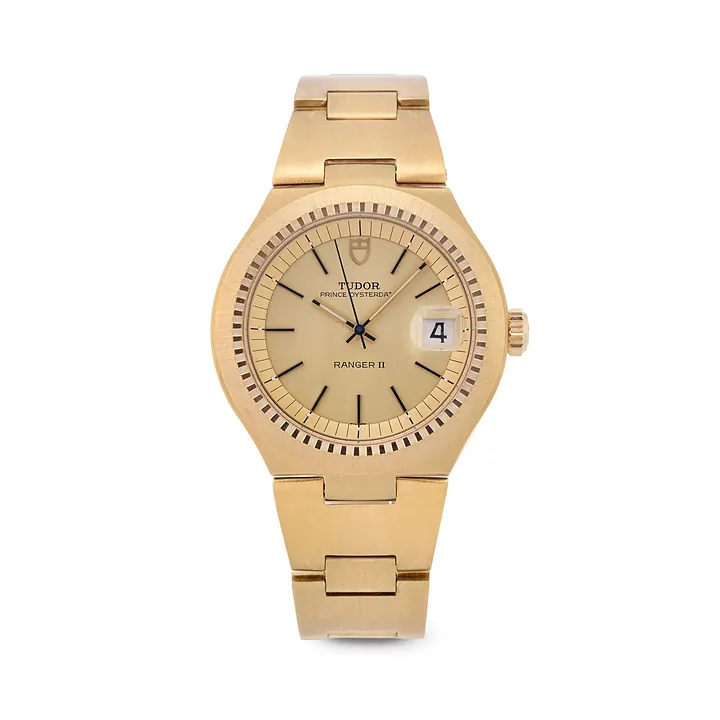
Tudor Prince Oysterdate Ranger II, ref. 9101/1, c. 1973
Antiquorum auction archive, Geneva
Wristwatches · c. 1973
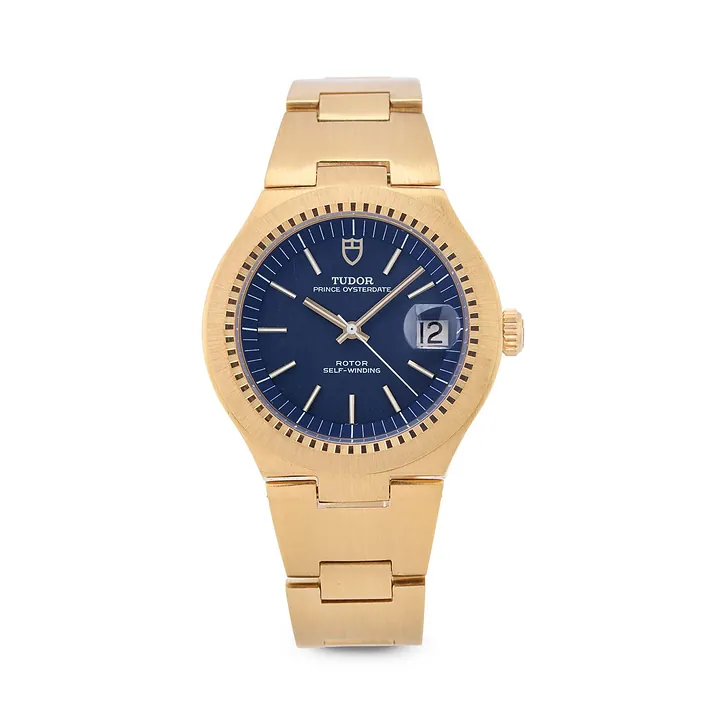
Tudor Prince Oysterdate, ref. 9101/1, c. 1973 (Antiquorum Lot 389-114)
Antiquorum auction archive, Geneva
Wristwatches · c. 1973
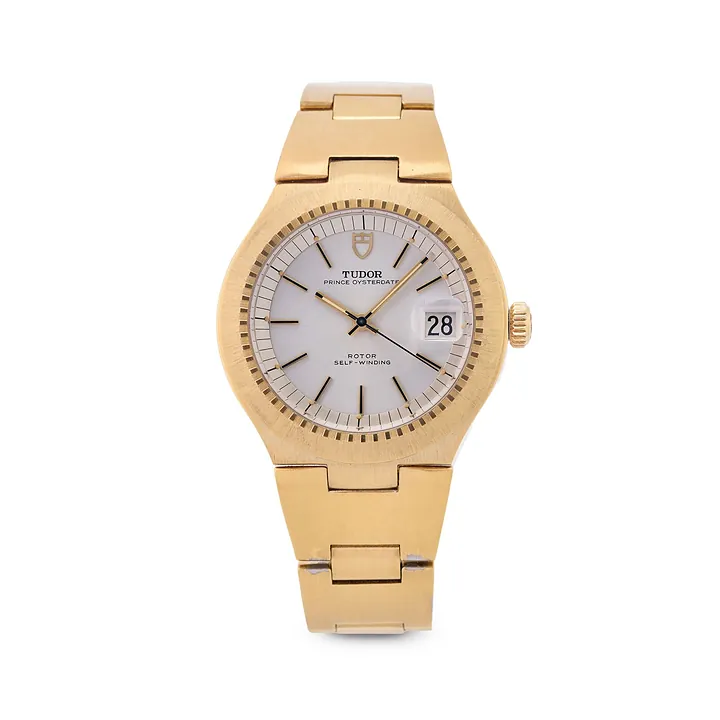
Tudor Prince Oysterdate, ref. 9101/1, c. 1973 (Antiquorum Lot 389-115)
Antiquorum auction archive, Geneva
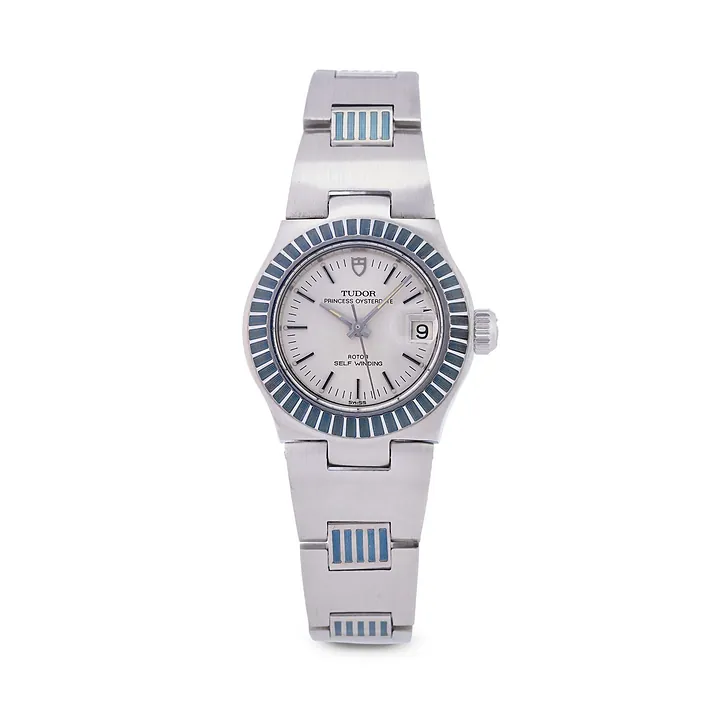
Wristwatches · c. 1974
Tudor Princess Oysterdate, ref. 9311/0, c. 1974
Antiquorum auction archive, Geneva

Wristwatches · 1945
Wristwatch by Eterna, 1945
Museum Rotterdam

Wristwatches · c. 1945
Breitling Premier, ref. 790, c. 1945
Antiquorum auction archive, Geneva

Wristwatches · c. 1945
Universal Genève Uni-Compax, ref. 22492, c. 1945
Antiquorum auction archive, Geneva

Wristwatches · c. 1950s
Baume & Mercier wristwatch, c. 1950s
Antiquorum auction archive, Geneva