Clocks · Table clock
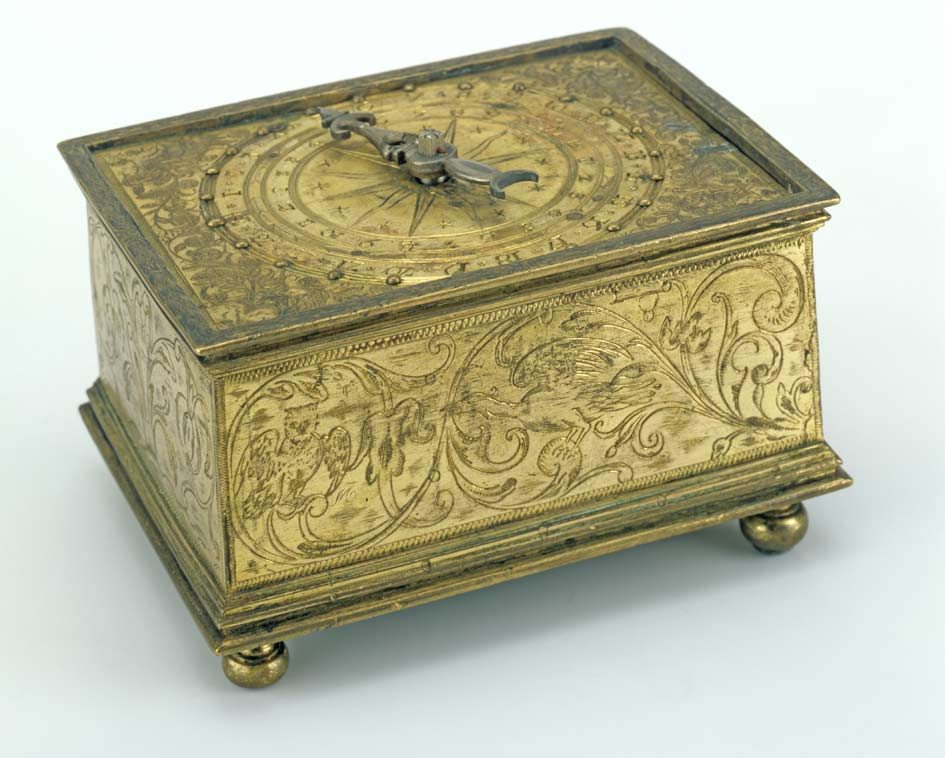
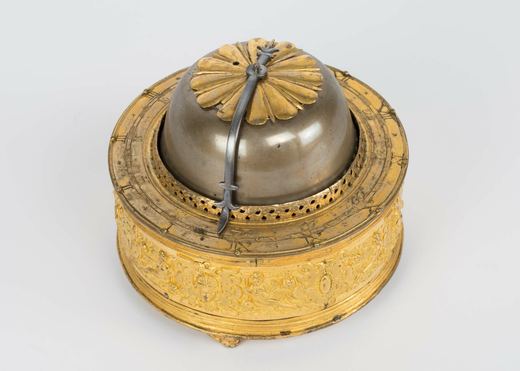
Table clock, Karlsruhe, 1500–1599
- Maker / attribution
- Unrecorded in source
- Date
- 1500–1599
- Historical period
- Renaissance Horology (1400 – 1600)
- Country of origin
- Unrecorded in source
- Place
- Karlsruhe
- Object type
- Table clock
- Holding institution
- Badisches Landesmuseum Karlsruhe
- Accession / object no.
- item_FQTE3QKLWTHK6DKOHCSX2OZTELCE73Y3
- Catalogue title (original)
- Tischuhr (56/137) (German)
Record summary
Held and catalogued by Badisches Landesmuseum Karlsruhe (object number item_FQTE3QKLWTHK6DKOHCSX2OZTELCE73Y3), this is a table clock, made in Karlsruhe, dated 1500–1599. The Atlas places it in the Renaissance Horology period (1400 – 1600) of its Clocks collection. The record is illustrated with 1 photograph.
Assembled from the source record's structured fields. Dates and attributions are given as the source states them; where a field is missing the Atlas leaves it blank rather than estimating.
Catalogue description
Catalogue description from Badisches Landesmuseum Karlsruhe (German)
Die reich gravierte quaderförmige Tischuhr ruht auf vier Kugelfüßen. In der vertieft eingelassenen Deckplatte befindet sich das Zifferblatt mit dem Stundenzeiger in einem Außenkreis mit den Ziffern 1 bis 24 und einem inneren Kreis mit den Ziffern 1 bis 12. Auf den Seitenwänden sind Wellenranken aus Blättern mit Vögeln eingraviert, die auf Ornamentstichen des Kupferstechers Hieronymus Bang, um 1590, beruhen.
Shown in the original language of the source catalogue. An editor-reviewed English translation has not yet been published; we do not publish machine translations as authoritative text.
Historical context
Renaissance Horology (1400 – 1600)
Spring power makes clocks portable; Nuremberg and Augsburg produce the first watches; the Prague Orloj is built.
Spring power made the domestic clock portable. Augsburg and Nuremberg produced gilt-brass table clocks, often with astronomical dials and alarms; weight-driven Gothic wall clocks and English lantern clocks served households. Clocks of this period have foliot or balance-wheel control and usually only an hour hand.
Read the period in the timelineMore clocks from this periodEarlier: Medieval Period
Atlas type guide
Bracket, table and spring-driven clocks
Spring-driven clocks freed timekeeping from the hanging weight. The coiled mainspring, documented from the fifteenth century, made portable table clocks possible; to even out its declining force, makers used the fusee, a conical pulley connected to the barrel by a gut line or chain. Renaissance table clocks from Augsburg and Nuremberg — drum-shaped, square or tower-shaped in gilt brass — were luxury scientific objects, often with astronomical dials and alarms.
After the pendulum, English makers developed the bracket clock: a wooden case with a carrying handle, a short pendulum with a verge escapement, and often repeating work to sound the hours on demand at night. Later examples use the anchor escapement. In the nineteenth century, 'table clock' became a broad term for spring clocks of every nationality.
What to look for
- A fusee in the movement (cone-shaped pulley) and the type of line — gut or chain.
- Verge escapement with a short bob pendulum, often with a decoratively engraved backplate.
- Repeat cords or buttons that make the clock strike again on demand.
- Gilt-brass engraved cases and horizontal dials on Renaissance pieces.
- Case shapes: inverted bell, bell top, break-arch, lancet or balloon.
Dating clues
- Drum and tower table clocks: c. 1520–1650.
- Ebony veneered English bracket clocks with verge escapements: c. 1670–1800.
- Engraved backplates were usual on English clocks until c. 1800, then generally plain.
General guidance written by the Atlas editors about this kind of object. It is not a statement about this particular piece; for that, rely on the source record above and on physical examination.
Related records
Clocks · 1400–1499
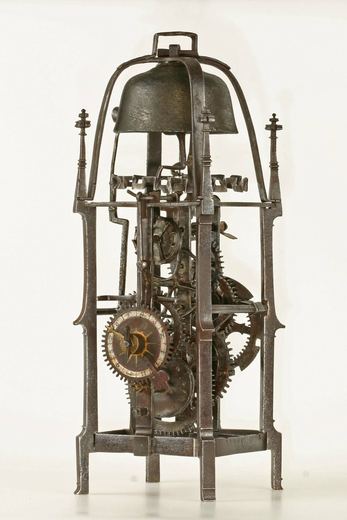
Alarm clock, Germany, 1400–1499
German Clock Museum
Clocks · Mid-15th century
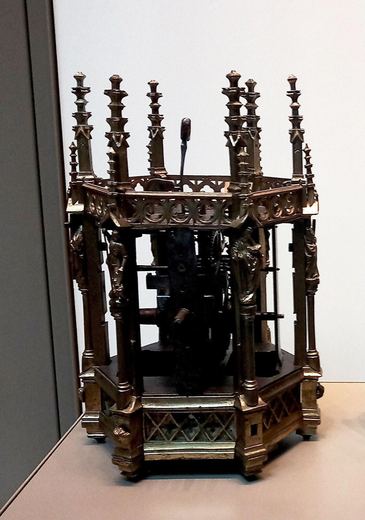
Clock with iron movement in gilt brass case. Burgundian; mid-15th-century (with later restorations).
Victoria and Albert Museum, London
Clocks · 1400-1499
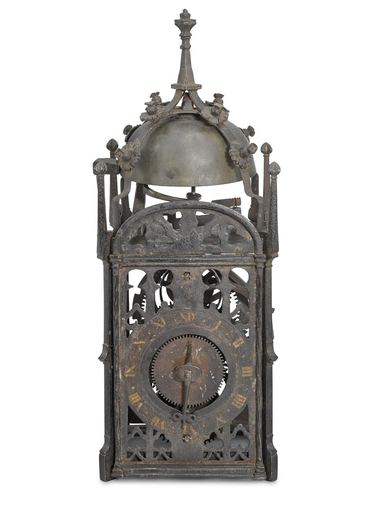
Lantern clock, Germany, 1400-1499
Science Museum Group, London
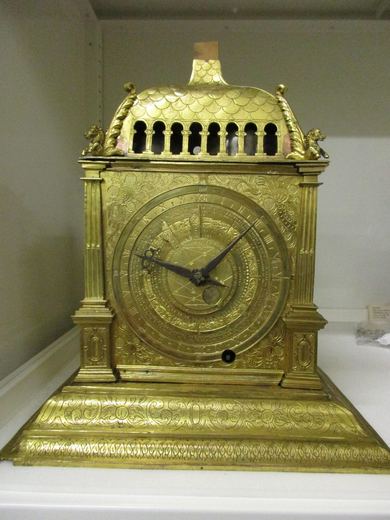
Clocks · 1500-1600
An astronomical clock in a gilt-bronze case, Venetian, sixteenth century.
Victoria and Albert Museum, London
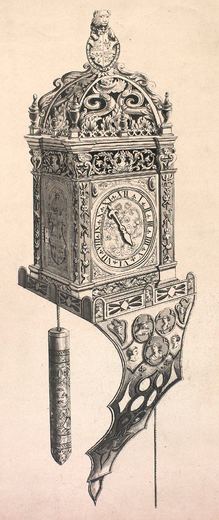
Clocks · 1500–1599
Bracket clock by Anne Boleyn, United Kingdom, 1500–1599
Archaeology Data Service
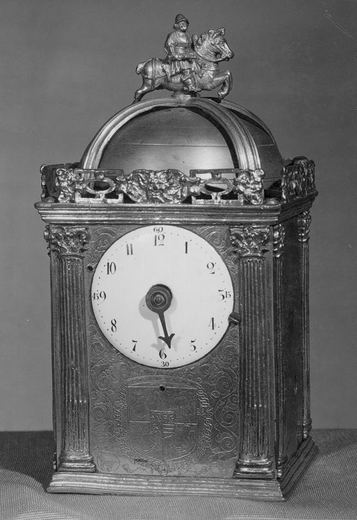
Clocks · 1500–1599
Clock by P. Plantart, Belgium, 1500–1599
Royal Institute for Cultural Heritage
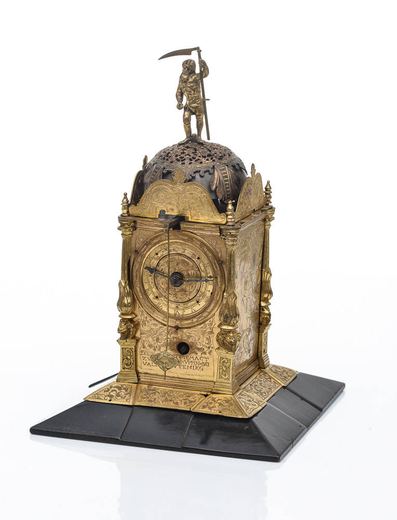
Clocks · 1500–1599
Table clock by Rutenieg, Valentin (um 1550) (Uhrmacher), Germany, 1500–1599
City Museum Berlin
Clocks · 1500–1599
Table clock, Denmark, 1500–1599
German Clock Museum