Clocks · Astronomical clock
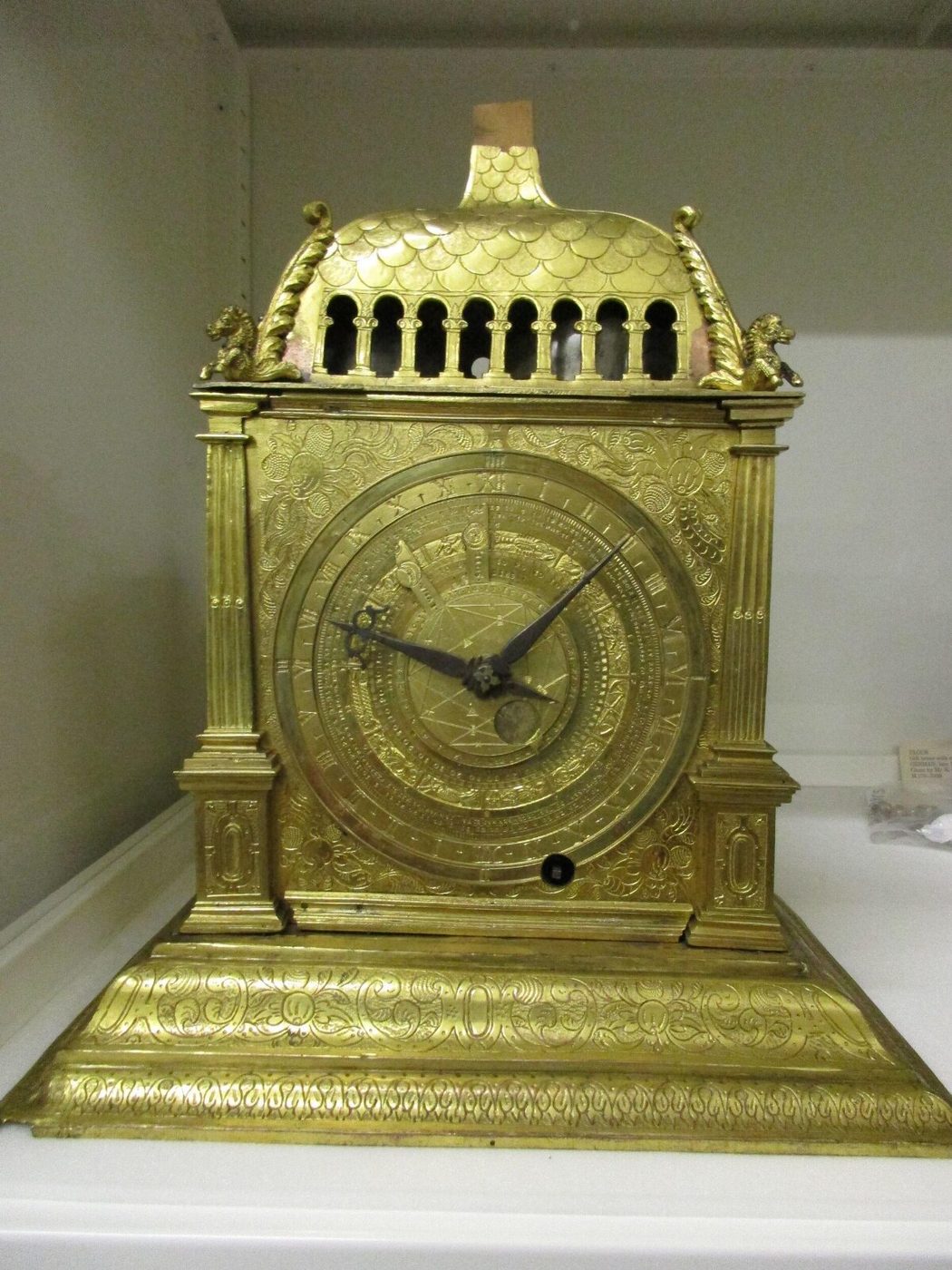
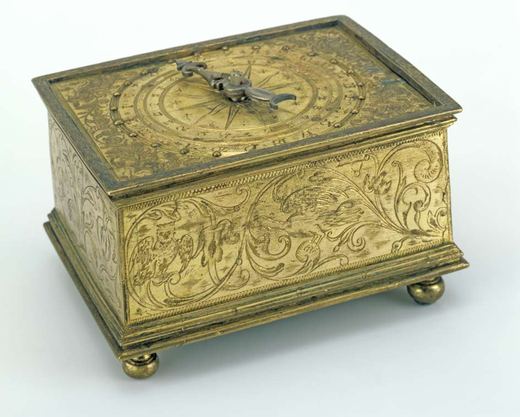
An astronomical clock in a gilt-bronze case, Venetian, sixteenth century.
- Maker / attribution
- Unrecorded in source
- Date
- 1500-1600
- Historical period
- Renaissance Horology (1400 – 1600)
- Country of origin
- Italy
- Place
- Venice
- Object type
- Astronomical clock
- Materials / technique
- Gilt-bronze
- Dimensions
- Height: 14.75 in
- Holding institution
- Victoria and Albert Museum, London
- Accession / object no.
- 638&A-1865
Record summary
Held and catalogued by Victoria and Albert Museum, London (object number 638&A-1865), this is an astronomical clock, made in Venice, Italy, dated 1500-1600. The Atlas places it in the Renaissance Horology period (1400 – 1600) of its Clocks collection. Materials and techniques recorded by the source: Gilt-bronze. Recorded dimensions: Height: 14.75 in. The record is illustrated with 4 photographs.
Assembled from the source record's structured fields. Dates and attributions are given as the source states them; where a field is missing the Atlas leaves it blank rather than estimating.
Catalogue description
V&A — Physical description
Rectangular table clock with 2 bells, and dials on four faces, last dial with 4 figures. Time to the hour and alarm, striking set up, with astronomical indications, the whole surmounted by a female figure. German, 16th century.
V&A — Object history
From the collection of Jules Soulages (1803-1857), a lawyer from Toulouse, acquired in Italy and housed in Paris, then moved to Toulouse before its acquisition by the South Kensington Museum between 1859 and 1865 in installments for £11,0000. Soulages collected French and Italian Renaissance Art from 1825. The gilt bronze figure of Minerva was given by Mr J Whitecombe Greene and added as a finial September 1920.
Historical context
Renaissance Horology (1400 – 1600)
Spring power makes clocks portable; Nuremberg and Augsburg produce the first watches; the Prague Orloj is built.
Spring power made the domestic clock portable. Augsburg and Nuremberg produced gilt-brass table clocks, often with astronomical dials and alarms; weight-driven Gothic wall clocks and English lantern clocks served households. Clocks of this period have foliot or balance-wheel control and usually only an hour hand.
Read the period in the timelineMore clocks from this periodEarlier: Medieval Period
Atlas type guide
Astronomical, musical and automaton clocks
Astronomical clocks display more than the hour: the positions of the sun and moon in the zodiac, the phase of the moon, the calendar, sometimes the planets and eclipses. From Richard of Wallingford's and Giovanni de' Dondi's fourteenth-century clocks to the Prague Orloj and the Strasbourg cathedral clocks, they demonstrated the order of the cosmos. Renaissance makers in Augsburg and Nuremberg built celestial globe clocks and monstrance clocks as princely treasures.
Automaton and musical clocks entertained as well as informed: figures move, birds sing, organs and carillons play tunes from pinned cylinders. The eighteenth-century trade with China ('sing-songs') and Ottoman Turkey created a market for elaborate English, Swiss and French automata.
What to look for
- Subsidiary dials for moon phase, calendar, zodiac and planetary positions.
- Celestial globes or armillary spheres turned by the movement.
- Pinned cylinders, bellows and pipes or bells for music.
- Figures on cams and levers; separate trains for automaton work.
Dating clues
- Renaissance astronomical table and globe clocks: c. 1550–1650.
- English and Swiss automaton clocks for the Chinese market: c. 1760–1820.
- Picture clocks (clockwork pictures) are mostly nineteenth century.
General guidance written by the Atlas editors about this kind of object. It is not a statement about this particular piece; for that, rely on the source record above and on physical examination.
Read next:Verge escapementFusee
Related records
Clocks · 1400–1499
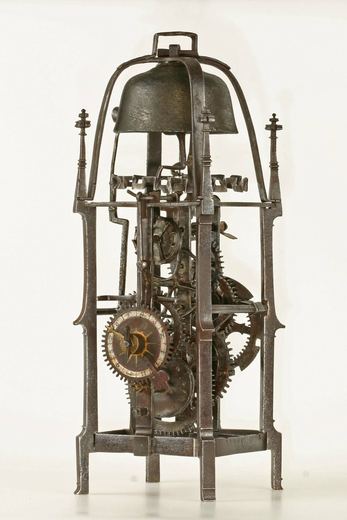
Alarm clock, Germany, 1400–1499
German Clock Museum
Clocks · Mid-15th century
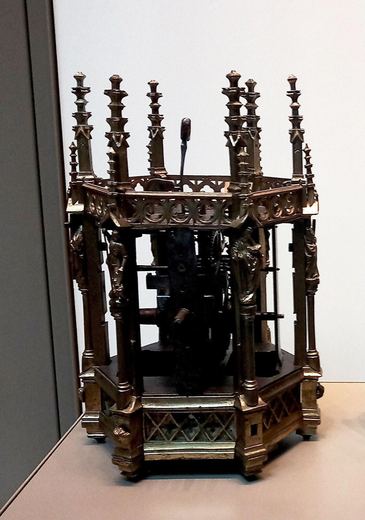
Clock with iron movement in gilt brass case. Burgundian; mid-15th-century (with later restorations).
Victoria and Albert Museum, London
Clocks · 1400-1499
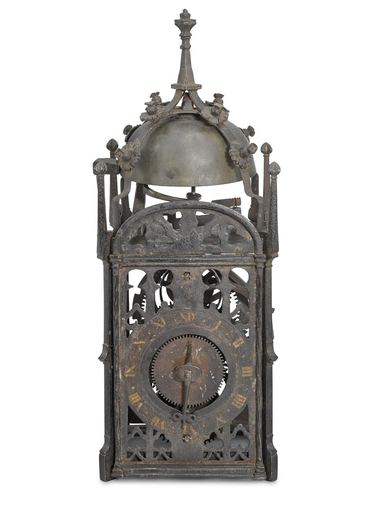
Lantern clock, Germany, 1400-1499
Science Museum Group, London
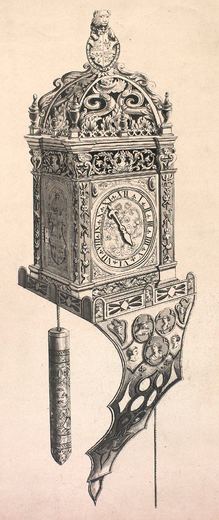
Clocks · 1500–1599
Bracket clock by Anne Boleyn, United Kingdom, 1500–1599
Archaeology Data Service
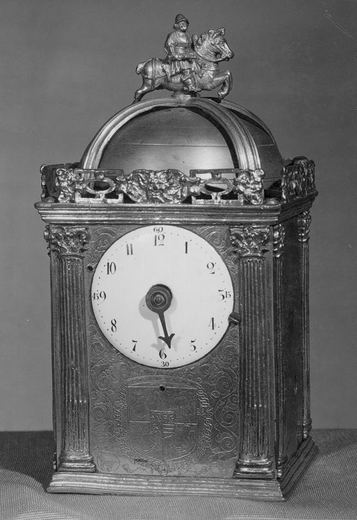
Clocks · 1500–1599
Clock by P. Plantart, Belgium, 1500–1599
Royal Institute for Cultural Heritage
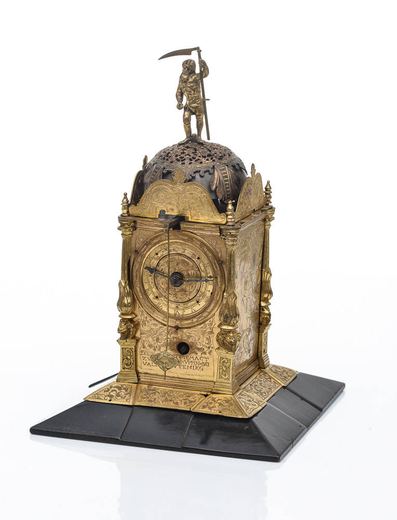
Clocks · 1500–1599
Table clock by Rutenieg, Valentin (um 1550) (Uhrmacher), Germany, 1500–1599
City Museum Berlin
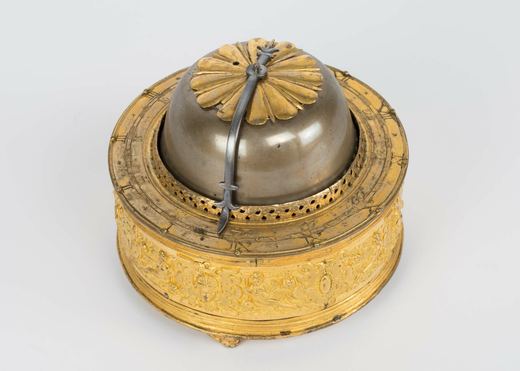
Clocks · 1500–1599
Table clock, Denmark, 1500–1599
German Clock Museum
Clocks · 1500–1599
Table clock, Karlsruhe, 1500–1599
Badisches Landesmuseum Karlsruhe