Clocks · Chamber clock
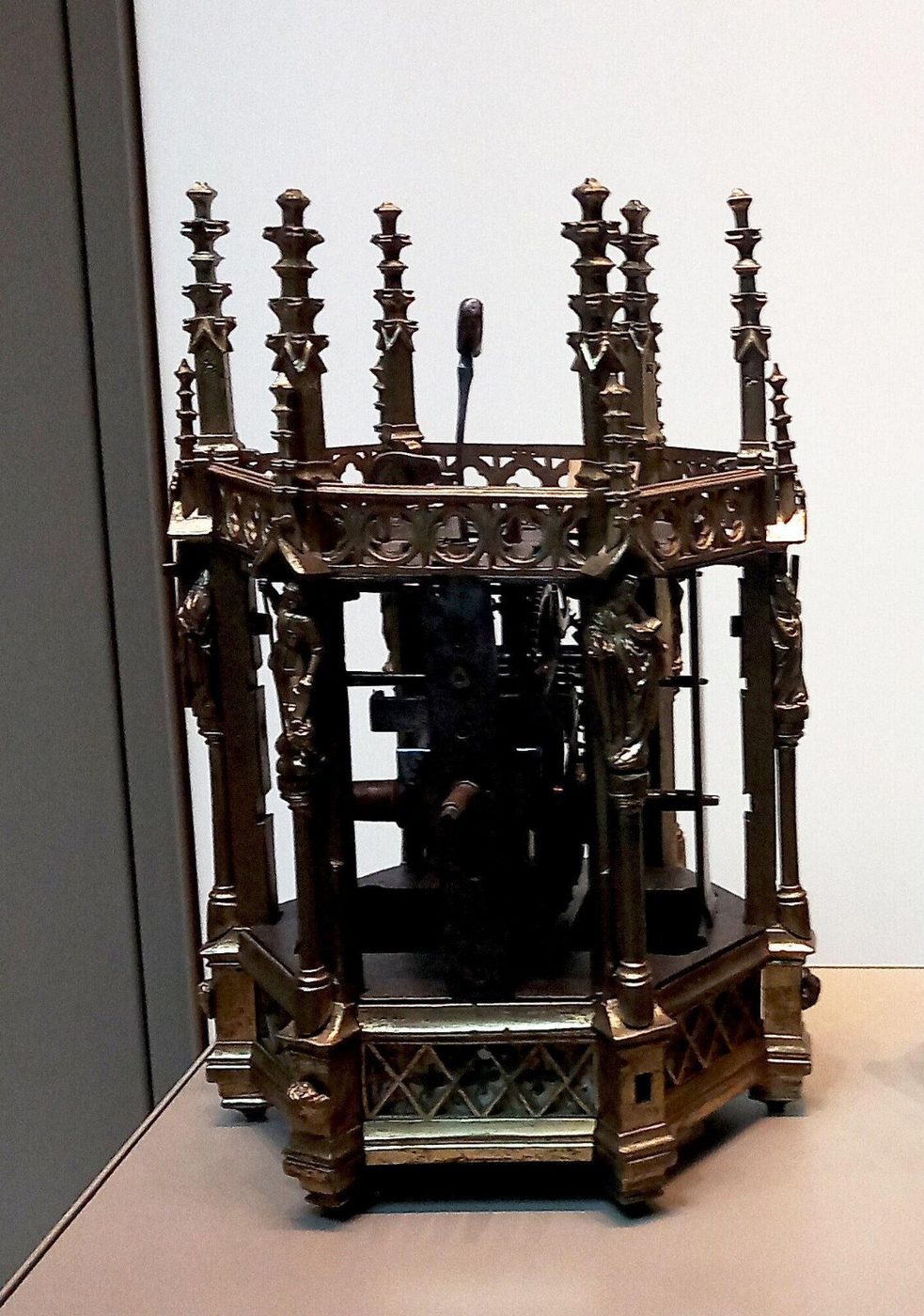
Clock with iron movement in gilt brass case. Burgundian; mid-15th-century (with later restorations).
- Maker / attribution
- Unrecorded in source
- Date
- Mid-15th century
- Historical period
- Renaissance Horology (1400 – 1600)
- Country of origin
- Unrecorded in source
- Place
- Burgundy
- Object type
- Chamber clock
- Materials / technique
- Iron and gilded brass
- Dimensions
- Height: 11 1/2 in; Width: 19 cm; Depth: 17 cm
- Holding institution
- Victoria and Albert Museum, London
- Accession / object no.
- M.11-1940
- Credit line
- Mrs Sigismund Goetze in memory of her husband
Record summary
Held and catalogued by Victoria and Albert Museum, London (object number M.11-1940), this is a chamber clock, made in Burgundy, dated Mid-15th century. The Atlas places it in the Renaissance Horology period (1400 – 1600) of its Clocks collection. Materials and techniques recorded by the source: Iron and gilded brass. Recorded dimensions: Height: 11 1/2 in; Width: 19 cm; Depth: 17 cm. The record is illustrated with 3 photographs.
Assembled from the source record's structured fields. Dates and attributions are given as the source states them; where a field is missing the Atlas leaves it blank rather than estimating.
Catalogue description
V&A — Summary
A spring-driven chamber clock made in Burgundy in the mid-fifteenth century. The gilt-brass case in Gothic style with an upper frieze pierced with quatrofoils in roundels and a lower frieze of lozenge pattern pierced with quatrofoils. Each corner pillar containes a figure of a saint; the pillars taper to form crotched spires; originally a further level of pillars would have supported a bell. Plinths for pillars have applied winged cherubs heads in relief (two are missing). Three saints can be identified as St Catherine of Alexandra, with book and sword; St George with dragon; St Helena, crowned with cross.
V&A — Physical description
Hexagonal with figures of saints on columns under crocketed canopies at the angles; it rests on six feet above which are applied churub- heads (two wanting); bands of tracery at top and bottom.
V&A — Object history
Historical significance: David Thompson (British Museum Clock Room) notes that this is one of two very rare surviving examples of a spring-driven clock (the earliest known). Converted to weight-drive, date unknown. The movement re-built. The case with restoration, probably in the 19th century. The other example is in the Germanisches National Museum, Nuremberg. [information provided by Pippa Shirley 6.11.1998] The clock has been converted to be weight-driven, it was originally spring-driven. Beresford Hutchinson, former curator of clocks and watches at the British Museum, made a reconstruction of the movement to show the original arrangement of the spring barrels and fusees, based on the evidence provided by the original clock. Much of the clock is now missing; there is no dial and most of the wheelwork is replaced. The clock was given by Constance Goetze, widow of Sigismund Goetze (1866-1939) in memory of her husband in 1940. The gift included a pewter tankard, two pricket candlesticks and another clock signed by Conrad Heckel of Vienna.
V&A gallery label
Chamber Clock. Anonymous. Burgundy. Mid AD 1400s This is the oldest clock in the British Museum. It is made of iron and gilded brass. The decoration reflects cathedral and church architecture of the time; each corner pillar has a niche containing a figure of a saint, the bell and parts of the case are now missing and the mechanism has been adapted originally it was driven by a spring but was later changed to weight driven. [Written by the British Museum]
Historical context
Renaissance Horology (1400 – 1600)
Spring power makes clocks portable; Nuremberg and Augsburg produce the first watches; the Prague Orloj is built.
Spring power made the domestic clock portable. Augsburg and Nuremberg produced gilt-brass table clocks, often with astronomical dials and alarms; weight-driven Gothic wall clocks and English lantern clocks served households. Clocks of this period have foliot or balance-wheel control and usually only an hour hand.
Read the period in the timelineMore clocks from this periodEarlier: Medieval Period
Atlas type guide
Lantern, chamber and Gothic clocks
Domestic weight-driven clocks were made in southern Germany, Switzerland, Italy and Flanders from the fifteenth century. These 'Gothic' or chamber clocks have an open iron frame with corner posts, a verge escapement controlled by a foliot or balance wheel, and often an alarm or hour striking on a bell mounted above.
In England the lantern clock appeared around 1600: a brass posted-frame clock with a bell on top under decorative frets, hung on a hook or set on a wall bracket. After about 1658 many were converted to pendulum control, so originality of the escapement is a key question for any surviving example.
What to look for
- Iron (continental) or brass (English) posted frames with turned corner pillars and finials.
- A single hour hand — minute hands are rare before the pendulum era.
- Evidence of conversion: plugged holes, replaced escapement wheels or later pendulums.
- Fret designs and engraving on the dial centre, which help date English lantern clocks.
Dating clues
- Continental Gothic chamber clocks: c. 1450–1650.
- English lantern clocks: c. 1600–1720, with provincial examples later.
- Short 'bob' pendulum conversions after 1658; long pendulums with anchor escapement after c. 1670.
General guidance written by the Atlas editors about this kind of object. It is not a statement about this particular piece; for that, rely on the source record above and on physical examination.
Related records
Clocks · 1400–1499
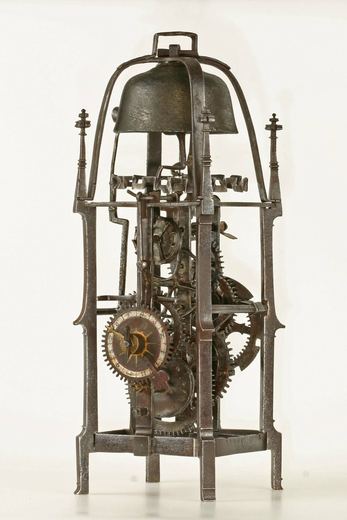
Alarm clock, Germany, 1400–1499
German Clock Museum
Clocks · 1400-1499
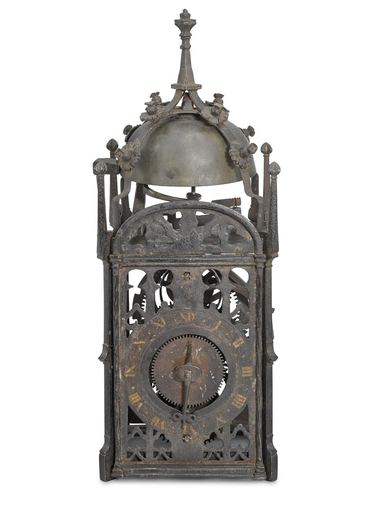
Lantern clock, Germany, 1400-1499
Science Museum Group, London
Clocks · 1500-1600
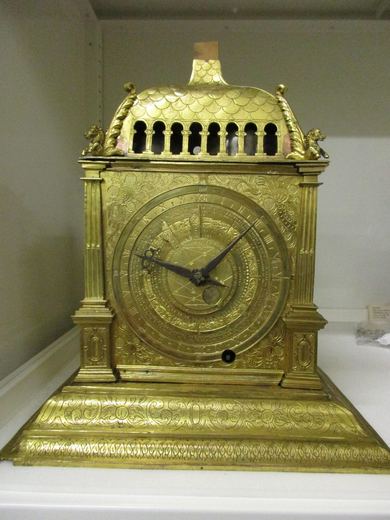
An astronomical clock in a gilt-bronze case, Venetian, sixteenth century.
Victoria and Albert Museum, London
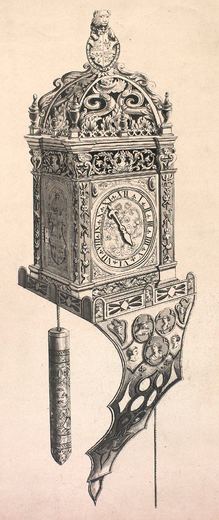
Clocks · 1500–1599
Bracket clock by Anne Boleyn, United Kingdom, 1500–1599
Archaeology Data Service
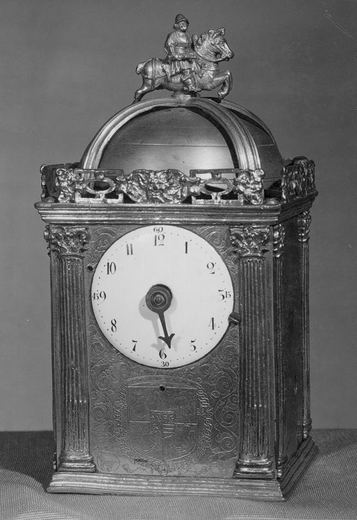
Clocks · 1500–1599
Clock by P. Plantart, Belgium, 1500–1599
Royal Institute for Cultural Heritage
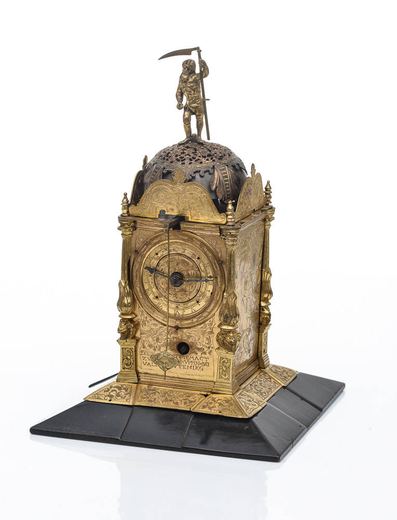
Clocks · 1500–1599
Table clock by Rutenieg, Valentin (um 1550) (Uhrmacher), Germany, 1500–1599
City Museum Berlin
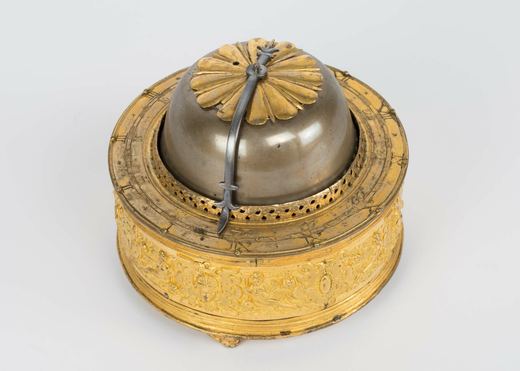
Clocks · 1500–1599
Table clock, Denmark, 1500–1599
German Clock Museum
Clocks · 1500–1599
Table clock, Karlsruhe, 1500–1599
Badisches Landesmuseum Karlsruhe