
Instruments · Sundial
Sundial, Sweden, 1647
- Maker / attribution
- Unrecorded in source
- Date
- 1647
- Historical period
- Early Modern Horology (1600 – 1750)
- Country of origin
- Sweden
- Place
- Frankrike Stockholm Stockholm null
- Object type
- Sundial
- Materials / technique
- Ben/tand/elfenben
- Dimensions
- Bredd 5.8 cm
- Holding institution
- Nordic Museum Foundation
- Accession / object no.
- NM.0151433
- Credit line
- Nordic Museum Foundation
- Catalogue title (original)
- Solur (Swedish)
View the source record ↗ (opens another website in a new tab)Suggest a correction
Record summary
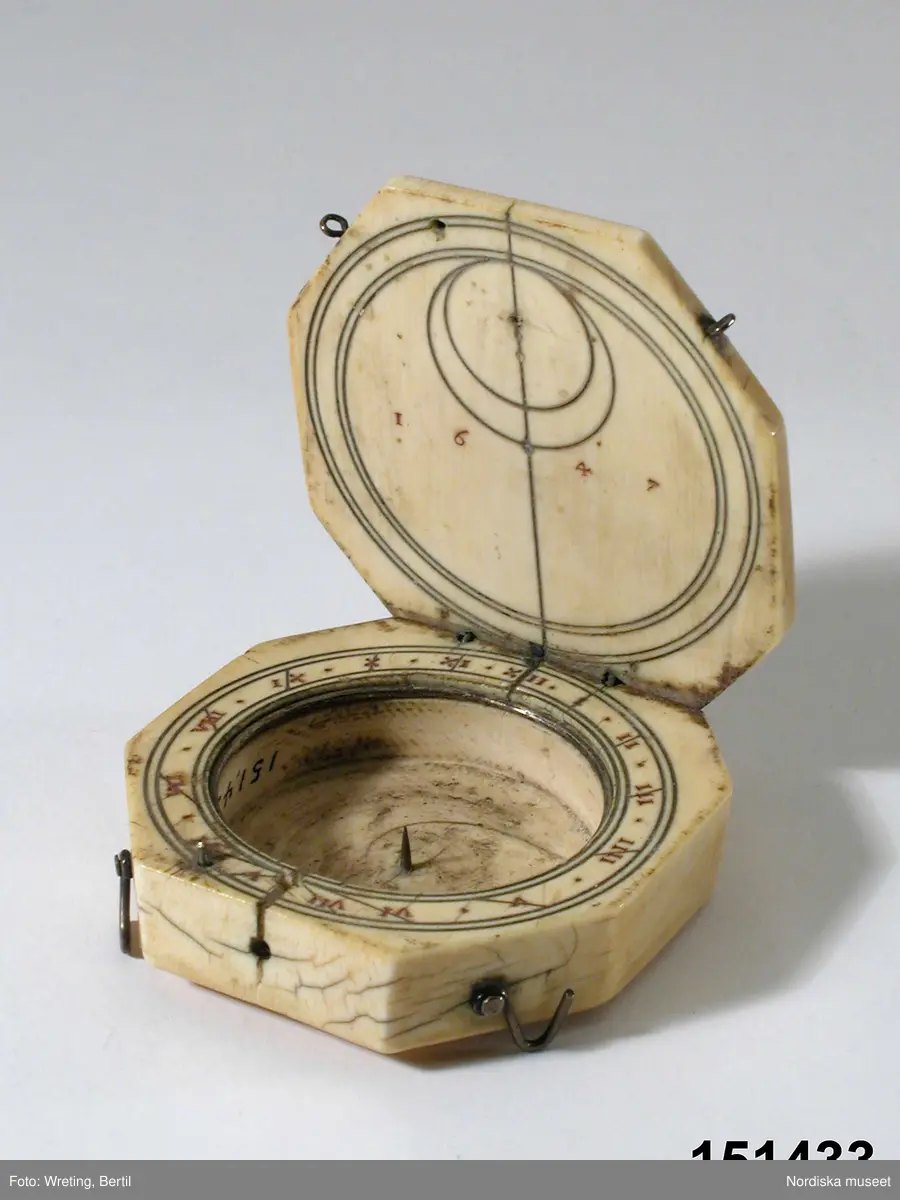
Held and catalogued by Nordic Museum Foundation (object number NM.0151433), this is a sundial, made in Frankrike Stockholm Stockholm null, Sweden, dated 1647. The Atlas places it in the Early Modern Horology period (1600 – 1750) of its Instruments collection. Materials and techniques recorded by the source: Ben/tand/elfenben. Recorded dimensions: Bredd 5.8 cm. The record is illustrated with 1 photograph.
Assembled from the source record's structured fields. Dates and attributions are given as the source states them; where a field is missing the Atlas leaves it blank rather than estimating.
Catalogue description
Catalogue description from Nordic Museum Foundation
Katalogkort: "Tidvisare med kompass. Ben, mässing. Handgjord. 1647, osignerad. Åttkantig dosa med lockskiva som är betydligt tunnare än bottnen. Lockets insida har graverade dubbla koncentriska cirklar samt två mindre cirklar där mellanrummet dem emellan bildar en månskära. Alla graveringar fägade i svart. Därunder graverat '1647' i rött. Bottendelen har rund försänkning för kompass med inlagd mässingsring upptill, men saknar vindros, nål och glas. På plattan, runt om försänkningen, är graverat V-XII, I-VII för dagens och nattens timmar. Snodd saknas. Tre intakta haspar, typ kasthake. Anm: Vertikal-horisontell spricka i framkant/underdel. Från teckningslärare A. Ekströms samling. Inköp från fru Aula Winroth, f. Ekström, Stockholm 1925. /Eva Lillienberg Olsson aug 1999."
Shown in the original language of the source catalogue. An editor-reviewed English translation has not yet been published; we do not publish machine translations as authoritative text.
Historical context
Early Modern Horology (1600 – 1750)
Huygens' pendulum and balance spring transform accuracy; English makers develop the anchor and deadbeat escapements.
Pocket sundials, Butterfield dials and sandglasses remained essential companions to imperfect clocks; navigators used sandglasses and the log line; observatories began to combine telescopes with pendulum clocks.
Read the period in the timelineMore instruments from this periodEarlier: Renaissance Horology
Atlas type guide
Sundials and solar time-finders
A sundial tells time from the position of a shadow cast by a gnomon or style. Because the sun's apparent motion depends on latitude, every fixed dial is laid out for a particular latitude, and portable dials either carry a latitude scale or are made for one region. Sundials show local apparent solar time, which drifts against mean (clock) time by up to about sixteen minutes over the year — the equation of time.
Portable dials were the pocket instruments of the sixteenth to eighteenth centuries. Nuremberg and Augsburg workshops produced folding ivory diptych dials with inset compasses; English and French makers sold brass horizontal dials, ring dials and the Butterfield type; Japanese and Chinese makers had their own traditions of compass dials. After mechanical watches became reliable, dials remained in use for setting them, and nineteenth-century heliochronometers were built to correct directly for the equation of time.
What to look for
- The latitude engraved on the dial plate or a latitude arc on the gnomon — it shows where the dial was meant to be used.
- The type of hour lines: equal (equinoctial) hours, Italian or Babylonian hours counted from sunset or sunrise, or unequal temporal hours on early and Islamic instruments.
- An inset magnetic compass and whether a magnetic-declination mark is drawn on its card — a useful dating clue because declination changes over time.
- Maker's signatures and town marks: Nuremberg compass-makers (Kompassmacher) often struck a personal mark and the town's punch.
- Additional scales such as lunar volvelles, wind roses, perpetual calendars or lists of cities with their latitudes.
Dating clues
- Ivory diptych dials are characteristic of Nuremberg between about 1500 and 1700.
- Butterfield-type dials with a bird-shaped adjustable gnomon point to Paris workshops from the late seventeenth century onward.
- Equation-of-time tables engraved on the plate became common after the mid-seventeenth century, once pendulum clocks made the difference between solar and mean time obvious.
General guidance written by the Atlas editors about this kind of object. It is not a statement about this particular piece; for that, rely on the source record above and on physical examination.
Read next:The history timeline
Related records
Instruments · 1705
Sundial, Sweden, 1705
Bohuslän Museum
Instruments · 1735
Sundial, Sweden, 1735
Sörmland Museum
Instruments · 1676
Sundial, Sweden, 1676
Nordic Museum Foundation
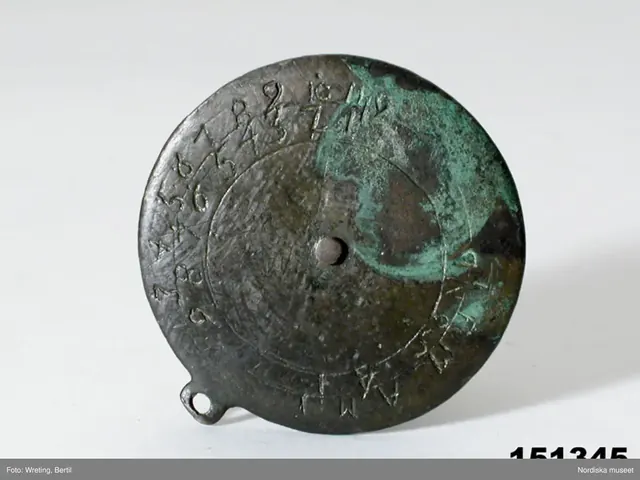
Instruments · 1724
Sundial by Iohanes Ason, Sweden, 1724
Nordic Museum Foundation
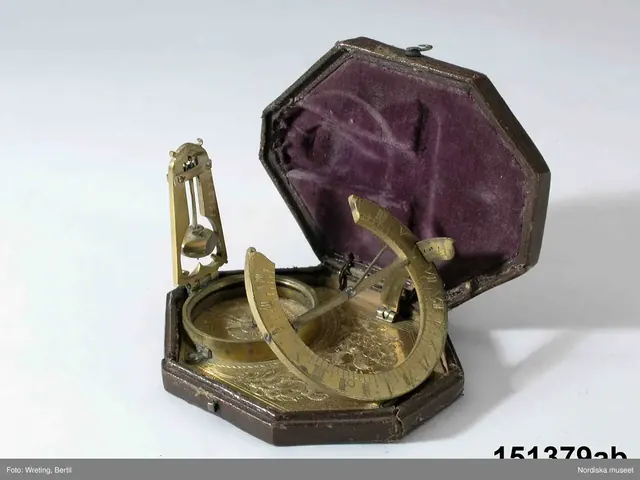
Instruments · 1676
Sundial by Christian Boyling, Sweden, 1676
Nordic Museum Foundation
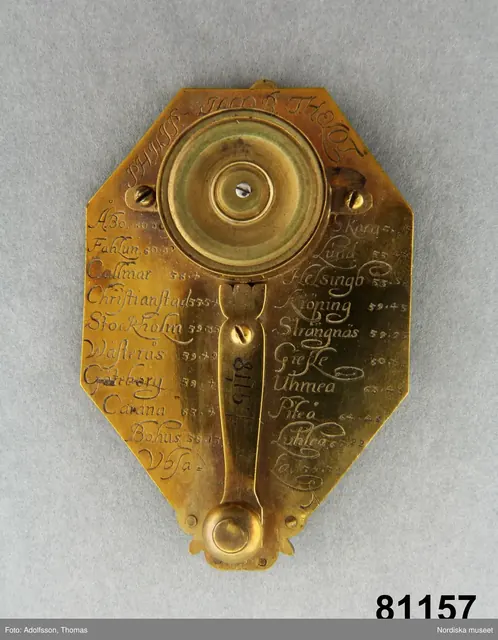
Instruments · 1690
Sundial by Philip Jacob Thelott, Sweden, 1690
Nordic Museum Foundation
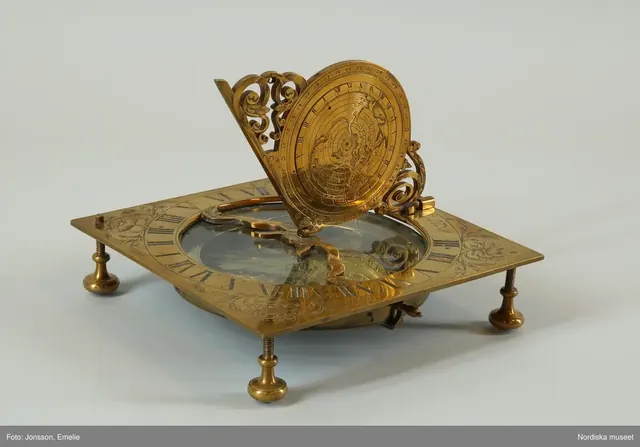
Instruments · 1670–1699
Sundial by Philipp Jacob Thelott, Sweden, 1670–1699
Nordic Museum Foundation
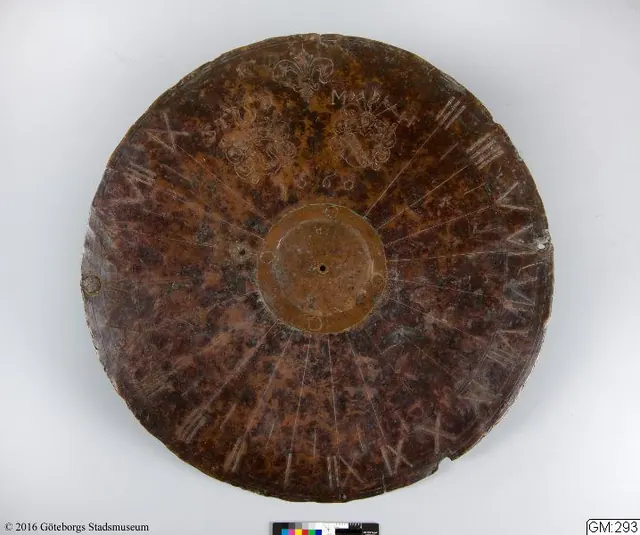
Instruments · 1660
Sundial, Sweden, 1660
Museum of Gothenburg