Clocks · Table clock
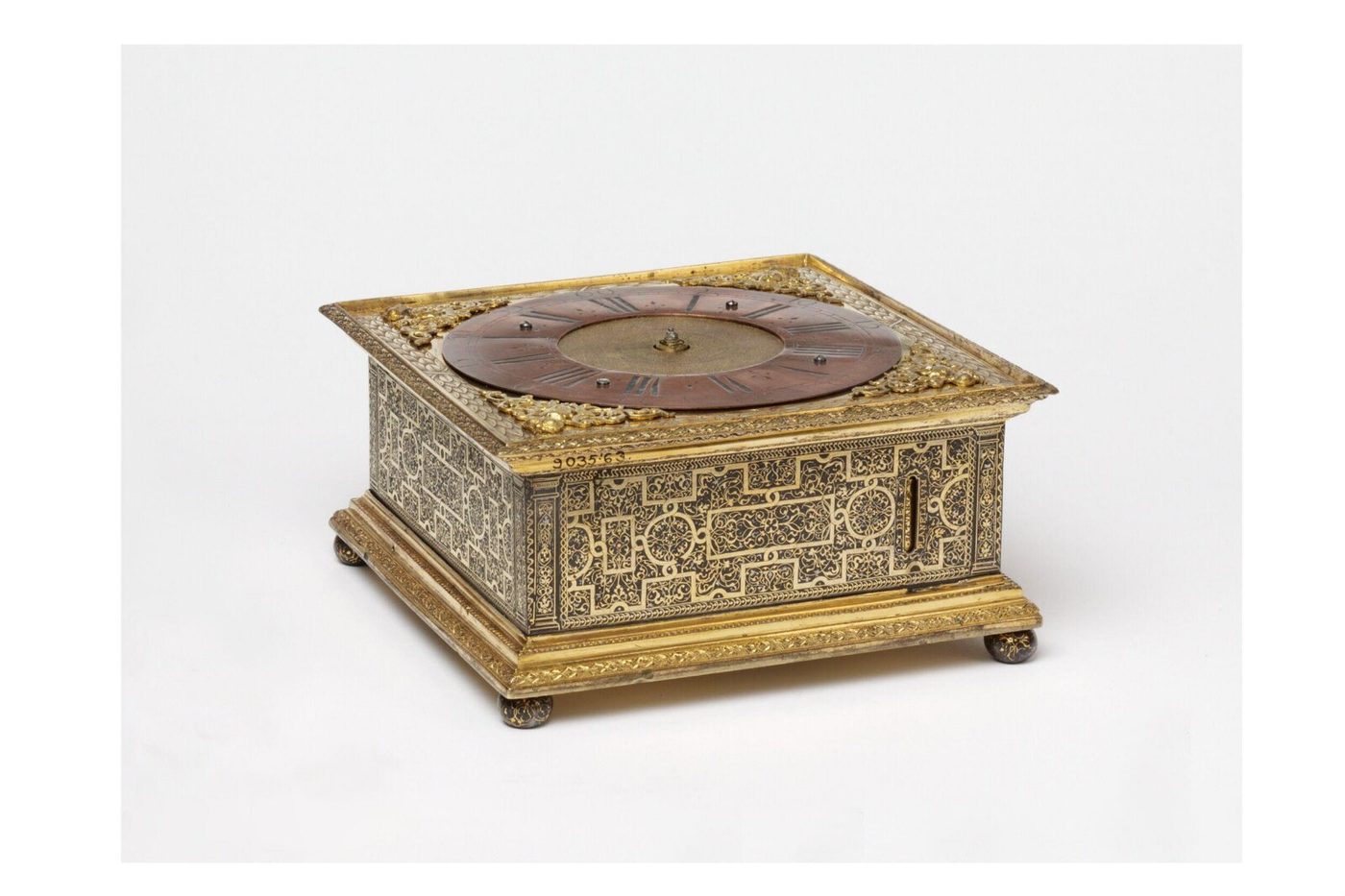
Square table clock of brass and iron, damascened, engraved and partly gilded, signed by Jacob Marquart of Augsburg and dated 1567.
- Maker / attribution
- Jacob Marquart (maker)
- Date
- 1567
- Historical period
- Renaissance Horology (1400 – 1600)
- Country of origin
- Germany
- Place
- Augsburg
- Object type
- Table clock
- Materials / technique
- Brass and iron, raised from sheet, engraved, damascened and gilt
- Dimensions
- Height: 10.4 cm; Width: 21.5 cm; Depth: 21.5 cm; Diameter: 14.6 cm (loose dial); Thickness: 0.6 cm (loose dial); Weight: 7.02 kg
- Holding institution
- Victoria and Albert Museum, London
- Accession / object no.
- 9035-1863
Record summary
Held and catalogued by Victoria and Albert Museum, London (object number 9035-1863), this is a table clock by Jacob Marquart, made in Augsburg, Germany, dated 1567. The Atlas places it in the Renaissance Horology period (1400 – 1600) of its Clocks collection. Materials and techniques recorded by the source: Brass and iron, raised from sheet, engraved, damascened and gilt. Recorded dimensions: Height: 10.4 cm; Width: 21.5 cm; Depth: 21.5 cm; Diameter: 14.6 cm (loose dial); Thickness: 0.6 cm (loose dial); Weight: 7.02 kg. The record is illustrated with 2 photographs.
Assembled from the source record's structured fields. Dates and attributions are given as the source states them; where a field is missing the Atlas leaves it blank rather than estimating.
Catalogue description
V&A — Summary
This clock was made in 1567 by Jacob Marquart, a member of a famous family of clockmakers in Augsburg, southern Germany. With its finely engraved dials and intricately decorated casing, this clock was not simply a functional household item but a treasury piece, prized primarily for its craftsmanship and technical ingenuity. Shallow, horizontal clocks resting on small feet such as this were made in Europe from the middle of the fifteenth century until the eighteenth century and came in a variety of shapes including square, hexagonal, octagonal and drum shaped. In fact so important were such clocks to the repertoire of the clockmaker in cities like Augsburg, Nuremberg and Ulm, that apprentices were given eight months to make an elaborate horizontal clock to demonstrate their fitness to practise. Many South German examples incorporated astronomical, astrological and calendar information in their dials. Jacob Marquart was the son of Benedikt Marquart who for fifty years was Augsburg's town clockmaker. Both men spent time working in Italy and France and this clock was probably made for one of Jacob's wealthy clients in Italy. The dials display the Italian hours: timekeeping varied from country to country during the sixteenth century and in Italy the hours began at sunset. By the 1550s it was fashionable for wealthy gentlemen to have a sound understanding of all branches of learning, from art and literature to mathematics and the natural sciences. Clocks such as this were housed alongside automatons and scientific instruments such as astrolabes and sundials in Scientifica , collections celebrating human ability to control nature. Jacob Marquart's clients included the Emperoro Maximilian II for whom he is recorded in 1569 as working on a complicated clock likely to take two years to complete.
V&A — Physical description
Table clock with alarm in square brass case on four bun feet, whose underside has sundials and calendars. The brass clock dial with applied copper chapter ring on the top surface is a later alteration from around 1700. The flat iron sides are lightly engraved and damascened with strapwork. The movement of the clock is mounted between two iron plates 175mm square finely engraved with strapwork on both surfaces. The movement has been extensively altered but still contains: the going train with engraved brass barrel, fusee and chain; the striking train with engraved brass barrel and 'nag's head' release; the alarm train with plain brass resting barrel and single-end bell hammer whose tail engages with a ratchet-toothed wheel. Inside there are 3 brass dials no longer with any mechanisms attached: a ring with the zodiac signs; a ring marked 1 to 12; a disc numbered 1 to 7 with weekday symbols marked 'DIES PLANETARVM'. The removable bottom cover is of brass engraved with intertwined foliage and has four large engraved circular dials and one small one: Top left: 'CIRCLVS EPACTA' with an inner ring of years from 1567 to 1585 and with an outer ring giving the epact (the number of days the solar year exceeds the lunar year of 12 months) and a hand-set rotating dial marked 'EPACTA' Top right: A horizontal sundial showing hours a.m. and p.m. and the Italian hours. A compass box, now with needle missing, is mounted over part of this dial. The box has a removable engraved lid. Bottom left: a series of concentric rings showing the Dominical letters (denoting the dates of Sundays) including Advent Sunday for a 28-year solar cycle for the years 1560 to 1587 marked 'CIRCVLS SOLARIUS', and with a hand-set rotating arm marked 'ADVENTVS DOM'. Bottom right: Rings giving the 'golden numbers' (used to calculate the date of Easter) and corresponding dates for Easter Day for a cycle of 19 years from 1558 to 1576 marked 'AVREVS NVMERVS' and with a hand-set rotating arm marked 'PASCHA'. Centre: A small ring for the cycle of the Indiction, a measurable period of time on the ecclesiastical calendar, with 1558 opposite year 1, and with a hand-set rotating arm marked 'INDICTIO'
V&A — Historical context
Clocks were luxury items designed to impress as well as educate. By the 1550s it was fashionable for wealthy gentlemen to have a sound understanding of all branches of learning, from art and literature to mathematics and the natural sciences. Clocks such as this were housed alongside automatons and scientific instruments such as astrolabes and sundials in Scientifica , collections celebrating human ability to control nature. Shallow, horizontal clocks resting on small feet such as this were made in Europe from the middle of the fifteenth century until the eighteenth century and came in a variety of shapes including square, hexagonal, octagonal and drum shaped. In fact so important were such clocks to the repertoire of the clockmaker in the cities of Augsburg, Nuremberg and Ulm, that apprentices were given eight months to make an elaborate horizontal clock to demonstrate their fitness to practise. Many South German examples incorporated astronomical, astrological and calendar information in their dials.
V&A — Object history
This clock was made in 1567 by Jacob Marquart (born around 1525, died 1575), a member of a famous family of clockmakers in Augsburg, southern Germany. With its finely engraved dials and intricately damascened and engraved casing, this clock was not simply a functional household item but a treasury piece, prized primarily for its craftsmanship and technical ingenuity. Marquart was the son of Benedikt Marquart who for fifty years was Augsburg's town clockmaker. Both men spent time working in Italy and France and this clock was probably made for one of Jacob's wealthy clients in Italy. The dials display the Italian hours: timekeeping varied from country to country during the sixteenth century and in Italy the hours began at sunset. The clock was bought by the V&A in 1863 for £9. Historical significance: The clocks's significance lies not just in its fine decoration but in its maker, Jacob Marquart. He was from an important family of German clockmakers. His clients included the Emperoro Maximilian II for whom he is recorded in 1569 as working on a complicated clock likely to take two years to complete. Very few clocks by Jacob Marquart survive. A small drum-shaped table clock by him from around 1570 is in the Adler Planetarium and Astronomy Museum in Chicago, USA (Museum No. M.381)
V&A — Production note
Also spelt Jakob Marquart and sometimes Marquet
V&A gallery label
TABLE-CLOCK Gilt brass, with steel side damascened with gold and silver The bottom with sundial, calendars, etc. Signed by Jacob Marquart German (Augsburg); dated February 1567 The dial is 18th century
Inscriptions & marks
Inscribed on base following a square outside the dials: JACOB. MARQVART. VON. AVGSPVRG. BIN. IH. GENANT. MEIN. NAM. IST. IN WELSLANDT. GAR. WOL. BEKANT. DER. HAT. DAS. WERCK. GEMACHT. FIRWAR. IM. 1567. IAR. AIN. SVNENVR. IST. DAS. GENANT. AVF. WELS. VND. DEISCH. LANDT. ERKANT
Historical context
Renaissance Horology (1400 – 1600)
Spring power makes clocks portable; Nuremberg and Augsburg produce the first watches; the Prague Orloj is built.
Spring power made the domestic clock portable. Augsburg and Nuremberg produced gilt-brass table clocks, often with astronomical dials and alarms; weight-driven Gothic wall clocks and English lantern clocks served households. Clocks of this period have foliot or balance-wheel control and usually only an hour hand.
Read the period in the timelineMore clocks from this periodEarlier: Medieval Period
Atlas type guide
Bracket, table and spring-driven clocks
Spring-driven clocks freed timekeeping from the hanging weight. The coiled mainspring, documented from the fifteenth century, made portable table clocks possible; to even out its declining force, makers used the fusee, a conical pulley connected to the barrel by a gut line or chain. Renaissance table clocks from Augsburg and Nuremberg — drum-shaped, square or tower-shaped in gilt brass — were luxury scientific objects, often with astronomical dials and alarms.
After the pendulum, English makers developed the bracket clock: a wooden case with a carrying handle, a short pendulum with a verge escapement, and often repeating work to sound the hours on demand at night. Later examples use the anchor escapement. In the nineteenth century, 'table clock' became a broad term for spring clocks of every nationality.
What to look for
- A fusee in the movement (cone-shaped pulley) and the type of line — gut or chain.
- Verge escapement with a short bob pendulum, often with a decoratively engraved backplate.
- Repeat cords or buttons that make the clock strike again on demand.
- Gilt-brass engraved cases and horizontal dials on Renaissance pieces.
- Case shapes: inverted bell, bell top, break-arch, lancet or balloon.
Dating clues
- Drum and tower table clocks: c. 1520–1650.
- Ebony veneered English bracket clocks with verge escapements: c. 1670–1800.
- Engraved backplates were usual on English clocks until c. 1800, then generally plain.
General guidance written by the Atlas editors about this kind of object. It is not a statement about this particular piece; for that, rely on the source record above and on physical examination.
Related records
Clocks · 1400–1499
Alarm clock, Germany, 1400–1499
German Clock Museum
Clocks · 1400-1499
Lantern clock, Germany, 1400-1499
Science Museum Group, London
Clocks · 1500–1599
Table clock by Rutenieg, Valentin (um 1550) (Uhrmacher), Germany, 1500–1599
City Museum Berlin
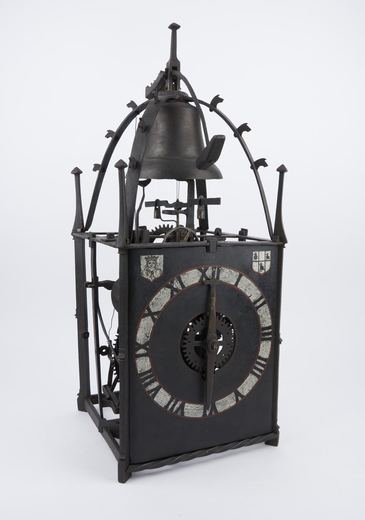
Clocks · 1501-1600
German 16th century iron chamber clock
Science Museum Group, London
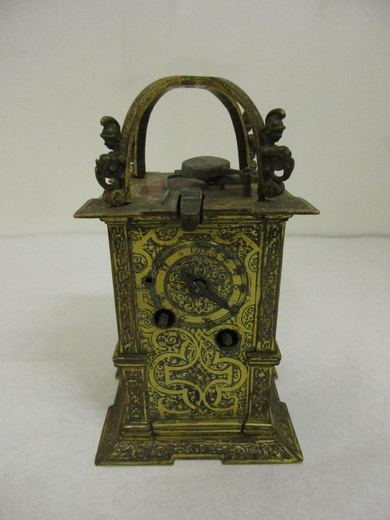
Clocks · ca.1550
Clock, a striking alarm clock in a gilt brass case, Germany, ca.1550.
Victoria and Albert Museum, London
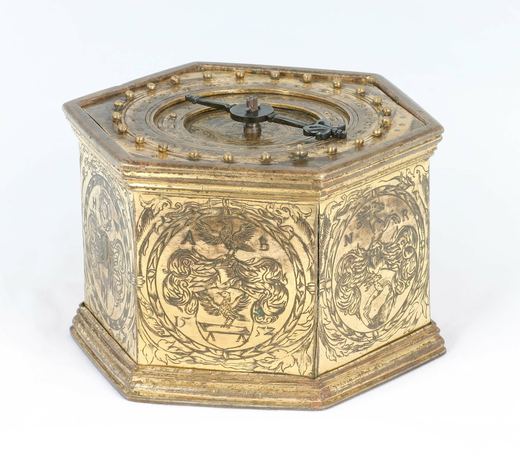
Clocks · 1552
Carriage / travel clock, Germany, 1552
German Clock Museum
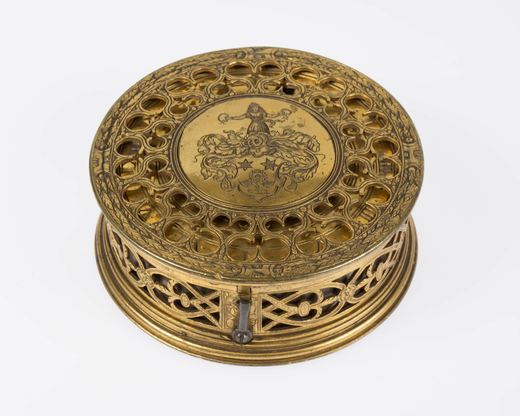
Clocks · 1560
Carriage / travel clock by HG, Germany, 1560
German Clock Museum
Clocks · 1564
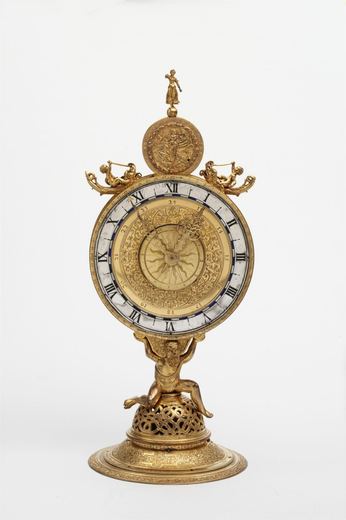
Clock, gilt brass with enamelled silver dial ring, signed by Jeremias Metzger, Augsburg, southern Germany, dated 1564
Victoria and Albert Museum, London