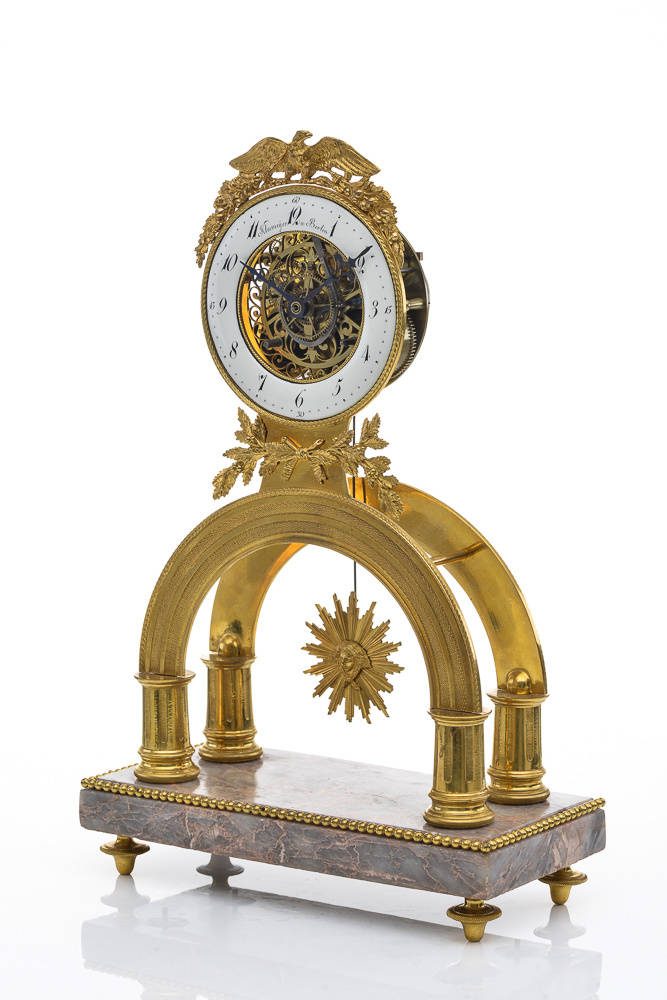
Clocks · Skeleton clock
Skeleton clock by Kleemeyer, Christian Ernst (1739-1799) (Uhrmacher), Germany, 1700–1799
- Maker / attribution
- Kleemeyer, Christian Ernst (1739-1799) (Uhrmacher) (creator)
- Date
- 1700–1799
- Historical period
- Early Modern Horology (1600 – 1750)
- Country of origin
- Germany
- Place
- Berlin
- Object type
- Skeleton clock
- Holding institution
- City Museum Berlin
- Accession / object no.
- item_JESN7AEP6Z2X7DO3TIJNOBYISYYTJ3HY
- Catalogue title (original)
- Skelettuhr (German)
Record summary
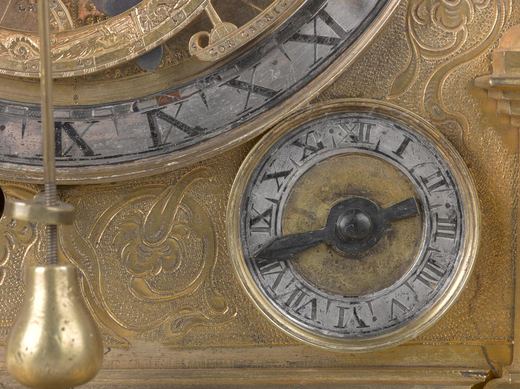
Held and catalogued by City Museum Berlin (object number item_JESN7AEP6Z2X7DO3TIJNOBYISYYTJ3HY), this is a skeleton clock by Kleemeyer, Christian Ernst (1739-1799) (Uhrmacher), made in Berlin, Germany, dated 1700–1799. The Atlas places it in the Early Modern Horology period (1600 – 1750) of its Clocks collection. The record is illustrated with 1 photograph.
Assembled from the source record's structured fields. Dates and attributions are given as the source states them; where a field is missing the Atlas leaves it blank rather than estimating.
Catalogue description
Catalogue description from City Museum Berlin (German)
Sogenannte Skelettuhr, die den Einblick in das Werk erlaubt, ohne eine Tür oder Fenster öffnen zu müssen. Die Vorderplatine ist floral ausgearbeitet, so dass nur Stege für die Lager der Wellen vorhanden sind.
Shown in the original language of the source catalogue. An editor-reviewed English translation has not yet been published; we do not publish machine translations as authoritative text.
Historical context
Early Modern Horology (1600 – 1750)
Huygens' pendulum and balance spring transform accuracy; English makers develop the anchor and deadbeat escapements.
Huygens's pendulum (1656–57) improved clock accuracy from about a quarter of an hour to under a minute a day. The anchor escapement (c. 1670) and the long seconds pendulum created the longcase clock; London makers such as Fromanteel, Knibb, Tompion and Quare led European clockmaking, and French makers created the Boulle pendule.
Read the period in the timelineMore clocks from this periodEarlier: Renaissance Horology
Atlas type guide
Skeleton clocks
A skeleton clock displays its movement: the plates are pierced to a minimum so that wheels, escapement and fusee can be seen, usually under a glass dome. French makers produced fine skeleton clocks in the late eighteenth century; in Victorian England they became popular showpieces, with frames in the shapes of cathedrals and famous buildings.
What to look for
- Pierced brass plates in scroll or architectural shapes.
- A glass dome and wooden or marble base.
- Fusee movements and sometimes passing strike on a bell.
Dating clues
- French skeleton clocks: c. 1780–1830.
- English cathedral-style skeleton clocks: c. 1840–1890.
General guidance written by the Atlas editors about this kind of object. It is not a statement about this particular piece; for that, rely on the source record above and on physical examination.
Read next:FuseeAnchor (recoil) escapement
Related records
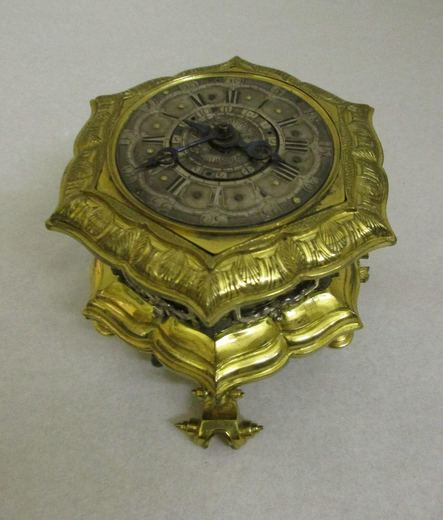
Clocks · 1600-1700
Clock, Germany, 1600-1700
Victoria and Albert Museum, London
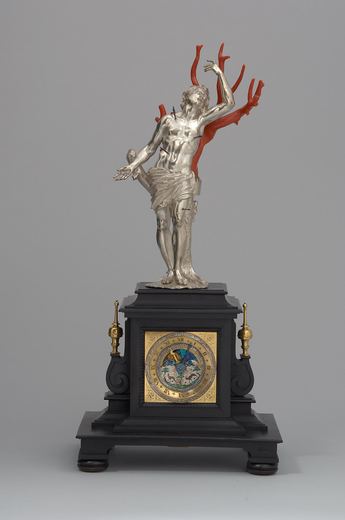
Clocks · 1600–1699
Table clock by #Hans_Christoph_II._Fesenmair_Künstler/in, Germany, 1600–1699
Fine Arts Museum Vienna
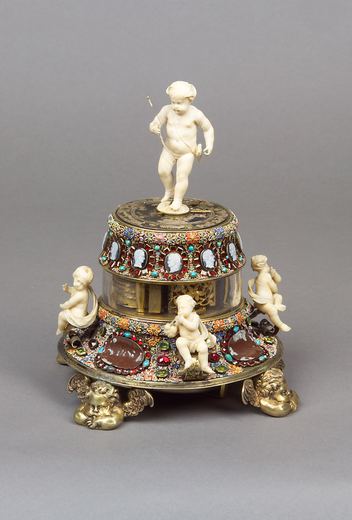
Clocks · 1600–1699
Table clock by Hans Jakob Mair (artist), Germany, 1600–1699
Fine Arts Museum Vienna
Clocks · 17th century
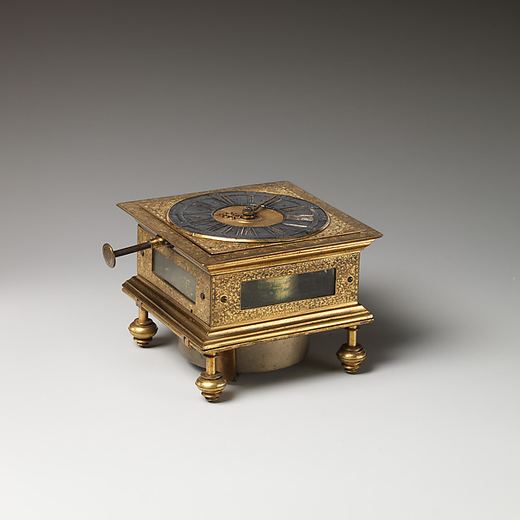
Table clock by Johann Heinrich Kleinschmidt, Germany, 17th century
The Metropolitan Museum of Art, New York
Clocks · 1600–1699
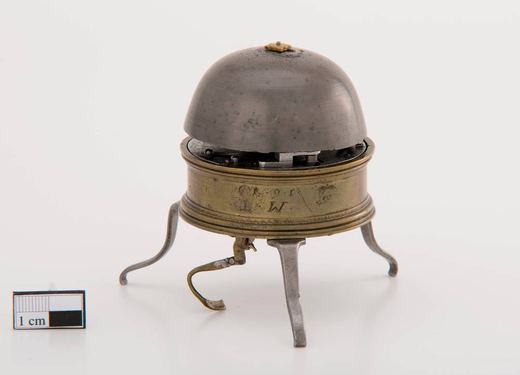
Table clock by unbekannt, deutsch, 17. Jh.; Uhrmacher, Germany, 1600–1699
Dresden State Art Collections. Royal Cabinet of Mathematical and Physical Instruments
Clocks · ca. 1625
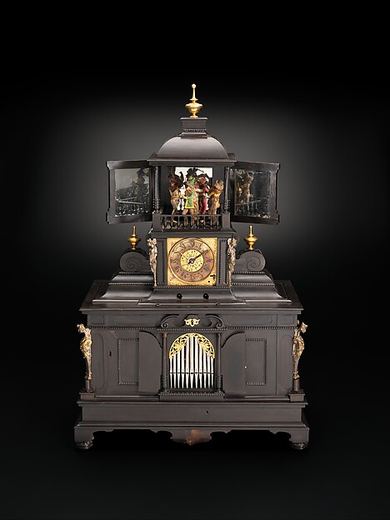
Musical clock with spinet and organ by Veit Langenbucher, Germany, ca. 1625
The Metropolitan Museum of Art, New York
Clocks · 1624–1630
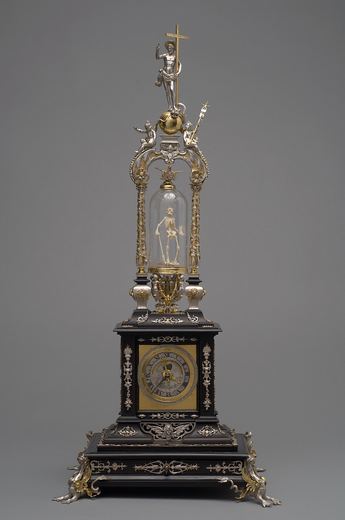
Table clock by Christoph Angermair (Künstler/in), Germany, 1624–1630
Fine Arts Museum Vienna
Clocks · 1625-1635
Upright table clock with winding key, by unknown maker, made in Augsburg, Germany, 1625-1635
Science Museum Group, London