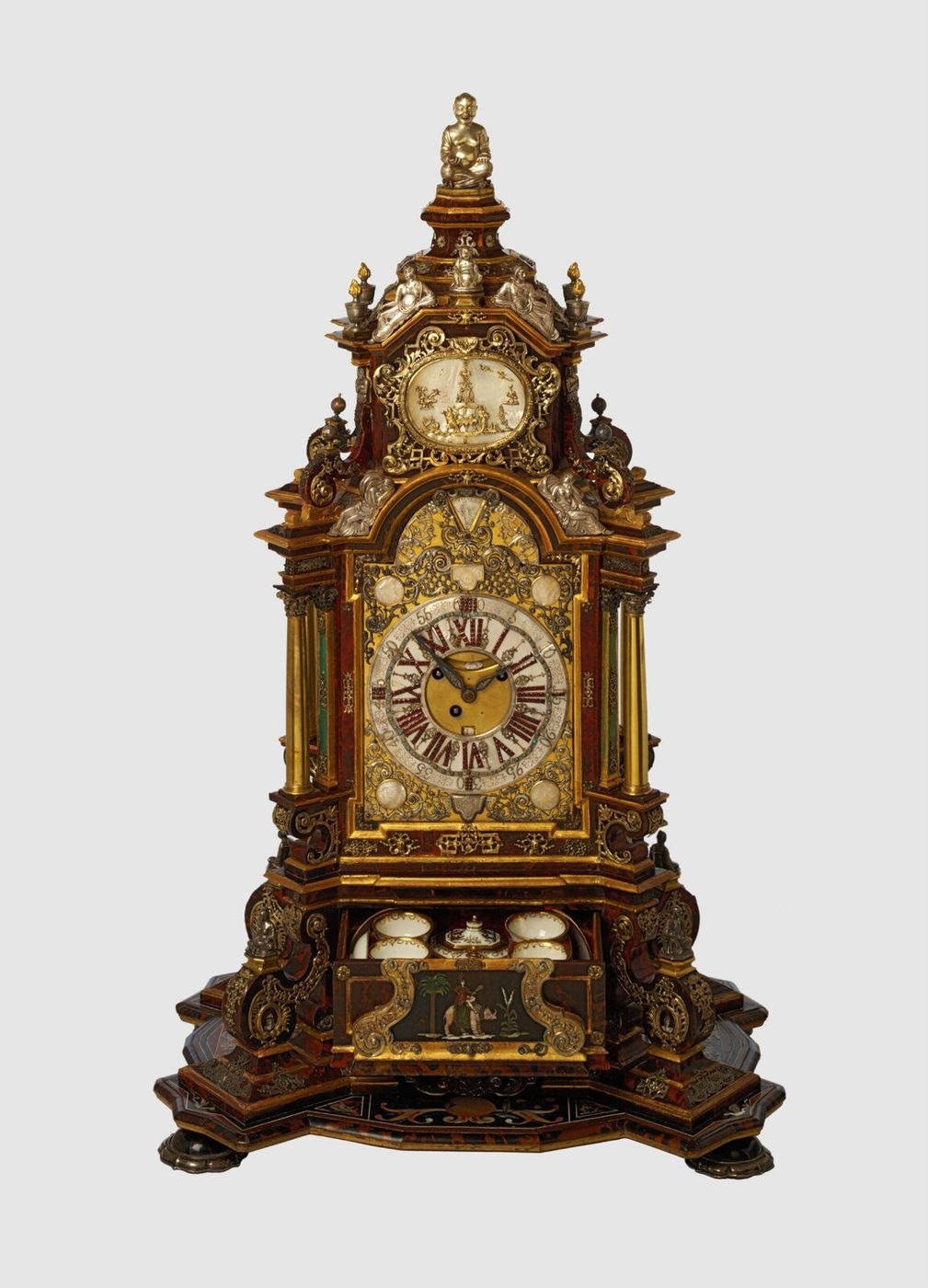
Clocks · Cabinet clock
Silver-gilt wood, tortoiseshell, silver, mother of pearl and other materials, Augsburg; 1700-1725 and later
- Maker / attribution
- Unrecorded in source
- Date
- 1700-1725
- Historical period
- Early Modern Horology (1600 – 1750)
- Country of origin
- Germany
- Place
- Augsburg
- Object type
- Cabinet clock
- Materials / technique
- Wood, boulle marquetry and tortoiseshell, silver and gilded silver (silver-gilt), inlaid mother-of-pearl, ivory, enamel and brass, pietre dure, cut garnets, turquoise, micromosaic, velvet, porcelain, mirror glass, gilt bronze, oil on copper
- Dimensions
- Height: 110.9 cm; Width: 69.5 cm; Depth: 50.3 cm
- Holding institution
- Victoria and Albert Museum, London
- Accession / object no.
- LOAN:GILBERT.3:1-2008
- Credit line
- The Rosalinde and Arthur Gilbert Collection on loan to the Victoria and Albert Museum, London
- Catalogue title (original)
- Augsburg Clock
Record summary
Held and catalogued by Victoria and Albert Museum, London (object number LOAN:GILBERT.3:1-2008), this is a cabinet clock, made in Augsburg, Germany, dated 1700-1725. The Atlas places it in the Early Modern Horology period (1600 – 1750) of its Clocks collection. Materials and techniques recorded by the source: Wood, boulle marquetry and tortoiseshell, silver and gilded silver (silver-gilt), inlaid mother-of-pearl, ivory, enamel and brass, pietre dure, cut garnets, turquoise, micromosaic, velvet, porcelain, mirror glass, gilt bronze, oil on copper. Recorded dimensions: Height: 110.9 cm; Width: 69.5 cm; Depth: 50.3 cm. The record is illustrated with 4 photographs.
Assembled from the source record's structured fields. Dates and attributions are given as the source states them; where a field is missing the Atlas leaves it blank rather than estimating.
Catalogue description
V&A — Summary
Clocks like this extraordinary piece were famous Augsburg products in early modern times. They showcased the city’s excellence in creating luxury goods, including the decoration of Meissen porcelain. Gemstones, additional silver mounts and precious veneer from different sources were added in the 19th century to suit the tastes of collectors, such as Lord Roseberry, British Prime Minister from 1894-5. His wife Hannah inherited the great Rothschild mansion Mentmore, where this clock resided until it became part of the Gilbert Collection in 1977. Arthur Gilbert enthused that this clock exhibits ‘every form of decorative art that you could possibly imagine'. Sir Arthur Gilbert and his wife Rosalinde formed one of the world's great decorative art collections, including silver, mosaics, enamelled portrait miniatures and gold boxes. Arthur Gilbert donated his extraordinary collection to Britain in 1996.
V&A — Physical description
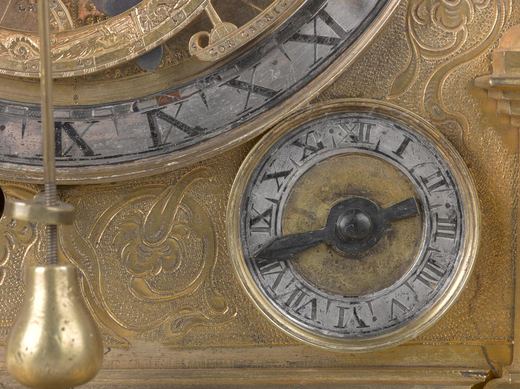
A cabinet clock of architectural form in three sections: a base with shaped borders and volutes at the corners; a central body; and a top storey with a lantern. The cabinet is faced in tortoiseshell, with borders and Corinthian columns at each corner of silver-gilt. Chinoiserie panels, inlaid mother-of-pearl, ivory, enamel and brass are set around the base and upper storey. The front of the upper storey bears a large mother-of-pearl plaque inlaid with Chinoiserie motifs and relief designs in silver-gilt. Small silver statuettes of Buddha adorn the volutes at the base, the centre of the upper storey, and the pediment of the lantern. Figures from classical mythology appear on the sides of the cabinet. On the front of the base is a red, velvet-lined drawer containing a Meissen tea service consisting of nine pieces. Below this is another drawer containing a removable square silver-gilt inkwell and pounce pot, and having two rectangular compartments, probably intended to hold pens and keys. There are six keys; one large and five small. The mother of pearl dial applied with cut garnets and turquoise, the arms are made of micromosaic. The clock mechanism has a calendar movement and is quarter striking.
V&A — Historical context
The clock was probably made for a member of the aristocracy. Anna Maria Massinelli sees a link with the politically influential countly family Schönborn based upon the repeated use of the motif of a rhinoceros in combination with the Schönborn coat-of-arms on works of art from the same period.
V&A — Object history
Provenance: Fifth Earl of Rosebery, Mentmore Towers Sale, Sotheby's, lot 1053, 20/05/1977; Ronald A. Lee, London, 1977.
V&A — Production note
Containing an engraved and incised silver frame in the manner of Andreas Thelot (Augsburg 1655-1734); and Meissen porcelain tea service with Augsburg Hausmaler decoration, the gilding attributed to a member of the Seuter family
Inscriptions & marks
APOLLO DEUS ARTIUM MERCURIUS LEGATUS DEORUM
Historical context
Early Modern Horology (1600 – 1750)
Huygens' pendulum and balance spring transform accuracy; English makers develop the anchor and deadbeat escapements.
Huygens's pendulum (1656–57) improved clock accuracy from about a quarter of an hour to under a minute a day. The anchor escapement (c. 1670) and the long seconds pendulum created the longcase clock; London makers such as Fromanteel, Knibb, Tompion and Quare led European clockmaking, and French makers created the Boulle pendule.
Read the period in the timelineMore clocks from this periodEarlier: Renaissance Horology
Atlas type guide
Bracket, table and spring-driven clocks
Spring-driven clocks freed timekeeping from the hanging weight. The coiled mainspring, documented from the fifteenth century, made portable table clocks possible; to even out its declining force, makers used the fusee, a conical pulley connected to the barrel by a gut line or chain. Renaissance table clocks from Augsburg and Nuremberg — drum-shaped, square or tower-shaped in gilt brass — were luxury scientific objects, often with astronomical dials and alarms.
After the pendulum, English makers developed the bracket clock: a wooden case with a carrying handle, a short pendulum with a verge escapement, and often repeating work to sound the hours on demand at night. Later examples use the anchor escapement. In the nineteenth century, 'table clock' became a broad term for spring clocks of every nationality.
What to look for
- A fusee in the movement (cone-shaped pulley) and the type of line — gut or chain.
- Verge escapement with a short bob pendulum, often with a decoratively engraved backplate.
- Repeat cords or buttons that make the clock strike again on demand.
- Gilt-brass engraved cases and horizontal dials on Renaissance pieces.
- Case shapes: inverted bell, bell top, break-arch, lancet or balloon.
Dating clues
- Drum and tower table clocks: c. 1520–1650.
- Ebony veneered English bracket clocks with verge escapements: c. 1670–1800.
- Engraved backplates were usual on English clocks until c. 1800, then generally plain.
General guidance written by the Atlas editors about this kind of object. It is not a statement about this particular piece; for that, rely on the source record above and on physical examination.
Related records
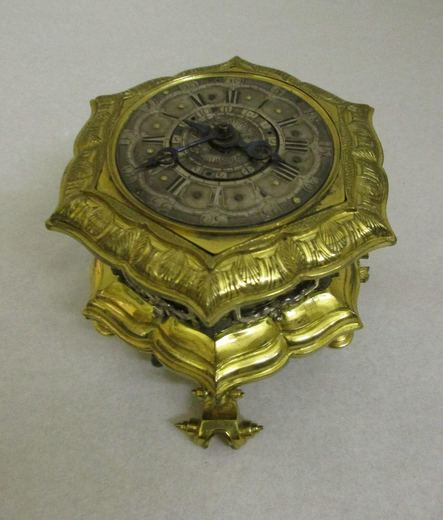
Clocks · 1600-1700
Clock, Germany, 1600-1700
Victoria and Albert Museum, London
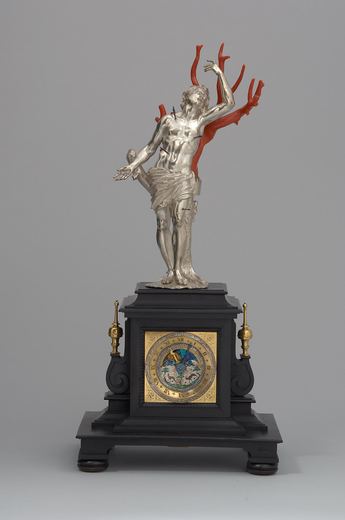
Clocks · 1600–1699
Table clock by #Hans_Christoph_II._Fesenmair_Künstler/in, Germany, 1600–1699
Fine Arts Museum Vienna
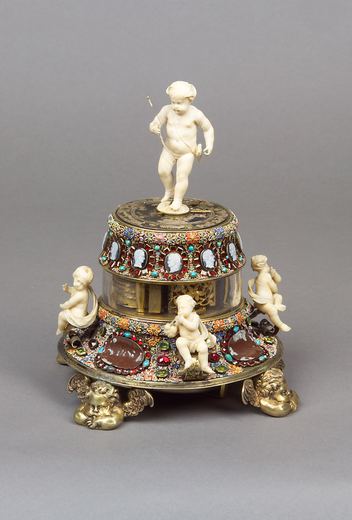
Clocks · 1600–1699
Table clock by Hans Jakob Mair (artist), Germany, 1600–1699
Fine Arts Museum Vienna
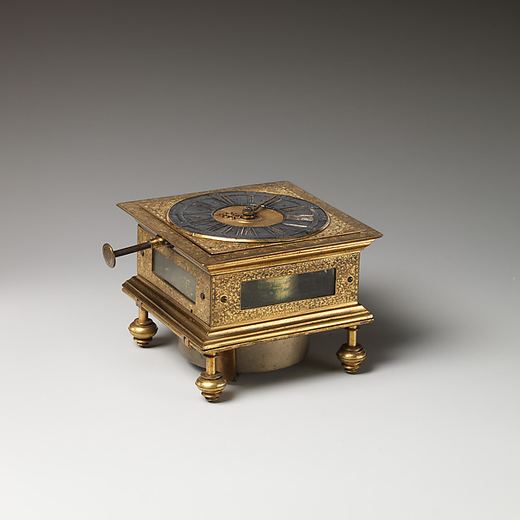
Clocks · 17th century
Table clock by Johann Heinrich Kleinschmidt, Germany, 17th century
The Metropolitan Museum of Art, New York
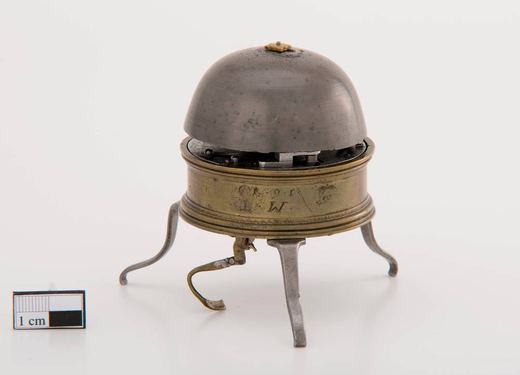
Clocks · 1600–1699
Table clock by unbekannt, deutsch, 17. Jh.; Uhrmacher, Germany, 1600–1699
Dresden State Art Collections. Royal Cabinet of Mathematical and Physical Instruments
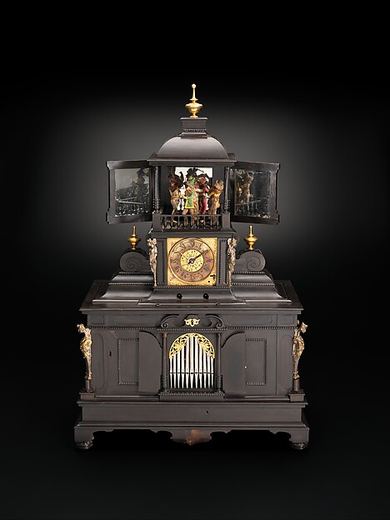
Clocks · ca. 1625
Musical clock with spinet and organ by Veit Langenbucher, Germany, ca. 1625
The Metropolitan Museum of Art, New York
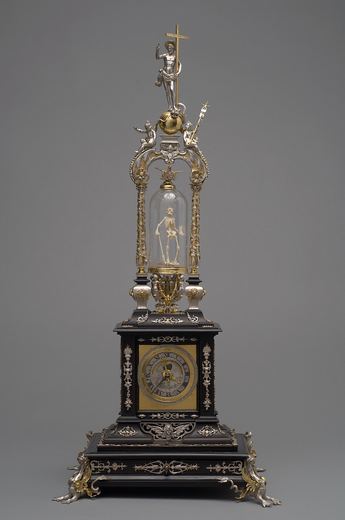
Clocks · 1624–1630
Table clock by Christoph Angermair (Künstler/in), Germany, 1624–1630
Fine Arts Museum Vienna
Clocks · 1625-1635
Upright table clock with winding key, by unknown maker, made in Augsburg, Germany, 1625-1635
Science Museum Group, London