
Wristwatches · Wristwatch
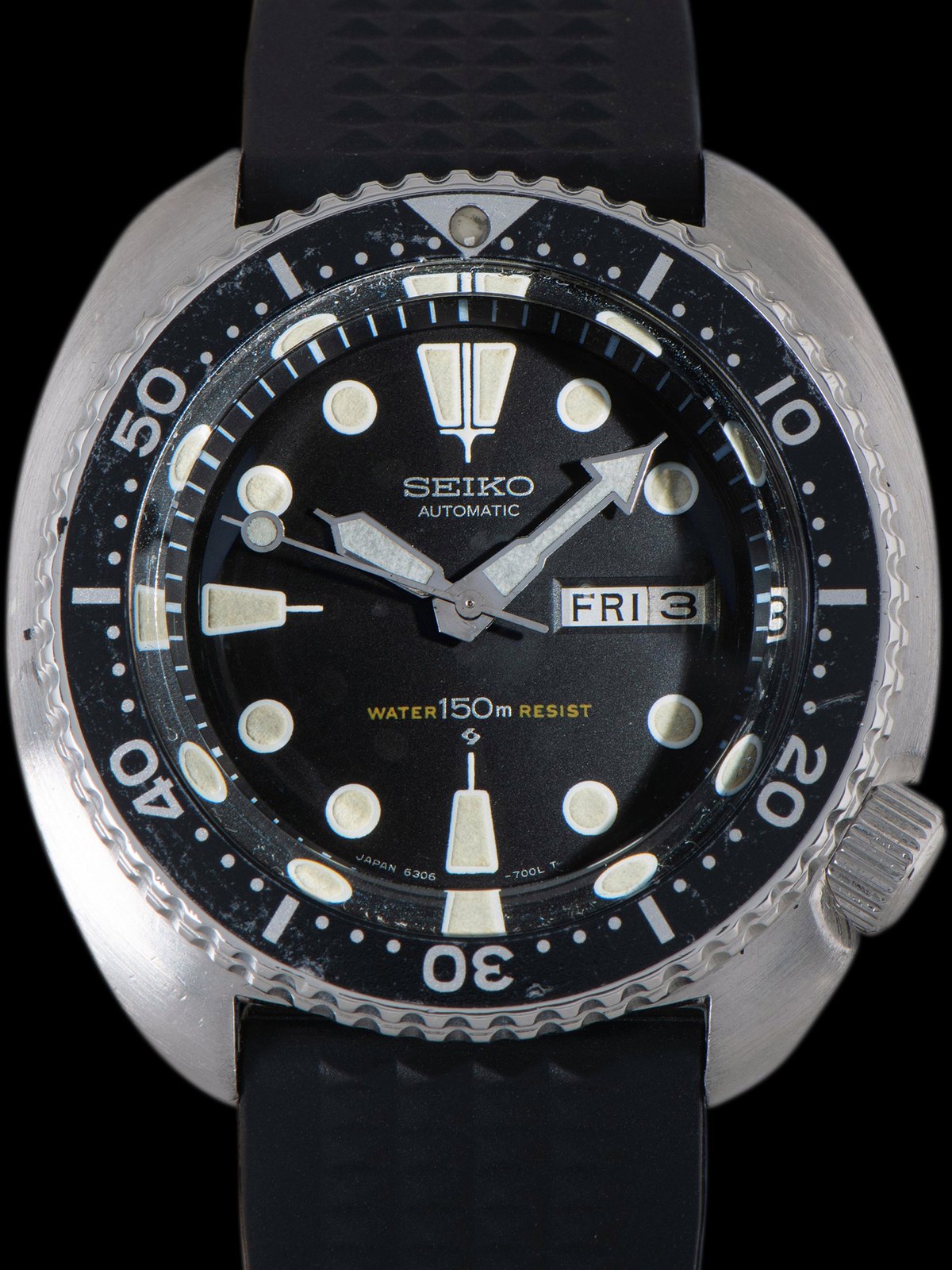
Seiko Turtle Diver (Ref. 6306-7001) "JDM", 1978
- Maker / attribution
- Seiko (maker)
- Date
- 1978
- Historical period
- Quartz Revolution (1969 – 1990)
- Country of origin
- Japan
- Object type
- Wristwatch
- Dimensions
- Case 45 mm
- Stock no.
- SKO63067001
- Credit line
- Dealer listing, Craft & Tailored (SKO63067001)
- Catalogue title (original)
- 1978 Seiko Turtle Diver (Ref. 6306-7001) "JDM" (English)
View the source record (dealer listing) ↗ (opens another website in a new tab)Suggest a correction
Record summary
Catalogued by Craft & Tailored (dealer), Los Angeles (stock number SKO63067001), this is a wristwatch by Seiko, made in Japan, dated 1978. The Atlas places it in the Quartz Revolution period (1969 – 1990) of its Wristwatches collection. Recorded dimensions: Case 45 mm. The record is illustrated with 6 photographs.
Assembled from the source record's structured fields. Dates and attributions are given as the source states them; where a field is missing the Atlas leaves it blank rather than estimating.
Catalogue description
Dealer description — Craft & Tailored
The Seiko 6306-7001 is the Japanese Domestic Market (JDM) version of Seiko’s third-generation professional diver, produced from 1976 to 1988. A counterpart to the 6309-7049 made for the American market, the 6306-7001 is powered by a superior movement featuring hacking seconds and a higher jewel count—making it a favorite among collectors and enthusiasts alike. Both variants share the same robust case dimensions: 45mm wide, 48mm lug-to-lug, and 13mm thick, with a 22mm lug width. The case itself is classic Seiko tool-watch design—circular brushing on the top, polished sides and caseback, and a strong mid-case line separating the surfaces. The screw-down crown at 4 o'clock ensures excellent water resistance and ergonomic functionality. Notable features include a double-row knurled bezel for enhanced grip, a bold and highly legible handset designed for underwater visibility, and a day/date complication with quickset functionality. Altogether, the 6306-7001 offers a rugged, reliable, and function-forward design that has influenced Seiko's diver lineage for decades. Culturally, this era of Seiko Divers holds a place in history—its sibling model was famously worn by Ed Harris in The Abyss, and Mick Jagger has been seen wearing his personal example. While most surviving examples show heavy wear from serious use, this particular piece remains in excellent, original condition—an increasingly rare find. SPECS Stock # SKO63067001 Brand Seiko Style Diver Model 6306-7001 Serial 80XXXX Size Men's Material Stainless Steel Dial Matte Black Millimeters 45 Strap 2pc Rubber Uncle Seiko Strap CASE & BRACELET The robust case remains in wonderful condition, exhibiting minor signs of honest wear and minimal evidence of being previously polished. The original bezel insert shows honest wear, though no cracks or chips. The original screw-down crown is located at 4 o'clock. The case back retains all of its original factory engravings and markings in deep and legible condition. The watch comes supplied on a 2pc rubber Uncle Seiko strap. DIAL & HANDS The matte black dial is in exceptional condition, showing no damage or notable elements of age. The lume plots have taken on a handsome ivory patina and show no degradation when inspected under UV light. The original lume hands have aged darker than the dial, to a medium grey patina, and exhibit no degradation when inspected under UV light. ACCESSORIES None. The watch is keeping time, but the service history is unknown. A movement service can be provided upon request.
Historical context
Quartz Revolution (1969 – 1990)
Seiko's Astron begins mass quartz timekeeping; traditional industries contract sharply.
Quartz and digital watches transformed the market after 1969. Swiss employment collapsed, Japanese and Hong Kong production soared, and the Swatch (1983) helped the Swiss industry recover; mechanical watches survived as luxury goods.
Read the period in the timelineMore wristwatches from this periodEarlier: Modern Mechanical Horology
Atlas type guide
Dive and water-resistant watches
Keeping water and dust out of a wristwatch was a long-standing challenge. Rolex's screw-down Oyster case (1926) and Omega's Marine (1932) were landmarks; in the early 1950s Blancpain's Fifty Fathoms and Rolex's Submariner defined the professional dive watch with rotating bezels for timing dives, luminous dials and high water resistance. The ISO 6425 standard (1982) later codified what a 'diver's watch' must do.
Dive watches became icons of post-war design and exploration, and their evolution — helium escape valves, ceramic bezels, saturation-diving depth ratings — records the history of underwater work.
What to look for
- Unidirectional or bidirectional rotating bezel with minute markings.
- Screw-down crown and case back; depth rating printed on the dial.
- Luminous hands and markers (radium before c. 1960, tritium c. 1960–1998, then Super-LumiNova).
- Reference numbers on the case between the lugs or inside the back.
Dating clues
- Screw-down Oyster cases: from 1926.
- Professional dive watches: from 1953.
- Tritium 'T' marks on dials: c. 1960–1998.
General guidance written by the Atlas editors about this kind of object. It is not a statement about this particular piece; for that, rely on the source record above and on physical examination.
Related records
Wristwatches · 1967
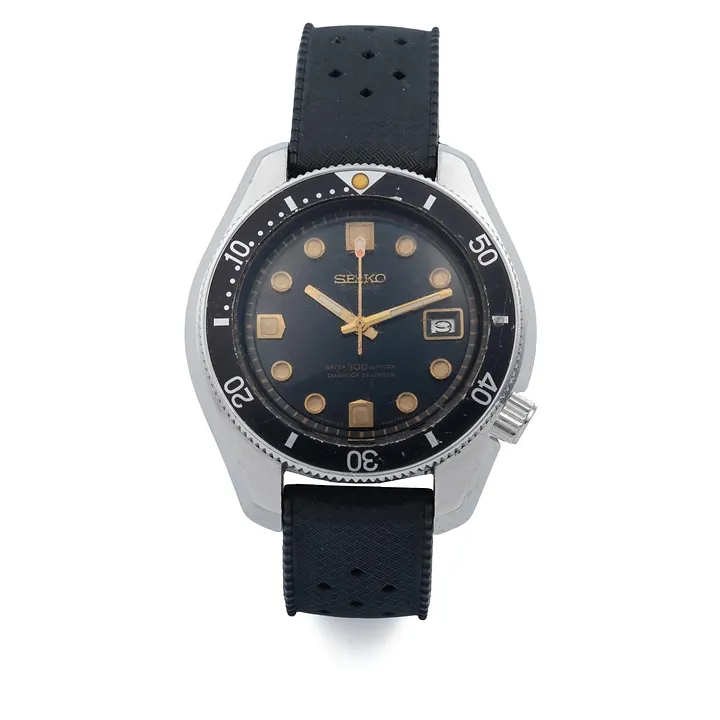
Seiko 300 M, ref. 6215-7000, 1967
Antiquorum auction archive, Geneva
Wristwatches · 1967
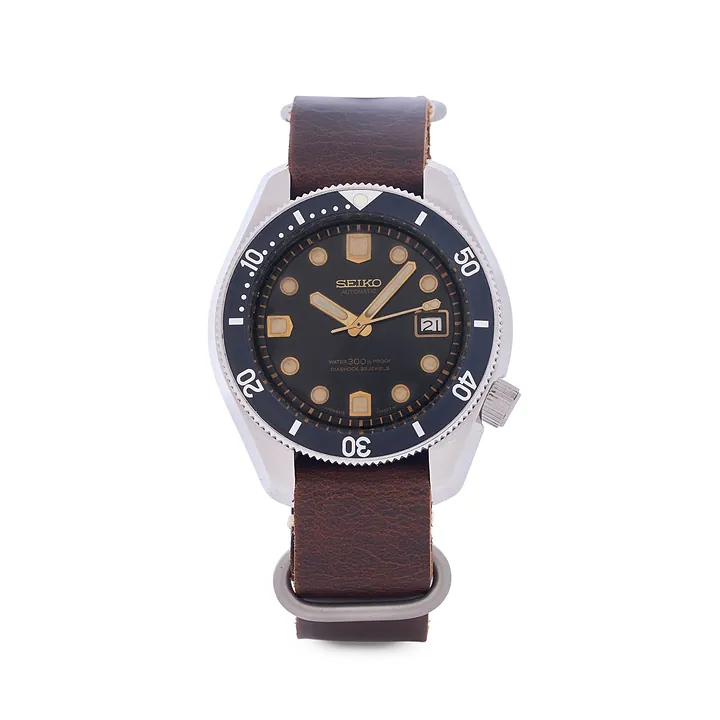
Seiko 300 Meter Diver, ref. 6215-7000, 1967
Antiquorum auction archive, Geneva
Wristwatches · c. 1968
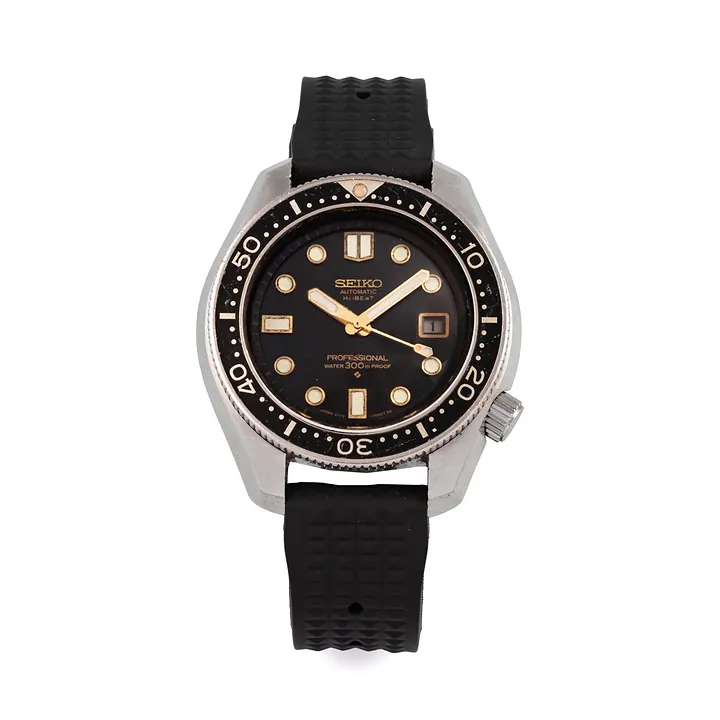
Seiko Hi-Beat, ref. 6159-7000, c. 1968
Antiquorum auction archive, Geneva
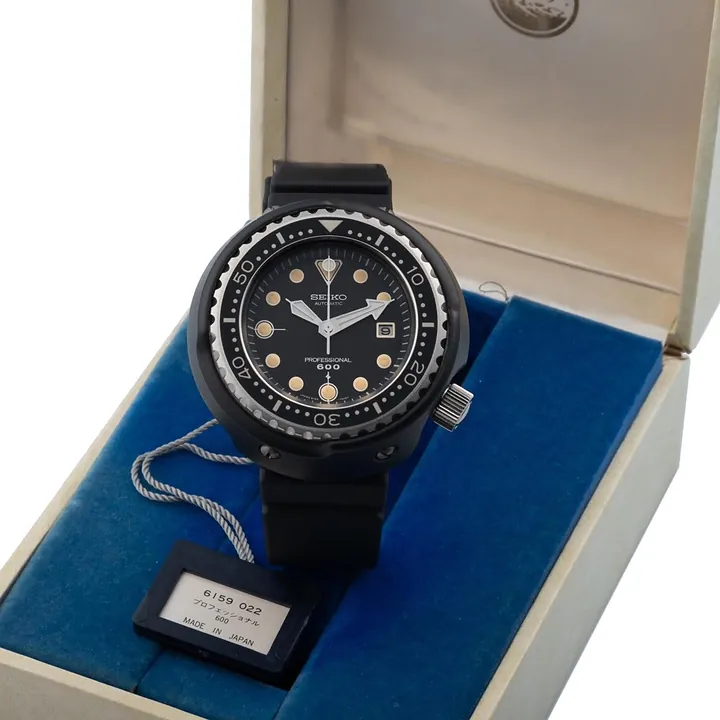
Wristwatches · 1975
Seiko Tuna Professional 600, ref. 6159-7010, 1975
Antiquorum auction archive, Geneva
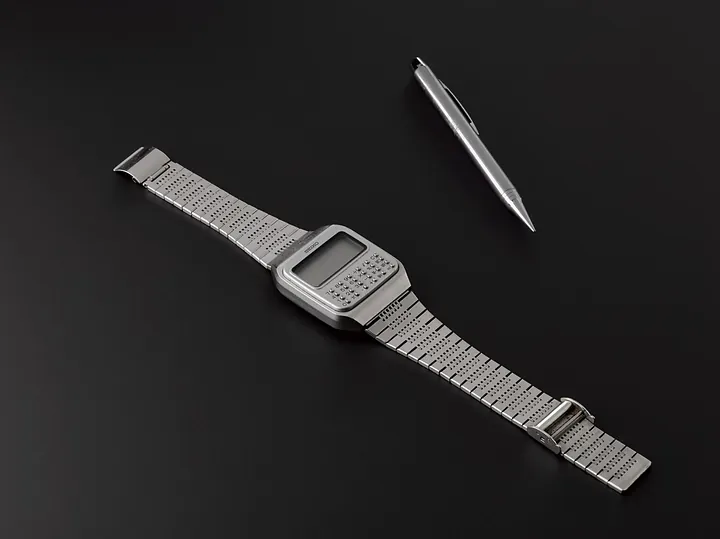
Wristwatches · 1978
Calculator wristwatch by Suwa Seikosha Co. Limited, Japan, 1978
Science Museum Group, London
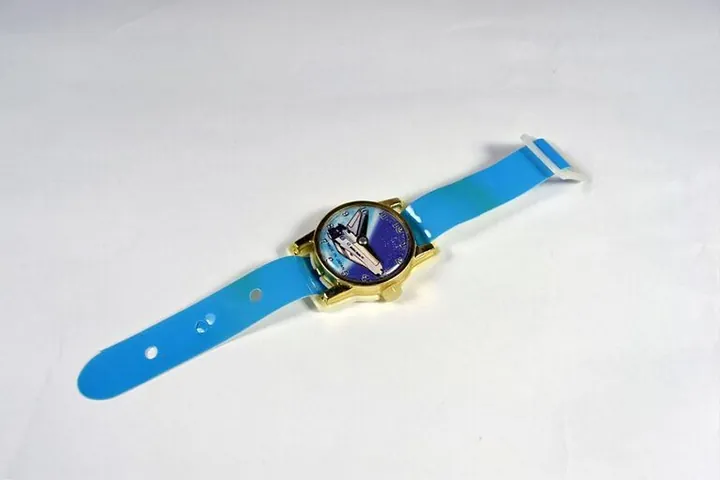
Wristwatches · 1980–1982
Wristwatch, Space Shuttle; plastic, Japan, 1970-1979?
Victoria and Albert Museum, London
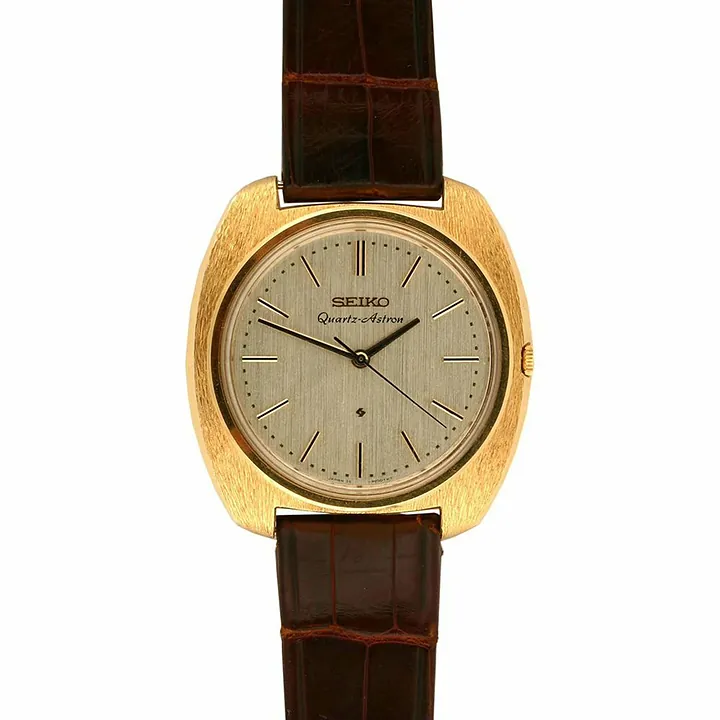
Wristwatches · 1969
Wristwatch, Japan, 1969 (no. 29912)
German Clock Museum
Wristwatches · c. 1972
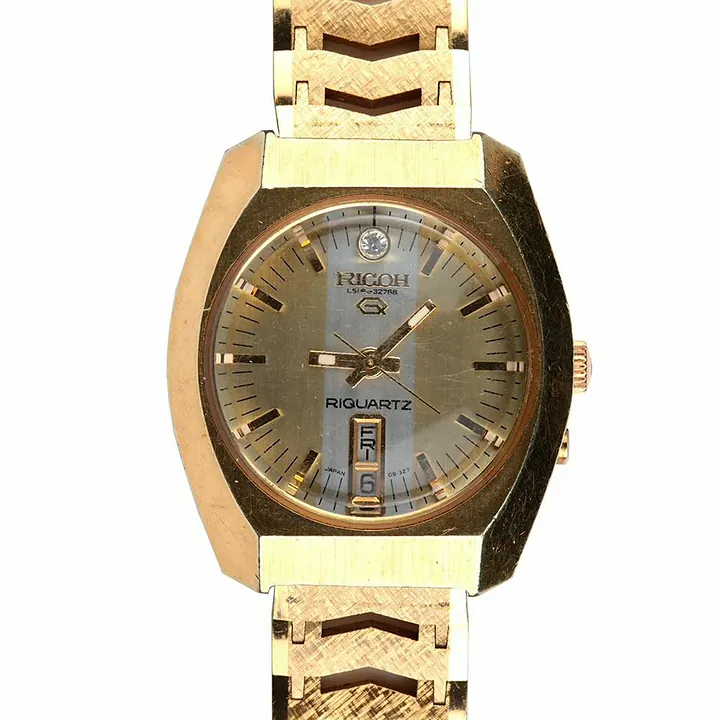
Wristwatch, Japan, c. 1972
German Clock Museum