
Wristwatches · Wristwatch
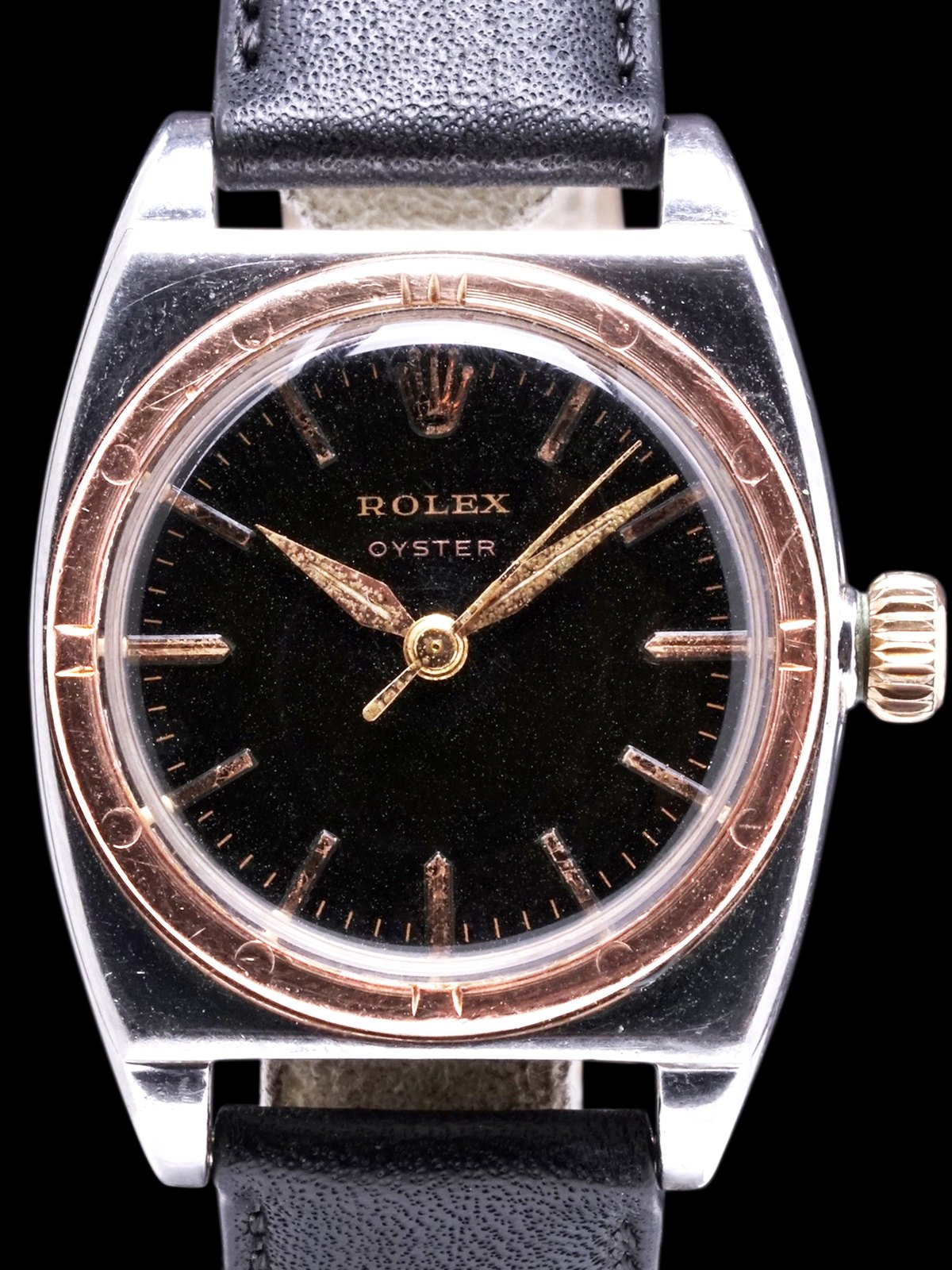
Rolex Two-Tone Viceroy (Ref. 3359), 1943
- Maker / attribution
- Rolex (maker)
- Date
- 1943
- Historical period
- Golden Age of Mechanical Watchmaking (1900 – 1945)
- Country of origin
- Switzerland
- Object type
- Wristwatch
- Materials / technique
- two-tone
- Stock no.
- RLXVRY3359
- Credit line
- Dealer listing, Craft & Tailored (RLXVRY3359)
- Catalogue title (original)
- 1943 Rolex Two-Tone Viceroy (Ref. 3359) W/ RSC Letters, Invoice, & RSC Box (English)
View the source record (dealer listing) ↗ (opens another website in a new tab)Suggest a correction
Record summary
Catalogued by Craft & Tailored (dealer), Los Angeles (stock number RLXVRY3359), this is a wristwatch by Rolex, made in Switzerland, dated 1943. The Atlas places it in the Golden Age of Mechanical Watchmaking period (1900 – 1945) of its Wristwatches collection. Materials and techniques recorded by the source: two-tone. The record is illustrated with 6 photographs.
Assembled from the source record's structured fields. Dates and attributions are given as the source states them; where a field is missing the Atlas leaves it blank rather than estimating.
Catalogue description
Dealer description — Craft & Tailored
Finding a Rolex watch that is accompanied by service papers isn’t impossible, however, to find a Rolex watch of this vintage, and with this level of extensive Rolex to customer correspondence is, to say the least impressive. The extensive paperwork provided with this 1943 Rolex Viceroy ref. 3359 details the correspondence from Rolex to the watch's original owner in reference to the watch's service in the summer of 1983. These letters and invoices tell a tale of a man who believed in the mechanical prestige of his Rolex watch and wouldn’t take “no” for an answer even as Rolex suggested he retire his cherished ref. 3359. Rolex goes on to detail that the watch may be beyond repairable condition and that the work they perform on the watch could no longer be guaranteed. Rolex continues their candor in an almost humorous fashion saying that they no longer manufacture the parts needed and that they don’t want to say “I told you so” if the watch fails to meet their standards. Though this is remarkable provenance for this Rolex Viceroy ref. 3359, what all of this does provide is an insight into a time when Rolex was a much younger brand than they are today. A time when they were able to provide thorough and personalized responses to their customers based on their capabilities at the time. After the service was all said and done, Rolex managed the bring the watch back to operating condition. They replaced the hands of the watch, refinished the luminous material, overhauled the moment, and polished the case, as detailed in the documents provided. As the watch stands today, almost as a testament to the watchmaking capabilities of Rolex from its beginning to now, is running perfectly, keeping excellent time, and now has an incredible story to go along with it. Stock # RLXVRY3359 Brand Rolex Style Viceroy Model 3359 Serial 285XXX Size Men's Material SS/ Rose Gold Dial Glossy Black Millimeters 29.5 Bracelet 2pc Leather Strap CASE & BRACELET The geometrical Viceroy case has a wonderful aesthetic and gives the watch more presence than expected. The case was previously polished by Rolex in 1983, as detailed in the provided documents, and shows light signs of honest use. The rose gold bezel has been polished as well, though it does retain its original markings for each hour. The crystal was recently replaced for legibility of the dial, the watch will include the crystal that was paired with the watch during its 1983 service. The watch retains its original rose gold capped screw-down “Oyster Patent” crown. The serial and reference engravings between the lugs remain legible and visible to the naked eye. The watch will come supplied on a 2pd leather strap. DIAL & HANDS The glossy gilt dial has a beautiful vintage appearance and has taken on a deep brown coloration that is apparent in the sunlight. The dial retains its glossy finish and does show age, with spidering that is consistent through the dial and light corrosion on the markers. The lume plots were restored by Rolex during its 1983 service and have aged to a lovely golden coloration. The gold alpha hands were replaced during the watch’s 1983 service as well, and show normal age and oxidation, under U.V. light inspection they exhibit no degradation. ACCESSORIES The purchase of this watch includes all of the letters and invoices from Rolex's Consumer Service Division for its 1983 service interval and the Rolex service box that the watch was returned in. The watch is keeping excellent time and functioning perfectly.
Historical context
Golden Age of Mechanical Watchmaking (1900 – 1945)
The wristwatch displaces the pocket watch; waterproof cases, self-winding and grand complications.
The wristwatch overtook the pocket watch. Military use in the First World War, aviation, water-resistant cases (1926), automatic winding (1923–31), rectangular Art Deco designs and early chronographs and calendars defined the period.
Read the period in the timelineMore wristwatches from this periodEarlier: Industrial Revolution
Atlas type guide
Wristwatches
Bracelet watches were worn by women from the early nineteenth century — Breguet made one for Caroline Murat, Queen of Naples, in 1810–12 — but the wristwatch only became a man's instrument with military use and aviation in the early twentieth century. Between the World Wars it overtook the pocket watch; the 1920s and 1930s brought rectangular Art Deco cases, water-resistant cases and the first automatic winding systems.
After 1945 the wristwatch became a carrier of identity — dress watches, sports and dive watches, chronographs, calendars — produced by Swiss, American, Japanese, German, Soviet and Chinese industries. The quartz revolution after 1969 and the mechanical renaissance since the 1990s, including the rise of independent watchmakers, complete the story.
What to look for
- The reference number (between the lugs or inside the case back) and serial number, the starting point for dating.
- The calibre: its maker and number are often stamped under the dial or on the bridge.
- Originality of dial, hands and crown — refinished ('redial') dials are common.
- Case material marks: 18K/750, 14K/585, stainless steel, gold-filled, plated.
Dating clues
- Wire-lug cases: before c. 1925.
- Water-resistant screw-down cases: from 1926.
- Quartz movements: from 1969; sapphire crystals widespread after c. 1980.
General guidance written by the Atlas editors about this kind of object. It is not a statement about this particular piece; for that, rely on the source record above and on physical examination.
Related records

Movements & Components · c. 1970s
Rolex watch movement, c. 1970s
Antiquorum auction archive, Geneva

Pocket Watches · 1982
Fake Rolex watch, gold coloured metal, possibly made in Taiwan, 1982; part of a casual outfit, UK, 1982-84.
Victoria and Albert Museum, London

Wristwatches · c. 1920s
Rolex wristwatch, c. 1920s
Antiquorum auction archive, Geneva

Wristwatches · c. 1920s
Rolex wristwatch, ref. 6194, c. 1920s
Antiquorum auction archive, Geneva

Wristwatches · 1931
Rolex 'Oyster Perpetual' rotor self-winding wrist-watch, lever escapement, in steel case with glass in back, Montres Rolex SA, Geneva, Switzerland, 1931
Science Museum Group, London

Wristwatches · 1900–1999
Wristwatch by Certina, Switzerland, 1900–1999
Nordic Museum Foundation

Wristwatches · 1900–1999
Wristwatch by Omega, Västerås, 1900–1999
Nordic Museum Foundation

Wristwatches · 1900–1999
Wristwatch by Universal, Switzerland, 1900–1999
Nordic Museum Foundation