
Wristwatches · Wristwatch
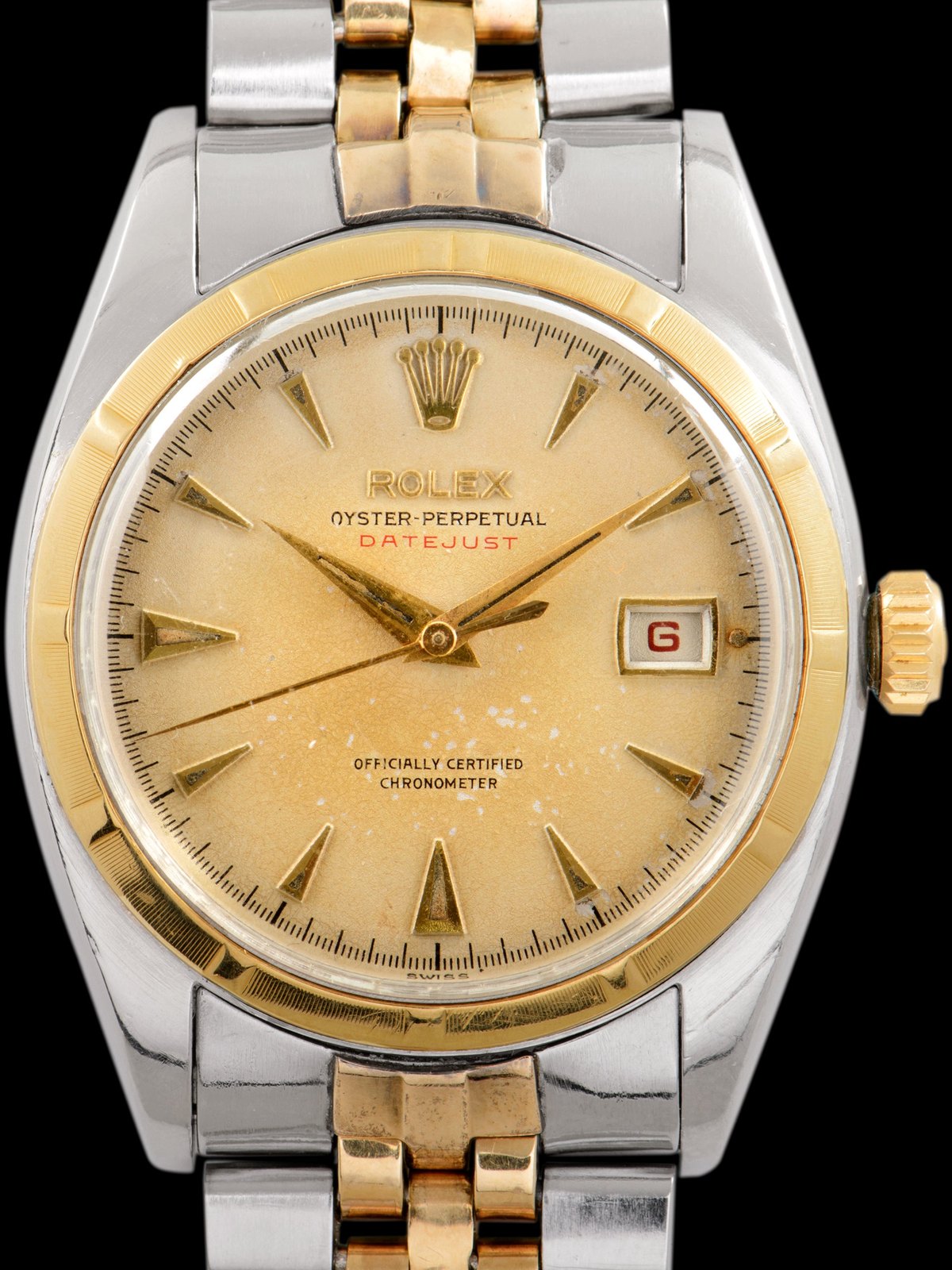
Rolex Two-Tone Red Datejust (Ref. 6104) "Ovettone", 1953
- Maker / attribution
- Rolex (maker)
- Date
- 1953
- Historical period
- Modern Mechanical Horology (1945 – 1969)
- Country of origin
- Switzerland
- Object type
- Wristwatch
- Materials / technique
- two-tone
- Dimensions
- Case 36 mm
- Stock no.
- RLXTTDJ6104
- Credit line
- Dealer listing, Craft & Tailored (RLXTTDJ6104)
- Catalogue title (original)
- 1953 Rolex Two-Tone Red Datejust (Ref. 6104) "Ovettone" W/ Papers & Early RSC Documents (English)
View the source record (dealer listing) ↗ (opens another website in a new tab)Suggest a correction
Record summary
Catalogued by Craft & Tailored (dealer), Los Angeles (stock number RLXTTDJ6104), this is a wristwatch by Rolex, made in Switzerland, dated 1953. The Atlas places it in the Modern Mechanical Horology period (1945 – 1969) of its Wristwatches collection. Materials and techniques recorded by the source: two-tone. Recorded dimensions: Case 36 mm. The record is illustrated with 6 photographs.
Assembled from the source record's structured fields. Dates and attributions are given as the source states them; where a field is missing the Atlas leaves it blank rather than estimating.
Catalogue description
Dealer description — Craft & Tailored
The Rolex Datejust is one of the most iconic and beloved watches made by Rolex. Launched in 1945, it remains a timeless classic and is instantly recognizable as an item of superior quality and functional design. We love the early Rolex Datejust for its simplicity and its classic sophistication, making for a watch that can be worn just as easily with a suit as it can be with jeans and a t-shirt. "Ovettone" roughly translates from Italian as 'Big Egg' and is a term coined by collectors to represent early 36mm models that feature round case backs, more commonly seen in the smaller Bubble-Back Rolex model range, which is why "Ovettones" are also commonly referred to as "Big Bubble-Backs". The Rolex Datejust wasn't actually signed "Datejust" on the dial until the 1950s, and these early signed models were done so with special red text that was phased out after only a few years. This is synonymous with most of the new model introductions from Rolex in this era, such as the Red Submariner ref. 1680, and Double Red Sea-Dweller ref. 1665. This red detail, however small, adds an incredible amount of exclusivity and character to the Datejust dials. This two-tone Rolex Red Datejust ref. 6104 is truly stunning, not only is the original "Red Datejust" dial absolutely stunning, but it is accompanied by its original red date wheel, hands, and engine-turned gold bezel on the case. Adding to the desirability of this early Datejust reference is its accompanying accessories, this watch comes with the original chronometer certificate, papers, early Rolex service documentation, early booklets, and a rare Rolex leather card booklet making for a true collector's set on an already exclusive piece. SPECS Stock # RLXTTDJ6104 Brand Rolex Style Datejust Model 6104 Serial 91XXXX Size Men's Material SS / 14K YG Dial Yellow "Aged" Millimeters 36 Bracelet Rolex Two-Tone Jubilee W/ 55 End Pieces CASE & BRACELET The early Datejust case is exceptionally well preserved, boasting very thick and symmetrical lugs that exhibit light signs of honest use. The original and early 14k yellow gold engine-turned bezel retains its factory grooving and dimensions with normal signs of use and previous light polishing present. The yellow gold crown is an early service replacement as it features the underlined Rolex logo instead of the Rolex + brevet crown, which is common to see as crowns were frequently replaced at service in this era. The era-correct Rolex two-tone Jubilee bracelet with 55 end pieces is stamped 4/60 and was sourced with the watch, it is believed to be an early service replacement. The bracelet retains 21 links that exhibit normal stretch for the style and age of the bracelet. DIAL & HANDS The original yellow dial is exceptionally well-preserved for the age of the watch, featuring an applied Rolex logo and markers along with the iconic red "Datejust" text. The dial exhibits some age however it is very minor and accentuates the vintage aesthetic the watch offers. The original radium lume inlaid into the markers has achieved a dark patina, and displays minimal degradation when inspected under U.V. light. The original radium dauphine hands match the dial and remain in overall excellent condition, under U.V. light inspection the hour exhibits lume loss which is common, and the minute hand lume remains fully intact. The red date wheel is both original and rare. ACCESSORIES The watch comes complete with its original chronometer certificate, chronometer papers, Rolex service documents from Rolex New York in 1958, its original booklet, and a rare Rolex leather wallet. The watch is keeping time and excellent working order, previous service history is unknown.
Historical context
Modern Mechanical Horology (1945 – 1969)
Tool watches for divers, pilots and astronauts; electric watches anticipate the electronic age.
The classic era of the mechanical wristwatch: dive watches, chronographs for motor racing and space flight, GMT watches for jet travel, slim dress watches, automatic calendars, and the rise of Japanese manufacturers alongside Swiss, American, German and Soviet industries.
Read the period in the timelineMore wristwatches from this periodEarlier: Golden Age of Mechanical Watchmaking
Atlas type guide
Calendar, moon-phase and perpetual calendar watches
Calendar complications range from a simple date to the perpetual calendar, which automatically allows for months of different lengths and leap years until 2100. Pocket watches with perpetual calendars were made in the eighteenth and nineteenth centuries; Patek Philippe made the first perpetual calendar wristwatch in 1925, and series production followed in 1941. The annual calendar (Patek Philippe, 1996) needs correction only once a year.
Moon-phase displays use a disc with two moons and 59 teeth advanced daily, approximating the 29.5-day lunation; more precise trains reduce the error to one day in over a century.
What to look for
- Apertures or subsidiary dials for day, date, month and leap year.
- Moon disc under a 'bosom' shaped aperture.
- Recessed correctors on the case band for setting the calendar.
Dating clues
- Triple-date wristwatches: popular c. 1940–1955.
- Perpetual calendar wristwatches: from 1925 (unique) and 1941 (series).
General guidance written by the Atlas editors about this kind of object. It is not a statement about this particular piece; for that, rely on the source record above and on physical examination.
Related records

Movements & Components · c. 1970s
Rolex watch movement, c. 1970s
Antiquorum auction archive, Geneva

Pocket Watches · 1982
Fake Rolex watch, gold coloured metal, possibly made in Taiwan, 1982; part of a casual outfit, UK, 1982-84.
Victoria and Albert Museum, London

Wristwatches · c. 1920s
Rolex wristwatch, c. 1920s
Antiquorum auction archive, Geneva

Wristwatches · c. 1920s
Rolex wristwatch, ref. 6194, c. 1920s
Antiquorum auction archive, Geneva

Wristwatches · 1945
Wristwatch by Eterna, 1945
Museum Rotterdam

Wristwatches · c. 1945
Breitling Premier, ref. 790, c. 1945
Antiquorum auction archive, Geneva

Wristwatches · c. 1945
Universal Genève Uni-Compax, ref. 22492, c. 1945
Antiquorum auction archive, Geneva

Wristwatches · c. 1950s
Baume & Mercier wristwatch, c. 1950s
Antiquorum auction archive, Geneva