
Wristwatches · Wristwatch
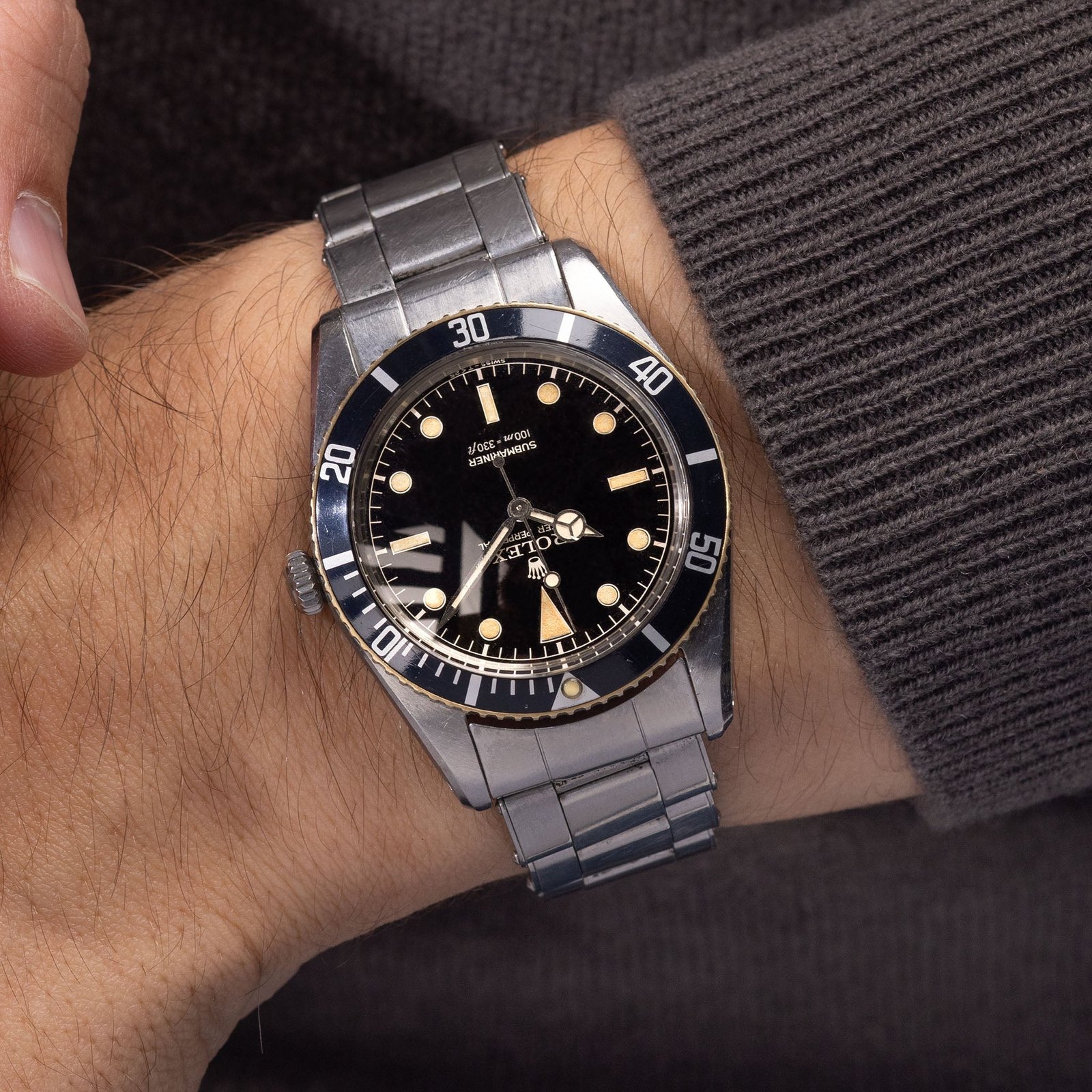
Rolex Submariner Small Crown ref. 5508 T<25 Gilt Dial, 1959
- Maker / attribution
- Rolex (maker)
- Date
- 1959
- Historical period
- Modern Mechanical Horology (1945 – 1969)
- Country of origin
- Switzerland
- Object type
- Wristwatch
- Stock no.
- W-3483
- Credit line
- Dealer listing, Bulang & Sons (W-3483)
- Catalogue title (original)
- Rolex Submariner Small Crown ref. 5508 T<25 Gilt Dial (English)
View the source record (dealer listing) ↗ (opens another website in a new tab)Suggest a correction
Record summary
Catalogued by Bulang & Sons (dealer), Copenhagen (stock number W-3483), this is a wristwatch by Rolex, made in Switzerland, dated 1959. The Atlas places it in the Modern Mechanical Horology period (1945 – 1969) of its Wristwatches collection. The record is illustrated with 6 photographs.
Assembled from the source record's structured fields. Dates and attributions are given as the source states them; where a field is missing the Atlas leaves it blank rather than estimating.
Catalogue description
Dealer description — Bulang & Sons
As you might know by now — we love Submariners. Whether it’s a contemporary version with a gloss dial and sapphire crystal, or a vintage plexi piece with matte tritium dials — maxi dials, meters-first, or red Subs — we get warm, fuzzy feelings for all of them! The early versions without crown guards might just be the most distinctive of all. The so-called “Big Crowns” have an unmistakably bold presence on the wrist — that chunky case profile, the domed plexi sitting high above the dial — all combining to give a wonderfully rugged, oversized feel. On the other hand, the “Small Crown” references feel more refined, sitting flatter on the wrist — a different experience altogether, but equally cool in our book. At hand, we have just that: an early Submariner “Small Crown,” reference 5508. Take a look at the case on this one — especially the factory finish along the sides. We rarely use the word unpolished , but in this case… these hips don’t lie, baby! This example dates to 1959, so it would have originally been born with a “Swiss only” dial. The current dial, however, is a 1960s replacement, signed Swiss <T-25 . We presume the watch went back to Rolex for service sometime in the mid-1960s and received a new dial at that time — as many did. After all, these watches were used , not pampered! By then, Rolex had already moved away from the earlier luminous materials of the 1950s, which had been restricted under Swiss law. Nevertheless, this dial remains a beautiful gilt example — instantly recognizable for its glossy, mirror-like surface and warm golden printing. The term “gilt” doesn’t refer to gold leaf, but rather to the exposed brass base revealed after layers of black lacquer were applied and carefully etched away. Because of the complexity and cost of this process, Rolex eventually switched to simpler pad printing. Yet these gilt dials possess a charm that only time can create — aging with warmth and individuality, just like the one here, even if it’s a few years younger than the case itself. Overall, this watch is in superb condition (again — look at that case!). The insert is a later addition, but beautifully matched, the dial with gilt text in a light golden hue and luminous material that’s aged to a lovely lemon tone. It’s fitted with a stretch riveted bracelet, reference 6636 — what’s not to love? Fully serviced by our watchmaker and ready for new adventures, this cool tool watch has all the charm you’d hope for. So, if you’re after a fantastic case, a rich gilt glow, and a dial full of character — without the fragility of 1950s lume — this might just be the one . Specifications Rolex Reference 5508 Submariner “Small crown “ 38 steel case Serial 399xxx dating to 1959 Superglossy”service “ gilt dial , signed “Swiss T<-25, , tritium zinc sulfide lume Fat font bezel insert Oyster rivet bracelet reference 6636 , spring loaded , clasp stamped '1 66” end links stamped 80 Fully serviced by our watchmaker
Historical context
Modern Mechanical Horology (1945 – 1969)
Tool watches for divers, pilots and astronauts; electric watches anticipate the electronic age.
The classic era of the mechanical wristwatch: dive watches, chronographs for motor racing and space flight, GMT watches for jet travel, slim dress watches, automatic calendars, and the rise of Japanese manufacturers alongside Swiss, American, German and Soviet industries.
Read the period in the timelineMore wristwatches from this periodEarlier: Golden Age of Mechanical Watchmaking
Atlas type guide
Dive and water-resistant watches
Keeping water and dust out of a wristwatch was a long-standing challenge. Rolex's screw-down Oyster case (1926) and Omega's Marine (1932) were landmarks; in the early 1950s Blancpain's Fifty Fathoms and Rolex's Submariner defined the professional dive watch with rotating bezels for timing dives, luminous dials and high water resistance. The ISO 6425 standard (1982) later codified what a 'diver's watch' must do.
Dive watches became icons of post-war design and exploration, and their evolution — helium escape valves, ceramic bezels, saturation-diving depth ratings — records the history of underwater work.
What to look for
- Unidirectional or bidirectional rotating bezel with minute markings.
- Screw-down crown and case back; depth rating printed on the dial.
- Luminous hands and markers (radium before c. 1960, tritium c. 1960–1998, then Super-LumiNova).
- Reference numbers on the case between the lugs or inside the back.
Dating clues
- Screw-down Oyster cases: from 1926.
- Professional dive watches: from 1953.
- Tritium 'T' marks on dials: c. 1960–1998.
General guidance written by the Atlas editors about this kind of object. It is not a statement about this particular piece; for that, rely on the source record above and on physical examination.
Related records

Movements & Components · c. 1970s
Rolex watch movement, c. 1970s
Antiquorum auction archive, Geneva

Pocket Watches · 1982
Fake Rolex watch, gold coloured metal, possibly made in Taiwan, 1982; part of a casual outfit, UK, 1982-84.
Victoria and Albert Museum, London

Wristwatches · c. 1920s
Rolex wristwatch, c. 1920s
Antiquorum auction archive, Geneva

Wristwatches · c. 1920s
Rolex wristwatch, ref. 6194, c. 1920s
Antiquorum auction archive, Geneva

Wristwatches · 1945
Wristwatch by Eterna, 1945
Museum Rotterdam

Wristwatches · c. 1945
Breitling Premier, ref. 790, c. 1945
Antiquorum auction archive, Geneva

Wristwatches · c. 1945
Universal Genève Uni-Compax, ref. 22492, c. 1945
Antiquorum auction archive, Geneva

Wristwatches · c. 1950s
Baume & Mercier wristwatch, c. 1950s
Antiquorum auction archive, Geneva