
Wristwatches · Wristwatch
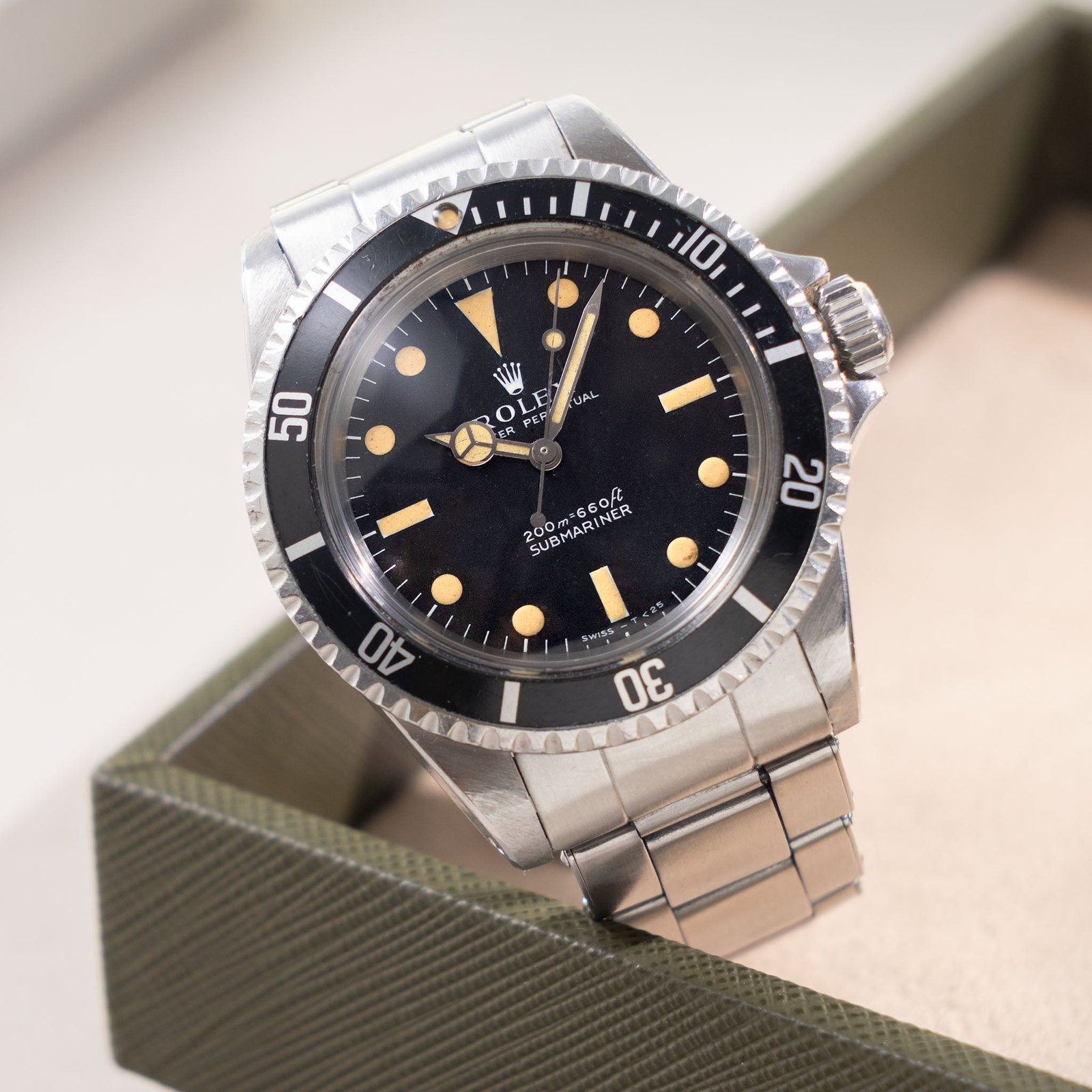
Rolex Submariner 5513 Meters First Dial with Vivid Patina, 1967
- Maker / attribution
- Rolex (maker)
- Date
- 1967
- Historical period
- Modern Mechanical Horology (1945 – 1969)
- Country of origin
- Switzerland
- Object type
- Wristwatch
- Dimensions
- Case 40 mm
- Stock no.
- W-3779
- Credit line
- Dealer listing, Bulang & Sons (W-3779)
- Catalogue title (original)
- Rolex Submariner 5513 Meters First Dial with Vivid Patina (English)
View the source record (dealer listing) ↗ (opens another website in a new tab)Suggest a correction
Record summary
Catalogued by Bulang & Sons (dealer), Copenhagen (stock number W-3779), this is a wristwatch by Rolex, made in Switzerland, dated 1967. The Atlas places it in the Modern Mechanical Horology period (1945 – 1969) of its Wristwatches collection. Recorded dimensions: Case 40 mm. The record is illustrated with 6 photographs.
Assembled from the source record's structured fields. Dates and attributions are given as the source states them; where a field is missing the Atlas leaves it blank rather than estimating.
Catalogue description
Dealer description — Bulang & Sons
The Rolex Submariner reference 5513 was introduced as a more accessible alternative to its chronometer-rated sibling, the reference 5512, which debuted in 1959. Designed as a pure tool watch, the 5513 went on to enjoy an exceptionally long production run of nearly three decades. Throughout this period, it evolved through a wide range of dial and hand variations — a detail that continues to make it especially appealing to collectors today. One of the defining characteristics of the 5513 is its clean, balanced dial layout. Unlike the 5512, which typically features four lines of text at 6 o’clock, the 5513 is most often seen with just two: “Submariner” and the depth rating. This simpler configuration creates a more open, symmetrical aesthetic that perfectly reflects the watch’s utilitarian design philosophy. Presented here is a particularly attractive early example, a so-called “Meters First” version. This designation refers to the depth rating reading in meters before feet (200m = 660ft). These dials represent the first matte executions of the 5513, produced during the transition away from the earlier glossy “gilt” dials around 1966–1967. The “Meters First” configuration was only produced for a short window, approximately 1967–1969, before Rolex switched to “Feet First” dials to better align with the American market — making these early variants notably more sought after. The case on this example remains in great condition, retaining strong proportions and presence, and is fitted with a lovely fat-font insert that shows very little fading. The caseback carries a light period engraving reading “KJT 7-31-73,” adding a touch of character and history to the watch. The dial shows a beautiful, even patina across both plots and hands, developing into a warm cream tone over time. It features tritium lume with the characteristic zinc-sulfide compound, known for its brief green glow under UV exposure before fading away. Completing the watch is a Rolex riveted-style Oyster bracelet, reference 7206, fitted with end links stamped “80” and a clasp dated “3 69,” as well in excellent condition. The watch has been fully checked and regulated by our watch maker and is ready for new adventures . Early tool watch poetry — defined in meters, preserved in time , message us! Specifications: Rolex Submariner Reference 5513 40mm steel case Serial serial 177xxxx dating to 1967 “Meters first” matte dial, tritium zinc-sulfide lume Charcoal colour fat font bezel insert Oyster bracelet ref 7206 with ref 80 end links Soft case back engraving ; ' KJT 7-31-73' Fully checked and regulated by our watchmaker
Historical context
Modern Mechanical Horology (1945 – 1969)
Tool watches for divers, pilots and astronauts; electric watches anticipate the electronic age.
The classic era of the mechanical wristwatch: dive watches, chronographs for motor racing and space flight, GMT watches for jet travel, slim dress watches, automatic calendars, and the rise of Japanese manufacturers alongside Swiss, American, German and Soviet industries.
Read the period in the timelineMore wristwatches from this periodEarlier: Golden Age of Mechanical Watchmaking
Atlas type guide
Dive and water-resistant watches
Keeping water and dust out of a wristwatch was a long-standing challenge. Rolex's screw-down Oyster case (1926) and Omega's Marine (1932) were landmarks; in the early 1950s Blancpain's Fifty Fathoms and Rolex's Submariner defined the professional dive watch with rotating bezels for timing dives, luminous dials and high water resistance. The ISO 6425 standard (1982) later codified what a 'diver's watch' must do.
Dive watches became icons of post-war design and exploration, and their evolution — helium escape valves, ceramic bezels, saturation-diving depth ratings — records the history of underwater work.
What to look for
- Unidirectional or bidirectional rotating bezel with minute markings.
- Screw-down crown and case back; depth rating printed on the dial.
- Luminous hands and markers (radium before c. 1960, tritium c. 1960–1998, then Super-LumiNova).
- Reference numbers on the case between the lugs or inside the back.
Dating clues
- Screw-down Oyster cases: from 1926.
- Professional dive watches: from 1953.
- Tritium 'T' marks on dials: c. 1960–1998.
General guidance written by the Atlas editors about this kind of object. It is not a statement about this particular piece; for that, rely on the source record above and on physical examination.
Related records

Movements & Components · c. 1970s
Rolex watch movement, c. 1970s
Antiquorum auction archive, Geneva

Pocket Watches · 1982
Fake Rolex watch, gold coloured metal, possibly made in Taiwan, 1982; part of a casual outfit, UK, 1982-84.
Victoria and Albert Museum, London

Wristwatches · c. 1920s
Rolex wristwatch, c. 1920s
Antiquorum auction archive, Geneva

Wristwatches · c. 1920s
Rolex wristwatch, ref. 6194, c. 1920s
Antiquorum auction archive, Geneva

Wristwatches · 1945
Wristwatch by Eterna, 1945
Museum Rotterdam

Wristwatches · c. 1945
Breitling Premier, ref. 790, c. 1945
Antiquorum auction archive, Geneva

Wristwatches · c. 1945
Universal Genève Uni-Compax, ref. 22492, c. 1945
Antiquorum auction archive, Geneva

Wristwatches · c. 1950s
Baume & Mercier wristwatch, c. 1950s
Antiquorum auction archive, Geneva