
Wristwatches · Wristwatch
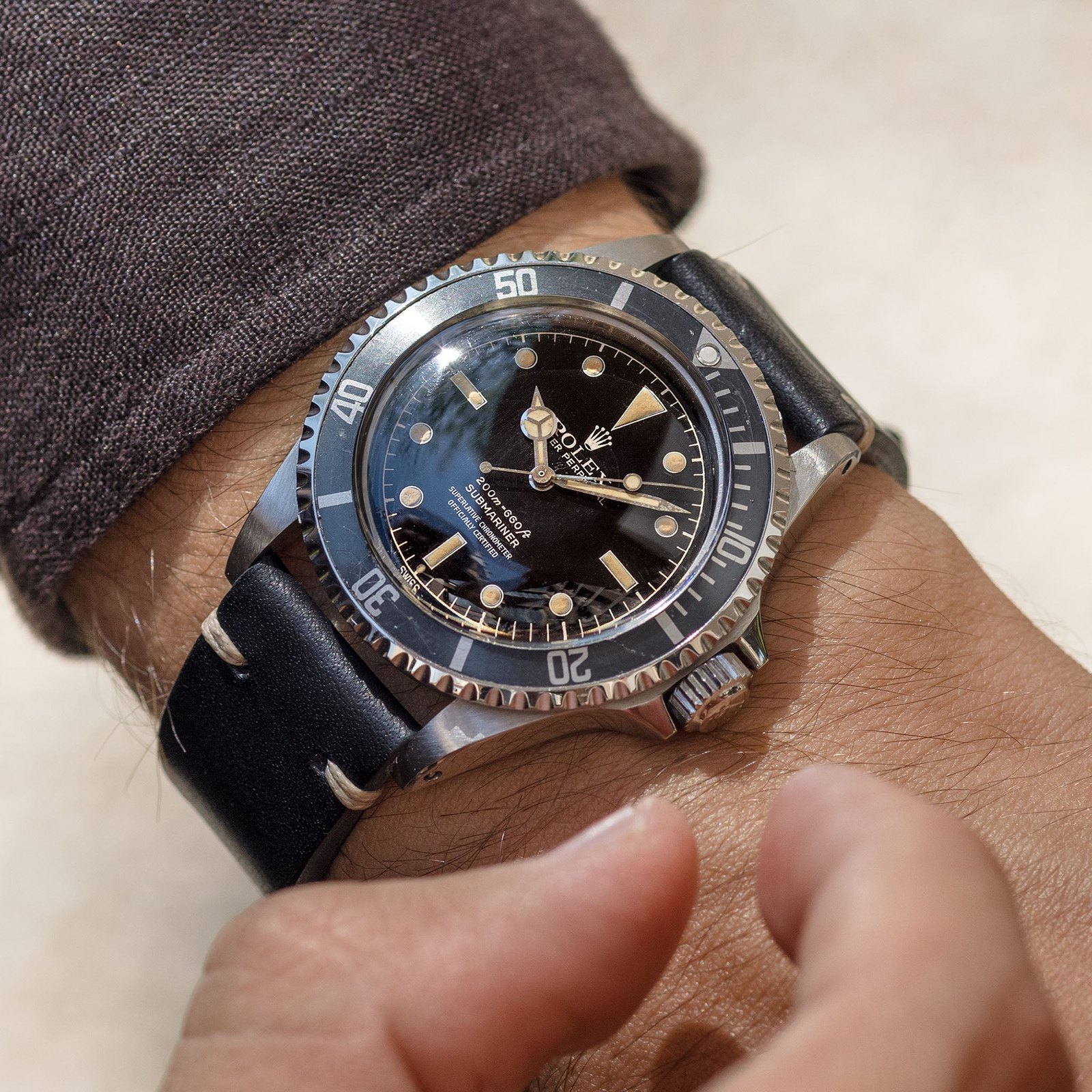
Rolex Submariner 5512 4-liner Gilt Chapter Ring Exclamation point Dial Pointed Crown Guards Case, 1963
- Maker / attribution
- Rolex (maker)
- Date
- 1963
- Historical period
- Modern Mechanical Horology (1945 – 1969)
- Country of origin
- Switzerland
- Object type
- Wristwatch
- Dimensions
- Case 40 mm
- Stock no.
- W-3849
- Credit line
- Dealer listing, Bulang & Sons (W-3849)
- Catalogue title (original)
- Rolex Submariner 5512 4-liner Gilt Chapter Ring Exclamation point Dial Pointed Crown Guards Case (English)
View the source record (dealer listing) ↗ (opens another website in a new tab)Suggest a correction
Record summary
Catalogued by Bulang & Sons (dealer), Copenhagen (stock number W-3849), this is a wristwatch by Rolex, made in Switzerland, dated 1963. The Atlas places it in the Modern Mechanical Horology period (1945 – 1969) of its Wristwatches collection. Recorded dimensions: Case 40 mm. The record is illustrated with 6 photographs.
Assembled from the source record's structured fields. Dates and attributions are given as the source states them; where a field is missing the Atlas leaves it blank rather than estimating.
Catalogue description
Dealer description — Bulang & Sons
Introduced in 1959, the Rolex Submariner reference 5512 is widely regarded as one of the most important dive watches ever produced. Manufactured until approximately 1980, it established the blueprint for the modern Submariner by introducing crown guards and increasing the Oyster case to the now-classic 40mm diameter. Although it shared much of its appearance with the reference 5513, the 5512 was produced in far smaller numbers, making it one of the most sought-after vintage Submariners today. Prior to the 5512, Submariners featured "no crown guard" cases, leaving the winding crown exposed to knocks and impacts. With the 5512, Rolex introduced protective crown guards, a defining feature that would become standard across the Submariner line. Their design evolved through three distinct phases over the years. The earliest examples from 1959 featured square crown guards. While exceptionally rare today, they proved somewhat impractical, as their blocky shape made it difficult for professional divers to unscrew the crown while wearing gloves. Rolex soon replaced them with the elegant pointed crown guards—known among collectors as "PCG" or Cornino —whose tapered profile improved accessibility while giving the watch one of its most distinctive silhouettes. By 1964, the familiar rounded crown guards were introduced, a design that remained in production until the end of the reference and continues to define the Submariner to this day. The movement also evolved during production. Early reference 5512s were powered by the non-chronometer calibre 1530 and featured the clean "two-line" dial, displaying only the model designation and depth rating above six o'clock. In 1962, Rolex upgraded the 5512 with chronometer-certified calibres 1560 and later 1570. As a result, the dial gained the additional "Superlative Chronometer Officially Certified" text, creating the familiar four-line layout. Offered here is an early 1963 example featuring the highly desirable pointed crown guard (PCG) case. The case remains beautifully full and strong, while the bezel insert has gracefully faded to a rich mid-blue tone. We often think of a bezel insert as the frame around a painting—the right frame makes all the difference—and this one complements the dial beautifully. The glossy gilt chapter ring dial is equally attractive and features the sought-after "Exclamation Point" configuration, named after the small lume dot positioned beneath the six o'clock marker, creating the appearance of an exclamation mark. The tritium lume has aged to a warm beige tone, perfectly complementing the rich golden gilt printing. The hands are later service replacements, fitted with matte tritium and no longer reacting under UV light. The watch is paired with one of our own Bulang and Sons leather straps—a combination we think suits this vintage Submariner exceptionally well. Fully serviced by our watchmaker, this 1963 icon is ready for many more years of adventures. Beautifully framed, beautifully aged, beautifully honest , Pointed guards, gilt dial, Exclamation Point... some Submariners really do have it all. Get in touch! Specifications: Rolex Submariner Reference 5512 40mm steel case, pointed crown guard Serial 870xxx dating to 1963 Four line gilt, chapter ring dial with "Exclamation Point", cream colour lume Faded fat font bezel insert Bulang and sons leather strap Fully serviced by our watchmaker
Historical context
Modern Mechanical Horology (1945 – 1969)
Tool watches for divers, pilots and astronauts; electric watches anticipate the electronic age.
The classic era of the mechanical wristwatch: dive watches, chronographs for motor racing and space flight, GMT watches for jet travel, slim dress watches, automatic calendars, and the rise of Japanese manufacturers alongside Swiss, American, German and Soviet industries.
Read the period in the timelineMore wristwatches from this periodEarlier: Golden Age of Mechanical Watchmaking
Atlas type guide
Dive and water-resistant watches
Keeping water and dust out of a wristwatch was a long-standing challenge. Rolex's screw-down Oyster case (1926) and Omega's Marine (1932) were landmarks; in the early 1950s Blancpain's Fifty Fathoms and Rolex's Submariner defined the professional dive watch with rotating bezels for timing dives, luminous dials and high water resistance. The ISO 6425 standard (1982) later codified what a 'diver's watch' must do.
Dive watches became icons of post-war design and exploration, and their evolution — helium escape valves, ceramic bezels, saturation-diving depth ratings — records the history of underwater work.
What to look for
- Unidirectional or bidirectional rotating bezel with minute markings.
- Screw-down crown and case back; depth rating printed on the dial.
- Luminous hands and markers (radium before c. 1960, tritium c. 1960–1998, then Super-LumiNova).
- Reference numbers on the case between the lugs or inside the back.
Dating clues
- Screw-down Oyster cases: from 1926.
- Professional dive watches: from 1953.
- Tritium 'T' marks on dials: c. 1960–1998.
General guidance written by the Atlas editors about this kind of object. It is not a statement about this particular piece; for that, rely on the source record above and on physical examination.
Related records

Movements & Components · c. 1970s
Rolex watch movement, c. 1970s
Antiquorum auction archive, Geneva

Pocket Watches · 1982
Fake Rolex watch, gold coloured metal, possibly made in Taiwan, 1982; part of a casual outfit, UK, 1982-84.
Victoria and Albert Museum, London

Wristwatches · c. 1920s
Rolex wristwatch, c. 1920s
Antiquorum auction archive, Geneva

Wristwatches · c. 1920s
Rolex wristwatch, ref. 6194, c. 1920s
Antiquorum auction archive, Geneva

Wristwatches · 1945
Wristwatch by Eterna, 1945
Museum Rotterdam

Wristwatches · c. 1945
Breitling Premier, ref. 790, c. 1945
Antiquorum auction archive, Geneva

Wristwatches · c. 1945
Universal Genève Uni-Compax, ref. 22492, c. 1945
Antiquorum auction archive, Geneva

Wristwatches · c. 1950s
Baume & Mercier wristwatch, c. 1950s
Antiquorum auction archive, Geneva