
Wristwatches · Wristwatch
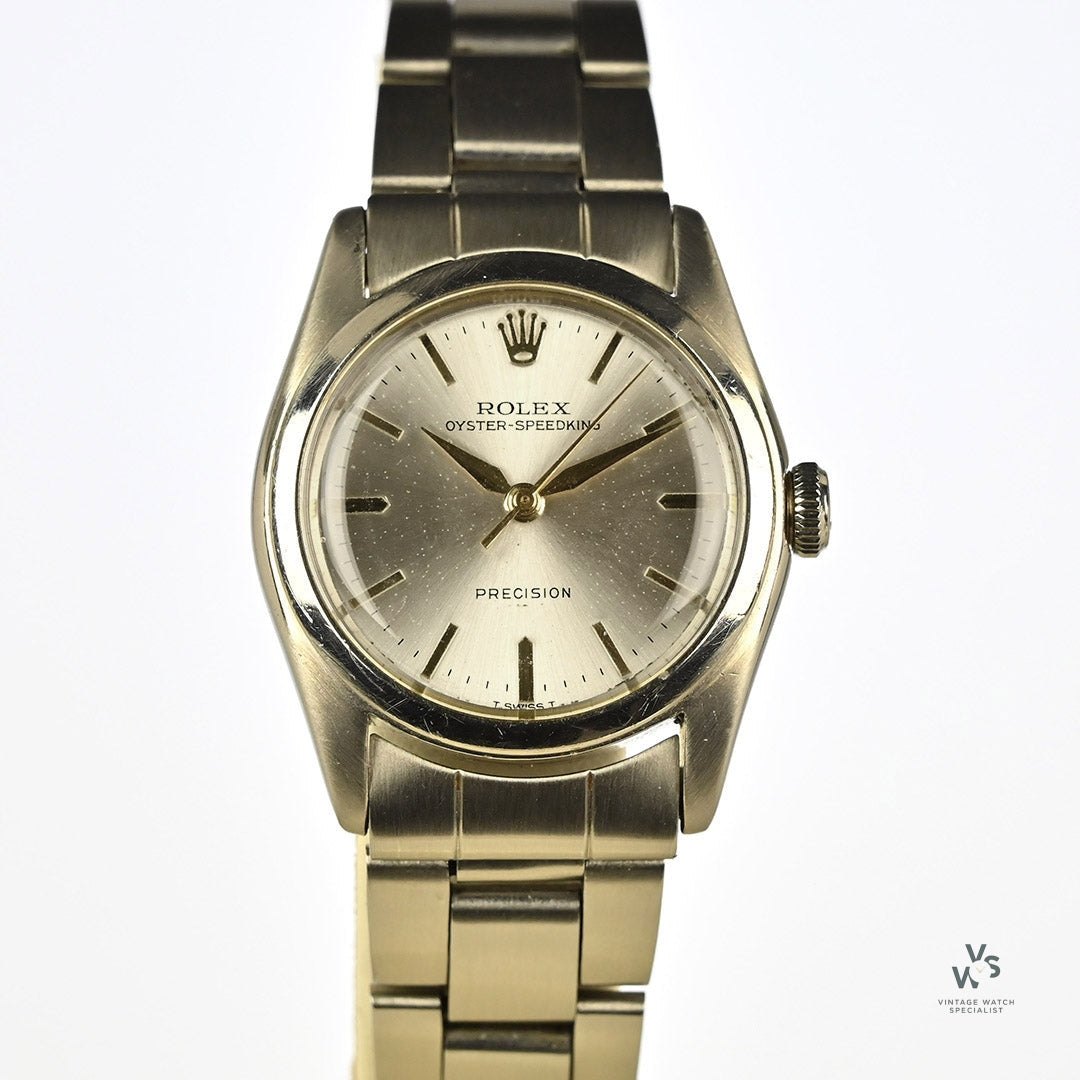
Rolex Oyster Speed King, ref. 5056, Manual Wind, Silver Sunburst Dial, circa 1948
- Maker / attribution
- Rolex (maker)
- Date
- c. 1948
- Historical period
- Modern Mechanical Horology (1945 – 1969)
- Country of origin
- Switzerland
- Object type
- Wristwatch
- Materials / technique
- silver
- Dimensions
- Case 30 mm
- Stock no.
- vws3105
- Credit line
- Dealer listing, Vintage Watch Specialist (vws3105)
- Catalogue title (original)
- Rolex Oyster Speed King - Model Ref: 5056 - Manual Wind - Silver Sunburst Dial - c.1948 (English)
View the source record (dealer listing) ↗ (opens another website in a new tab)Suggest a correction
Record summary
Catalogued by Vintage Watch Specialist (dealer), United Kingdom (stock number vws3105), this is a wristwatch by Rolex, made in Switzerland, dated c. 1948. The Atlas places it in the Modern Mechanical Horology period (1945 – 1969) of its Wristwatches collection. Materials and techniques recorded by the source: silver. Recorded dimensions: Case 30 mm. The record is illustrated with 6 photographs.
Assembled from the source record's structured fields. Dates and attributions are given as the source states them; where a field is missing the Atlas leaves it blank rather than estimating.
Catalogue description
Dealer description — Vintage Watch Specialist
A Beautiful Rolex Oyster Speedking Precision (Prisoner Of War), Manual Wind Watch with a Stunning Silver Sunburst Dial, Yellow Gold Dial Furniture and Oyster Bracelet, c.1948 A piece of Rolex history, the Speedking made its first appearance in the 1940s and brought with it a classic design that is just as relevant today as it was when it first debuted. It was named after the “King of Speed” Sir Malcolm Campbell, a Rolex fan and breaker of speed records. On 4 September 1935, he set a land speed record of over 300 miles per hour – while wearing his Rolex watch. The Speedking is also well known for being the "PoW" watch as it was offered to British prisoners of war during WWII as a morale boost - it wouldn't need to be paid for until the war was over and the men returned home. Many officers took up Rolex on this option and paid for the watches when returning to the UK after the war! What’s On Offer It may be small, but it's mighty! Mighty charming that is, in every sense, from its 30mm dimensions to its bewitching silver sunburst dial which has a very subtle sprinkling of pleasing patina, it's barely visible to the naked eye but adds to the charisma this watch enjoys. Beautiful yellow gold Dauphine hands glide over the applied baton indices and crown at 12, a needle central seconds hand completes a simple yet sophisticated dial. This watch has been very well taken care of through the years, you really would not think it was a 1940s watch given its remarkable condition, this is likely due to the fact it has been in one of our watchmaker's personal collection of watches for many years! This is a really charming watch, timelessly designed for the more slender wrist. Effortless chic for any occasion, vintage Rolex at its best. Running like a dream as one would expect, coming from a watchmaker it has been serviced on a regular basis by him.
Historical context
Modern Mechanical Horology (1945 – 1969)
Tool watches for divers, pilots and astronauts; electric watches anticipate the electronic age.
The classic era of the mechanical wristwatch: dive watches, chronographs for motor racing and space flight, GMT watches for jet travel, slim dress watches, automatic calendars, and the rise of Japanese manufacturers alongside Swiss, American, German and Soviet industries.
Read the period in the timelineMore wristwatches from this periodEarlier: Golden Age of Mechanical Watchmaking
Atlas type guide
Dive and water-resistant watches
Keeping water and dust out of a wristwatch was a long-standing challenge. Rolex's screw-down Oyster case (1926) and Omega's Marine (1932) were landmarks; in the early 1950s Blancpain's Fifty Fathoms and Rolex's Submariner defined the professional dive watch with rotating bezels for timing dives, luminous dials and high water resistance. The ISO 6425 standard (1982) later codified what a 'diver's watch' must do.
Dive watches became icons of post-war design and exploration, and their evolution — helium escape valves, ceramic bezels, saturation-diving depth ratings — records the history of underwater work.
What to look for
- Unidirectional or bidirectional rotating bezel with minute markings.
- Screw-down crown and case back; depth rating printed on the dial.
- Luminous hands and markers (radium before c. 1960, tritium c. 1960–1998, then Super-LumiNova).
- Reference numbers on the case between the lugs or inside the back.
Dating clues
- Screw-down Oyster cases: from 1926.
- Professional dive watches: from 1953.
- Tritium 'T' marks on dials: c. 1960–1998.
General guidance written by the Atlas editors about this kind of object. It is not a statement about this particular piece; for that, rely on the source record above and on physical examination.
Related records

Movements & Components · c. 1970s
Rolex watch movement, c. 1970s
Antiquorum auction archive, Geneva

Pocket Watches · 1982
Fake Rolex watch, gold coloured metal, possibly made in Taiwan, 1982; part of a casual outfit, UK, 1982-84.
Victoria and Albert Museum, London

Wristwatches · c. 1920s
Rolex wristwatch, c. 1920s
Antiquorum auction archive, Geneva

Wristwatches · c. 1920s
Rolex wristwatch, ref. 6194, c. 1920s
Antiquorum auction archive, Geneva

Wristwatches · 1945
Wristwatch by Eterna, 1945
Museum Rotterdam

Wristwatches · c. 1945
Breitling Premier, ref. 790, c. 1945
Antiquorum auction archive, Geneva

Wristwatches · c. 1945
Universal Genève Uni-Compax, ref. 22492, c. 1945
Antiquorum auction archive, Geneva

Wristwatches · c. 1950s
Baume & Mercier wristwatch, c. 1950s
Antiquorum auction archive, Geneva