
Wristwatches · Wristwatch
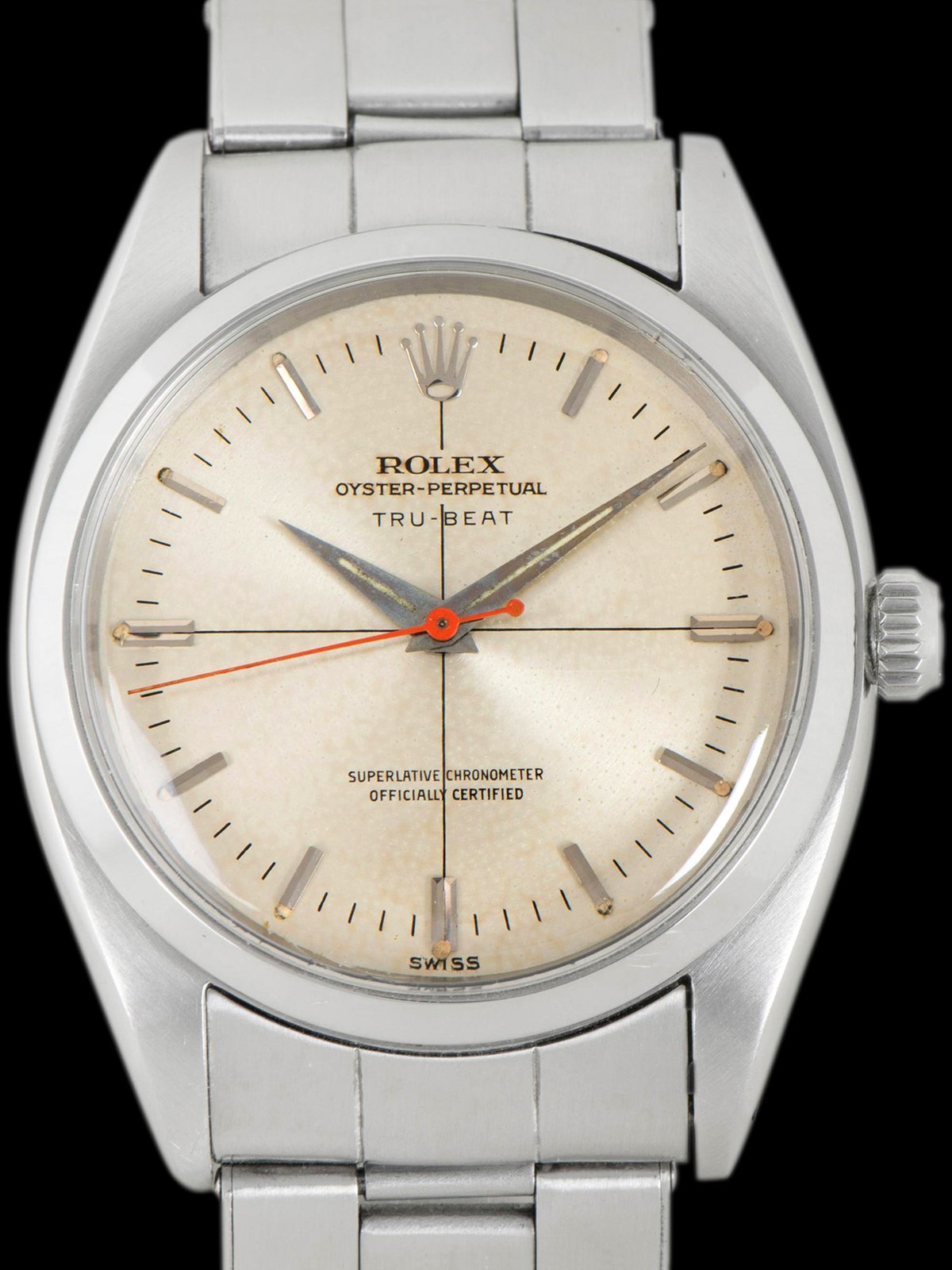
Rolex Oyster-Perpetual Tru-Beat (Ref. 6556) "Crosshair Dial", 1956
- Maker / attribution
- Rolex (maker)
- Date
- 1956
- Historical period
- Modern Mechanical Horology (1945 – 1969)
- Country of origin
- Switzerland
- Object type
- Wristwatch
- Stock no.
- RLXTRU6556
- Credit line
- Dealer listing, Craft & Tailored (RLXTRU6556)
- Catalogue title (original)
- 1956 Rolex Oyster-Perpetual Tru-Beat (Ref. 6556) "Crosshair Dial" (English)
View the source record (dealer listing) ↗ (opens another website in a new tab)Suggest a correction
Record summary
Catalogued by Craft & Tailored (dealer), Los Angeles (stock number RLXTRU6556), this is a wristwatch by Rolex, made in Switzerland, dated 1956. The Atlas places it in the Modern Mechanical Horology period (1945 – 1969) of its Wristwatches collection. The record is illustrated with 6 photographs.
Assembled from the source record's structured fields. Dates and attributions are given as the source states them; where a field is missing the Atlas leaves it blank rather than estimating.
Catalogue description
Dealer description — Craft & Tailored
Amongst the most niche watches produced by The Crown, which the brand had a habit of producing in its heyday, one stands out as being more misunderstood than the rest. The Rolex Oyster-Perpetual Tru-Beat features one of the most complex, yet visually simple movements produced at the time with the Rolex patented Cal. 1040 While the signature ticking of the ref. 6556 may seem commonplace today with the popularization of quartz movements, the dead-seconds mechanism of the Tru-Beat pre-dates quartz watches by over a decade and does so with a fully mechanical movement. The cal. 1040 employs an additional "swinging anchor" gear train that specifically interacts with the second's hand to give it that signature tick. Essentially, every aesthetic and mechanical aspect of the Tru-Beat is based on its functionality. The purpose of this movement was to aid medical professionals as the tick of the second's hands was much easier to track with a patient's heart rate or pulse than the more common-at-the-time sweeping second's hand. This is also why the dial features a crosshair to split the dial into 4 sectors and the second's hand was even made a vibrant red color at the factory, to help visually aid the reading of the watch at a glance. Although it's apparent every aspect of the ref. 6556 Tru-Beat was considered and executed for its intended application, it was, unfortunately, a commercial failure. Because of that and its extremely niche design, the watch was only produced for a very short period and in minuscule numbers. Today, the Tru-Beat has become a true enthusiast's grail, not only for its whimsical attributes, but the watch represents a time when the pursuit of Rolex was to create purely functional tools for the professional with the primary concern being the best possible timepiece as opposed to mainstream success. Though don't be mistaken, a Tru-Beat ref. 6556 in original and excellent condition like the example we're proud to present here are devilishly handsome. SPECS Stock # RLXTRU6556 Brand Rolex Style Tru-Beat Model 6556 Serial 13XXXX Size Men's Material Stainless Steel Dial Silver "Crosshair" Millimeters 34 Bracelet Rolex 7205 Oyster Bracelet W/ 57 End Pieces CASE & BRACELET The impressive case displays minimal signs of previous polishing and boasts very thick and symmetrical lugs that show minimal signs of previous use. The smooth stainless steel bezel is in excellent condition with almost no signs of use present. The unique flat-top case back is very well-preserved with only light signs of previous polishing and gentle signs of use. The era-correct but later Rolex 7205 Oyster rivet bracelet with 57 end pieces dates to 1966 and retains 12 links that exhibit minimal stretch and will fit up to a 7 1/2-inch wrist. DIAL & HANDS The silver dial with crosshair printing and concentric brushing is original to the watch and in exceptionally well-preserved condition, featuring a tasteful warm patina that features subtle speckling but no actual damage. The radium lume plots have handsome tan coloration that features some dark elements which is commonplace in lume from this era, under U.V. light inspection all the lume plots remain present, though some of the lume plots display very minor degradation which is expected. The original dauphine hands match the dial almost perfectly but are a shade lighter and display no degradation when inspected under U.V. light. The "ticking" center red seconds hand is original to the watch as well. ACCESSORIES None. This watch is keeping time within COSC timing spec, and functioning correctly. Due to the scarcity of parts for this specific movement, we can only guarantee the timekeeping of this movement to the best of our ability, however, we cannot guarantee the ability to fix it should a component catastrophically fail.
Historical context
Modern Mechanical Horology (1945 – 1969)
Tool watches for divers, pilots and astronauts; electric watches anticipate the electronic age.
The classic era of the mechanical wristwatch: dive watches, chronographs for motor racing and space flight, GMT watches for jet travel, slim dress watches, automatic calendars, and the rise of Japanese manufacturers alongside Swiss, American, German and Soviet industries.
Read the period in the timelineMore wristwatches from this periodEarlier: Golden Age of Mechanical Watchmaking
Atlas type guide
Dive and water-resistant watches
Keeping water and dust out of a wristwatch was a long-standing challenge. Rolex's screw-down Oyster case (1926) and Omega's Marine (1932) were landmarks; in the early 1950s Blancpain's Fifty Fathoms and Rolex's Submariner defined the professional dive watch with rotating bezels for timing dives, luminous dials and high water resistance. The ISO 6425 standard (1982) later codified what a 'diver's watch' must do.
Dive watches became icons of post-war design and exploration, and their evolution — helium escape valves, ceramic bezels, saturation-diving depth ratings — records the history of underwater work.
What to look for
- Unidirectional or bidirectional rotating bezel with minute markings.
- Screw-down crown and case back; depth rating printed on the dial.
- Luminous hands and markers (radium before c. 1960, tritium c. 1960–1998, then Super-LumiNova).
- Reference numbers on the case between the lugs or inside the back.
Dating clues
- Screw-down Oyster cases: from 1926.
- Professional dive watches: from 1953.
- Tritium 'T' marks on dials: c. 1960–1998.
General guidance written by the Atlas editors about this kind of object. It is not a statement about this particular piece; for that, rely on the source record above and on physical examination.
Related records

Movements & Components · c. 1970s
Rolex watch movement, c. 1970s
Antiquorum auction archive, Geneva

Pocket Watches · 1982
Fake Rolex watch, gold coloured metal, possibly made in Taiwan, 1982; part of a casual outfit, UK, 1982-84.
Victoria and Albert Museum, London

Wristwatches · c. 1920s
Rolex wristwatch, c. 1920s
Antiquorum auction archive, Geneva

Wristwatches · c. 1920s
Rolex wristwatch, ref. 6194, c. 1920s
Antiquorum auction archive, Geneva

Wristwatches · 1945
Wristwatch by Eterna, 1945
Museum Rotterdam

Wristwatches · c. 1945
Breitling Premier, ref. 790, c. 1945
Antiquorum auction archive, Geneva

Wristwatches · c. 1945
Universal Genève Uni-Compax, ref. 22492, c. 1945
Antiquorum auction archive, Geneva

Wristwatches · c. 1950s
Baume & Mercier wristwatch, c. 1950s
Antiquorum auction archive, Geneva