
Wristwatches · Wristwatch
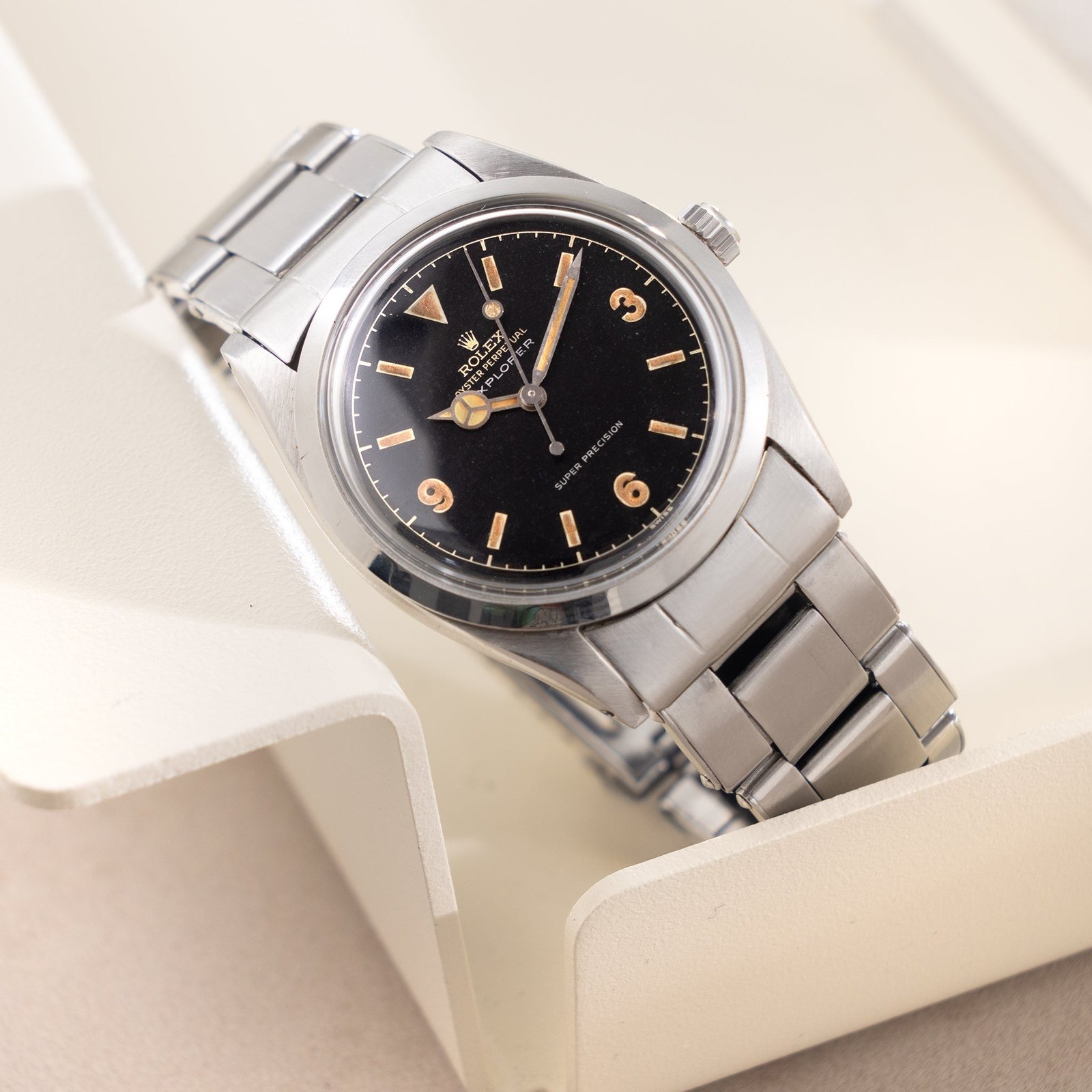
Rolex Explorer 5504 “Super precision” Gilt Chapter-ring Dial, 1960
- Maker / attribution
- Rolex (maker)
- Date
- 1960
- Historical period
- Modern Mechanical Horology (1945 – 1969)
- Country of origin
- Switzerland
- Object type
- Wristwatch
- Dimensions
- Case 36 mm
- Stock no.
- W-3369
- Credit line
- Dealer listing, Bulang & Sons (W-3369)
- Catalogue title (original)
- Rolex Explorer 5504 “Super precision” Gilt Chapter-ring Dial (English)
View the source record (dealer listing) ↗ (opens another website in a new tab)Suggest a correction
Record summary
Catalogued by Bulang & Sons (dealer), Copenhagen (stock number W-3369), this is a wristwatch by Rolex, made in Switzerland, dated 1960. The Atlas places it in the Modern Mechanical Horology period (1945 – 1969) of its Wristwatches collection. Recorded dimensions: Case 36 mm. The record is illustrated with 6 photographs.
Assembled from the source record's structured fields. Dates and attributions are given as the source states them; where a field is missing the Atlas leaves it blank rather than estimating.
Catalogue description
Dealer description — Bulang & Sons
The Explorer has long represented what many consider the perfect “one good watch” to own. Its clean design and understated versatility make it equally suited to everyday life and adventurous escapes. The reference 1016, in particular, holds a special place in watch history—produced for an impressive 29 years, from 1960 to 1989. With its modest 36mm case, no-date dial, and sharp black face—whether gilt or matte—it remains the quintessential vintage Rolex sports watch. Quietly iconic, the Explorer is the Rolex for those who appreciate substance over status. For many watch enthusiasts, including us at Bulang and Sons, a gilt dial Explorer with a chapter ring is the ultimate grail—and when people picture that, they usually think of the Rolex 1016. While this is not a reference 1016, it is the ref. 5504—often overlooked and perhaps even “a forgotten Explorer reference.” Unlike its “brother” reference 5500, which is 34mm, the 5504 retains the full 36mm case size. Let’s break down why this watch is such an interesting one: When the 5504 Explorer was first produced in 1958, the chronometer-certified Explorer was actually the Rolex 6610, which used the older caliber 1030 movement that Rolex was beginning to phase out of its sports models. The 5504 was one of the first to feature the newer caliber 1530, which was also used in early Submariners of the time, including the legendary 5508 and 5510 “Big Crown” models—better known as the “James Bond” watches. This newer caliber was compact and highly precise, but it was built as more of a workhorse movement. That’s why it appeared in several non-chronometer models, including early Submariners, the later 5513, and the Air-King. This fine example features a beautiful gilt dial with a chapter ring, bold lume-filled numerals, and silver printing for "Explorer" and "Super Precision." The hands were replaced during a later service and are tritium—no longer glowing under UV light. The riveted Oyster bracelet (ref. 7206) has end links marked 80 and a clasp stamped 2/69. The watch has been fully checked and regulated by our watchmaker and is ready to “explore some more” in the years ahead! It wears beautifully on the wrist—classic and under-the-radar, never loud. Get in touch if this low-key legend speaks to you. Specifications: Rolex Explorer Reference 5504 Super precision 36mm case with smooth bezel Serial 571xxx dating to 1960 Black gilt chapter ring dial “Swiss only “with two silver lines Hand set later then the watch Riveted Oyster bracelet ref 7206 with end links 80 Fully checked by our watchmaker
Historical context
Modern Mechanical Horology (1945 – 1969)
Tool watches for divers, pilots and astronauts; electric watches anticipate the electronic age.
The classic era of the mechanical wristwatch: dive watches, chronographs for motor racing and space flight, GMT watches for jet travel, slim dress watches, automatic calendars, and the rise of Japanese manufacturers alongside Swiss, American, German and Soviet industries.
Read the period in the timelineMore wristwatches from this periodEarlier: Golden Age of Mechanical Watchmaking
Atlas type guide
Wristwatches
Bracelet watches were worn by women from the early nineteenth century — Breguet made one for Caroline Murat, Queen of Naples, in 1810–12 — but the wristwatch only became a man's instrument with military use and aviation in the early twentieth century. Between the World Wars it overtook the pocket watch; the 1920s and 1930s brought rectangular Art Deco cases, water-resistant cases and the first automatic winding systems.
After 1945 the wristwatch became a carrier of identity — dress watches, sports and dive watches, chronographs, calendars — produced by Swiss, American, Japanese, German, Soviet and Chinese industries. The quartz revolution after 1969 and the mechanical renaissance since the 1990s, including the rise of independent watchmakers, complete the story.
What to look for
- The reference number (between the lugs or inside the case back) and serial number, the starting point for dating.
- The calibre: its maker and number are often stamped under the dial or on the bridge.
- Originality of dial, hands and crown — refinished ('redial') dials are common.
- Case material marks: 18K/750, 14K/585, stainless steel, gold-filled, plated.
Dating clues
- Wire-lug cases: before c. 1925.
- Water-resistant screw-down cases: from 1926.
- Quartz movements: from 1969; sapphire crystals widespread after c. 1980.
General guidance written by the Atlas editors about this kind of object. It is not a statement about this particular piece; for that, rely on the source record above and on physical examination.
Related records

Movements & Components · c. 1970s
Rolex watch movement, c. 1970s
Antiquorum auction archive, Geneva

Pocket Watches · 1982
Fake Rolex watch, gold coloured metal, possibly made in Taiwan, 1982; part of a casual outfit, UK, 1982-84.
Victoria and Albert Museum, London

Wristwatches · c. 1920s
Rolex wristwatch, c. 1920s
Antiquorum auction archive, Geneva

Wristwatches · c. 1920s
Rolex wristwatch, ref. 6194, c. 1920s
Antiquorum auction archive, Geneva

Wristwatches · 1945
Wristwatch by Eterna, 1945
Museum Rotterdam

Wristwatches · c. 1945
Breitling Premier, ref. 790, c. 1945
Antiquorum auction archive, Geneva

Wristwatches · c. 1945
Universal Genève Uni-Compax, ref. 22492, c. 1945
Antiquorum auction archive, Geneva

Wristwatches · c. 1950s
Baume & Mercier wristwatch, c. 1950s
Antiquorum auction archive, Geneva