
Wristwatches · Wristwatch
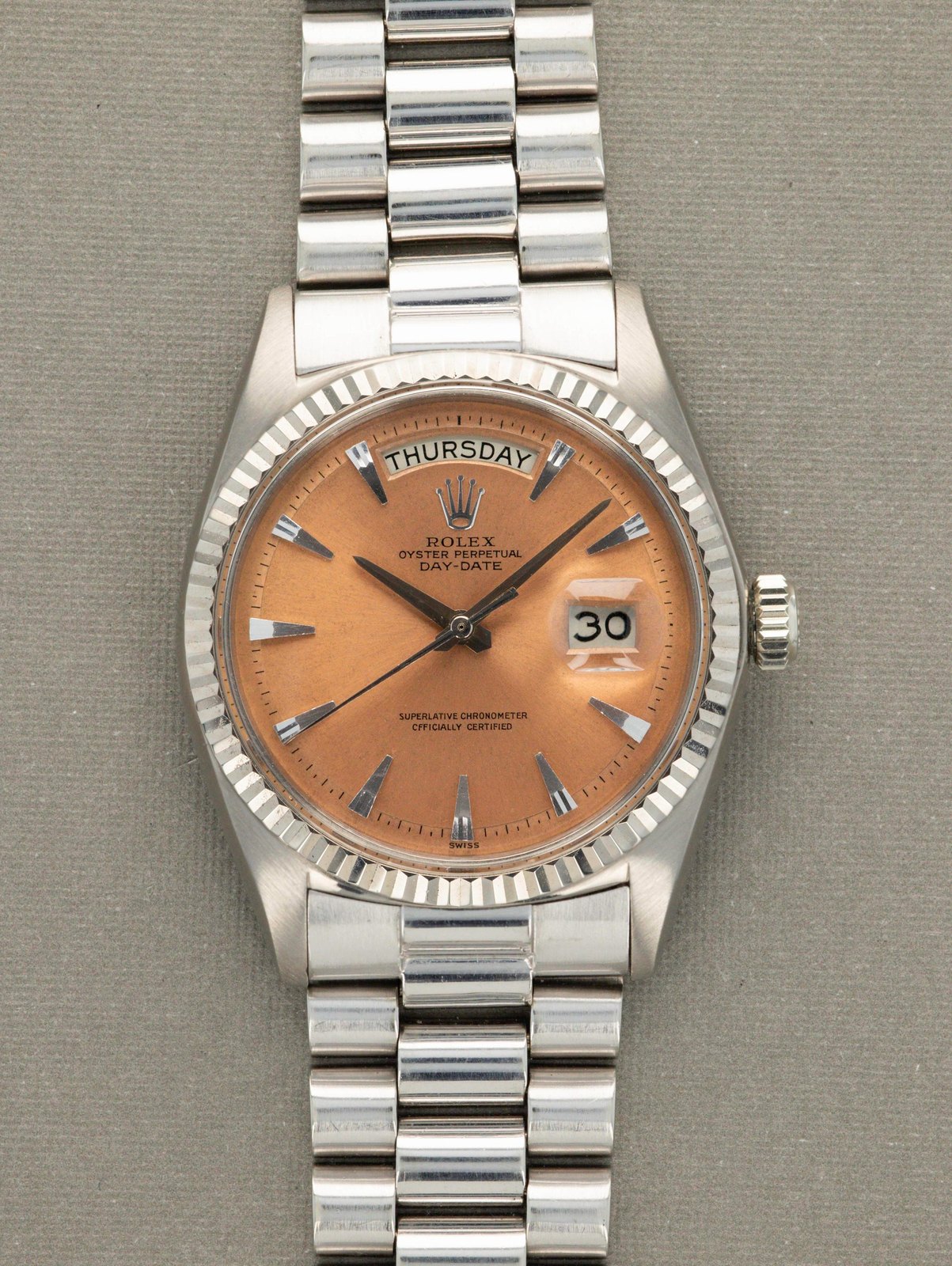
Rolex Day-Date ref. 1803, Salmon 'Claw' Dial
- Maker / attribution
- Rolex (maker)
- Date
- c. 1963
- Historical period
- Modern Mechanical Horology (1945 – 1969)
- Country of origin
- Switzerland
- Object type
- Wristwatch
- Stock no.
- OC2142
- Credit line
- Dealer listing, Oliver & Clarke (OC2142)
- Catalogue title (original)
- Rolex Day-Date Ref. 1803 - Salmon 'Claw' Dial (English)
View the source record (dealer listing) ↗ (opens another website in a new tab)Suggest a correction
Record summary
Catalogued by Oliver & Clarke (dealer), United Kingdom (stock number OC2142), this is a wristwatch by Rolex, made in Switzerland, dated c. 1963. The Atlas places it in the Modern Mechanical Horology period (1945 – 1969) of its Wristwatches collection. The record is illustrated with 6 photographs.
Assembled from the source record's structured fields. Dates and attributions are given as the source states them; where a field is missing the Atlas leaves it blank rather than estimating.
Catalogue description
Dealer description — Oliver & Clarke
When the Day-Date was released in 1956, Rolex had made numerous attempts to capture the market with more complicated timepieces such as the Ref. 6036, the Ref. 8171, and the Ref. 6062, but it seemed like buyers were not particularly fond of complicated Rolexes. All of that changed when President Dwight D. Eisenhower was spotted wearing one Rolex in particular: a Day-Date. The model has since become known worldwide as ‘The President’ and as a symbol of success and prestige. Simply put, this one stuck. The Day-Date has only ever been made in precious metals, with yellow gold not only being by for the most common, but also the most synonymous with the the Day-Date's colloquial nickname: The President. It was also produced in both rose and white gold, as well as platinum, with all examples being offered on a leather strap, or on a bracelet (called a 'President' bracelet), like the example that we have here. White gold Day-Dates, while not outright rare, are uncommon. At a glance, they look like a steel watch — not nearly as eye-catching as its yellow gold siblings. These pieces epitomize the if you know, you know element in watches. In the case of this piece (no pun intended), the dial further plays into that idea... This particular white gold Reference 1803 from circa 1963 features a wildly rare, early dial. Known as a 'claw' dial for the shape of the applied indices, this example is further rarified by the color of the dial itself: a shade of pinkish-orange, or salmon. The dial itself is non-luminous and shows faint, uniform oxidation throughout and is hardly visible without a loupe. The 'claw' indices also exhibit light oxidation in some areas, and are complimented by a correct non-luminous 'obelisk' handset. The case shows signs of a light, thoughtful previous polishing, retaining symmetrical lugs and showing only light signs of wear throughout with no significant blemished or damage. The matching, though slightly later white gold President bracelet also exhibits a light previous polishing and light wear. This also piece retains a correct white gold crown, white gold 'fluted' bezel, and an English day disk within. Salmon dials fitted within a white gold or platinum case are an elusive combination. Something about the combination is a horological grand slam and is cherished within the collector community. This exceedingly rare configuration is one heck of a looker — fit for a collector looking for something that you're unlikely to see in the wild. And if you do, well, you should probably tip your hat at that person.
Historical context
Modern Mechanical Horology (1945 – 1969)
Tool watches for divers, pilots and astronauts; electric watches anticipate the electronic age.
The classic era of the mechanical wristwatch: dive watches, chronographs for motor racing and space flight, GMT watches for jet travel, slim dress watches, automatic calendars, and the rise of Japanese manufacturers alongside Swiss, American, German and Soviet industries.
Read the period in the timelineMore wristwatches from this periodEarlier: Golden Age of Mechanical Watchmaking
Atlas type guide
Calendar, moon-phase and perpetual calendar watches
Calendar complications range from a simple date to the perpetual calendar, which automatically allows for months of different lengths and leap years until 2100. Pocket watches with perpetual calendars were made in the eighteenth and nineteenth centuries; Patek Philippe made the first perpetual calendar wristwatch in 1925, and series production followed in 1941. The annual calendar (Patek Philippe, 1996) needs correction only once a year.
Moon-phase displays use a disc with two moons and 59 teeth advanced daily, approximating the 29.5-day lunation; more precise trains reduce the error to one day in over a century.
What to look for
- Apertures or subsidiary dials for day, date, month and leap year.
- Moon disc under a 'bosom' shaped aperture.
- Recessed correctors on the case band for setting the calendar.
Dating clues
- Triple-date wristwatches: popular c. 1940–1955.
- Perpetual calendar wristwatches: from 1925 (unique) and 1941 (series).
General guidance written by the Atlas editors about this kind of object. It is not a statement about this particular piece; for that, rely on the source record above and on physical examination.
Related records

Movements & Components · c. 1970s
Rolex watch movement, c. 1970s
Antiquorum auction archive, Geneva

Pocket Watches · 1982
Fake Rolex watch, gold coloured metal, possibly made in Taiwan, 1982; part of a casual outfit, UK, 1982-84.
Victoria and Albert Museum, London

Wristwatches · c. 1920s
Rolex wristwatch, c. 1920s
Antiquorum auction archive, Geneva

Wristwatches · c. 1920s
Rolex wristwatch, ref. 6194, c. 1920s
Antiquorum auction archive, Geneva

Wristwatches · 1945
Wristwatch by Eterna, 1945
Museum Rotterdam

Wristwatches · c. 1945
Breitling Premier, ref. 790, c. 1945
Antiquorum auction archive, Geneva

Wristwatches · c. 1945
Universal Genève Uni-Compax, ref. 22492, c. 1945
Antiquorum auction archive, Geneva

Wristwatches · c. 1950s
Baume & Mercier wristwatch, c. 1950s
Antiquorum auction archive, Geneva